Solar Heater Expectations: The Limits of M18 Heat
On this page 6 sections
The key number with any M18 heater isn’t the model name, it’s the wattage draw versus the amp‑hours in your battery. From that you can work out, on a napkin, if it’ll actually keep you warm or just take the edge off for a coffee break.
You’ll see claims like “heats 200 square feet” or “warms a tent in minutes.” Here’s what those really mean in practice, what’s safe, what a battery heater can fairly do, and where you’re better off with a regular plug‑in or propane heater instead.
M18 Heater: What It Is And What It Can Really Heat

An M18 heater is a small electric heater that runs on 18 V tool batteries and is meant for close-up spot heat, not whole-room heating. A Milwaukee M18 heater or other battery operated heater in this class is basically a downsized space heater that trades runtime and heat output for portability and no cord.
Most M18 heaters are simple resistance or infrared elements powered by 18 V lithium packs “+” a fan; some wear the Milwaukee badge, others are third‑party battery powered heater designs, but the physics is the same. A plug‑in 120 V space heater is capped around 1,500 W by a standard outlet, while heaters operated by batteries are usually in the low hundreds of watts because the pack just can’t deliver that much power for long. Take a common 18 V 5.0 Ah pack: 18 V × 5.0 Ah ≈ 90 Wh of energy. If your heater draws 150 W, ideal runtime is 90 Wh ÷ 150 W = 0.6 hours, about 36 minutes, and losses in the electronics knock that down further.
That limited energy shapes what an M18 heater can really heat: think your hands and torso at arm’s length, the driver’s seat in a cold cab, or a corner of a small, well‑sealed tent. You’ll feel the side of you facing the infrared element warm up quickly, but the air temperature in a normal bedroom or garage barely moves unless the space is tiny and insulated like a cooler. If you need the whole room at a steady heater temperature, a full 1,500 W plug‑in unit or a fuel heater is the realistic tool for the job heater temperature.
How Long Do Battery Operated Heaters Actually Run?
A battery operated heater only runs as long as its battery has watt‑hours to feed the heater’s watt draw, which usually means well under two hours per pack. The key numbers are battery watt‑hours (volts × amp‑hours) and heater wattage; runtime in hours is roughly watt‑hours ÷ watts, then trim 20–30% for losses and cold.
For an 18 V system: a 3.0 Ah pack is about 54 Wh (18 × 3), a 5.0 Ah pack about 90 Wh, and an 8.0 Ah pack about 144 Wh. On a 150 W battery powered heater, perfect‑world runtimes are 54 ÷ 150 ≈ 0.36 h (22 minutes), 90 ÷ 150 ≈ 0.6 h (36 minutes), and 144 ÷ 150 ≈ 0.96 h (58 minutes). Knock off 20–30% for inverter and heat losses and you’re realistically in the 15–45 minute range per pack. That’s what “heaters operated by batteries” look like in the real world.
Double the heat to 300 W and the math flips on you. Those same packs give 54 ÷ 300 ≈ 0.18 h (about 11 minutes), 0.3 h (18 minutes), and 0.48 h (29 minutes) before losses, so maybe 8–20 minutes of strong heat from each battery. High is for a quick warm‑up; low is for stretching runtime to something useful.
On running costs, charging those packs uses the same kilowatt‑hours a plug‑in heater or a Dyson heater does; the battery just stores grid power, it doesn’t make free heat. A 200 W heater for 3 hours uses 0.6 kWh whether you feed it straight from the outlet or through charged packs, so Dyson heater running costs and M18 heater costs follow the same watts × hours × rate math.
Cold weather and age shorten runtime further, because lithium packs deliver fewer usable watt‑hours when they’re cold or worn. Treat any printed runtime as best‑case: expect less outdoors below freezing and from older batteries, then be pleasantly surprised if you beat it.
Where A Cordless M18 Heater Makes Sense (And Where It Won’t)
An M18 battery powered heater is a battery operated heater that shines for short-range, short-duration spot heat, not for whole rooms or as one of the heaters that will reduce heating bill for your home.
If you are actually searching for heaters without electricity or heaters for indoor use non electric, that means fuel-burning gear like propane or kerosene heaters, which bring carbon monoxide and ventilation issues that a cordless electric unit avoids. For UTV heaters for Polaris Rangers and similar side‑by‑sides, an M18 heater can take the edge off the air around your legs on a short drive, but it cannot compete with an engine coolant heater or a high‑output propane system for real cabin warmth.
Where an M18 makes sense is tight, personal spaces: warming your hands at a workbench, blowing heat at your feet under a desk, taking the chill off a vehicle cab while you scrape ice, giving a small tent corner a bit of warmth before you climb into a sleeping bag, or keeping tools and small parts from freezing when they sit right in front of the outlet.
For personal comfort in a car interior, at a desk or in a small tent where you do not have a handy outlet, a compact M18-compatible heater is about as practical as battery heat gets.
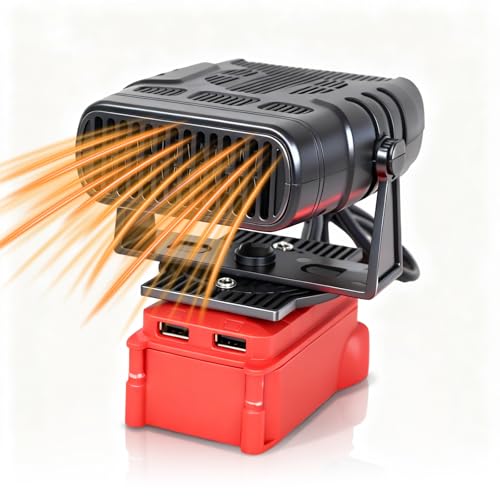
Try to warm a big garage, a whole bedroom, or an open basement with one of these and it will disappoint: the heat only reaches a small radius and the duty cycle is limited by how often you are willing to swap and recharge battery packs. Using a cordless heater instead of the furnace for hours at a time quickly turns into a stack of dead batteries and very little change in room temperature.
Charging those same packs still uses grid electricity, so the energy you get out of the heater is the same electricity you paid for going into the charger. You do not get free heat, and using a small heater in a corner while leaving the central system at the same setting will not lower bills; any savings only happen if you let the main thermostat drop and accept that you are heating one small bubble of space instead of the whole home.
Electric M18 heaters themselves do not create carbon monoxide and are fine for indoor air from that perspective, treated like any other electric space heater. Some “M18” branded propane heaters, though, only use the battery for a fan or ignition; those are still fuel-burning heaters with real CO and oxygen‑depletion risk and have to follow the same ventilation and clearance rules as any other portable gas unit.
M18 Heater Versus Plug-In And Propane Heaters
Against a plug‑in electric or propane gas heater, an M18 battery heater trades portability and fume‑free operation for much lower power, shorter runtime and higher cost per hour of usable heat.
A typical plug‑in electric space heater pulls up to 1,500 W from a wall outlet, while an 18 V tool battery can only feed a few hundred watts for a short time, which is why plug‑ins can actually warm whole rooms and an M18 heater only covers arm’s‑length space. For the same indoor heat, every electric resistance heater—the plug‑in, electric furnace strips or the battery operated heater after you recharge its pack—uses kWh that cost the same on your bill, so these are not magic heaters that will reduce heating bill unless you also turn the main thermostat down and accept cooler rooms elsewhere.
A radiant heater uses an infrared element to send heat directly to your skin and nearby objects, so you feel warm even while the surrounding air is still cool. A convection heater warms air, either passively or with a fan, so the whole room temperature slowly evens out even if it feels slower on your skin. The main radiant heater disadvantages are hot front surfaces, line‑of‑sight heat that drops sharply once you step aside, and weak performance if you move around the room; many portable propane heaters and some plug‑in units are radiant, while most standard electric space heaters are fan‑forced convection.
Portable propane heaters are the common heaters for indoor use non electric in garages, workshops and outdoor work areas, delivering tens of thousands of BTU per hour but adding combustion moisture and carbon monoxide risk. These are gas heaters, and gas heaters for homes that are installed permanently are usually vented through a flue; the venting carries exhaust outside instead of into the room. Portable propane models are best kept to larger, leaky spaces or short, supervised use where you can follow the manual for ventilation and clearances.
Ventless gas heaters, also called vent‑free or ventless gas heaters, exhaust directly into the room and are restricted or banned in some states and cities. They should never go in bedrooms or small, tightly sealed rooms, and any use indoors demands a working CO alarm in the same space plus strict attention to the manufacturer’s sizing and ventilation rules.
| Heater type | Power level and runtime | Best use | Power or fuel needed | Main safety concerns |
|---|---|---|---|---|
| M18 / battery heater | Low power, personal spot heat only; usually under an hour of strong output per battery pack | Hands, feet or seat in a car, small tent, desk, or UTV cab when an outlet is not nearby | Charged 18 V tool batteries and a charger back at a wall outlet | Hot grille, tip‑over risk, battery handling and charging safety |
| Plug‑in electric space heater | Up to about 1,500 W continuously as long as the circuit can supply it | Bedrooms, offices, living rooms and other enclosed rooms with access to a standard 120 V outlet | 120 V receptacle on a suitable 15 A or 20 A branch circuit | Fire risk if too close to combustibles, burns on hot surfaces, overloaded circuits or extension cords |
| Portable propane heater | Medium to very high output, often 10,000–30,000+ BTU/h, for several hours per cylinder depending on the setting | Garages, workshops, job sites, patios and other well‑ventilated or semi‑outdoor spaces | Propane cylinders or bulk tank, plus enough ventilation air | Carbon monoxide, oxygen depletion, moisture buildup, fire risk from hot surfaces and nearby combustibles |
On running costs, electric resistance heat is straightforward: a 1,500 W plug‑in for 4 hours uses 1.5 × 4 = 6 kWh, and pushing that same 6 kWh through a battery charger and into an M18 pack to run a cordless heater costs essentially the same on your utility bill. Propane can sometimes beat grid electricity on cost per BTU in areas with cheap fuel, but you pay for that with added ventilation needs, combustion moisture that can fog up windows and tools, and strict safety rules about where and how gas heaters can run indoors.
Quick Checklist Before You Buy Or Use An M18 Heater
Before you spend on an M18 heater or fire it up, decide if you need a quick comfort boost or a real heater installation fix. If your gas furnace, boiler or water heater is unreliable, that’s a job for an HVAC tech or plumber rather than stacking small portables; yes, plumbers routinely fix gas heaters and replace them. For cutting the heating bill, a cordless heater won’t do it—careful use of a full‑size plug‑in space heater and a lower thermostat can help more than any battery unit, and many very cheap heaters are just 1,500 W boxes with fewer safety features.