The lowest energy use electric heaters are usually the ones that heat the smallest space for the shortest time, and a 1,500 W unit costs about 26 cents an hour at 17 cents per kWh. A 100 W personal heater is closer to 2 cents an hour, but only if it actually keeps you warm enough to stop turning the room heater up later.
The common mistake is buying a “more efficient” 1,500 W heater and then running it longer because the room still feels cold. That can cost more than a smaller heater with a thermostat, because the watts are only half the story.
The real trick is matching wattage to the space, then using a thermostat, timer and a shorter schedule so the heater cycles off instead of cooking the whole room like a mildly disapproving toaster.
The essentials
A 1,500 W space heater uses about 1.5 kWh per hour, so at 17 cents per kWh it costs about 26 cents an hour.
A 100 W heater costs about 2 cents an hour, but it only works for very small, targeted heat.
A thermostat and timer usually save more than a fancy fan pattern or oscillation.
The cheapest heat is the heat you do not buy: close doors, cut drafts and warm the room you use.
If you need more than a small room, compare the heater against oil, propane or a heat pump before you chase a lower watt number.
Lowest Energy Use Electric Heaters
The lowest energy use electric heaters are usually low-watt personal heaters or well-controlled heaters that run only as long as you need them; a standard 1,500 W heater uses 1.5 kWh in one hour, costing about 26 cents at 17 cents per kWh. For more information on energy consumption, check out how much watt dors oil burning heater. For electric heaters energy saving, choose fewer watts for a smaller area, then use a thermostat to stop heating once the room reaches the set temperature.
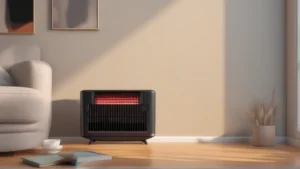
This low-watt heater exemplifies energy-efficient options.
The most common mistake is leaving a 1,500 W heater running to chase one extra degree. That can cost more than a smaller heater with a tighter thermostat, even though both turn electricity into heat in much the same way. Resistance heaters are nearly 100% efficient at converting electricity into heat at the point of use, so electric heaters energy efficient claims mostly come down to lower power and shorter runtime—not a magical heating element.
1.5 kWh
Energy used by a 1,500 W heater in one hour
At 17 cents per kWh, 1.5 kWh costs 25.5 cents, usually rounded to about 26 cents. A standard 1,500 W plug-in heater also draws about 12.5 amps from a 120 V circuit.
Heater
Watts
Per hour
Per day (8 h)
Per month (30 days)
1,500 W room heater
1,500 W
26¢
$2.04
$61.20
100 W personal heater
100 W
1.7¢
14¢
$4.08
Calculated at 17¢ per kWh. Assumes 8 hours each day, 30 days, and an electricity rate of 17 cents per kWh. A thermostat may reduce actual runtime below the full eight hours.
The practical low-draw choices are a personal heater for the space around your chair, an oil-filled radiator that cycles gently after warming its oil, and any heater with a thermostat that avoids overshooting. Oil doesn’t make resistance heat cheaper per watt; its thermal mass can let the heating element stay off for longer while the radiator continues releasing warmth. A 100 W personal heater uses one-fifteenth the power of a 1,500 W unit, but it won’t replace room heat if the rest of you is still cold.
For electric room heaters energy efficient operation, match the heater to the occupied area rather than heating the whole house by default. Product 1 is a sensible fit when precise control matters: its thermostat adjusts from 41°F to 95°F in 1°F steps, and its ECO mode can help prevent unnecessary full-power runtime.
Useful for thermostat control
DREO Space Heater
Choose product 1 if you need a portable 1,500 W heater with fine temperature adjustment, ECO mode, tip-over protection and overheat protection; skip it if your priority is the lowest possible wattage for heating only your feet.
Say a desk worker heats only the area around a chair with a 100 W personal heater for 8 hours. That uses 0.8 kWh, or about 14 cents at 17 cents per kWh. A 1,500 W heater used for the same eight hours consumes 12 kWh, so the smaller heater wins only if it provides enough warmth to keep the larger heater off.
Personal heater100 W × 8 hours = 0.8 kWh
Room heater1,500 W × 8 hours = 12 kWh
Electricity rate$0.17 per kWh
Safety still sets the floor
Plug any electric heater directly into a wall outlet, never an extension cord or power strip. Keep at least 3 feet from bedding, curtains and furniture, and look for tip-over and overheat protection plus a UL, ETL or CSA listing. The best energy efficient electric heater low watt option is useless if it creates an electrical or clearance problem.
In short
Use the smallest heater that can keep your occupied area comfortable, then let its thermostat shut the element off. Lower watts reduce the bill only when they provide enough heat to prevent you from switching on a second heater.
How Electric Heaters Compare With Oil, Propane And Pellets
An oil-filled radiator and a plug-in space heater use the same electricity for the same wattage, so neither magically beats the other on raw energy use. A 1,500 W oil radiator and a 1,500 W ceramic heater each draw 1.5 kWh per hour while heating; the radiator may feel cheaper because its oil reservoir coasts after the element switches off and its thermostat can cycle more smoothly.
Oil-filled radiator-style heaters are energy efficient when steady, quiet heat matters in a bedroom or office, but they don’t create more heat from each watt. A 1,500 W unit still costs about 26 cents an hour at 17 cents per kWh when its element runs continuously. Space heaters do use a lot of energy if they run all night or heat a large, leaky room; a 1,500 W heater draws about 12.5 amps, more than a refrigerator or laptop, though less continuously than many electric water heaters.
Heat source
Simple running-cost example
Where it makes sense
Electric resistance
1.5 kW for 1 hour at 17 cents per kWh yields about 0.26 dollars in energy cost
Small room, short use, precise spot heating
Propane
0.25 gallons burned in 1 hour at 3 dollars per gallon results in roughly 0.75 dollars
Indoor-rated heater where electricity is limited; check ventilation and code
Kerosene
0.08 gallons per hour multiplied by 1 hour and 4 dollars per gallon gives about 0.32 dollars
Only a 1-K kerosene heater in an approved, ventilated space
Diesel
At a burn rate of 0.07 gallons per hour and fuel cost of 4 dollars per gallon, hourly cost is near 0.28 dollars
A diesel heater with exhaust routed outside the occupied space
Pellets
Using 0.75 pounds per hour at 50 cents per pound equals about 0.38 dollars per hour
Longer heating periods with a listed stove and suitable venting
Illustrative assumptions only: fuel prices and burn rates vary by heater, location and setting.
Those fuel examples use deliberately plain assumptions: $3 per gallon of propane, $4 per gallon of kerosene or diesel, and 50 cents per pound of pellets. Your actual bill also includes startup, cycling and delivery losses, so burn rate × hours × price is a comparison tool rather than a promise.
Fuel changes the risk
Propane, kerosene and diesel heaters add carbon monoxide and ventilation concerns that an electric resistance heater doesn’t. Use an indoor-rated model, follow its ventilation instructions, and keep a working CO alarm; never bring an outdoor, patio, torpedo or construction heater indoors.
Two comparisons that confuse people
A heat pump usually delivers heat at a lower electricity cost than portable resistance heat, but that belongs in a whole-home comparison. A natural-gas space heater may be economical where gas is cheap and venting is suitable; reviews calling a gas model efficient don’t make an electric heater more efficient, and local code can restrict vent-free units.
For a closer look at the numbers behind oil-filled units, see these oil portable heaters before treating a heavier radiator as a lower-wattage heater.
Useful Tools For Lowering The Bill
Only the things that change the number, not the ones that just sound clever.
Precise temperature control
DREO 1500W Indoor Space Heater
Product 1 gives you 1°F thermostat adjustments from 41°F to 95°F, so you can set the lowest temperature that still feels comfortable instead of running full heat by habit. Its ECO mode and 34dB operation suit a bedroom, though the 1,500W maximum still draws the usual full-load power.
Product 2 combines a 12-hour timer with a 50°F to 95°F thermostat, giving you a practical way to stop heating after the room is used. Its 70° oscillation spreads warmth across the space, but moving more air doesn’t lower the 1,500W draw while the heating element is on.
Product 3 lets you change the temperature, heating mode and timer from the remote, which makes it easier to turn the heat down when you leave the room. Its PTC heating element warms quickly, while 70° oscillation helps distribute heat instead of leaving one corner comfortable and the rest chilly.
The biggest electric-heater savings usually come from heating less space for less time, not from replacing a heater that already works. Start with the room, then the thermostat, timer, drafts and wattage.
Using a programmable thermostat can help reduce heating costs.
Heat one occupied room and close the door so warm air isn’t serving the hallway, spare bedroom and the cat’s chosen throne.
Set the thermostat near 68 to 70°F in the room you’re using, then adjust for comfort; a lower setpoint often saves more than a heater upgrade because runtime is the expensive part.
Use a timer or scheduled shutoff so the heater isn’t warming an empty room. Four hours at 1,500 W uses 6 kWh; eight hours uses 12 kWh, exactly twice as much.
Seal obvious drafts around the door, window sash and floor trim. A rolled towel at a door gap costs less than asking the heater to fight January air all night.
Choose a lower-watt heater only if it still maintains the room temperature. Dropping from 1,500 W to 750 W halves the draw, but it also halves the available heat.
Useful for scheduled heating
OLIXIS 23″ Space Heater for Indoor Use
Product 2 fits the timer step with a thermostat, a 12-hour timer and four modes; use it directly in a wall outlet, with 3 feet of clearance and no extension cord or power strip.
Close the door to the room you’re heating and check for a visible draft at the threshold.
Set the thermostat near 68 to 70°F before raising the heater to maximum.
Set a timer for the hours you’ll actually occupy the room.
Keep curtains, bedding, furniture and paper at least 3 feet from the heater.
Plug the heater directly into a standard wall outlet; don’t use an extension cord or power strip.
Check the tip-over and overheat protection, and stop using the unit if the plug or outlet becomes hot.
Check the easy leak first
Hold your hand near the bottom of the exterior door and window frame on a cold day. A noticeable cold stream can waste more heat than a small change in heater efficiency can recover.
In short
Cut hours first, then lower the room temperature a little. A 1,500 W heater used four hours instead of eight costs half as much to run, while a 750 W heater used for the same eight hours also cuts the draw in half.
From HeaterGuides · our own guidePage 4 shows what each heater costs per hour; the 30-day plan on page 11 cuts the bill.Winter Heating Bill CutterSee what every heater in your home really costs, heat the rooms you use, and cut the waste in 30 days.Cost-per-hour tables for every heaterThermostat schedule and draft-proofing planRunning-cost and bill calculator (Excel)$14.99$9.99Get it for $9.99See what's inside and watch the 2-minute video →14-page printable PDF + Excel calculator · instant download · 30-day refund
Which Efficient Model Changes The Number Most
For a large room, the best energy efficient electric heater is usually the one that prevents wasted runtime, but a small portable heater won’t replace whole-room heating in a drafty space. Product 1 suits a bedroom or office because its thermostat adjusts in 1-degree steps, its ECO mode can reduce unnecessary full-power operation, and its quiet 34 dB operation won’t make you reach for a larger heater just to overcome the noise.
Best for a small room with controlled he
DREO Space Heater
Product 1 fits a bedroom or office where precise thermostat settings, ECO mode and quiet operation can trim runtime; skip it if you need strong heat across a large or poorly insulated room.
Product 2 makes more sense in a lived-in room where 70-degree oscillation helps spread warmth and the 12-hour timer limits accidental overuse. Its thermostat maintains a set temperature, while the timer gives you a firm stop instead of letting a 1,500 W heater run until morning because the remote vanished under a cushion.
Good for
Product 1 has 1-degree temperature steps from 41°F to 95°F.
ECO mode, a thermostat and 34 dB operation suit bedrooms and offices.
Tip-over and overheat protection are useful baseline safeguards.
Not for
A 1,500 W heater still draws the same maximum power when its heating element is on.
Its compact coverage won’t solve major heat loss in a large room.
Measure the real number
An Energy Star label alone won’t tell you what your room costs to heat. A thermostat, timer or plug-in energy meter rated for the heater’s load shows the useful number: actual kilowatt-hours over an evening. Keep the heater in a wall outlet, never an extension cord, power strip or multi-outlet adapter.
Searches for an energy efficient space heater at Walmart, including models with knobs on the front panel, describe shopping filters rather than a special low-energy design. Front knobs may make control easier, but wattage, thermostat behavior and runtime decide consumption. Keep 3 feet of clearance around any portable heater, and don’t leave it running while you sleep or leave the house unless the manual specifically allows it.
For a genuinely large room, compare coverage and controls before chasing the word efficient; a larger listed heater may run less often than an undersized unit that never catches up. A large-room buying guide can help with that comparison: large-room space heaters.
How Much Energy A Water Heater Uses
How much energy a water heater uses depends on tank size, incoming water temperature, hot-water demand and standby loss, so the appliance’s wattage alone isn’t enough. An electric tank may use more than a room heater over a day because it repeatedly reheats stored water, including water you haven’t used yet.
12 kWh
A 1,500 W heater running 8 hours
The arithmetic is 1.5 kW × 8 hours = 12 kWh. A water heater can exceed that daily total depending on tank size, showers, laundry, dishes and how often the tank reheats.
Electric heaters convert energy to heat through resistance: electricity passes through a resistive element, the element gets hot, and that heat moves into air or water. A tank water heater uses the same basic principle, except the element heats a reservoir and the tank also loses some heat through its insulation between heating cycles.
Compare the job, not the label
A 1,500 W space heater warms one room while it runs; a water heater supplies hot water throughout the home and maintains a stored supply. That different job explains why two appliances with familiar watt numbers can produce very different daily energy use.
More Questions, Answered
Are oil filled radiant heaters the most energy saving type space heaters?
No. An oil-filled radiator uses the same electricity as any other resistance heater at the same wattage; a 1,500 W model uses 1.5 kWh for every hour it runs. Its oil reservoir holds heat after the thermostat clicks off, which can make room temperature steadier, but it doesn’t create more heat from each kilowatt-hour.
What kind of space heater is most energy efficient for use in Spain?
For a plug-in resistance heater in Spain, choose the lowest wattage that heats the space you occupy and use its thermostat or timer to limit runtime. A 1,000 W heater running for three hours uses 3 kWh, regardless of whether the heat comes from a fan, ceramic element or infrared panel; check your electricity tariff for a cheaper off-peak period if one is available.
Is a Dyson portable heater energy efficient?
A Dyson portable heater turns electricity into heat much like other electric resistance heaters, so its energy use depends mainly on wattage and runtime. Temperature control and a lower heat setting can prevent wasted runtime, but a fan or premium design doesn’t make each kilowatt-hour produce more heat than a basic resistance heater.
Do space heaters use a lot of energy?
They can, especially at full power for many hours. A 1,500 W heater running for eight hours uses 12 kWh, so at 17 cents per kWh the arithmetic is 12 × $0.17, or about $2.04; a 100 W personal heater uses 0.8 kWh over the same period.
What is the best thermostat setting for energy savings for an electric heater?
Set the thermostat to the lowest temperature that keeps you comfortable, then lower it when the room is empty or you’re asleep if the heater’s controls allow that safely. A thermostat saves energy by shutting the element off after the room reaches the setpoint, while drafts, open doors and poor insulation make it run more often at any setting.
Before you go · a welcome giftGet the Winter Heating Bill Cutter for $4.99See what every heater in your home really costs, heat the rooms you use, and cut the waste in 30 days. Normally $14.99; your welcome price saves $10.00. We'll email your link right now.or buy it now for $9.99 without the gift →One email with your link now. We never share your address.


 Winter Heating Bill CutterSee what every heater in your home really costs, heat the rooms you use, and cut the waste in 30 days.Cost-per-hour tables for every heaterThermostat schedule and draft-proofing planRunning-cost and bill calculator (Excel)