

You walk the plant floor and see it: a molding machine cycling 12 seconds slower than spec, a food pasteurizer holding product 3°C above target, a cleanroom that swings 2°C every time the dock door opens. Each one looks minor. Each one costs real money.
Temperature is the quiet variable in manufacturing. It sits behind every process — curing, cooling, extruding, mixing, storing — and when it drifts, you pay. Sometimes in scrap, sometimes in rework, sometimes in energy bills that climb 8% without anyone noticing. The fix isn’t a bigger chiller or a stricter thermostat. It’s a systematic approach that ties temperature data to throughput, quality, and profit.
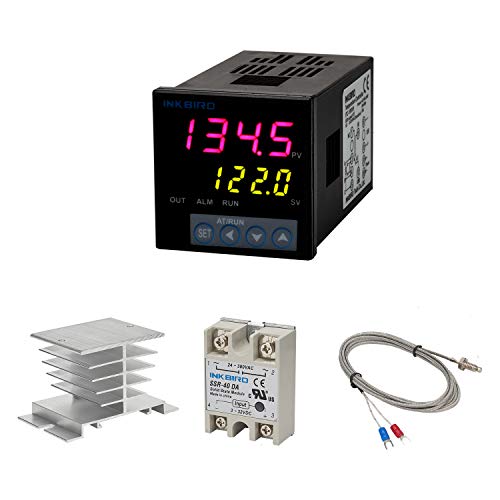
Inkbird
Inkbird PID Temperature Controller Kit, High Voltage…
- Alarm Output: With 1 alarm relay output, AC250 V, 3 A (Resistive load), ON or NC, you can wire a buzzer
- Supports 3-Wire Sensor: a 3-wire sensor or 2-wire sensor, like the K type thermocouple and Cu500, is supported by this PID tempera…
- SSR Output: With 1 relay output for external SSR, an SSR or relay is a must for this temperature controller; A 40DA SSR is include…
This article gives you that approach. You’ll walk away with quantified costs of poor temperature control, a data-driven method to find and fix thermal bottlenecks, industry-specific solutions, and a diagnostic checklist you can use tomorrow morning.
One tool that makes this easier is the Inkbird PID Temperature Controller Kit. It gives you dual displays for real-time temperature and setpoint, supports K-type thermocouples and Cu500 sensors, and includes a 40DA SSR for switching. For a single-zone retrofit, it’s a solid starting point. Check the current price on Amazon if you want to see if it fits your budget.

Why Temperature is the Hidden Variable in Manufacturing Efficiency
Most efficiency programs focus on speed, waste, and downtime. Temperature gets treated as a maintenance issue — something to check when a product fails. That’s backwards.

Think about what temperature actually controls. In injection molding, melt temperature determines viscosity, which determines fill time and part density. In food processing, core temperature determines microbial kill, which determines shelf life. In electronics assembly, reflow temperature determines solder joint integrity, which determines field failure rates. Each of those ties directly to yield and rework.
Temperature also drives energy consumption. Industrial processes use 30-40% of their energy for heating and cooling. A 1°C over-temperature on a large oven can add 2-3% to its energy draw. Over a year, that’s thousands of dollars for a single unit.
The real issue is process variability. When temperature fluctuates, every downstream step adjusts. Operators compensate by adding time or material. That’s where the hidden costs live — not in the temperature itself, but in the ripple effects.
The Real Cost of Poor Temperature Control (Quantified)
Let’s put numbers on it. These are realistic ranges from industry studies and plant data, not exact figures for your facility.
- Scrap and rework: A 5°C deviation in a curing oven can increase scrap by 3-7% for thermoset composites. That’s $15,000-$35,000 per month on a $500,000 monthly output line.
- Energy waste: An oversized chiller running at 60% load instead of 85% wastes 12-18% of its energy draw. On a 100 kW chiller, that’s $200-$300 per month.
- Equipment lifespan: Thermal cycling — repeated heating and cooling — causes mechanical stress. Bearings fail 30% sooner, seals leak, and motor windings degrade. A $5,000 motor replacement becomes a $12,000 event with downtime.
- Regulatory compliance: In food and pharma, a temperature excursion can mean a full batch quarantine. The cost of testing, investigation, and potential disposal runs $10,000-$100,000 per incident.
Those numbers add up. A mid-sized plant can lose 2-4% of its annual operating budget to temperature-related inefficiencies. For a $20 million operation, that’s $400,000-$800,000 per year.
One example: a plastics extruder in Ohio ran its barrel temperatures 10°C high to avoid die freeze-off. The extra energy cost $1,200 per month, but the real loss was product quality — the melt index drifted, causing 4% more off-spec film. Fixing the die heaters and adding a PID controller cut the over-temperature and saved $3,500 per month.
You can’t fix what you don’t measure. That’s why the next section is about building a data-driven temperature strategy.
Core Principles of Thermal Optimization
Heat Transfer Fundamentals for Production Managers
You don’t need a thermodynamics degree, but you need the basics. Heat moves three ways: conduction (through solids), convection (through fluids), and radiation (through space). Every process uses one or more of these.
In a heat exchanger, the rate of heat transfer is proportional to the temperature difference between the two fluids. Double the difference, double the transfer rate — up to a point. That’s why oversized exchangers are inefficient: they operate at low ΔT, so they need more surface area and more pumping power.
Pro tip: Check your heat exchanger approach temperature. That’s the difference between the outlet temperature and the cooling water inlet temperature. If it’s more than 5-7°C, you have fouling or low flow. Cleaning the exchanger can restore performance without any capital spend.
Balancing Temperature vs. Throughput vs. Quality
Every process has a sweet spot. Run too hot, and you speed up the chemical reaction but risk degradation. Run too cold, and you slow down the line but get better consistency.
Take a metal heat treatment furnace. At 850°C, you can harden steel in 30 minutes. At 820°C, it takes 45 minutes — but the grain structure is finer, and the parts are tougher. The right choice depends on your product spec, not on what’s cheapest.
The key is to define acceptable temperature windows based on product quality, not just process limits. That means testing your product at the edges of the window. If your parts pass at 830°C but fail at 845°C, your window is 15°C wide. That tells you how tight your control needs to be.
Most plants run with a window that’s too wide because nobody tested the edges. That’s a missed opportunity to increase throughput safely.
A Data-Driven Approach to Temperature Optimization
Implementing IoT Sensors and Real-Time Monitoring
You can’t optimize what you don’t measure. Start by mapping every critical temperature point in your process. That includes product temperature, equipment surface temperature, ambient temperature, and fluid temperatures.
Install IoT sensors that log data continuously. You don’t need a full IIoT platform — a simple data logger with Wi-Fi can work. But you do need data at intervals of 1 minute or less. Temperature drifts happen slowly, and if you only check hourly, you’ll miss them.
Pro tip: Place sensors where they measure the process, not the equipment. A thermocouple on the outside of a pipe reads the pipe temperature, not the fluid temperature. Use an insertion probe or a surface-mount sensor with good thermal contact.
For a low-cost start, the smart control system approach can work for single-zone processes. But for multi-zone, you’ll need a PLC or a dedicated temperature controller with data logging.
Using Analytics to Predict Thermal Drift
Once you have data, look for patterns. Temperature drift is rarely random. It correlates with ambient temperature, production rate, or equipment age.
Example: A food plant noticed that pasteurizer outlet temperature dropped 0.5°C every time the ambient humidity rose above 60%. The cause? Condensation on the heat exchanger surfaces, which reduced heat transfer. By adding a humidity sensor and a control loop that adjusted the steam valve, they eliminated the drift.
You can also use simple regression analysis. Plot temperature deviation against production time. If it trends upward over the day, you have a heat load problem — the equipment can’t reject heat fast enough. That points to a cooling system upgrade or a maintenance issue.
Predictive maintenance uses the same data. A temperature spike on a bearing often precedes failure by weeks. Monitoring those trends lets you schedule maintenance before a breakdown, not after.
Industry-Specific Temperature Challenges and Solutions
Food and Beverage (Thermal Processing)
Food safety is non-negotiable. Pasteurization, sterilization, and cooling all have strict temperature requirements. The challenge is balancing safety with throughput.
In pasteurization, the target is a specific time-temperature combination. Run too hot, and you denature proteins, ruining texture. Run too cold, and you risk pathogens. The solution is a control loop that adjusts heating based on continuous product temperature, not just a fixed setpoint.
Pro tip: Install a temperature recorder on every batch. If a deviation occurs, you’ll have the data to prove the product is safe, avoiding a full recall. That’s a cheap insurance policy.
Plastics and Injection Molding
Melt temperature, mold temperature, and cooling rate all affect part quality. A 5°C change in melt temperature can alter shrinkage, causing warpage or sink marks.
Most molding machines have PID controllers, but they’re often set to a default that’s not tuned. Run an autotune cycle on each zone. That takes 20 minutes and can cut cycle time by 2-5%.
Mold temperature is equally critical. For semi-crystalline materials like nylon, a mold temperature below 80°C results in poor surface finish and weak weld lines. Use a mold temperature controller to maintain ±2°C.
One real-world fix: A molder in Michigan was seeing 8% scrap on a polycarbonate part. The mold temperature swung from 85°C to 95°C because the chiller was undersized. Adding a second chiller and a PID controller on the mold loop cut scrap to 2% — a $4,000 monthly saving.
Electronics and Precision Assembly
Electronics manufacturing is all about thermal precision. Reflow ovens need a specific temperature profile — ramp rate, peak temperature, and cooling rate — to form reliable solder joints.
The most common issue is thermal profiling. Each board has a different mass and component layout, so the oven needs a profile that matches. If the profile is off, you get cold solder joints or component damage.
Solution: Use a profiling system that measures actual board temperature, not just oven setpoints. That data tells you if your oven is delivering the right heat to the board. Adjust the conveyor speed and zone temperatures accordingly.
For precision assembly, ambient temperature control matters too. A cleanroom that swings 2°C can cause expansion and contraction in fixtures, leading to misalignment. Maintain a tight ambient range, especially for high-precision work.
Integrating Temperature Control with Lean Manufacturing and OEE
Temperature control isn’t a standalone activity. It belongs in your Lean toolkit.
In DMAIC (Define, Measure, Analyze, Improve, Control), temperature is often the hidden X that drives process variability. Use the Measure phase to collect temperature data alongside quality data. In Analyze, correlate the two. In Improve, adjust the temperature control strategy. In Control, monitor it with SPC charts.
OEE (Overall Equipment Effectiveness) has three components: availability, performance, and quality. Temperature affects all three. A thermal shutdown affects availability. A slow cycle due to cold equipment affects performance. Off-spec parts affect quality.
Pro tip: Add temperature deviation to your OEE dashboard as a secondary metric. When OEE drops, check if temperature is the cause before blaming the machine or operator.
Kaizen events often focus on flow and waste, but a temperature kaizen can be just as effective. Pick one process, gather a week of temperature data, and look for the biggest deviation. Fix that one thing, and you’ll often see a measurable quality improvement.
The Troubleshooting Checklist: Diagnosing Temperature Inefficiencies
Use this checklist when you suspect temperature problems. It’s ordered from simplest to most complex.
- Verify the sensor. A bad sensor gives false readings. Check calibration with a known reference. If the sensor reads more than ±1°C off, replace it.
- Check the controller settings. Is the setpoint correct? Are the PID parameters tuned? Run an autotune cycle if you haven’t in the last year.
- Inspect the actuator. A stuck valve, a failed heater, or a blocked cooling line will cause drift. Listen for abnormal sounds and check for vibration.
- Look at the heat transfer surface. Fouling is the #1 cause of efficiency loss in heat exchangers. Check the approach temperature and clean if needed.
- Measure the ambient conditions. Seasonal changes affect cooling efficiency. If your chilled water is 5°C warmer in summer, your process will drift.
- Review the temperature data. Plot the last 24 hours. Look for cycles, spikes, or slow drifts. A cycle suggests a control loop issue; a spike suggests a disturbance.
- Check for thermal cycling. If your process runs intermittently, the expansion and contraction can loosen connections and degrade seals. Inspect for leaks and loose fittings.
- Evaluate the load. Is the equipment sized for the current production rate? An oversized chiller will short-cycle, causing temperature swings.
Pro tip: Keep a log of every temperature-related fix. After three months, you’ll see patterns that point to systemic issues, not one-off problems.
Future-Proofing: AI and Predictive Thermal Management
AI isn’t a buzzword here. It’s a practical tool for thermal management.
Machine learning models can predict temperature drift before it happens. Train a model on historical temperature data, production rates, and ambient conditions. It will learn the patterns and give you a warning when conditions start to shift.
For example, a chemical plant used AI to predict exothermic reaction runaway. The model monitored reactor temperature, pressure, and feed rate. It flagged a potential runaway 10 minutes before the traditional alarms, giving operators time to add coolant. That prevented a $200,000 batch loss.
You don’t need a data science team to start. Use a simple spreadsheet to track temperature and quality data. Run a correlation analysis. If you see a relationship, you’ve already moved from reactive to predictive.
The next step is closed-loop control. Modern controllers can adjust setpoints in real time based on product quality feedback. That’s the future: temperature control that’s self-optimizing, not just self-regulating.
Making Temperature Control a Strategic Advantage
Temperature control isn’t a maintenance task. It’s a profit lever.
- Measure every critical temperature point with data logging, not just a gauge.
- Quantify the cost of temperature deviation — scrap, energy, lifespan — and use that to justify improvements.
- Tune your PID controllers annually. Autotune takes minutes and pays for itself.
- Use temperature data to predict maintenance needs, not just react to failures.
- Integrate temperature metrics into your OEE and Lean programs.
- Start with one process, fix it, and measure the ROI before scaling.
- Don’t ignore ambient conditions — seasonal changes will affect your process.
One final thought: the best temperature control strategy is the one you actually use. Start small, get the data, and let the numbers guide you. You’ll find the hidden savings faster than you think.
For more on related topics, check out this guide on optimizing thermostat settings and this piece on common thermostat errors.

HeaterGuides covers home heating, water heating and HVAC: how the equipment works, what it costs to run, and how to use it safely.