For most large rooms, choose the DREO 1500W ceramic heater: its 70° oscillation, ECO mode and 34 dB operation balance broad heat distribution with quieter use. No plug-in 1,500W heater can heat every large or drafty room cheaply, so check the stated coverage and your electricity rate first.
The essentials
A 1,500W plug-in heater draws up to 12.5 A on a 120V circuit.
The DREO’s listed 70° oscillation and ECO mode suit rooms where moving warm air matters.
The PELONIS tower lists coverage of 106–167 sq ft; don’t treat it as a whole-house heater.
Thermostats can reduce runtime, but electric resistance heat still turns electricity into heat at the point of use.
Plug electric heaters directly into a wall outlet and keep 3 feet of clearance.
An undersized heater can run for hours and still leave cold corners; an oversized expectation can send you shopping for a room-size claim the product data doesn’t support.
The picks below use listed specifications, not invented testing or blanket claims that one heater type uses less electricity.
Five Picks for Large-Room Heating
#1Best Overall Balance
DREO 1500W Oscillating Ceramic Heater
Best for Large rooms where quiet operation and oscillating heat matter
The 70° oscillation helps spread warmth around the room, while ECO mode adjusts between 1,000W and 1,500W to maintain your set temperature. At a listed 34 dB, it’s the quietest pick here with a stated noise level.
Max wattage 1500WOscillation 70°Noise 34 dBTimer 12-hour
Why it made the cut
70° oscillation and ECO mode
34 dB operation
12-hour timer
Good to know
No listed room-coverage figure
Maximum draw is 1,500W
Skip it if Skip it if you need a heater with a stated coverage area before you buy.
Best for Large rooms where a dual heating system and quiet blower appeal
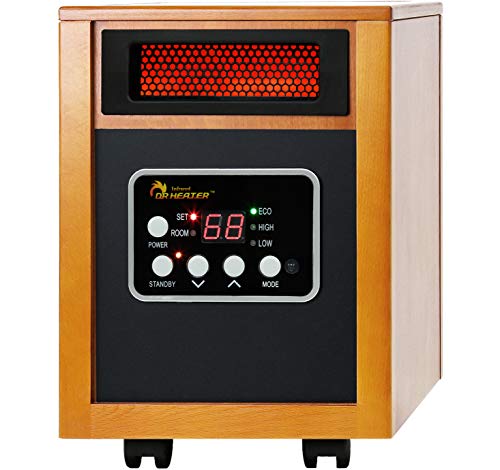
Its infrared quartz tube and PTC heating system are designed for large-room use, and the 39 dB blower is quieter than the listed noise level of several other picks. Caster wheels make it easier to move between rooms.
Max wattage 1500WNoise 39 dBThermostat range 50 to 85 degreesTimer 12-hour automatic shut-off
Why it made the cut
Infrared quartz tube plus PTC heating
39 dB noise level
Caster wheels and 12-hour shutoff timer
Good to know
Uses up to 1,500W
No listed coverage area
Skip it if Skip it if you want a published coverage figure to compare with your room size.
Best for Rooms within its listed 106–167 sq ft coverage
PELONIS gives you a specific coverage range, which makes it easier to judge fit than a broad large-room claim. The tower oscillates and offers an ECO mode, plus an 8-hour timer for scheduled use.
Best for A small room or office where a lower power setting is useful
The two settings let you choose between 750W and 1,500W, so you can use less power when full output isn’t needed. Its remote and thermostat help you adjust the heat without walking back to the unit; it can sit on its feet or mount on a wall.
Max wattage 1,500 wattsLower setting 750 wattsHeat output 5200 BTUMounting Floor or wall
Why it made the cut
750W and 1,500W settings
Can stand on feet or mount on a wall
Remote control and built-in thermostat
Good to know
Described for a small room or office, not a large room
No listed noise level or timer
Skip it if Skip it if you need a heater specified for large-room coverage.
Best for Rooms up to 200 sq ft where quiet operation and a timer matter
The product lists coverage up to 200 sq ft and noise at 35 dB, with ECO mode, a thermostat and a 24-hour timer. That combination suits a smaller room where you want adjustable heat and scheduled shutoff.
Max wattage 1500WListed coverage Up to 200 sq.ftNoise 35dBTimer 24H
Why it made the cut
Listed coverage up to 200 sq ft
35 dB noise level
24-hour timer and ECO mode
Good to know
Not a fit for rooms larger than its listed coverage
No oscillation listed
Skip it if Skip it if your room is larger than 200 sq ft or needs oscillation to spread heat.
Energy-Efficient Space Heaters for Large Rooms: What to Compare
For energy-efficient space heaters for large rooms, compare usable coverage, controls and heat direction—not an efficiency label alone. Electric resistance heaters turn electricity into heat, so a 1,500W model doesn’t make more heat per watt than another 1,500W resistance heater; the most energy-efficient space heater is the one that keeps you comfortable while running for fewer hours or at a lower setting. That’s the practical way to judge the best energy efficient space heaters.
Model
Listed coverage
Wattage and useful details
PELONIS 23” Oscillating Ceramic Tower Space Heater
106–167 sq ft
Check the exact listing for wattage and controls
R.W.FLAME Small Space Heaters for Indoor Use
Up to 200 sq ft
Check the exact listing for wattage and controls
DREO Space Heaters for Indoor Use with Thermostat, 1500W
Not provided here
1,500W; 70° oscillation, ECO mode
Heat Storm Phoenix Infrared Space Heater with Attachable Fe…
Not provided here
Check the exact listing
Dr Infrared Heater DR-968 Portable Space Heater
Not provided here
Check the exact listing
Coverage and features vary by model; don’t assume wattage proves a heater can warm the stated room.
Oscillation spreads warm air across a wider area, while placement affects where that heat lands. A thermostat or ECO mode can reduce runtime by cycling the heater or lowering output after the room warms; it doesn’t create extra heat from each watt. For more picks, see energy efficient space heaters for large rooms.
Searching energy efficient space heater Walmart listings? Compare the exact model’s front-panel controls, timer, thermostat and safety details; retailer availability can change, and similar names don’t guarantee identical features. ENERGY STAR certification isn’t established for these products in the supplied specs, so check the product label before relying on that claim.
From HeaterGuides · our own guidePage 6: heat only the rooms you use. Page 10 covers space-heater safety.Winter Heating Bill CutterSee what every heater in your home really costs, heat the rooms you use, and cut the waste in 30 days.Cost-per-hour tables for every heaterThermostat schedule and draft-proofing planRunning-cost and bill calculator (Excel)$14.99$9.99Get it for $9.99See what's inside and watch the 2-minute video →14-page printable PDF + Excel calculator · instant download · 30-day refund
Match the Heater to the Room and Your Electric Rate
Space heaters can use a lot of energy if they run at full power for hours, but the bill depends on wattage, runtime and your electric rate. Room area alone won’t tell you whether a heater can keep up: drafts, insulation, ceiling height, outdoor temperature and open doorways all affect heat loss. That’s why energy efficient home heating starts with the room and how you use it.
Eight hours at 17 cents per kWh
Say a 1,500W heater runs for eight hours at an assumed electricity rate of $0.17 per kWh. The calculation is 1,500W ÷ 1,000 × 8 × $0.17 = $2.04. At a 750W setting, 0.75 kW × 8 × $0.17 = $1.02, before any thermostat cycling.
Assumed rate$0.17 per kWh
1,500W for 8 hours12 kWh of electricity used
750W for 8 hours6 kWh of electricity used
Runtime changes the bill
A thermostat can cycle the heater off after the room reaches its set temperature, lowering actual use. Poor insulation or a drafty doorway can keep it running longer; your utility bill or rate plan gives the price per kWh to use in the arithmetic.
For several rooms, a central heat pump or another whole-home system may cost less to operate than multiple portable heaters, but the better choice depends on climate, installation and energy rates. Treat solar-powered space heating claims cautiously: these electric heaters’ supplied specs don’t show solar input, and a solar panel system would need to supply the heater’s electrical load. Compare system options in most energy-efficient electric heaters.
Ceramic and Oil-Filled Heaters Use Power Differently
A ceramic heater can be energy efficient at directing heat where you need it, but it doesn’t create more heat per watt than another electric resistance heater. Its thermostat can reduce running time; an ECO label alone doesn’t promise a specific percentage of savings.
Energy-efficient oil-filled radiators and energy-efficient oil radiators trade quick output for steadier comfort. The heating element warms oil and metal, which keep releasing heat after the thermostat cycles off. That stored heat smooths delivery over time, but it doesn’t reduce the electricity needed to produce the same total heat.
Type
What you get
What it means for energy use
Ceramic
Fast, directed heat from a fan and heating element
Uses its rated wattage while heating; thermostat cycling can shorten runtime
Oil-filled
Quiet, stored heat from warm oil and metal
Keeps releasing warmth after cycling off; stored heat doesn’t change watts per unit of heat
Both types are electric resistance heaters; comfort and runtime differ more than basic heat-per-watt efficiency.
Myth
Oil-filled heat stores electricity and saves power.
Fact
The oil stores heat, not electricity. A 1,500W oil radiator running for 4 hours at $0.17 per kWh uses 6 kWh, so the cost is $1.02; use your actual runtime and rate in the same calculation.
Are DeLonghi oil radiator-style space heaters energy efficient? Compare the specific unit’s wattage, thermostat behavior and safety label, then calculate from actual runtime rather than the brand name. The supplied products don’t include an oil-filled radiator, so there isn’t a listed model here to rank or a specification to invent.
Use Electric Heaters Safely
An energy star space heater still needs the same basic checks: plug it directly into a wall outlet, keep at least 3 feet from combustibles, and verify the specific unit’s certification and safety features.
Outlet And Clearance Rules
Never use an extension cord or power strip with a portable heater. Keep curtains, bedding, furniture, paper and clothing at least 3 feet away, and don’t run the heater on a circuit already carrying another high-draw appliance.
12.5 A
Approximate draw of a 1,500W heater at 120V
That leaves little capacity on a standard 15A circuit. A tripping breaker is a warning to reduce the circuit load, not a reason to use a heavier extension cord.
Before You Run It
Confirm tip-over protection shuts the heater off if it falls.
Confirm overheat protection is listed in the manual or product specifications.
Look for a UL, ETL or CSA listing on the specific heater.
Check ENERGY STAR status on the specific unit; ECO mode or efficiency wording doesn’t establish it.
Don’t run a portable heater while sleeping or away unless the manufacturer says that model is designed for it.
The R.W.FLAME Small Space Heaters for Indoor Use and the DREO Space Heaters for Indoor Use with Thermostat, 1500W list ETL certification. That listing shouldn’t be assumed for the PELONIS, Heat Storm or Dr Infrared picks unless their own product information shows it.
Check These Details Before You Buy
A solar energy efficient space heater isn’t identified by any spec in the listed models; check the heater’s input requirements before assuming it can run from a solar setup. Energy efficient HVAC systems and energy-efficient cooling are whole-home equipment topics, not benefits you can confirm by choosing a portable heater.
Before you buy, match the heater’s stated coverage to the room and check that its controls and power cord suit the spot where you’ll use it. A 1,500W rating tells you its maximum electrical draw; it doesn’t guarantee enough heat for a large, drafty room.
Buyer Check
Room conditions: note the room’s size, drafts and insulation.
Listed coverage: confirm the manufacturer’s stated area suits the room.
Wattage: check the maximum draw and your expected use.
Controls: make sure the thermostat, timer or other controls fit how you’ll run it.
Outlet access: confirm you can reach a wall outlet without an extension cord or power strip.
Safety features: check for tip-over and overheat protection.
Certification: look for a UL, ETL or CSA listing.
More Questions, Answered
Can I run a 1,500W space heater on a 15-amp circuit?
Usually, if the circuit serves only light loads: a 1,500W heater draws about 12.5 amps at 120 volts, leaving little room on a 15-amp circuit. Avoid running other high-draw appliances on it, and plug the heater directly into the wall—not an extension cord or power strip.
Which space heater has knobs on the front panel?
Check the control-panel photos and product specifications before buying; knob placement varies by model and can change between versions. The listed DREO pick is specified for oscillation, ECO mode and quiet operation, but its available data does not confirm front-panel knobs.
Can I use a space heater with solar power?
Yes, if the solar system and inverter can supply the heater’s continuous wattage, and the battery has enough usable energy for the runtime. A 1,500W heater running for four hours needs 6 kWh before inverter losses, so check the system’s continuous output and battery capacity.
Is a space heater suitable for use in Spain?
A US 120V heater generally isn’t suitable for direct use on Spain’s household supply, which is typically 230V; a plug adapter does not convert voltage. Choose a heater rated for the local voltage and fitted with the correct plug, or consult an electrician about a properly rated solution.
Do electric space heaters heat an entire house?
A portable electric heater is best for one occupied room, not whole-house heating. Heat leaks through walls, floors and open doorways, while a standard plug-in unit is limited to 1,500W; central heating or a properly sized heat pump is a better fit for multiple rooms.
Can an oil-filled radiator be left on overnight?
Only if the manufacturer’s instructions permit unattended operation, and the radiator is in good condition with its tip-over and overheat protections working. Keep it at least 3 feet from bedding and other combustibles, place it on a stable surface, and plug it directly into a wall outlet.
Does an ECO mode guarantee lower electric bills?
No. ECO mode may reduce power or cycle the heater toward a set temperature, but the bill still depends on how many watts it uses, how long it runs and your electricity rate. Compare actual runtime and settings; the mode name alone doesn’t establish savings.
Before you go · a welcome giftGet the Winter Heating Bill Cutter for $4.99See what every heater in your home really costs, heat the rooms you use, and cut the waste in 30 days. Normally $14.99; your welcome price saves $10.00. We'll email your link right now.or buy it now for $9.99 without the gift →One email with your link now. We never share your address.



 Winter Heating Bill CutterSee what every heater in your home really costs, heat the rooms you use, and cut the waste in 30 days.Cost-per-hour tables for every heaterThermostat schedule and draft-proofing planRunning-cost and bill calculator (Excel)


