For most readers searching for a Utilitech space heater, Product 1 is the best small space heater because its 1,500-watt ceramic heat, simple thermostat, ETL certification and tip-over protection suit an office or bedroom without app controls or installation.
The common mistake is treating every 1,500-watt heater as a whole-room heater. That can leave a drafty room cold while the fan runs, adding roughly 12 kWh over eight hours at full power.
The products below are ranked by the job they can realistically do: personal heat, a small room, quiet operation, larger supplemental zones or smart control. No unsupported Utilitech specification is presented as fact.
The Best Small Space Heaters Ranked
#1Best Overall
R.W.FLAME Small Ceramic Heater
Best for Small offices and bedrooms up to 108-130 square feet
Product 1 keeps the controls simple: two knobs, low or high heat, and an adjustable thermostat. Its 1,500-watt PTC ceramic element, ETL certification, overheat protection and tip-over shutoff suit everyday heating when you don’t want an app or installation.
Power 950W low / 1,500W highCoverage 108-130Controls Two knobs for thermostat and modesSafety ETL certified; overheat and tip-over protectionSize 6.22 x 6.22 x 8.78 inches
Why it made the cut
1,500W high setting with 950W low setting
Simple thermostat and mode controls
ETL certified with overheat and tip-over protection
Quiet operation below 35dB
Good to know
No remote, timer or app controls
Coverage is limited to 108-130 square feet
Skip it if Skip it if you need smart controls, a remote or heat for a larger room.
Best for Small to medium rooms that need wider heat distribution
Product 5 uses widespread oscillation to move 1,500-watt ceramic heat across more of the room instead of holding the airflow in one direction. Manual top controls, two heat settings and a 16-inch tower make it a practical choice for a bedroom or home office.
Power 900W low / 1,500W highControls Manual top controls and adjustable thermostatSafety Overheat protection and cool-touch housingSize About 15.75 inches tallCord 6 feet
Why it made the cut
Widespread oscillation helps reduce cold spots
1,500W high and 900W low settings
Adjustable thermostat with manual controls
Cool-touch housing and overheat protection
Good to know
No remote or app controls
Taller than the compact tabletop models
Skip it if Skip it if you want a very small heater or precise control from a remote.
Best for Bedrooms and offices where fan noise is distracting
Product 3 is the quietest listed option at 34dB, with a brushless DC motor and winglet fan design. Its 1-degree temperature adjustments from 41 to 95°F, remote, timer and ECO mode make it the better fit when basic knob controls feel too bare.
Power 1,500WNoise 34dBTemperature range 41-95°FTimer 12 hoursModes Power heat, ECO and fan only
Why it made the cut
34dB quiet operation
Temperature range from 41-95°F in 1°F increments
Remote control and 12-hour timer
Tip-over protection and V0 flame-retardant materials
Good to know
More controls than some readers need
The product data does not state a coverage area
Skip it if Skip it if you prefer a simple two-knob heater with no remote or extra modes.
Best for Basic spot heating with fan-only and anti-freeze settings
Product 4 sticks to the milkhouse-heater format: a sturdy carry handle, a thermostat and three settings for fan-only, 1,300W or 1,500W heat. Its tip-over switch, overheat protection and ETL certification cover the safety features most readers should check first.
Power Fan-only / 1,300W / 1,500WControls Thermostat and three power settingsSafety ETL certified; tip-over shutoff and overheat protectionFeatures Anti-freeze settingPortability Solid carry handle
Why it made the cut
Fan-only, 1,300W and 1,500W settings
Anti-freeze setting
Tip-over shutoff and overheat protection
ETL certified
Good to know
The product data does not state a noise level
Less compact than the smallest tabletop heaters
Skip it if Skip it if you want oscillation, a remote or a stated quiet-operation rating.
Best for Living rooms and bedrooms where heat and fireplace décor belong together
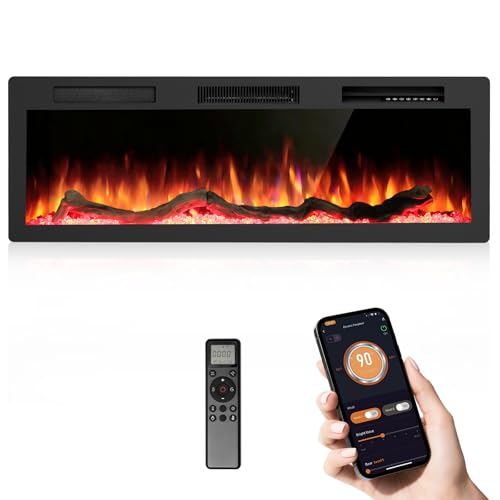
Product 2 combines supplemental heat with a recessed or wall-mounted electric fireplace. Remote, touch, smartphone and Alexa controls give you more ways to adjust the 750W or 1,500W heat, while the flame colors, brightness and sound effects handle the decorative side.
Power 750W warm air / 1,500W hot airCoverage Up to 400 square feetControls Remote, touch panel, smartphone and AlexaTemperature range 59-95°FSize 50L x 17.32H x 5.71W inches
Why it made the cut
Wall-mounted or recessed installation
750W and 1,500W heating modes
Remote, touch, smartphone and Alexa controls
Supplemental heating for up to 400 square feet
Good to know
Requires installation or wall space
Much larger than a portable small-space heater
More features than needed for simple spot heating
Skip it if Skip it if you want a portable heater that can move from room to room.
Utilitech Space Heater Review: Best Small Space Heaters
This Utilitech Space Heater Review ranks five alternatives for shoppers comparing the best small space heaters, including people searching for a Walmart space heater or space heaters indoor Walmart. We don’t have verified specifications for a current Utilitech model, so these picks are comparisons—not claims about how a Utilitech heater performs.
R.W.FLAME Small Space Heater is Best overall for a small office or bedroom. It offers 950W and 1,500W settings, a thermostat, ETL certification, tip-over protection and overheat protection. Its stated heating area is 108–130 square feet, and the manufacturer claims operation under 35 dB. Those figures describe this product, not a verified Utilitech model.
Pick
What sets it apart
Best fit
R.W.FLAME Small Space Heater
950W/1,500W; thermostat; stated 108–130 sq ft coverage
Small office or bedroom
DREO Space Heater
Stated 34 dB; 41–95°F thermostat in 1°F increments; remote and 12-hour timer
Oscillation spreads 1,500W heat; described for small-to-medium rooms
Larger rooms among these portable picks
R.W.FLAME 50-Inch Electric Fireplace
750W and 1,500W modes; stated supplemental coverage up to 400 sq ft
Wall-mounted or recessed smart controls
Features and coverage are product claims; room results depend on the space and conditions.
The DREO earns Quietest for its stated 34 dB operation, plus a thermostat adjustable from 41°F to 95°F in 1°F steps. The remote and 12-hour timer add convenience if you want more control than a basic dial offers.
The BEYOND HEAT is Best budget for straightforward heat: it has fan-only operation, 1,300W and 1,500W settings, an anti-freeze setting, ETL certification and a basic thermostat. The Lasko is Best for large rooms among these portable picks because oscillation spreads its 1,500W output; its data describes small-to-medium rooms but gives no square-foot rating, so don’t assume it can heat a large, cold space by itself.
The R.W.FLAME fireplace is Best smart controls, but it’s a different purchase: a 50-inch recessed or wall-mounted unit, not a portable room heater. Its 750W and 1,500W modes and stated supplemental coverage up to 400 square feet may suit a room where you want a fireplace-style installation.
What this review can—and can’t—verify
This comparison isn’t based on first-hand testing, and it makes no unsupported performance claim about Utilitech. No current Utilitech price or rating is verified here. A thermostat can cycle a heater off when the room reaches its setting; it can’t make the heater deliver more heat than its wattage allows.
From HeaterGuides · our own guidePage 6: heat only the rooms you use. Page 10 covers space-heater safety.Winter Heating Bill CutterSee what every heater in your home really costs, heat the rooms you use, and cut the waste in 30 days.Cost-per-hour tables for every heaterThermostat schedule and draft-proofing planRunning-cost and bill calculator (Excel)$14.99$9.99Get it for $9.99See what's inside and watch the 2-minute video →14-page printable PDF + Excel calculator · instant download · 30-day refund
Where The Heat Actually Goes
A typical plug-in space heater uses up to 1,500 watts; whether that’s a lot of electricity depends on how long it runs and your local rate. For a large room, the best space heater is one whose stated coverage fits the room, but no portable heater can ignore drafts, poor insulation or a high ceiling. An oil-filled space heater can suit winter use when steady, quiet heat matters more than a fast warm-up.
Electric resistance heaters turn nearly all the electricity they use into heat. A 1,500-watt ceramic heater doesn’t make cheaper heat than another 1,500-watt electric heater; a thermostat can reduce cost by switching the element off when the room reaches its set temperature.
Product
Power
Stated coverage
R.W.FLAME Small Space Heater
1,500 W
108–130 sq ft
R.W.FLAME Smart Electric Fireplace
Not specified here
Up to 400 sq ft of supplemental zone heating
Coverage is a product claim, not a guarantee; room conditions change what you’ll feel.
The stated ranges give you a starting point, not a room-size promise. Insulation, ceiling height, drafts and outdoor temperature all affect how much heat a space needs. For a larger room, Product 2’s stated coverage is for supplemental zone heating, not a replacement for the home’s main heat.
At 120 volts, a 1,500-watt heater draws about 12.5 amps: 1,500 ÷ 120 = 12.5. That’s close to the practical limit of a standard 15-amp circuit once other loads are included, so avoid running other high-power appliances on the same circuit.
Eight Hours At Full Power
At an assumed $0.17 per kWh, 1,500 W × 8 hours = 12 kWh; 12 × $0.17 = about $2.04 for that night before thermostat cycling. The heater costs less if it cycles off for part of the night.
Power1,500 W
Energy used12 kWh
Assumed rate$0.17 per kWh
Estimated cost12 kWh
Heater
Watts
Per hour
Per day (8 h)
Per month (30 days)
1,500 W heater at full power
1,500 W
26¢
$2.04
$61.20
950 W heater at full power
950 W
16¢
$1.29
$38.76
Calculated at 17¢ per kWh. Full-power estimates at $0.17 per kWh; thermostat cycling lowers actual use.
Low mode only saves money if it provides enough heat. At 950 W for eight hours, the math is 0.95 kW × 8 = 7.6 kWh; at $0.17 per kWh, that’s about $1.29 before thermostat cycling. An oil-filled radiator keeps radiating heat after its element cycles off, but it still draws its rated wattage while heating and usually warms a cold room more slowly than a fan heater. For more models to compare, see best space heaters.
The Safety Details That Matter
Safe space heaters are listed electric models with tip-over and overheat protection, used on a clear, level surface and plugged straight into a wall outlet. There’s no single safest electric space heater for home: look for those protections and a UL, ETL or CSA listing, then follow the manual. A space heater with automatic shutoff is safer against specific faults, but it still needs supervision.
ETL-listed Products 1, 4 and 5 have an independent laboratory listing stated in their product data. That’s a checkable safety credential; a familiar brand name or a thermostat is not. A thermostat controls temperature, while a listing indicates the product was evaluated to applicable safety standards.
Before You Switch It On
Plug the heater directly into a wall outlet. Never use an extension cord or power strip.
Leave at least 3 feet between the heater and bedding, curtains, furniture, clothing or anything else that can burn.
Set it on a solid, level surface where it won’t be bumped or tipped.
Check the plug and cord for damage. Stop using the heater if either is frayed, cracked, hot or otherwise damaged.
Keep the air intake and outlet uncovered, and don’t place the heater where someone could drape clothing over it.
Tip-over protection shuts the heater off if it falls; overheat protection cuts power if the unit gets too hot. Both reduce particular risks, but neither makes it safe to leave a heater running while you sleep or leave home unless the manufacturer specifically permits that use.
Check the Circuit
A 1,500-watt heater draws about 12.5 amps at 120 volts. Add a toaster, hair dryer or another heater on the same circuit and you may trip the breaker; a poor or overloaded connection can overheat. If the breaker trips, unplug the heater and reduce the load—don’t keep resetting it.
Space heaters are dangerous when they’re too close to combustibles, connected through an unsuitable cord or left running unattended; the heat can start a fire, and a damaged connection can overheat. For older adults and children, choose cool-touch housing where available and place the heater out of reach of bumps, while keeping its controls reachable without setting it beside a bed or chair. Never put it where a person could cover the air intake or outlet.
A Small Heater Cannot Heat Every Space
A normal plug-in indoor space heater is for a suitable indoor room, not an uninsulated garage, crawl space, tent or vehicle cabin. A 1,500-watt heater can warm you or a nearby work area while doing little to raise the temperature of a large, drafty space.
How do space heaters for garages work? Choose a model specifically listed for garage use, then follow its installation instructions for mounting and clearance. Never use a patio, torpedo or construction heater indoors; fuel-burning heaters can produce carbon monoxide and need the ventilation specified by the manufacturer plus a working CO alarm. A crawl space is a poor place for a portable heater because dampness, tight clearances and nearby insulation or stored items raise the risk of fire or electrical trouble. Use equipment approved for that location and follow local code.
Myth
A battery-operated space heater or solar-powered indoor space heater can deliver sustained 1,500-watt heat without much planning.
Fact
Sustained heat takes substantial stored energy and inverter output. At 1,500 watts, a heater uses 1.5 kWh for each hour it runs, before conversion losses; check the battery’s watt-hour capacity and the inverter’s continuous output rating. Solar panels don’t provide steady heat after dark unless the system also has enough storage and output.
A non-electric space heater may use propane, kerosene or diesel, but combustion brings carbon-monoxide risk. Use only a model rated for the location, provide the ventilation its manual requires and keep a working CO alarm nearby. Kerosene heaters take 1-K kerosene only; diesel heaters must exhaust outside the cabin. Fuel-burning heater installation and gas-line work should go to a qualified professional where local code requires it. Vent-free gas heaters are restricted or banned in some places, so check local rules first.
Same Heater, Different Room
In a sealed bedroom, a 1,500-watt unit may provide useful supplemental heat near the person using it. In an uninsulated garage with open gaps, the same output may warm the workbench area without bringing the whole room up to temperature.
BedroomSuitable indoor room with a nearby outle
GarageUninsulated, drafty space
Choose By Location
For a nearby indoor outlet and supplemental room heat, choose Product 1, Product 3, Product 4 or Product 5.
Choose Product 2 only if a wall-mounted or recessed fireplace installation suits the room and project.
For garage use, select a heater specifically listed for that use and follow its installation and clearance instructions.
For battery or solar power, compare actual watt-hour capacity and continuous output with the heater’s draw.
Frequently Asked Questions
Can a space heater run on batteries?
A typical 1,500-watt space heater is impractical on batteries: it draws 1.5 kilowatts continuously, so even a short runtime needs a large battery and inverter. Check both the inverter’s continuous-watt rating and the battery’s usable capacity; a small power bank won’t run a household heater.
Can solar-powered space heaters heat a home?
Solar panels can supply electricity to a space heater through a suitable inverter, but output changes with sunlight and the heater needs substantial power. Heating a whole home that way generally requires a system designed and sized for the load, often with battery storage for cloudy periods and nighttime.
How do space heaters for garages work?
Electric models convert electricity to heat, while fuel-burning models produce heat by burning fuel; either way, the garage’s insulation and air leaks determine how much warmth stays inside. A standard 1,500-watt plug-in heater may struggle in an uninsulated garage, and fuel-burning heaters must be rated for indoor use, vented as their manuals require, and used with a working carbon monoxide alarm.
What is the heating element in a space heater?
In a ceramic space heater, electricity heats a ceramic element, and a fan moves room air across it. Other electric heaters use a resistance wire or a radiant element; the heating method affects how heat reaches you, not the heater’s maximum electrical draw.
Can I repair a gas space heater myself?
Limit DIY work to tasks the manual permits, such as cleaning an accessible filter or checking the thermostat setting. Gas connections, burners, pilot assemblies and venting can create fire or carbon monoxide hazards if repaired incorrectly, so have a qualified gas-heating technician diagnose those faults.
Do crawl spaces need a heater?
Usually, a crawl space needs moisture control and properly sealed or insulated plumbing rather than a space heater. Heating a damp or leaky crawl space can waste energy; check local code and consult a qualified contractor before adding heat, especially if pipes are at risk of freezing.
Before you go · a welcome giftGet the Winter Heating Bill Cutter for $4.99See what every heater in your home really costs, heat the rooms you use, and cut the waste in 30 days. Normally $14.99; your welcome price saves $10.00. We'll email your link right now.or buy it now for $9.99 without the gift →One email with your link now. We never share your address.


 Winter Heating Bill CutterSee what every heater in your home really costs, heat the rooms you use, and cut the waste in 30 days.Cost-per-hour tables for every heaterThermostat schedule and draft-proofing planRunning-cost and bill calculator (Excel)