For most open jobsites and large, drafty workshops, choose the 85,000 BTU BILT HARD: it has a 5-gallon tank, adjustable thermostat, and a lower output than the larger picks, making it the more practical starting point. These forced-air heaters burn fuel but still need electricity to run their glow plug, pump, fan, and controls.
The essentials
Choose 85,000 BTU for a smaller open work area; don’t treat the listed square-foot coverage as a guarantee for a cold, leaky building.
Forced-air torpedo heaters are for outdoor use, not indoor rooms, tents, or vehicle cabins.
Check the exact fuel listed on the heater; 1-K kerosene is the recommended fuel for the listed BILT HARD models.
Plan for electrical power, exhaust clearance, and refueling before setting up a heater.
A diesel heater can mean two different machines: a torpedo-style forced-air heater for an open work area, or a sealed diesel air heater installed in a vehicle or enclosed space. The picks below are outdoor-use forced-air models; they are not interchangeable with sealed vehicle heaters.
The belief that these heaters run on fuel alone is only half true: fuel makes the heat, but electricity starts and controls the burner and moves air. Skip these picks for a bedroom, tent, or occupied enclosed room.
Best Forced-Air Heaters by Use
#1Best Starting Point
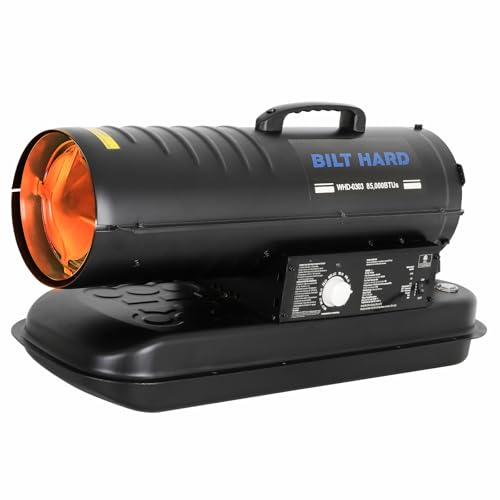
BILT HARD 85,000 BTU Heater
Best for Open jobsites and drafty workshops needing moderate output
The 85,000 BTU output is the most practical starting point for many open work areas, while the 5-gallon tank is sized for up to 9 hours of listed heating. An adjustable 40°F–110°F thermostat helps prevent full-blast operation when you only need to take the edge off. It supports filtered diesel, though the manufacturer recommends 1-K kerosene for best operation.
Heat output 85,000 BTUListed coverage 2,200 sq. ft.Fuel capacity 5 gallonsListed runtime Up to 9 hoursThermostat range 40°F–110°F
Why it made the cut
5-gallon fuel capacity
Adjustable 40°F–110°F thermostat
Listed coverage up to 2,200 sq. ft.
Supports filtered diesel #1 and #2
Good to know
Lower output than the larger picks
Manufacturer recommends 1-K kerosene for best operation
Skip it if Skip it if your space needs more than 85,000 BTU or has heavy heat loss across a very large area.
Best for Larger open workshops and job areas needing extra heat
This 135,000 BTU model steps up the heat for larger or draftier work areas without jumping to the biggest heater here. Its thermostat, self-diagnostics, indicator lamp, and cord make day-to-day operation easier to monitor. Filtered diesel #1 and #2 are supported, while 1-K kerosene remains the recommended fuel.
Heat output 135,000 BTUListed coverage 3,200 sq. ft.Listed runtime Up to 8 hoursThermostat range 40°F–110°FFuel options Kerosene, filtered diesel #1 and #2, fuel oil #1 and #2, or
Why it made the cut
135,000 BTU output
Listed coverage up to 3,200 sq. ft.
Self-diagnostics and indicator lamp
Adjustable 40°F–110°F thermostat
Good to know
More output than a small workshop may need
Fuel capacity isn’t listed in the product data
Skip it if Skip it if your workspace is small enough for the 85,000 BTU model or if you need a listed fuel-tank capacity before buying.
Best for Large workshops, barns, and open industrial work areas
The 13.2-gallon tank and listed runtime of up to 9.5 hours suit long shifts where refueling is a nuisance. A thermostat knob, room-temperature display, fuel gauge, and low-fuel shutoff give you more information than a basic torpedo heater. Use only one fuel type at a time, and follow the manual’s ventilation and placement rules.
Heat output 175,000 BTUListed coverage 36,021 cu. ft. / 1,020 m³Fuel capacity 13.2 gallonsListed runtime Up to 9.5 hoursFuel consumption 1.3 gallons per hour under normal conditions
Why it made the cut
175,000 BTU output
13.2-gallon tank
Fuel gauge and low-fuel shutoff
Listed coverage up to 36,021 cu. ft.
Good to know
Consumes 1.3 gallons per hour under normal conditions
Large output can overwhelm a smaller workspace
Only one fuel type should be used at a time
Skip it if Skip it if your work area is modest or you don’t need the larger tank and higher fuel consumption.
Best for Very large open job areas that need 215,000 BTU
With 215,000 BTU, a 13.2-gallon tank, wheels, and a pull handle, this is the heavy-output choice for very large open work areas. The digital display, thermostat, and overheat protection make a large heater easier to control and move. Its size is excessive for a small garage, and the manual still governs fuel, clearance, and ventilation.
Heat output 215,000 BTUListed coverage 10,750 sq. ft.Fuel capacity 13.2 gallonsFuel options 2-K kerosene and filtered diesel #1 and #2Controls Thermostat and digital display
Why it made the cut
215,000 BTU output
13.2-gallon fuel capacity
Wheels and pull handle
Digital display, thermostat, and overheat protection
Good to know
Too much output for smaller work areas
Requires simple assembly
Listed runtime isn’t provided
Skip it if Skip it unless your space genuinely needs its 215,000 BTU output and has room for a large forced-air heater.
Best for Small enclosed rooms where a diesel heater isn’t appropriate
This isn’t a diesel heater, but its 1,500-watt ceramic design is the sensible alternative for a small enclosed room where combustion exhaust is unacceptable. It covers up to 200 sq. ft. and adds a thermostat, 24-hour timer, tip-over shutoff, overheat protection, and ETL certification. Use it from a wall outlet, not an extension cord or power strip.
A forced-air diesel heater—the product behind the search “forced air heater diesel”—is a fuel-burning torpedo heater that blows heated air into the work area. The listed BILT HARD 85,000, 135,000, and 215,000 BTU units are outdoor-use products, so they belong on open jobsites or similarly ventilated work areas, not in an occupied room.
A sealed diesel air heater works differently: fuel burns in a combustion chamber, a heat exchanger warms separate room air, and combustion gases leave through an exhaust. The two air paths stay apart. That design is why a properly installed sealed unit can suit a camper, RV, or boat when the heater is listed for that application; a torpedo heater is the wrong substitute. See diesel space heaters for indoor use for the venting tradeoff.
Myth
A diesel heater needs no electricity.
Fact
Fuel supplies the heat, but a 12 V or 24 V supply may run the glow plug, metering pump, blower fan, electronic control unit, and controller. Startup power can differ from operating power, and the product data here doesn’t establish a wattage for these BILT HARD picks.
Heater type
What gets heated
Air or exhaust path
Torpedo forced-air
Work-area air
Combustion products enter the heated-air stream; outdoor use only
Sealed diesel air
Room air
A heat exchanger separates heated air from combustion gases; exhaust exits outside
Diesel water heater
Coolant or another fluid
The fluid circulates through a heat exchanger; it doesn’t blow combustion air into the room
The name “diesel heater” covers more than one heat-transfer method.
A diesel water heater is better understood as a hydronic system: it heats coolant or another fluid for circulation through a heat exchanger. For that type, see choosing the best diesel water heater. An air heater in a diesel engine is a separate vehicle application, and vehicle parking heaters are not the same as jobsite torpedo heaters; best diesel parking heaters for vehicles covers that category.
If you searched “diesel eater no electric,” the short answer is no: these heaters still need electrical power for control and airflow. For a diesel furnace for a camper or boat heaters diesel search, choose a sealed, application-listed unit with its combustion intake and exhaust installed as the manual requires—not an outdoor forced-air heater.
From HeaterGuides · our own guidePage 6: heat only the rooms you use. Page 10 covers space-heater safety.Winter Heating Bill CutterSee what every heater in your home really costs, heat the rooms you use, and cut the waste in 30 days.Cost-per-hour tables for every heaterThermostat schedule and draft-proofing planRunning-cost and bill calculator (Excel)$14.99$9.99Get it for $9.99See what's inside and watch the 2-minute video →14-page printable PDF + Excel calculator · instant download · 30-day refund
Forced Air Diesel Heater Output Depends on the Space
Choose heater output from the building conditions as well as the floor area: ceiling height, insulation, drafts, outdoor temperature, and how often doors stay open can matter more than the square-foot number on the box. A large leaky warehouse may need more heat than a smaller insulated shop.
Heater
Claimed coverage
BILT HARD 85,000 BTU
Up to 2,200 sq ft
BILT HARD 135,000 BTU
Up to 3,200 sq ft
BILT HARD 215,000 BTU
Up to 10,750 sq ft
These are manufacturer coverage claims, not guaranteed results for every building.
Worked example
Say your workshop is 24 × 24 feet: 24 × 24 = 576 square feet. That is below each listed coverage claim, but square footage alone can’t establish suitability. A well-insulated shop with closed doors may need far less delivered heat than a drafty building with a tall ceiling and a roll-up door open to winter air.
Workshop24 × 24 ft
Floor area576 sq ft
Listed claims2,200 to 10,750 sq ft
Oversizing can waste fuel and leave hot spots near the heater while workers remain cold elsewhere. The search phrase “warehouse diesel space heaters” often points toward higher output, but a warehouse with low heat loss may need less than a much smaller leaky shop. “Diesel radiant shop heaters” are a different heating approach; compare their installation and coverage rather than treating radiant output as identical to forced air. See radiant diesel heaters for that alternative.
Check before choosing output
Measure floor area and ceiling height.
Note insulation, open doors, drafts, and the coldest outdoor conditions you expect.
Treat the coverage chart as a starting claim, not a sizing guarantee.
Plan where people work, since one hot corner doesn’t heat a whole building evenly.
For occupied indoor comfort or quiet, choose a listed electric heater or an appropriately installed sealed diesel air heater instead of a standing outdoor torpedo heater. That is also the safer alternative heating system to a standing diesel space heater when the room is occupied; an electric unit needs a wall outlet, while a sealed fuel heater needs its combustion intake and exhaust routed correctly.
Diesel Fuel Can Be Used as Heating Oil in Some Systems
Diesel fuel may be used as heating oil only if the specific heater’s manual lists it. That answers “can you use diesel fuel for heating oil,” “can I use diesel as heating oil,” and similar searches—but it doesn’t make diesel a blanket substitute for home heating oil in a residential furnace. Don’t pour it into a home heating system or mix fuels unless that system’s manufacturer explicitly permits it.
For the BILT HARD portable heaters covered here, the product data lists filtered diesel #1 and #2 among the supported fuels and recommends 1-K kerosene. The 215,000 BTU model specifies 2-K kerosene and filtered diesel #1 and #2, with 1-K kerosene also recommended. Check the manual for your exact model; fuel grades and additives differ.
Heater
Fuel listed in product data
BILT HARD 85,000 BTU
Filtered diesel #1 and #2; 1-K kerosene recommended
BILT HARD 135,000 BTU
Filtered diesel #1 and #2; 1-K kerosene recommended
Follow the exact model’s manual if its instructions differ from this product-data summary.
To compare fuel cost, multiply gallons per hour × hours used × price per gallon. For example, say a heater burns a hypothetical 0.5 gallon per hour, runs 6 hours, and fuel costs a hypothetical $4 per gallon: 0.5 × 6 × $4 = $12. Those are example inputs, not burn-rate or price claims for any listed heater; use the manual’s burn rate and your local price.
Cold fuel or severe weather can affect starting and performance, and altitude limits vary by model. Check the manual for operating limits rather than assuming a heater will perform the same at every elevation or temperature.
Route Intake and Exhaust Before You Install
Torpedo Heaters Belong Outdoors
The featured torpedo heaters are for outdoor use. Don’t run one indoors, in a tent, or in a vehicle cabin; a carbon monoxide alarm does not make an outdoor heater safe for an enclosed space.
For a diesel furnace for a camper or boat heater, use only a sealed diesel air heater designed and listed for that installation. Route its combustion intake and exhaust exactly as the manufacturer specifies, keep exhaust outside and away from openings, and keep hot components clear of combustibles. A poor installation, damaged heat exchanger, or exhaust leak can let carbon monoxide reach the heated-air path.
A sealed heater keeps combustion air and exhaust separate from the heated-air path; the two streams must not mix. Any indoor-rated fuel-burning appliance still needs a working carbon monoxide alarm, the ventilation its manual requires, and installation that follows local code and the appliance listing. If you need a safer alternative to a standing diesel space heater, choose an indoor-rated heater suited to the space instead of enclosing an outdoor model.
Before You Power It
Confirm the heater is rated for the location: outdoor worksite or a specific sealed vehicle or marine installation.
Check the manufacturer’s route for combustion intake and exhaust; keep the exhaust outside and away from openings.
Inspect the heat exchanger and exhaust connections for damage or leaks.
For an indoor-rated fuel-burning appliance, confirm the required ventilation and a working CO alarm.
Verify supply voltage, included power supply, startup draw, and continuous draw in the specific manual; don’t assume a battery or wall adapter is included.
Diesel heaters still need electricity for parts such as the glow plug, fuel pump, blower fan, and electronic control unit; a 12 V or 24 V supply requirement depends on the model. Check both startup and continuous draw before choosing a battery or power supply, because the startup load can be higher.
A diesel air heater warms air for the space; a diesel water heater warms circulating coolant or another fluid. For vehicle-focused options, see the RV diesel heater picks.
Why the Fan Keeps Running After Shutdown
A diesel heater may keep its fan running for a few minutes after shutdown to cool the heat exchanger and clear residual heat; leave power connected until the manufacturer’s shutdown cycle finishes. Electrical demand and fuel use depend on the model and setting, so check its manual for startup power, operating power, and burn rates. A diesel air heater may draw more electricity during startup to run the glow plug, then use power for the fan, pump, and controls; don’t assume another model’s figures apply.
Fuel use changes with the heat setting and model. If the manual lists a burn rate, multiply that rate by the hours you plan to run the heater, then multiply by your local fuel price to estimate cost. Don’t guess at a consumption figure when the manual doesn’t provide one.
1
Finish shutdown
Use the controller’s shutdown command and wait for the fan to stop before disconnecting power. Cutting power mid-cycle can interrupt cooldown.
2
Inspect the fuel system
Follow the manual’s schedule to check the fuel line and connections for damage or leaks.
3
Clear the paths
Keep air openings clear and check the exhaust system for blockage or damage. Clean or service components on the schedule specified for your model.
If a sealed heater won’t start
Read the displayed fault code and look it up in the manual.
Check the glow plug, fuel delivery, and airflow as directed by the manufacturer.
Don’t bypass safety controls or keep restarting the heater without resolving the fault.
Cold And Altitude
High altitude and severe cold can affect combustion and starting. Adjustment limits and cold-weather procedures vary by model, so use the manufacturer’s instructions rather than changing settings by guesswork.
More Questions, Answered
Can a diesel heater run without electricity?
No. A diesel heater needs electrical power for components such as the glow plug, fuel pump, blower fan, and controller, even though diesel supplies the heat. Check the manual for the required voltage and power supply before choosing a battery or power source.
Can you use heating oil in a diesel heater?
Only if the heater’s manual specifically permits that fuel. Heating oil and diesel can differ in formulation, so don’t assume one is an approved substitute; using the wrong fuel can cause poor operation or damage.
Can a diesel heater be used safely in a tent?
Only use a model specifically designed for that setup, with its exhaust routed fully outside and its combustion intake and heated-air path installed as the manual directs. Keep a working carbon monoxide alarm in the occupied space, and keep hot components away from fabric and other combustibles; never bring an outdoor torpedo heater into a tent.
How much electrical power does a diesel heater need at startup?
Startup demand varies by model because the glow plug draws power while the heater ignites. One listed example, the BougeRV Portable Diesel Outdoor Heater, uses 150 W at startup and a 12 V supply; check your model’s manual for both startup and running requirements before sizing a battery.
How does a diesel water heater differ from a diesel air heater?
A diesel air heater transfers combustion heat through a heat exchanger to air that its fan circulates into the space. A diesel water heater heats coolant or another fluid, which then carries heat to a separate heat exchanger; the two types need different plumbing and installation layouts.
Before you go · a welcome giftGet the Winter Heating Bill Cutter for $4.99See what every heater in your home really costs, heat the rooms you use, and cut the waste in 30 days. Normally $14.99; your welcome price saves $10.00. We'll email your link right now.or buy it now for $9.99 without the gift →One email with your link now. We never share your address.


 Winter Heating Bill CutterSee what every heater in your home really costs, heat the rooms you use, and cut the waste in 30 days.Cost-per-hour tables for every heaterThermostat schedule and draft-proofing planRunning-cost and bill calculator (Excel)