For most people searching for a portable electric heater with timer and room temperature control, the DREO 1500W model with 70° oscillation, a thermostat and a 12-hour timer is the strongest fit. It combines scheduled shutoff with temperature-based cycling, and its ETL listing and tip-over and overheat protection are useful checks for indoor use.
Choosing the wrong heater can leave a cold corner cold while the rest of the room overheats. Running a 1,500W heater for eight hours uses 12 kWh, so at 17 cents per kWh that’s about $2.04 a day.
The picks below favor usable thermostat and timer controls, clear safety information and a form that fits the room. A wall-mounted fireplace may have a timer, but it isn’t a portable room heater, so it doesn’t belong in this shortlist.
Best Portable Heaters With Timers
#1Best Overall
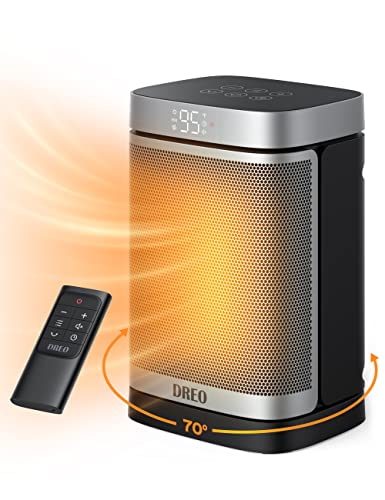
DREO 1500W Oscillating Space Heater
Best for Rooms where you want timed shutoff and heat spread across the space
A 12-hour timer handles scheduled shutoff, while the thermostat and ECO mode adjust heat to maintain your set temperature. Its 70° oscillation spreads warmth around the room, and ETL listing plus tip-over and overheat protection are useful checks for indoor use.
Heat output 1500WTimer 12-hour timerThermostat range Not specifiedOscillation 70°Safety listing ETL-certified
Why it made the cut
70° oscillation for broader heat distribution
12-hour timer and thermostat
ETL-listed with tip-over and overheat protection
Good to know
The listed heat output is 1500W, so it needs a suitable wall outlet and circuit
Timer details beyond the 12-hour setting are not specified
Skip it if Skip it if you need a heater that mounts on the wall or fits a fireplace opening.
Best for Bedrooms and offices where quiet operation and fine thermostat settings matter
The listed 34dB noise level suits rooms where fan sound can be distracting. Its thermostat adjusts from 41–95°F in 1°F increments, and the 12-hour timer gives you a clear shutoff window.
Best for A bedroom or office where oscillation and adjustable thermostat control are priorities
The 70° oscillation sweeps heat across a wider area, while ECO mode adjusts the heat level toward your selected temperature. The thermostat ranges from 41–95°F in 1°F increments, and the ETL-listed Shield360° system includes tip-over and overheat protection.
Heat output Up to 1500WTimer —Thermostat range 41–95°FOscillation 70°Safety listing ETL-listed
Why it made the cut
70° wide-angle oscillation
Thermostat adjusts from 41–95°F in 1°F increments
ETL-listed with tip-over and overheat protection
Good to know
Listed noise level is 37.5dB, higher than some other picks here
The product data does not specify a timer duration
Skip it if Skip it if you need a confirmed timer length before buying.
Best for Small rooms where a longer stated timer and remote control are useful
Its 24-hour timer gives you a longer listed shutoff window than the other portable picks. The thermostat has ±1°F precision, and the heater includes overheat protection, 45° tip-over shutoff and an ETL certification.
Heat output 1500WTimer 24-hour timerThermostat range —Coverage Up to 200 sq ftSafety listing ETL-certified
Why it made the cut
24-hour timer
Thermostat listed with ±1°F precision
ETL-certified with tip-over and overheat protection
Good to know
The product data does not give a thermostat temperature range
The listed 200 sq ft coverage is a manufacturer claim, not a room-heating guarantee
Skip it if Skip it if you need a thermostat range stated in degrees Fahrenheit.
Best for A bedroom or living room needing supplemental heat from a wall-mounted fireplace
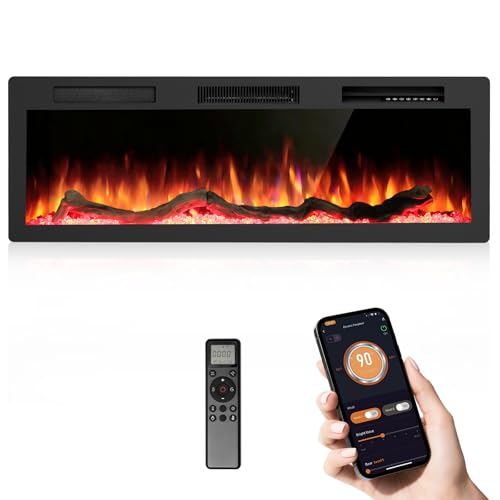
This is a wall-mounted or recessed fireplace rather than a portable heater, so choose it when the installation and fireplace appearance matter more than carrying it room to room. It offers 750W and 1500W heating modes, a 59–95°F temperature setting and a timer; the timer duration is not stated.
Heat output 750W or 1500WTimer Timer; duration not specifiedThermostat range 59–95°FInstallation Wall-mounted or recessedSafety listing —
Why it made the cut
Two heat settings: 750W and 1500W
Temperature setting range of 59–95°F
Remote, touch-panel, smartphone and Alexa control
Good to know
Requires wall-mounted or recessed installation
Timer duration and safety listing are not specified
Skip it if Skip it if you need a freestanding heater you can move between rooms.
Portable Electric Heater With Timer for Room Temperature Control
A portable electric heater with thermostat controls room temperature; its timer schedules when the heater runs or shuts off. For most people, the DREO 1500W model is the best portable electric heater with thermostat among these picks: it lists a thermostat, a 12-hour timer, 70° oscillation and ETL certification.
Portable electric heaters with thermostat can cycle heat around a set temperature, while a timer follows a schedule. One feature doesn’t replace the other, and a timer alone doesn’t guarantee energy savings; savings depend on your schedule, thermostat setting, room heat loss and operating hours.
Pick
Best for
What the supplied specs say
DREO 1500W model
Best Overall
Thermostat, 12-hour timer, 70° oscillation and ETL certification.
DREO portable heater
Quietest
Quiet operation and temperature control from 41–95°F.
DREO 1500W model
Best for Longer Timer
A 12-hour timer is listed; the supplied product data doesn’t establish that it’s longer than every other pick.
DREO portable heater
Best for Wide Heat Distribution
70° oscillation and ETL-listed protection are specified.
The product descriptions supplied don’t identify every model number, so check the listing before ordering.
The search phrase “Jndro portable electric space heater” doesn’t match any supplied product data. None of these picks can be identified as Jndro or treated as an equivalent brand.
From HeaterGuides · our own guidePage 4 shows what each heater costs per hour; the 30-day plan on page 11 cuts the bill.Winter Heating Bill CutterSee what every heater in your home really costs, heat the rooms you use, and cut the waste in 30 days.Cost-per-hour tables for every heaterThermostat schedule and draft-proofing planRunning-cost and bill calculator (Excel)$14.99$9.99Get it for $9.99See what's inside and watch the 2-minute video →14-page printable PDF + Excel calculator · instant download · 30-day refund
Match the Heater to the Room
Portable electric heaters are supplemental zone heaters, not whole-home replacements. The listed picks top out at 1,500W, and comfort depends on room layout, ceiling height, drafts and insulation—not wattage alone.
A portable electric heater or portable electric space heater won’t reliably heat a room based on a blanket 10W-per-square-foot rule. Use coverage figures only when a manufacturer supplies them, and treat those figures as guidance rather than a guarantee. The product data here gives no room-area figure for the model that describes extended air reach.
For portable electric room heaters, heat direction matters: the DREO models 3 and 4 list 70° oscillation to spread warm air across a wider area; a fixed-direction heater sends heat toward one spot. That can suit a desk or chair, but it won’t make a drafty room warm evenly. If you’re comparing DREO portable electric heater reviews, check the exact model’s controls and coverage claims rather than assuming every DREO heater shares them.
Worked Example
At full power, a 1,500W heater running 8 hours a day for 30 days uses 360 kWh. At an assumed $0.17 per kWh, that’s $61.20 for the month. The cost block uses the same full-power assumption; thermostat cycling can reduce actual use, while colder weather or a draftier room can keep the heater on longer.
Use1.5 kW × 8 hours × 30 days = 360 kWh
Assumed rate$0.17/kWh
Estimated costCheck the current listing
Heater
Watts
Per hour
Per day (8 h)
Per month (30 days)
1,500W portable heater
1,500 W
26¢
$2.04
$61.20
Calculated at 17¢ per kWh. Estimate assumes continuous full-power operation at $0.17/kWh; thermostat cycling may lower actual use.
About 12.5 A
At 1,500W and 120V
That’s a large share of a standard 15A circuit. Avoid sharing the circuit with other high-draw appliances.
The best portable electric heaters for home use depend on the room and whether you want focused or wider heat; for larger-room comparisons, see room space heaters compared.
Set the Timer and Thermostat Separately
A portable electric heater with thermostat controls room temperature; its timer limits when the heater runs. Check both controls before buying, because portable electric heaters with thermostat settings can still lack the schedule you need.
The DREO Space Heater, Portable Electric Heaters for Indoor Use… (product 2) lists a 12-hour timer and a thermostat adjustable from 41–95°F in 1°F increments. The DREO 1500W model (product 3) lists a 12-hour timer and ECO temperature control; product 4 lists a 12-hour timer and a 41–95°F thermostat range.
1
Limit the run window
Set the timer for the hours you expect to use the room, rather than scheduling hours of heat while it sits empty.
2
Choose the temperature
Set the thermostat to your comfort level. The heater cycles as needed to maintain that setting; the timer sets the operating window, not the room temperature.
3
Check ECO behavior
ECO mode can adjust power output to maintain a set temperature. It doesn’t make electric resistance heat use less energy per unit of heat delivered.
Check After a Power Cut
Don’t assume the heater remembers its timer or thermostat settings after an interruption. The listed specifications don’t establish memory behavior, so check the manual for what happens when power returns.
There’s no service-life figure in the supplied product data, so a portable electric heater expected lifespan can’t be stated reliably. Keep air intakes clear, inspect the cord, and stop using the heater if it’s damaged, smells unusual, or shuts down repeatedly.
Use Plug-In Heaters With Basic Safeguards
The safest portable electric heater is one with a UL, ETL, or CSA listing, plus tip-over and overheat protection, used exactly as its manual directs. Those are the portable electric heaters safety features to check; product 3 and product 4 state ETL certification or listing, and product 5 states ETL certification. Don’t assume product 2 has a certification that its data doesn’t name.
Before You Turn It On
Plug the heater directly into a wall outlet, never an extension cord or power strip.
Keep at least 3 feet between the heater and bedding, curtains, furniture, or other combustibles.
Use portable electric heaters for indoor use only as their manufacturer permits; don’t leave one running while you sleep or leave home unless that specific model is designed for it. A timer doesn’t replace supervision or a safety listing.
A Timer Isn’t a Safety Device
A scheduled shutoff can limit run time, but it doesn’t make an unattended heater safe. Follow the model’s instructions, including any restrictions on overnight or unattended operation.
1
Unplug and cool it
If a portable electric heater is not working, unplug it and let it cool before checking anything.
2
Check the basics
Check the outlet and breaker, then inspect the cord and air intake for damage or blockage. Don’t open or repair a damaged heater; replace it or use a qualified repair service.
3
Clear dust safely
Electric heaters don’t need an air filter. With the unit unplugged and cool, clean dust from the intake and grille only as the manual allows.
Questions People Ask
What is the most economical portable electric heater to run?
A 1,500W electric heater uses the same electricity at any brand’s full power, so the economical choice is the one that lets you heat only the room you’re using and shut off when it’s warm enough. A thermostat can reduce run time by cycling the heater, but it doesn’t make each hour of operation cheaper.
Can I use a portable electric heater overnight if it has a timer?
A timer alone doesn’t make overnight use safe. Don’t leave a portable heater running while you sleep unless the manufacturer says that model is designed for it; follow its manual, plug it directly into a wall outlet and keep it at least 3 feet from bedding and other combustibles.
How much does a 1,500W portable heater cost to run?
At full power, a 1,500W heater uses 1.5 kWh per hour. Multiply 1.5 by your electricity rate: at 17 cents per kWh, that’s about 26 cents an hour, or about $2.04 for eight hours; thermostat cycling can lower the actual cost.
What should I do if my portable electric heater is not working?
Unplug it and let it cool before checking for blocked air intakes, dust or a tripped tip-over switch; clear dust only as the manual allows. If it still won’t run, check the outlet with another device and reset the heater only as directed—don’t open the casing or bypass a safety switch.
How long should a portable electric heater last?
There’s no reliable fixed lifespan: use, storage and the condition of the cord, plug and controls all matter. Stop using the heater if the plug or outlet gets hot, the cord is damaged, or it smells burnt or behaves erratically, and replace it rather than attempting an internal repair.
Can I use a portable non-electric heater indoors?
Only if the heater is specifically rated for indoor use and you follow its ventilation requirements. Fuel-burning heaters can produce carbon monoxide, so use a working CO alarm; never run an outdoor or construction heater indoors, in a tent or in a vehicle cabin.
Before you go · a welcome giftGet the Winter Heating Bill Cutter for $4.99See what every heater in your home really costs, heat the rooms you use, and cut the waste in 30 days. Normally $14.99; your welcome price saves $10.00. We'll email your link right now.or buy it now for $9.99 without the gift →One email with your link now. We never share your address.



 Winter Heating Bill CutterSee what every heater in your home really costs, heat the rooms you use, and cut the waste in 30 days.Cost-per-hour tables for every heaterThermostat schedule and draft-proofing planRunning-cost and bill calculator (Excel)
