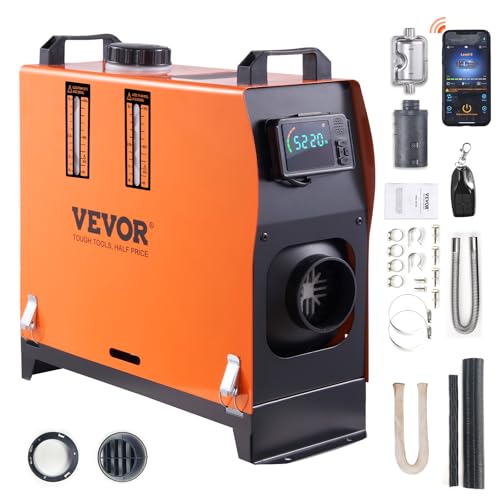
For most vehicle cabins, the VEVOR 2KW diesel air heater is the sensible starting point: its listed 2 kW output and 108–161 sq ft coverage suit smaller spaces better than an advertised 8 kW unit. Output claims aren’t independently verified, so compare specs as listings, not test results.
What to remember
Start with the 2 kW model for a smaller, reasonably insulated vehicle; consider 5 kW for a larger or leakier space.
Treat advertised kilowatts and coverage as manufacturer-listed figures, not independently verified output.
Check voltage, fuel consumption and tank capacity as separate specifications before comparing runtime.
An all-in-one unit still needs combustion exhaust routed safely outside and fresh-air routing that follows its manual.
Confirm altitude limits, parts availability and service support with the seller before relying on a heater for a remote trip.
A diesel parking heater warms the cabin while the engine is off, but the right size depends on insulation, outside temperature and how much air leaks in. A heater that’s too large can cycle frequently; one that’s too small may run hard without keeping up.
One useful number: the VEVOR 2KW listing gives fuel consumption of 0.12–0.26 L/h. At the listed upper rate, an 8-hour run would use 2.08 L; actual use depends on setting and conditions.
Best Diesel Heaters for Vehicle Use
#1Best for smaller cabins
VEVOR 2KW Diesel Air Heater
Best for Smaller vehicle cabins and campers listed at 108–161 sq ft
The listed 2 kW output and 108–161 sq ft coverage make this a more sensible starting point for a smaller cabin than an advertised 8 kW unit. Automatic altitude adjustment, Bluetooth app control and a remote give you several ways to manage preheating. Treat the output and coverage as listing claims, not verified results.
Output and coverage 2 kW; 108–161 ft²Fuel use 0.12–0.26 L/hVoltage 12 VAltitude Automatic adjustment up to 18,045 ft
Why it made the cut
2 kW output with listed coverage of 108–161 sq ft
Automatic altitude adjustment listed up to 18,045 ft
Bluetooth app control, remote and LCD
Good to know
The listed fuel-use range is 0.12–0.26 L/h, not a guaranteed burn rate
Skip it if Skip it if your vehicle has a larger space than the listed coverage or you need a heater rated for a different voltage.
Best for Vehicle owners who also want a heater for a 110V outlet
This 5 kW all-in-one heater supports 12 V and 24 V, and the kit includes a 110 V transformer for a compatible outlet. The remote, digital display and 5 L fuel tank suit someone who wants one unit for a vehicle and other listed settings. Its stated fuel use is 0.18–0.53 L/h.
Output 5 kWFuel use 0.18–0.53 L/hVoltage 12 V/24 V/110 VFuel tank 5 L
Why it made the cut
Supports 12 V, 24 V and 110 V with the included transformer
5 L fuel tank
Remote control and digital display
Good to know
The listing gives no coverage area or altitude limit
Skip it if Skip it if you need a listed coverage area or altitude limit to match your setup.
Best for Campers who want an all-in-one heater without installation
The listing describes this 8 kW unit as installation-free, which suits a portable setup where you don’t want a permanent heater installation. Bluetooth control, a remote and automatic altitude adjustment up to 18,045 ft add useful control options. Its listed coverage is 215–269 sq ft, so check the space before choosing the larger output.
Output and coverage 8 kW; 215–269 ft²Fuel use 0.16–0.62 L/hVoltage 12 VAltitude Automatic adjustment up to 18,045 ft
Why it made the cut
Listed as an installation-free all-in-one unit
Bluetooth app control and remote
Automatic altitude adjustment listed up to 18,045 ft
Good to know
The listed coverage is 215–269 sq ft, which may be more than a smaller cabin needs
Skip it if Skip it if your vehicle is a smaller space better matched to the listed 2 kW option.
Best for Larger vehicle or camper spaces listed at 215–269 sq ft
Its listed 8 kW output and 215–269 sq ft coverage point toward a larger cabin or camper, rather than a small vehicle interior. The 10 L tank, Bluetooth app control and automatic altitude adjustment up to 18,045 ft are useful features for extended use and changing elevation. The listing’s fuel-use range is 0.16–0.62 L/h.
Output and coverage 8 kW; 215–269 ft²Fuel use 0.16–0.62 L/hVoltage 12 VAltitude Automatic adjustment up to 18,045 ft
Why it made the cut
10 L fuel tank
Bluetooth app control, remote and LCD
Automatic altitude adjustment listed up to 18,045 ft
Good to know
The 8 kW listing may be oversized for a smaller vehicle cabin
Skip it if Skip it if your space is closer to the listed 108–161 sq ft coverage of a 2 kW heater.
Best for Indoor electric heat where a diesel heater isn’t required
This is a 1,500 W ceramic electric space heater, not a diesel parking heater, so it won’t fit a vehicle setup that needs diesel heat. Its compact size, thermostat and listed tip-over and overheat protection may suit indoor personal heating instead. Plug an electric heater directly into a wall outlet, never an extension cord or power strip.
Power 950 W/1,500 WHeating area 108–130Power cord 6 ftWeight 3.53 pounds
Why it made the cut
Two heat settings: 950 W and 1,500 W
Thermostat and two-knob controls
Listed tip-over and overheat protection
Good to know
It is electric, not diesel-powered
The listing gives no vehicle coverage or altitude information
Skip it if Skip it if you need a diesel heater for a vehicle cabin.
A diesel heater for a garage can work when you’re warming a vehicle or a suitably enclosed space, but a parking heater isn’t a general-purpose construction heater. Its burner heats air through a heat exchanger, so the exhaust must be routed outdoors as the model’s manual allows. For the best diesel heater for a shed, choose by insulated volume and intended mounting—not the biggest number on the listing.
Model
Listed heating output
Listed coverage
VEVOR 2KW
2 kW
108–161 sq ft
VEVOR 8KW
Advertised 8 kW
Approximately 215–269 sq ft
VEVOR 8KW with Bluetooth app control
Advertised 8 kW
Approximately 215–269 sq ft
LF Bros 5KW
Claimed 4,700–17,000 BTU
No verified coverage figure supplied
These are listed or claimed figures, not results from a common side-by-side test.
The VEVOR 8 kW figure isn’t independently verified, and actual output may differ. Its listed coverage doesn’t establish how it will perform in a drafty garage, shed or boat; air leaks and insulation change the heating load. Treat coverage as a rough listing, not a guarantee.
Parking Heater Or Garage Heater?
A parking heater is intended to warm a vehicle or an enclosed space through its heat exchanger. Don’t treat it as a construction heater or run it with exhaust entering the building. Follow the specific model’s manual for installation and exhaust routing.
For a small shed or boat, compare the space’s insulated volume and the heater’s permitted mounting arrangement. A vehicle heater may suit a small, enclosed space only if the manual permits that use and you can route the exhaust safely outside; none of the coverage figures here proves suitability for a particular shed or boat.
Quick sizing rule
Start with the model’s listed coverage, then account for insulation, drafts and usable mounting space. If the space is leaky or its volume is unlike a vehicle cabin, don’t size it from the advertised kW rating alone.
If you’re comparing a vehicle-focused all-in-one unit with heaters meant for larger work areas, see our diesel space heaters explained guide for the difference in intended use.
Match Output to the Vehicle
Good quality parking heaters are sized to the vehicle: a 2 kW listing is the sensible starting point for a smaller, insulated cabin, while a larger or less insulated parking heater vehicle or truck may call for a 5 kW or 8 kW listing. For diesel heater for overlanding use, match the cabin first, then confirm voltage and altitude support. None of the output figures below has independent side-by-side verification.
Model
Listed output
Fuel use
Tank
Voltage
VEVOR 2KW
2 kW
0.12–0.26 L/h
10 L
12 V
LF Bros 5KW
5 kW
0.18–0.53 L/h
5 L
12 V / 24 V; 110 V via included transformer
VEVOR 8KW
8 kW
0.16–0.62 L/h
10 L
12 V
VEVOR 8KW with Bluetooth app control
8 kW
0.16–0.62 L/h
5 L
12 V
Output and coverage are listing claims, not verified performance. The two VEVOR 8KW listings have different tank capacities.
A bigger kilowatt number doesn’t guarantee more useful heat in your cabin. The VEVOR 2KW is listed for smaller spaces; the 8KW listing claims approximately 215–269 square feet, but that coverage and its output aren’t independently verified. Treat advertised ratings as a rough comparison, not a measured result.
Estimate Maximum-Rate Runtime
Divide the listed tank capacity by the stated maximum fuel rate. These are theoretical estimates, not guaranteed runtimes; actual use depends on operating conditions and settings.
VEVOR 2KW10 L ÷ 0.26 L/h ≈ 38 hours
LF Bros 5KW5 L ÷ 0.53 L/h ≈ 9.4 hours
VEVOR 8KW listingsAt 0.62 L/h, 10 L is about 16 hours; 5 L
Estimate diesel cost with listed fuel consumption × operating hours × your local diesel price per liter. For example, use 0.26 L/h × 8 hours × your price per liter for the 2KW’s listed maximum rate. Startup and shutdown also draw electrical power, and the product data gives no amperage figures, so check the exact model’s power requirements before planning a battery setup.
Confirm the Exact Version
VEVOR models are listed as 12 V. LF Bros supports 12 V and 24 V, with an included transformer for 110 V operation. Verify the product version, voltage compatibility and power requirements on the listing and manual before buying; similar names don’t guarantee identical equipment.
1
1. Size the cabin
Choose the 2 kW listing for a smaller, insulated cabin; consider 5 kW or an 8 kW listing for a larger or less insulated space.
2
2. Match your power
Check the heater’s exact voltage and power needs against your vehicle or available supply.
3
3. Check elevation, then route exhaust
Confirm altitude support for your expected elevation, and plan safe exhaust routing before the trip.
Check Altitude, Controls and Noise
For overlanding, check the exact diesel heater model’s altitude limits and controller before you buy; a listing’s maximum elevation doesn’t prove it will run well there. A Chinese diesel heater can be a reasonable option, but nationality doesn’t establish quality: check the model-specific manual, warranty terms, parts supply and seller support. The available product data doesn’t establish long-term reliability or parts availability.
The VEVOR 2KW and 8KW models list automatic altitude compensation up to 18,045 ft. That’s a stated limit, not independent proof of performance at that elevation. The JEABONG JB-018 lists adjustment up to 5,000 m, but it isn’t one of the product picks in this guide.
Verify the Altitude Claim
Find the manual for the exact model and check its maximum operating elevation.
Look for automatic altitude compensation and any required combustion-setting changes.
If the manual and listing don’t agree, ask the seller for written confirmation before purchase.
Listing Versus Field Performance
An advertised limit tells you what the seller claims, not how consistently the heater will burn at your elevation. Don’t assume one model’s altitude settings apply to another version.
A diesel heater controller should be checked for the controls you’ll actually use from the cabin. VEVOR lists Bluetooth app control, a remote and an LCD; LF Bros lists a remote and digital display. Check the app’s range from the heater’s actual mounting location, since the product data doesn’t establish that a phone will connect through your vehicle’s walls.
Check the Connection First
Before permanent mounting, test the app or remote from the spot where you’ll use it, with the heater in its planned location. A controller that works beside the heater may be less useful from your bed.
A diesel heater timer depends on the controller, not just the heater. VEVOR lists a timing function, but confirm the specific controller’s timer functions before purchase; the Espar timer specification doesn’t apply to these selected models.
Fuel-pump ticking and fan noise are normal operating sounds, so a silent diesel heater or no-noise diesel heater isn’t a realistic expectation. Are diesel heaters noisy? They make mechanical and airflow noise, but the supplied data gives no measured sound ratings, so there’s no supported quietest diesel heater here. VEVOR’s “low-noise” pump wording isn’t a decibel measurement.
Plan Exhaust and Permanent Mounting
Parking heater maintenance starts with the manual: inspect, clean and diagnose fault codes on the schedule it specifies, and stop using the heater if you find an exhaust leak, damaged wiring, unusual smoke or repeated shutdowns. A diesel heater for a boat or caravan also needs an installation suitable for that setting; check the model instructions and applicable local requirements before fitting it.
An all-in-one heater is portable, not exempt from exhaust and fresh-air routing. Its heat exchanger separates combustion gases from the air it warms, but damage or poor installation can let exhaust contaminate the heated air.
Keep Exhaust Outside
Never run a diesel heater with its exhaust inside a vehicle, garage, tent or cabin. Route combustion exhaust outdoors, away from doors, windows and air intakes, following the manual. A cracked window does not make unsafe exhaust routing safe. Keep a working carbon monoxide alarm in the occupied vehicle or enclosed space.
1
Choose the mounting position
For permanent mounting, check the heater’s location and the routes for its fuel line, electrical supply, combustion-air intake and exhaust before cutting or drilling. Follow the manufacturer’s mounting instructions; have a qualified installer handle work beyond your skills.
2
Plan both air routes
Identify where combustion air enters and where exhaust exits. Keep the exhaust outlet clear of openings and vehicle air intakes, and install each component as the manual directs.
3
Check the installation before use
Inspect mounting, fuel connections, wiring and exhaust separation. Confirm the CO alarm works, then follow the manual for startup and maintenance.
Before Permanent Mounting
The model and instructions suit the vehicle, boat, caravan or garage.
Fuel, electrical, combustion-air and exhaust routes are planned before drilling.
Exhaust exits outdoors, away from doors, windows and air intakes.
A working CO alarm is in the occupied space.
Use the Fault Codes
Follow the manual’s diagnosis steps for a fault code rather than repeatedly restarting the heater. Stop using it if shutdowns recur or you see smoke, wiring damage or an exhaust leak.
Choose and Install in This Order
For the best diesel heater for overlanding, start with the cabin and installation—not the biggest number on the box; a parking heater truck setup needs the same checks. A diesel heater for a garage must also be suitable for that space, with exhaust routed outdoors.
1
Measure the heated space
Measure the cabin or work area, then assess insulation, drafts and the outdoor temperatures you expect. A cold, leaky space needs more heat than a small, insulated cabin.
2
Choose a listed output to investigate
A 2 kW listing is a starting point for a smaller cabin; 5–8 kW listings may suit a larger or less insulated space. Treat advertised output as a claim, not verified delivered heat.
3
Verify the exact model
Check voltage, tank capacity, stated fuel range, altitude limits and controller features against that listing and its manual. Make sure the voltage matches your power setup.
4
Choose temporary or permanent use
Decide how you’ll use the heater, then plan combustion-air intake and outdoor exhaust routing before purchase. Portable form doesn’t remove those requirements.
5
Inspect before startup
Check mounting, fuel connections, wiring, exhaust separation and the CO alarm. Follow the manual for startup, fault-code diagnosis and maintenance.
Check the Manual First
If the listing and manual differ on voltage, altitude or installation, use the manual for the exact model before buying or installing.
Questions People Ask
How noisy are diesel parking heaters in real use?
Noise varies by model, mounting and heat setting, so a listing alone can’t tell you how loud it will be in your vehicle. The combustion fan and ticking fuel pump are separate sound sources; mount the pump as the manufacturer directs and check for a model-specific noise measurement before buying.
How long will a diesel heater run on a full tank?
Divide tank capacity by the heater’s fuel-consumption rate to estimate runtime, then treat the result as a range. For example, a listed 5 L tank and 0.16–0.62 L/h consumption imply about 8–31 hours; actual use depends on heat setting and the model’s real fuel burn.
What power source does a vehicle diesel heater need?
Most vehicle parking heaters need a compatible DC supply, commonly 12 V or 24 V, and they also draw electrical power to start the fan and glow plug. Check the exact model’s voltage and installation instructions; an included transformer may allow operation from 110 V, but that does not make every model compatible with every outlet.
How do I maintain a diesel parking heater?
Follow the model’s service schedule for cleaning, inspections and fault-code checks, and use the specified fuel. Before each season, check the wiring, fuel line and exhaust routing for damage or leaks; stop using the heater if exhaust could enter the cabin.
Can a diesel parking heater work at high altitude?
Some models list altitude adjustment, but a stated maximum elevation is not proof of reliable operation at that height. Check whether the exact heater has automatic altitude adjustment or requires manual combustion-setting changes, then confirm the limit and procedure in its manual.