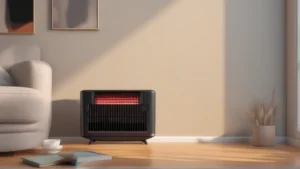
Cost-effective heating for small apartments usually means a compact electric heater for one room, plus draft control to keep the heat you already paid for inside. An infrared heater is a heater that warms objects and people directly rather than the air. In a tight apartment, that can feel cheaper because you warm the occupied space, not the whole building.
A small apartment is the easy case only on paper. Heat loss through drafts, thin walls, and old windows can change the bill faster than the heater type does.
The practical answer depends on room size, your electric rate, and how long you need the heat on. A 1,500 W heater used 8 hours a day makes about 12 kWh a day; at 17 cents per kWh, that’s about $2.04 a day.
Cost-Effective Heating For Small Apartments
For most small apartments, the cheapest practical answer is a plug-in electric space heater running in the one room you’re actually sitting in, not the building’s heat turned up for square footage nobody’s using. You heat the person, not the apartment. That’s the whole trick.
A plug-in electric space heater is an efficient choice for small apartments.
Electric resistance heat costs the same per kWh no matter what box it comes in, so the “most cost-effective system” question really comes down to how much of the heated air you keep. A 1,500 W heater draws 12.5 A at 120 V, which is the ceiling for a standard 15 A circuit. Run it eight hours a night and that’s 12 kWh. At 17 cents per kWh, roughly $2.04 a night, or about $61 a month if you do it every night.
Heater
Watts
Per hour
Per day (8 h)
Per month (30 days)
1,500 W space heater
1,500 W
26¢
$2.04
$61.20
Oil-filled radiator, same wattage
1,500 W
26¢
$2.04
$61.20
Small 700 W desk heater
700 W
12¢
95¢
$28.56
Calculated at 17¢ per kWh. Same wattage, same kWh. The difference is how long each one actually runs, not what it’s called on the box.
The three types behave differently even at identical wattage. Convection heaters warm the air, which then drifts toward the ceiling and out through every gap. Infrared heaters warm people and furniture directly, so you feel it in seconds and can sit under it with the room air still at 62°F. Oil-filled radiators heat the oil first, then the room, and keep radiating for 10 to 20 minutes after the thermostat clicks off, which is why they feel steadier in a bedroom.
Heater type
What it heats first
Typical use
Main limit
Convection (fan or tower)
Room air
Studio living areas, small offices
Feels cool the moment it cycles off
Infrared (quartz, carbon)
People and objects
Bedrooms, spot heating a desk or couch
Only the side facing it feels warm
Oil-filled radiator
Oil, then air
Bedrooms, overnight use
Slow to warm up, heavy to move
Match the type to the room before you match it to the price tag.
Room by room: a 400 to 600 W infrared panel or small radiator suits a bedroom you only occupy for sleep. A studio living area of 200 to 300 sq ft wants 1,500 W of convection or a 1,500 W radiator. A home office with one occupant can get by on 700 to 1,000 W of infrared aimed at the chair. Bathrooms need a model explicitly rated for damp locations, never a standard bedroom unit.
When central heat wins
Whole-apartment systems, including a properly sized heat pump or a gas furnace, only come out ahead if you’re heating several rooms for many hours a day and the system is already in place and working. Adding a mini-split to save money on a 500 sq ft apartment rarely pays back inside a lease.
12.5 A
What a 1,500 W heater draws
That’s most of a 15 A circuit. If the breaker trips when the microwave runs, the heater and the kitchen are sharing a circuit. Run it on its own outlet, never a power strip or extension cord.
In short
Buy one 1,500 W heater for the room you use most, run it only when you’re in that room, and spend an afternoon stopping the drafts before you spend another dollar on watts.
A good heater in a leaky apartment is like a bucket with a hole in it. Warm air is buoyant, so it rises, finds the gaps at the top of the door and around window frames, and pushes outside. Cold outside air gets pulled in at the bottom to replace it. Your heater’s only job becomes reheating air you already paid for.
That’s why the thermostat can say 72°F and you’re still cold. The air near the floor is 62°F, the air at the ceiling is 80°F, and the heater never catches up because the loss is continuous.
Worked example: one leaky door
Say your front door has a half-inch gap along the bottom, 36 inches wide. That’s roughly 18 square inches of open hole, and on a windy day it moves a surprising volume of air. Your 1,500 W heater runs continuously instead of cycling on and off at a 50% duty cycle. Eight hours of continuous running instead of four is 12 kWh instead of 6, which is about $2.04 instead of $1.02 at 17 cents per kWh. Over a 30-day month, that gap costs you roughly $30.
Gap36 in × 0.5 in
Extra runtime4 hours a night
Monthly cost of the leakAbout the cost of a 1,500 W heater runni
Sealing doesn’t replace insulation. It won’t fix a single-pane window or an unheated wall. What it does is cut the number of hours your heater has to run, and runtime is the only number on your bill that changes.
1
Find the leaks
On a windy day, hold a lit incense stick or a tissue near door edges, window frames, and where pipes and cables enter the wall. Watch which way it moves.
2
Seal the bottom of doors first
Threshold gaps are usually the biggest single leak in an apartment, and the easiest to fix without touching the door frame.
3
Then weatherstrip
Peel-and-stick foam or V-strip tape on window sashes and door jambs. Cheap, reversible, and rental-friendly.
4
Leave ventilation alone
Don’t block the bathroom fan, kitchen hood, or any combustion air vent. Those are there for a reason.
Fixes the door gap in the worked example
Custom Aluminum Screw-On Draft Stopper with Drop Seal & Screws
A screw-on aluminum draft stopper with an automatic drop seal closes the bottom gap when the door shuts and lifts clear when it opens, so it works on bedroom, apartment entry, and home office doors without pulling the door off its hinges.
Turning the thermostat up two degrees makes the heater run longer against the same leak. Sealing the leak first means every degree you do set actually stays in the room. Fix the hole, then adjust the dial.
One Product That Helps First
Use it only where drafts are part of the problem. Sealing the door bottom doesn’t add heat, it stops the heat you already bought from leaving through the gap — and in a small apartment, that gap is often the whole reason one room never catc
Seals door bottoms
Generic Aluminum Screw-On Door Draft Stopper
A concealed lift mechanism drops the silicone strip onto the floor when the door shuts and retracts it when the door opens, so the seal doesn’t drag or catch. The aluminum body takes screws through a surface-mount kit, which means no mortising and no pulling the door off its hinges in a rental.
Match the heater to how you use the room, not to the biggest number on the box. Every plug-in electric heater sold in the US tops out at 1,500 W, which is about 12.5 A on a 120 V circuit. That’s already most of a 15 A branch circuit, so the heater needs its own wall outlet and must never share an extension cord or power strip with anything else.
Choose the right heater for your specific room usage.
Type
How it heats
Best room
Trade-off
Oil-filled radiator
Heats oil, radiates slowly
Bedroom, quiet living room
Heavy, slow to warm up
Ceramic fan
Blows warmed air
Studio, quick warm-up
Fan noise, dries air
Infrared
Warms people and objects
Spot heating, desk or couch
Only feels warm in line of sight
Convection panel
Circulates air by natural rise
Small closed room
Slow, low output
All four run on a standard outlet and cap at 1,500 W.
For a bedroom, an oil-filled radiator wins on comfort: silent, no fan, and it keeps radiating after the thermostat clicks off. A ceramic fan heater warms a studio faster but cycles on and off with a hum. Infrared suits a couch or desk where you sit still, since it warms you directly, though the moment you step out of its path the warmth stops. Convection panels are the quiet middle ground for a small closed room.
Safety before comfort
Look for a UL, ETL or CSA listing, tip-over and overheat protection, and keep 3 feet of clearance from bedding, curtains and furniture. Don’t sleep or leave the apartment with a heater running unless the manufacturer’s manual says the model is designed for that use. A bathroom needs a model listed for damp locations, and only if the manual allows it there.
In short
Pick oil-filled for a silent bedroom, ceramic fan for a fast-warming studio, infrared for spot heat where you sit. All are 1,500 W, all need their own outlet, none should run unattended unless the manual says so.
If you want a shortlist already sorted by quiet operation and lease-friendly size, see our stay warm anywhere picks for small apartments.
From HeaterGuides · our own guidePage 4 shows what every heater costs per hour; the Excel sheet works out your own bill.Winter Heating Bill CutterSee what every heater in your home really costs, heat the rooms you use, and cut the waste in 30 days.Cost-per-hour tables for every heaterThermostat schedule and draft-proofing planRunning-cost and bill calculator (Excel)$14.99$9.99Get it for $9.99See what's inside and watch the 2-minute video →14-page printable PDF + Excel calculator · instant download · 30-day refund
Running Cost By Heater Type
The electric bill depends almost entirely on how long the heater runs, not on which type it is. Use this formula: watts ÷ 1,000 × hours × rate per kWh. A 1,500 W heater at 17 cents per kWh costs about 25.5 cents an hour, so 8 hours a day is roughly $2.04 a day, or about $61 a month.
Worked example
Say you run a 1,500 W heater 8 hours a day at 17 cents per kWh. That’s 1.5 kWh × 8 = 12 kWh a day, about $2.04. Cut it to 3 hours a day and the same heater costs about 77 cents a day, or $23 a month. The type didn’t change; the runtime did.
Heater1,500 W
Rate17¢/kWh
8 hrs/dayRunning a 1,500 W electric heater 8 hour
3 hrs/dayA 500 W oil-filled radiator running 8 ho
A lower-watt heater only saves money if it still meets the room’s need. Undersize it and the thermostat never satisfies, so it runs continuously and costs more than the 1,500 W unit that cycles off. Size to the room first, then look at watts.
Heater
Watts
Per hour
Per day (8 h)
Per month (30 days)
1,500 W space heater
1,500 W
26¢
$2.04
$61.20
700 W infrared panel
700 W
12¢
95¢
$28.56
400 W oil-filled radiator
400 W
6.8¢
54¢
$16.32
Calculated at 17¢ per kWh. Same 8 hours a day at 17 cents per kWh; the lower-watt rows only save money if the room still reaches temperature.
0.17
Cost per hour at 1,500 W and 17¢/kWh
Multiply by your actual daily hours to see your real monthly number.
Comfort and cost don’t always track together. A fan heater’s noise, an oil-filled unit’s slow cool-down, and cycle time all shape how the room feels even when two heaters draw the same watts. For a deeper look at the infrared side, our infrared heating costs breakdown covers where the money actually goes.
When The Apartment Has Real Limits
The most cost-efficient heating system is usually the one the building will actually let you run. For a one-room apartment, that’s almost always a plug-in electric heater on its own circuit, not a new boiler, because hydronic heating costs thousands to install before it saves you a dime.
Start with the circuit. A 1,500 W heater pulls about 12.5 A at 120 V, and a standard 15 A circuit starts tripping once lights, a TV and a phone charger join in. Old wiring with two-prong outlets or a fuse box is a real limit: one heater per circuit, and no daisy-chaining.
Never use an extension cord
Space heaters must plug directly into a wall outlet. Avoid using power strips or extension cords, as they can overheat and pose fire risks under heater loads. If the heater’s cord is too short, reposition the heater or have an electrician install a nearby outlet.
Before buying a second heater, find the breaker panel and map which outlets share a circuit. Two heaters on one 15 A circuit will trip it every time. If you rent, check your lease: many landlords ban unvented fuel-burning heaters outright, and some cities restrict vent-free gas models by code. Ask before you buy.
Fuel-burning rules
Any indoor propane or kerosene heater needs the ventilation its manual specifies and a working CO alarm nearby. Vent-free gas is banned or restricted in some states and cities, so confirm local code first.
In short
Match the heater to your wiring, your lease and your local code before you match it to your room size. A heater that trips breakers or violates your lease isn’t cost-effective at any price.
Check Before You Buy
Run these checks first, because a heater can’t fix a drafty apartment by itself. Sealing gaps around windows and doors often cuts your bill more than upgrading the heater does.
Pre-buy checklist
Measure the room’s square footage and match it to the heater’s rated coverage
Confirm the outlet’s circuit amperage and whether it’s shared with other rooms
Look for a UL, ETL or CSA listing plus tip-over and overheat shutoff
Leave 3 feet of clearance around the heater on all sides
Check for draft gaps at windows, doors and outlets before buying more watts
Read your lease for heater restrictions and ask your landlord about fuel-burning models
One space, one rulebook
A small detached garage is a different job: it usually needs a heater rated for unheated, possibly uninsulated space, with different clearance and ventilation rules than an apartment. Don’t cross-use the advice.
For cost-effective heating solutions, the checklist above does more than any single product choice. Work through it before you spend money or call a technician.
More Questions, Answered
What is the most cost efficient home heating option for a small apartment?
If the building already supplies heat you’ve paid for in rent, that system is your cheapest option and a space heater is only a supplement. If you pay for heat separately or the apartment has none, a single 1,500 W electric heater in the room you occupy beats heating every room. The honest ranking is: use the building’s heat, shrink the space you heat, then add electric heat last.
Is an infrared heater cheaper to run than a ceramic heater?
No. Both draw the same wattage at the same setting, so the meter spins at the same rate. The difference is where the heat lands: an infrared unit warms your body and the furniture in front of it within seconds, while a ceramic fan heater has to warm the air in the room first. In a drafty studio where you sit still in one chair, infrared can feel warmer at the same cost, which is why people assume it’s cheaper.
How much does a 1,500 W space heater cost to run for a month?
At 17 cents per kWh, eight hours a day for 30 days is about $61. The arithmetic: 1,500 W is 1.5 kW, times 8 hours is 12 kWh a day, times 30 days is 360 kWh, times $0.17 is $61.20. Your real number depends on your rate and, more than anything, on how many hours the thermostat actually keeps the element energized.
What size heater do I need for a studio apartment?
A single 1,500 W heater covers roughly 150 square feet of well-insulated space, so most studios need one unit, not two. If the studio is larger or the windows are single-pane, run one heater in the zone you occupy and close the door to the bathroom and closet. Two heaters on one 15 A circuit will trip the breaker, so plan on one at a time.
Can I use a space heater on an extension cord in an apartment?
No. A 1,500 W heater pulls about 12.5 A, and a standard 15 A branch circuit can’t spare that through a cord that may be 16-gauge. Plug the heater straight into a wall outlet, and if the cord or plug face feels warm to the touch, stop using that outlet and have an electrician look at it. Power strips and surge protectors are worse, not better, for this load.
Should I seal drafts before buying a second heater?
Yes, and the order matters. Weatherstripping a door, a door snake, and removable window film cost a fraction of a heater and cut the load the heater has to carry. Seal first, then measure how the room holds heat on a cold night, and only then decide whether one heater is enough.
Before you go · a welcome giftGet the Winter Heating Bill Cutter for $4.99See what every heater in your home really costs, heat the rooms you use, and cut the waste in 30 days. Normally $14.99; your welcome price saves $10.00. We'll email your link right now.or buy it now for $9.99 without the gift →One email with your link now. We never share your address.


 Winter Heating Bill CutterSee what every heater in your home really costs, heat the rooms you use, and cut the waste in 30 days.Cost-per-hour tables for every heaterThermostat schedule and draft-proofing planRunning-cost and bill calculator (Excel)