Classroom-Approved Space Heaters: Safety & Noise Considered
On this page 9 sections
- Key Specifications
- Why The Dreo Fits Small Classrooms Best
- Limits And Trade-Offs In A Real Classroom
- How Much Power This Heater Uses
- Safety Features That Matter Most
- How It Compares With Cheaper Indoor Picks
- What To Do Next For Your Room
- Classroom-Approved Space Heaters Reviewed
- Frequently Asked Questions

DREO Portable Electric Heater with Thermostat
Classroom heat is a small problem until the room is cold, the outlet is already busy, and the teacher has to choose between noise and warmth. The Dreo’s appeal is simple: fast 1,500 W supplemental heat, a wide thermostat range, and a short list of safety features that fit an occupied indoor room.
Get the size, placement and power use wrong and you’ll either pay to warm the whole building with one little heater or end up with a box that never takes the edge off. That is money wasted, and it can also mean tripped breakers, overheated cords or a heater that becomes a distraction instead of help.
Key Specifications
| Power | 1500 W |
|---|---|
| Noise Level | 34 dB |
| Temperature Range | 41-95℉ |
| Safety Features | Tilt-detection sensor, V0 flame retardant materials, overhea |
| Modes | Power heat, ECO, Fan Only |
| Control | Remote control, 12-hour timer |
Why The Dreo Fits Small Classrooms Best
The Dreo is a 1,500 W electric space heater designed to provide focused warmth for small classrooms, office corners, or similar zones. Its PTC ceramic heating element delivers consistent heat with quiet operation at about 34 dB, which suits learning spaces where noise matters. The thermostat adjusts from 41 to 95°F in 1°F increments, letting you set precise comfort levels rather than broad ranges.
At 1,500 W, the Dreo can efficiently heat a desk area or a room up to roughly 150 square feet, assuming standard insulation and ceiling height. It won’t warm an entire classroom with poor insulation or high ceilings, but it’s perfect for a small teaching nook or a reading area that needs a boost.
Convenience features include a remote control, a fan-only mode for air circulation without heat, and power and ECO heating modes that adjust energy use but don’t raise the maximum heat output. These add ease but don’t extend the heater’s range or capacity.
Limits And Trade-Offs In A Real Classroom
A 1,500 W space heater like the Dreo can’t replace central heating or fix structural issues such as cold floors, drafty windows, or single-pane glass. It provides spot heat but won’t warm the whole room if the building envelope leaks heat.
Classroom heaters need clearance from flammable materials like paper, backpacks, and curtains. Even with tip-over protection, the risk of fire or burns remains if the heater is crowded or unsupervised.
Electrical capacity in schools can limit how many heaters run simultaneously. One heater per room might overload circuits if other devices are in use. Placement matters to avoid tripping breakers or unsafe wiring.
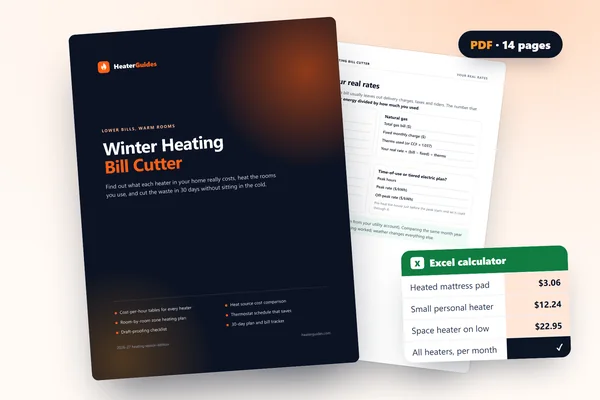 Winter Heating Bill CutterSee what every heater in your home really costs, heat the rooms you use, and cut the waste in 30 days.Cost-per-hour tables for every heaterThermostat schedule and draft-proofing planRunning-cost and bill calculator (Excel)
How Much Power This Heater Uses
The Dreo space heater runs at 1,500 watts, or 1.5 kilowatts, which is typical for plug-in electric heaters designed for small spaces.
To understand running costs, start by converting watts to kilowatts: 1,500 W ÷ 1,000 = 1.5 kW. Then multiply that by how many hours you run it and your electricity rate in dollars per kilowatt-hour. For example, 1.5 kW × 8 hours × $0.17 per kWh equals about $2.04 for a full school day.
| Heater | Watts | Per hour | Per day (8 h) | Per month (30 days) |
|---|---|---|---|---|
| 1,500 W space heater | 1,500 W | 26¢ | $2.04 | $61.20 |
A typical classroom might only need the heater on for the first two class periods, say 2.5 hours. That’s 1.5 kW × 2.5 hours × $0.17 = about 64 cents a day. On the other hand, running it all day doubles the cost.
Using a programmable space heater or a model like the Dreo with a built-in thermostat can help trim waste. The thermostat cycles the heater off when the room hits the set temperature and back on as needed. But this only saves energy if the room holds heat well enough between cycles.
Regarding how many heaters you can use at once, standard 15-amp, 120-volt circuits in classrooms support about 1,800 watts safely. That means you can run one 1,500 W heater with some margin left for lights or electronics, but running two at once risks tripping the breaker or overloading the wiring.
A programmable space heater lets you schedule run times to match class periods, avoiding wasted heat when the room is empty. The Dreo doesn’t have this feature built in, so pairing it with an external timer can work well.
Safety Features That Matter Most
Safe space heaters combine built-in protections with careful use. The Dreo heater includes tip-over and overheat protections, flame-retardant materials, and a safety listing, but the user still plays a key role.
Tip-over protection shuts the heater off if it falls, reducing fire risk. Overheat protection cuts power if internal temperatures rise too high. The Dreo’s use of V0 flame-retardant plastic delays ignition if exposed to a spark or heat. Finally, a UL, ETL, or CSA safety listing confirms the heater meets basic electrical and fire safety standards—verify this for your model.
Even with these features, space heaters remain dangerous if misused. Running a heater on an extension cord or power strip can cause overheating and fire. Placing it near curtains, papers, or clutter invites ignition. Leaving it unattended in a classroom risks unnoticed hazards. These protections reduce risk but don’t eliminate it.
Why are space heaters dangerous? They draw high current and generate intense heat, which can ignite flammable materials or cause electrical faults if the heater or its power source is compromised. Fires and carbon monoxide risks (for fuel heaters) are the top concerns.
The safest space heater is one with tip-over and overheat shutoffs, flame-retardant housing, and an official safety listing. Still, none are safe enough to ignore basic precautions, especially in a busy classroom where kids can accidentally bump or block the heater.
Check the Dreo’s label for a UL or ETL mark—this certifies it passed independent tests for electrical safety. If absent, verify with the manufacturer before using indoors. Classrooms should always follow school rules, which usually require heaters off when no one is present.
How It Compares With Cheaper Indoor Picks
Finding the best space heaters at Walmart often means balancing price, features, and noise level. The Dreo space heater review highlights it as a quiet 1,500 W option with a wide thermostat range and remote control, ideal for classrooms or offices sensitive to noise.
The GiveBest heater also runs at 1,500 W and serves well for indoor heating, but it lacks the Dreo’s quieter operation—Dreo claims 34 dB—and remote convenience. The wider thermostat range on the Dreo means you can dial in more precise temperatures, which matters in occupied spaces where comfort varies.
Amazon Basics offers a smaller, simpler model with 1,500 W, 900 W, and fan-only modes. It appeals if you want something basic and portable at a lower price point. Still, the Dreo is the stronger pick if you want more control over temperature rather than just on/off settings.
For rooms where noise is a distraction—like classrooms or quiet offices—the Dreo stands out. If you prioritize price or need straightforward portability, the GiveBest or Amazon Basics heaters are fine picks. None of these three should be counted on for large or very drafty rooms; a bigger heating solution is necessary.
| Feature | Dreo | GiveBest | Amazon Basics |
|---|---|---|---|
| Power | 1,500 W | 1,500 W | 1,500/900 W + fan-only |
| Thermostat | Wider range | Limited | Basic |
| Noise Level | 34 dB claim | No quiet rating | Not specified |
| Remote Control | Yes | No | No |
| Size | Compact | Compact | Smaller, simpler |
What To Do Next For Your Room
A safe space heater starts with the right fit for your room. Measure the space to know if a small space heater like the Dreo will handle the job. Check the outlet you plan to use—most plug-in heaters draw about 12.5 amps at 1,500 watts, so the circuit should handle that without tripping.
Decide if you need spot heat for a small, supervised area under about 150 square feet. The Dreo is sensible here. For larger or draftier rooms, or if the heater will run unattended, look for bigger systems or different heating categories.
Classroom-Approved Space Heaters Reviewed

GiveBest Ceramic Space Heater with Fan
