




Ventless garage heaters promise quick, efficient heating without the hassle of venting. That’s half true: they do warm up fast and run efficiently, but only when matched right to your space and fuel source.
Choosing the right model matters because not all ventless heaters deliver the same heat output, safety features, or fuel flexibility. We’ve ranked the best ventless garage heaters to help you pick one that actually warms your garage fast and safely.
Ventless Garage Heater Comparison
| Model | Best for | Heat Output (BTU) | Fuel Type | Room Size Coverage (sq. ft.) | Safety Features | Price |
|---|---|---|---|---|---|---|
| Mr. Heater 20,000 BTU Vent Free Propane | Best Overall | 20,000 BTU/HR | Propane | Up to 700 sq. ft. | Indoor Safe | View on Amazon |
| ProCom 30,000 BTU Dual Fuel Blue Flame | Best Dual Fuel | 30,000 BTU | Natural gas or liquid propane | — | Cool-touch cabinet | View on Amazon |
| Mr. Heater 30,000 BTU Natural Gas | Best Natural Gas Pick | 30,000 BTU/hr | Natural gas | Up to 1,000 sq. ft. | — | View on Amazon |
| ProCom 30,000 BTU Infrared Natural Gas | Best Infrared Heat | 30,000 BTU maximum | Natural gas | Up to 1,400 sq. ft. | Built-in pilot oxygen depletion sensor; ANSI Certified | View on Amazon |
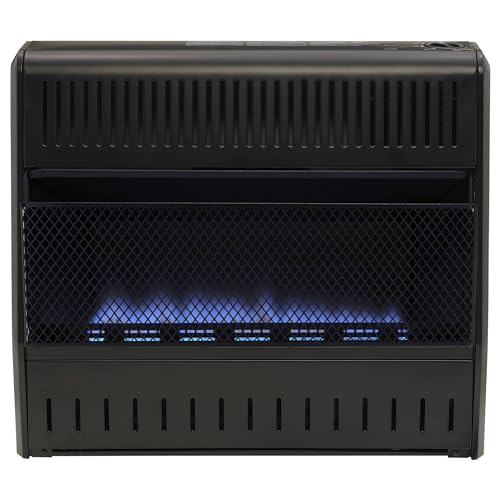
| ProCom 30,000 BTU Blue Flame Natural Gas | Best Manual Control | 30,000 BTU maximum | Natural gas only | Up to 1,400 sq. ft. | Oxygen depletion sensor with automatic shut-off | View on Amazon |
Best Ventless Garage Heaters Ranked by Heat and Features
Mr. Heater 20,000 BTU Vent Free Propane
ProCom 30,000 BTU Dual Fuel Blue Flame
Mr. Heater 30,000 BTU Natural Gas
ProCom 30,000 BTU Infrared Natural Gas
ProCom 30,000 BTU Blue Flame Natural Gas
How to Choose a Ventless Garage Heater That Warms Fast
The best ventless garage heater for most users is an indoor-rated propane model with enough BTUs for the space, a thermostat, an oxygen depletion sensor, and electric ignition; the Mr. Heater 20,000 BTU Vent Free Blue Flame Propane Heater covers up to 700 sq. ft. and starts without waiting for a standing pilot.
BTUs measure heat output, so a higher rating can warm a larger or colder garage, but it doesn’t automatically make a heater warm faster in every space. A 20,000 BTU heater has more output than a 10,000 BTU model, yet an oversized heater may cycle off quickly while using more fuel than you need. Match the rating to the garage size, ceiling height, insulation and winter conditions.
Choose Propane, Natural Gas Or Dual Fuel
Propane is the practical choice when your garage has no gas line because a 20 lb tank can supply the heater, while natural gas suits a permanently installed heater where a gas connection already exists. Dual-fuel heaters give you a choice between propane and natural gas, which helps if one fuel source is unavailable or you want to change later. The ProCom Dual Fuel Ventless Blue Flame Garage Heater is the flexible option in this group.
A thermostat matters more than a shiny maximum-BTU number for daily use because it cycles the burner to hold a set temperature instead of leaving you to turn the heater on and off by hand. Blue-flame models warm the room air, while infrared plaque models heat nearby surfaces and people more directly; that difference affects how quickly the garage feels comfortable.
Look for an oxygen depletion sensor and automatic shutoff on any ventless gas heater. If the sensor detects falling oxygen, the valve cuts the gas supply and the burner goes out; that safeguard doesn’t replace the ventilation required by the manual or a working carbon monoxide alarm. Use only an indoor-rated model indoors, and check local code because vent-free gas heaters are restricted in some places.
Electric ignition beats a standing pilot for a quick start because the burner lights when you call for heat instead of keeping a small flame burning between uses. The Mr. Heater 20,000 BTU Vent Free Blue Flame Propane Heater is a good fit when fast startup and no electrical connection are priorities; choose a natural-gas model if a fixed gas line matters more. For infrared options, compare the heating pattern with infrared garage heaters rather than assuming every ventless heater feels the same.
How to Size a Ventless Garage Heater for Your Space
To work out how many BTU to heat a garage, multiply its floor area by about 20 to 30 BTU per square foot, then adjust for ceiling height, insulation and how cold the garage gets. A ventless garage heater’s room size is therefore a starting range, not a promise printed in stone.
| Garage size | Area | Approximate output |
|---|---|---|
| 12 × 20 ft | 240 sq. ft. | 4,800–7,200 BTU |
| 20 × 20 ft | 400 sq. ft. | 8,000–12,000 BTU |
| 24 × 24 ft | 576 sq. ft. | 11,520–17,280 BTU |
| 24 × 30 ft | 720 sq. ft. | 14,400–21,600 BTU |
Say your garage is 24 × 24 feet: 24 × 24 gives 576 square feet, and 576 × 20 to 30 gives 11,520 to 17,280 BTU. A 20,000 BTU heater sits just above that basic range, which can make sense for a tall, drafty or poorly insulated garage, while a well-insulated space with a standard ceiling may need less output.
Ceiling height changes the amount of air and material you need to warm, so a 12-foot garage generally needs more help than a 7- or 8-foot garage with the same floor area. Poor insulation, an unsealed garage door and frequent door opening also push the requirement toward the upper end; insulation and weatherstripping can improve comfort without buying a larger burner.
Oversizing wastes fuel and can create short heating cycles, while undersizing leaves cold spots and forces the heater to run for long stretches. Put the heater where its manual allows, keep the required clearance around it, and size from the range before selecting a model such as the 20,000 BTU Mr. Heater or a larger natural-gas unit. If your garage has unusual height or severe drafts, a licensed HVAC professional can check the heat loss instead of guessing from square footage alone.
What Ventless Garage Heater Running Costs You Can Expect
For garage heaters, propane ventless models usually cost more to run than natural gas, but they work without a gas line or electricity. Fuel use follows the BTU setting: a 20,000 BTU heater burns less per hour than a 30,000 BTU heater, and a thermostat can reduce the time the burner stays on.
Propane And Natural Gas Burn Rates
Propane contains about 91,500 BTU per gallon, so a 20,000 BTU heater uses about 0.22 gallon per hour, or roughly 0.92 lb of propane. A 30,000 BTU model uses about 0.33 gallon per hour, or roughly 1.31 lb per hour. Those figures assume continuous full output; cycling lowers the real use.
Natural gas is commonly priced by the therm, with one therm equal to about 100,000 BTU. A 20,000 BTU heater uses about 0.20 therm per hour, while a 30,000 BTU heater uses about 0.30 therm per hour. In cubic feet, that is roughly 200 or 300 cubic feet per hour if your utility bills gas that way.
How Long A 20 Lb Tank Lasts
A full 20 lb propane tank holds about 4.7 gallons, so a 20,000 BTU heater running continuously could use it in about 21 hours: 4.7 gallons ÷ 0.22 gallon per hour. At 30,000 BTU, the same calculation gives about 14 hours. Real runtime varies with the fill level, outdoor temperature, regulator performance and how often the thermostat cycles the burner.
Calculate your cost with the fuel price you actually pay. For example, at $3 per gallon, eight hours at 20,000 BTU costs about $5.28: 0.22 gallon × 8 × $3. At $1.50 per therm, eight hours on a 30,000 BTU natural-gas heater costs about $3.60: 0.30 therm × 8 × $1.50. Multiply either daily figure by the number of heating days for a rough monthly estimate.
Electronic ignition can save fuel compared with a standing pilot because the pilot doesn’t burn continuously between heating cycles; it uses a small electrical input only when the burner needs to start. Keep a notebook beside the tank or photograph the tank gauge at the same time each day, then compare gallons used with burner hours. That catches a surprising fuel bill before winter turns it into a tradition.
Safety and Certification Tips for Ventless Garage Heaters
Are ventless garage heaters safe? An indoor-rated, properly sized model can be used safely only with its required ventilation, clearances, ODS and working carbon-monoxide alarm; a patio, torpedo or construction heater doesn’t qualify.
Why The ODS Matters
An oxygen depletion sensor, or ODS, shuts the gas off if oxygen falls below the level the heater can safely tolerate. Combustion changes as room air is depleted, so the ODS is a last-resort safeguard, not permission to run a ventless heater in a sealed garage. Never bypass it or keep using a heater that shuts down repeatedly.
Ventless heater safety also requires a working CO alarm near the garage-to-home entry and elsewhere required by local code. Carbon monoxide has no dependable smell, and a ventless burner adds combustion products and water vapor to the room. Leave immediately and call emergency services if the alarm sounds; don’t troubleshoot a possible CO event with the heater still running.
Clearance, Airflow And Certification
Follow the manual’s clearance from walls, stored fuel, vehicles, cardboard and other combustibles, and provide the ventilation opening it specifies. Small or poorly ventilated garages are bad candidates because oxygen can fall and CO can accumulate; an open door alone isn’t a substitute for the listed ventilation requirement.
Look for an appliance label showing an ANSI or CSA certification for an indoor vent-free gas heater, along with the correct fuel type. That listing means the heater was evaluated to the applicable safety standard; it doesn’t override local rules. Vent-free gas heaters are banned or restricted in some states and cities, so check local code before installation.
What Competitors Leave Out About Ventless Garage Heaters
For the best ventless garage heater that actually warms up fast, the Mr. Heater 20,000 BTU Vent Free Blue Flame Propane Heater is the straightforward pick for a typical garage because its thermostat and electronic ignition get heat moving without waiting for a duct system. Your fuel choice and heater style still matter more than a flashy BTU number.
Blue Flame Versus Infrared
Blue flame heaters warm the air by natural convection, so they suit enclosed garages where you want the whole space to come up in temperature. Infrared plaque heaters warm people, tools and nearby surfaces directly; they can feel faster when you’re standing in front of them, but warmth falls off more quickly with distance. The ProCom Heating Natural Gas Ventless Infrared Plaque Heater fits that targeted heating job, while a blue flame model is usually the better whole-garage choice.
Placement decides how evenly either style works. Keep the heater where its warm air or radiant heat can reach the occupied area, away from shelving, vehicles and stored materials that block circulation. A corner can work, but a tight recess traps heat around the thermostat and may shut the burner off before the far side feels comfortable. Natural gas options are worth comparing if your garage already has a suitable gas line; see garage heaters natural gas for more choices.
Gas Hookups And Air Movement
Dual-fuel heaters need the correct gas pressure, regulator and connection for the fuel selected, so the ProCom Dual Fuel Ventless Blue Flame Garage Heater isn’t a plug-and-play swap between propane and natural gas. Follow the manual’s hookup instructions, use the specified fittings, and have gas work checked by a qualified professional; the wrong pressure can cause poor ignition, soot or unsafe combustion.
A blower fan spreads warmed air faster than natural convection, but it doesn’t create extra BTUs. Use only a fan or blower approved for the heater or a safely positioned room fan, kept clear of the burner and combustible items. Fan blades also move dust, which gives you one more reason to clean the burner openings and air passages with the heater off and cool.
Frequently Asked Questions
What Is a Ventless Garage Heater and How Does It Work?
Are Ventless Garage Heaters Safe for Indoor Use?
How Long Does a 20 Lb Propane Tank Last With a Ventless Heater?
Can Ventless Garage Heaters Run on Natural Gas and Propane?
Do Ventless Garage Heaters Need Electricity to Operate?
What Size Ventless Heater Do I Need for a 2-Car Garage?

I am a mechanical engineer and love doing research on different home and outdoor heating options. When I am not working, I love spending time with my family and friends. I also enjoy blogging about my findings and helping others to find the best heating options for their needs.
Related guides

Seamlessly Compare the Best Pool Heater Brands Today
Ready to find the best pool heater brands? Compare top options and keep your pool warm and inviting…
Coziest Camper Heater That Really Warms Up Fast
For campers, the best heater for a camper ensures warmth without hassle. The Mr. Heater Portable Buddy Heater…
Ultimate Relaxation: Best Heated Foot Spa Ever!
Indulge in ultimate relaxation with the best heated foot spa. Treat your tired feet and rejuvenate your senses…