Product 4 is the best match for most readers who need a timer for a block heater because it handles up to 15A/1800W and gives you countdown and cyclic modes in one heavy-duty plug. For a vehicle block heater, though, the timer still has to match the heater’s manual and the outdoor setup you actually use.
Key takeaways
Match the timer to the heater’s voltage and amperage first; style comes second.
A 15A/1800W timer is the usual ceiling for a standard 120V plug-in heater load.
Countdown and cyclic modes help, but they do not replace a timer that is rated for the environment.
For outdoor engine use, the cord, plug covers, and outlet protection matter as much as the timer itself.
If the heater manual says not to use a timer or thermostat, follow the manual.
A block heater timer should control when power comes on, not guess how cold the engine feels. That means load rating, timer mode, and weather protection matter more than the glossy words on the box.
If your heater is a simple 120V plug-in block heater, a sturdy plug timer can save wasted run time. If the heater draws close to the circuit limit, or the cord sits outside in snow and slush, the timer choice gets stricter fast.
Best Timers And Controls For Block Heaters
#1Best Overall
ecoartheating Heavy-Duty Cyclic Timer
Best for Block heaters needing countdown or cyclic control up to 1800W
Product 4 is the closest match for a block-heater setup because its 15A/1800W output handles high-power heaters. Countdown ON, countdown OFF, countdown ON/OFF and cyclic modes give you more useful scheduling choices than a basic timer. The display and power-memory feature also make the settings easier to check after an interruption.
Power output 15A/1800WTimer modes Cyclic and countdown ON/OFFTemperature range -40°F to 210°FDisplay Clear figure displayMemory Power memory
Why it made the cut
Supports heaters up to 1800W
Offers countdown and cyclic modes
Has temperature control from -40°F to 210°F
Good to know
Temperature-controller features may be more than a simple block heater needs
The data doesn’t specify outdoor weather resistance
Skip it if Skip it if your heater’s manual requires a timer type or setup this controller doesn’t support.
Best for Replacing the cycle timer in a compatible Kozi heating system
Product 3 is a replacement part for specific Kozi equipment, including the Kozi Baywin, Model 100, Previa and Shop Heater. Its 120V rating and cycle-timer design suit that repair job. That makes it a poor general-purpose choice for a vehicle block heater unless the heater specifically calls for this part.
Voltage 120VCompatible parts TMR120AC, 10040, TRS51A11S2Compatible equipment Kozi Baywin, Kozi Model 100, Kozi Previa, Kozi Shop HeaterPart type Auger cycle timer
Why it made the cut
Designed as a compatible replacement part
Works with listed Kozi heater models
Has USA-based seller and customer support
Good to know
Not presented as a general block-heater timer
Compatibility is limited to listed equipment
Skip it if Skip it unless your heater manual or failed part identifies TMR120AC, 10040 or TRS51A11S2.
Best for A small indoor room that needs its own heater and 24-hour timer
Product 2 includes a 24H timer, thermostat and remote, so it can schedule the heater itself without a separate timer plug. Its 1500W high setting and 200-square-foot coverage suit a small indoor space. That convenience doesn’t make it a block-heater timer; it’s a complete ceramic heater.
High power 1500WTimer 24H timerCoverage Up to 200 sq. ft.Noise level 35dBSafety features Overheat protection and 45° tip-over shutoff
Why it made the cut
Includes a 24H timer
Has thermostat and ECO mode
Includes overheat and tip-over protection
Good to know
The product is a heater, not a timer for another heater
The data lists indoor use cases rather than vehicle block-heater use
Skip it if Skip it if you already own a block heater and only need an external timer.
Best for Supplemental indoor heating with built-in timer and remote control
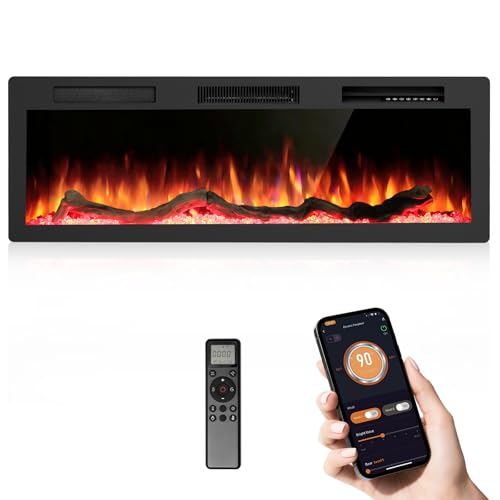
Product 1 has a built-in timer along with touch, remote, smartphone and Alexa control. Its 750W and 1500W heating modes are intended for supplemental heating up to 400 square feet. Those features help schedule this fireplace, but they don’t turn it into a plug-in timer for a separate block heater.
Heating modes 750W and 1500WCoverage Up to 400 sq. ft.Timer control Included timerInstallation Wall-mounted or recessedDimensions 50L × 17.32H × 5.71W
Why it made the cut
Includes a built-in timer
Offers 750W and 1500W heating modes
Can be controlled by touch, remote, smartphone or Alexa
Good to know
Designed as a recessed or wall-mounted fireplace
Not a standalone timer for a block heater
The product is intended for indoor supplemental heating
Skip it if Skip it if you need to control a separate vehicle block heater from an outlet.
The EcoartHeating Digital Temperature Controller Outlet, Cyclic… is the best match here for most plug-in block heaters: it’s rated up to 15A/1800W and offers countdown and cyclic modes. Check your heater’s manual and the timer’s outdoor-use rating before connecting them; the timer’s load capacity alone doesn’t make a wet or exposed setup safe.
Your need
Best fit
Why it fits
One planned warm-up
EcoartHeating Digital Temperature Controller Outlet, Cyclic…
Countdown mode can switch the heater off after a set run.
Repeating on/off periods
EcoartHeating Digital Temperature Controller Outlet, Cyclic…
Cyclic mode supports repeated operating periods.
A timer for a vehicle block heater
A timer rated for the heater’s load and approved for the setup
The timer controls power; your heater’s manual determines whether that use is allowed.
Product 4 is the pick here; confirm its rating against your heater and installation.
For a block heater, pick a timer that matches the heater’s voltage, amperage and operating instructions. Product 4’s 15A/1800W rating is its stated maximum, not spare capacity for other equipment on the same circuit. If you still need to choose the heater itself, compare options in this guide to the best block heater for a car.
A timer can’t make an indoor-only control suitable for outdoor use, protect a damaged cord or approve a heater for a vehicle. Check the timer’s instructions for outdoor use, keep plug connections protected as the manuals require, and don’t use the setup if the heater manufacturer prohibits a timer.
Myth
Any 15A timer is automatically suitable for a block heater.
Fact
A matching amperage rating is only one check. The timer also needs to match the heater’s voltage and use, and its instructions must allow the location and conditions where you’ll use it.
Choosing the Right Timer Mode for Your Heater
Choose a countdown timer for one planned heating run, a cyclic timer for repeating on/off periods, and a thermostat only when the heater is designed to respond to temperature. A timer can be used with an electric heater if its manual permits external control and the timer is rated for the heater’s load.
A 12-hour timer on a fan heater usually means the heater can run for up to 12 hours before the timer shuts it off; check the manual, since some models instead let you delay the start or set a daily schedule. For radiant heaters, an override timer generally lets you temporarily change the programmed on/off schedule. Check what “override” means on that controller: it may hold the heater on or off only until the next scheduled change.
1
Use countdown for a single run
Set the number of hours you want power on, and the timer shuts it off when the countdown ends. That suits a block heater you want to run before departure without leaving it energized all night.
2
Use cyclic for repeating bursts
A cyclic timer repeats its on/off intervals. It can suit equipment that needs regular bursts of heat; set intervals only within the heater maker’s instructions. The EcoartHeating Digital Temperature Controller Outlet offers this style of control alongside countdown mode.
3
Use thermostat control for temperature
A thermostat switches in response to sensed temperature, not the clock. That can help with some indoor heaters, but it isn’t a substitute for a vehicle block-heater timer unless the block heater is designed for thermostat control.
Don’t Mix Up Diesel Timers
A diesel heater timer controls a diesel air heater, which heats cabin air; it isn’t a timer for an engine block heater. Match the control to the appliance. If you’re shopping for a diesel air heater timer, see diesel block heater timer options only if you mean a vehicle engine heater; for diesel air-heater controls, check the heater maker’s documentation.
For Indoor Electric Heaters
Plug an electric heater directly into a wall outlet, never an extension cord or power strip, and keep 3 feet of clearance. Check the manual before adding a timer; a plug-in heater can draw enough current that an underrated control is a poor shortcut. For room-heater choices, compare space heaters with timers.
Match The Timer To The Load And Outlet
For most plug-in block heaters, use a 120V timer rated for at least the heater’s amperage and wattage; a 15A/1800W timer fits only when the heater and circuit are within those limits. Check the heater label and manual first. A timer’s rating doesn’t increase the outlet circuit’s capacity.
12.5 A
A 1,500W heater at 120V
That’s about 12.5A, leaving little room on a 15A circuit for other equipment. If the heater will run for hours, check the circuit’s continuous-load limits rather than assuming its breaker rating is available for the heater alone.
Check The Combined Load
Say a 1,500W block heater and a 300W work light share a 120V circuit. The heater draws about 12.5A; the light adds about 2.5A, for roughly 15A total. Put the light on a different circuit or don’t run it at the same time. The timer can switch the heater, but it can’t make room on the circuit.
Block heater1,500W ÷ 120V ≈ 12.5A
Work light300W ÷ 120V ≈ 2.5A
Combined loadAbout 15A
Check
What to match
Heater label and manual
Voltage, wattage, amperage, and any timer restrictions
Timer label
Voltage and rated load at least as high as the heater requires
Circuit
The heater plus other devices sharing that circuit
Connection
A snug plug and receptacle with no damage or discoloration
If the timer, heater, plug, or circuit has a lower rating, follow the lower limit.
Product 4, the EcoartHeating Digital Temperature Controller Outlet, Cyclic…, is the broadest fit here: its listed 120V, 15A/1800W rating covers many plug-in block heaters, and it offers countdown and cyclic modes. Use it only when the heater and circuit also meet their own limits; 1,800W is the timer’s ceiling, not extra capacity for a 15A outlet.
Product 3, the Kozi Auger Cycle Timer Block (120V), is a replacement part for compatible Kozi heaters, not a general-purpose block-heater timer. For a VW Golf, TDI, or tractor, choose the engine heater specified for that vehicle first, then check whether its manual permits an external timer and what load the timer must handle. best block heater for tractor
Stop If The Connection Gets Hot
Don’t add a power strip or chain cords to make a timer fit. If the plug, receptacle, or timer gets hot, the breaker trips, or you see scorch marks or a loose fit, stop using the setup and have the circuit checked.
Keep The Timer And Cord Safe Outside
A timer can control an electric block heater if the heater’s manual allows it and the timer is rated for the load and outdoor conditions. A propane gas heater isn’t a safe substitute for warming an engine in an apartment parking area; don’t use a fuel-burning heater for this job. A heater with a timer still needs a safe electrical setup.
Use outdoor-rated equipment anywhere the cord or connection may meet rain, melting snow, or wet ground. Keep the plug connection off the ground if the setup allows, and use a weather-protected outlet in line with the equipment instructions. An indoor timer or indoor extension cord doesn’t become weatherproof because the forecast looked promising.
Avoid improvised connections
Never plug a heater into a power strip or use a light-duty extension cord. If the heater’s cord won’t reach, follow its manual on extension cords; use only an outdoor-rated cord of the required type and capacity. Don’t join cords where water can collect, and stop using any cord or plug that’s cracked, loose, hot, or damaged.
Check before adding a timer
Read the heater manual before installing a timer. Some heaters require direct power and may not be used with an external timer or controller; follow that instruction rather than testing your luck.
For a vehicle block heater, the timer should switch the heater’s electrical supply—not replace the heater’s own controls or safety features. Set it to start only as early as needed for your usual departure, and confirm the plug connection stays protected through the full heating period. If the outlet or cord arrangement can’t be kept dry and secure, don’t run it there.
Power and Cost Savings from Using a Timer
A heater with a timer saves electricity only when the timer cuts hours the heater would otherwise run. For a 1,500 W heater, the cost of running it 8 hours a day for 30 days depends on your electricity rate; at 17 cents per kWh, the calculation is 1.5 kW × 8 hours × 30 days × $0.17, or $61.20. A timer doesn’t make an oversized heater efficient by itself.
Heater
Watts
Per hour
Per day (8 h)
Per month (30 days)
1,500 W heater
1,500 W
26¢
$2.04
$61.20
Calculated at 17¢ per kWh. Assumes 8 hours daily for 30 days at $0.17 per kWh. Your bill depends on your local rate and how much the heater actually runs.
An energy-efficient heater with a thermostat and timer can avoid needless operating time when its controls suit the job. But a thermostat doesn’t guarantee savings: actual use depends on the heater cycle, outside temperature, and the engine’s starting condition. Set the timer around your departure, then adjust based on how the vehicle starts.
Heating a small metal block
For the cheapest way to heat a small metal block, use a purpose-built electric heater that fits the part and follow its instructions. Targeted heat on the metal usually makes more sense than running a larger heater longer; compare the heater’s wattage and expected run time, since no single option is cheapest for every setup.
A 12-hour countdown timer usually runs the fan heater for the selected period, then cuts power automatically. It won’t control room temperature unless the heater also has a thermostat, and the timer may reset after a power outage.
Can I use a timer with my electric heater?
Yes, if the heater manual permits external timers and the timer matches the heater’s voltage, amperage and wattage. Plug the timer directly into a suitable wall outlet, keep the connection dry, and don’t use an extension cord or power strip.
What kind of timer can be used for a block heater?
Use a grounded 120V timer rated for at least the block heater’s load, with an outdoor rating if the timer and connection are exposed outside. A heavy-duty timer rated up to 15A/1800W is suitable only when the heater and circuit stay within those limits.
What are the best block heater timers?
The EcoartHeating Digital Temperature Controller Outlet is the strongest match here for most standard plug-in block heaters because it supports up to 15A/1800W and offers countdown and cyclic modes. Check the heater manual before using its thermostat mode, since some block heaters are intended simply to receive power.
How do I adjust the temperature and timer on my S5 heater?
Use the S5 heater’s own control panel and manual for the exact button sequence, since S5 models can use different controls. Set the target temperature first, then set the run or start time shown by that model; don’t guess at a generic sequence or cut power while the heater is completing its shutdown cycle.