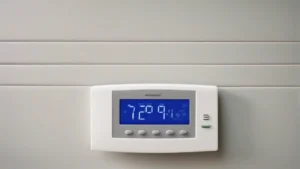
For most readers, the best energy efficient oil filled radiators pick is a 1,500 W model with a thermostat and tip-over protection, because it holds steady heat without fan noise and keeps the bill predictable. A 1,500 W heater running 8 hours uses 12 kWh, so at 17 cents per kWh that is about $2.04 a night.
The essentials
1,500 W is the practical ceiling for plug-in heaters on a normal 15 A, 120 V circuit.
Oil-filled radiators are quiet and steady, but they heat the room more slowly than ceramic tower heaters.
Choose a thermostat and at least overheat protection; tip-over protection matters for portable units.
For garages and workshops, hard-wired 240 V heaters make more sense than plug-in room heaters.
Running cost is mostly wattage times hours, so the thermostat and duty cycle matter more than the brand name.
Oil-filled radiators suit bedrooms, offices and other rooms where quiet heat matters more than fast blast heat. They warm the metal fins and the oil inside, then keep giving off heat after the thermostat clicks off, so the room feels steadier than it does with a fan heater.
If you are comparing heaters fast, start with wattage, controls and safety listing. Those three numbers tell you far more than marketing about how efficient, reliable and annoying the heater will be on a cold night.
Best Picks for Reliable, Efficient Heat
#1Best Overall
DUMOS Oil-Filled Radiator, 1500W
Best for Bedrooms, offices and medium rooms up to 10–15㎡
Product 4 is the straightforward pick for most readers: it combines a fanless design with 600W, 900W and 1500W settings, so you can reduce output after the room warms. Its adjustable thermostat, tip-over switch and overheat protection cover the controls and safety basics an oil radiator should have.
Heat settings 600W, 900W and 1500WRoom size 10–15㎡Controls Adjustable thermostat from -5 to 60°CSafety Overheat protection and tip-over safety switch
Why it made the cut
Fanless and quiet
Three heat settings
Tip-over and overheat protection
Good to know
Limited to spaces up to 10–15㎡
Requires a grounded wall outlet
Skip it if Skip it if you need to heat a large, poorly insulated garage or open-plan space.
Best for Readers who want quiet all-around warmth and simple knob controls
Product 5 suits a bedroom or living room where steady, silent heat matters. Its seven fins, three heat modes and high-conductivity thermal oil are designed for more even warmth, while the adjustable thermostat and caster wheels keep daily use simple.
Heat settings 600W, 900W and 1500WHeating design 7 advanced fins and high-conductivity thermal oilSafety Tip-over and overheating protectionControls Adjustable thermostat and simple knob controls
Why it made the cut
Quiet operation after reaching heat stability
600W, 900W and 1500W modes
ETL safety standards for plug and cord
Good to know
No room coverage figure is provided
Uses simple knob controls rather than a timer or remote
Skip it if Skip it if you need a stated room-size match or programmable controls.
Best for 106–167 sq ft rooms where fast heat and oscillation matter
Product 3 is a ceramic tower rather than an oil radiator, but it fits smaller rooms with a stated 106–167 sq ft coverage range. The ECO mode, thermostat, oscillation and 8-hour timer help it manage comfort without running at high output constantly.
Heat output 1500WVoltage 110 VoltsCoverage 106–167 sq.ftControls Three heat options, ECO mode, thermostat and 8-hour timer
Why it made the cut
Stated 106–167 sq ft coverage
ECO mode and thermostat
Tip-over and overheat protection
Good to know
Fan noise is rated at 50dB
Ceramic heat does not provide oil-radiator heat retention
Skip it if Skip it if fanless operation is your main reason for choosing an oil radiator.
Best for Large rooms where app control and wall mounting matter
Product 1 is a mica infrared panel, not an oil-filled radiator, but it offers useful control flexibility for a larger room. Its adjustable thermostat, exposed temperature sensor, WiFi app, Alexa compatibility and 180° coverage suit readers who want scheduled operation and flexible placement.
Heating type Mica infraredCoverage 180° panoramic heatingHeat-up time 10 secondsControls Adjustable thermostat, digital panel, remote and WiFi app
Why it made the cut
WiFi app and Alexa compatibility
Portable or wall-mounted
10-second heat-up and 180° coverage
Good to know
Not an oil-filled radiator
The data does not state wattage or room coverage
Skip it if Skip it if you need to compare running cost from a stated wattage.
Best for Garages and workshops with a hard-wired 240-volt supply
Product 2 is built for a garage or workshop, where a ceiling-mounted fan-forced heater can free the floor and direct air with adjustable louvers. Its digital thermostat, remote, 12-hour timer and overheat shutoff make sense for a large work area, but the installation is a serious commitment.
Heat output 7500 WattVoltage 240 VoltMounting Ceiling mountControls Digital thermostat, remote and 12-hour timer
Why it made the cut
7500W output for garage and workshop use
Ceiling mount frees floor space
Adjustable louvers and variable mounting angle
Good to know
Requires hard-wired installation
Uses 240 volts
Fan-forced operation is not silent
Skip it if Skip it for a bedroom, apartment or any room without a suitable hard-wired 240-volt circuit.
Energy efficient oil filled radiators suit steady room heating because their thermostat controls runtime and the oil-filled core keeps releasing heat after the element cycles off. Energy efficient oil radiators don’t create more heat from each watt than other electric resistance heaters, but they can feel steadier and quieter, with fewer sharp temperature swings. That answers how efficient are oil filled radiators: electrically, nearly all the input becomes heat; practical efficiency depends on how long the heater must run.
Are oil filled space heaters more efficient? Usually, no—not by watt for watt. A ceramic heater and an oil radiator rated at 1,500 W use roughly the same electricity while heating, while the radiator’s thermal mass smooths the room temperature after the thermostat opens the circuit. That can improve comfort and runtime in a reasonably insulated room. How efficient are oil filled radiator heaters? Pick the thermostat and controls first, then match the output to the room.
1,500 W
The usual plug-in ceiling
At 120 V, a 1,500 W heater draws about 12.5 A. On a 15 A circuit, that leaves little capacity for other loads, so a heater should plug directly into a suitable wall outlet rather than sharing a busy circuit.
Number
What it tells you
1,500 W
Maximum output for most ordinary plug-in space heaters
12.5 A
Approximate draw at 1,500 W and 120 V
12 kWh
Energy used by 1,500 W running for 8 hours
A 1,500 W heater running 8 hours uses 1.5 × 8 = 12 kWh. At 17 cents per kWh, that is about $2.04 for the night.
Myth
A higher wattage always means a more efficient heater.
Fact
Wattage mainly sets heat output, not the percentage of electricity turned into heat. A thermostat, insulation, room size and your chosen temperature determine how long the element runs. A larger heater can reach temperature sooner, then cycle off; it doesn’t make each kilowatt-hour cheaper.
For this use, the Dumos Oil Filled Radiator Heater with Adjustable Thermostat and the Pelonis Oil Filled Radiator Heater for Large Space fit best because they use the radiator format and give you thermostat-based control. The PELONIS 23” Oscillating Ceramic Tower Space Heater with Remote is the budget alternative when faster warm-up matters more than stored, lingering heat. Choose that style for quick spot heating; choose an oil radiator for a room you want held at a steadier temperature.
In short
Start with a 1,500 W oil-filled radiator with a thermostat for quiet, even heat. Higher wattage isn’t an efficiency shortcut; correct sizing and shorter runtime are.
Match Wattage To The Room
For most bedrooms and offices, a 1,500 W oil-filled radiator is the most efficient electric heater in practical use because it supplies enough heat for a typical room without running a smaller heater flat-out. The cheapest most efficient electric heater is the correctly sized one with a thermostat; resistive heaters turn nearly all of their electricity into heat, so wattage and runtime decide the bill. Safe efficient electric space heaters should have tip-over and overheat protection, a recognized safety listing, and a direct wall connection.
A ceramic heater is energy efficient at converting electricity to heat, but it isn’t automatically cheaper than an oil radiator. Ceramic towers warm room air quickly with a fan, while oil-filled radiators trade that quick start for quieter heat and a warm core that keeps releasing heat after the element cycles off. The PELONIS 23” Oscillating Ceramic Tower Space Heater with Remote is the quickest small-room plug-in option; choose an oil-filled model when quiet, steady heat matters more.
12 × 14-Foot Bedroom
A 12 by 14 ft bedroom is 168 sq ft, a sensible use for a 1,500 W plug-in radiator such as the Dumos Oil Filled Radiator Heater with Adjustable Thermostat or the Pelonis Oil Filled Radiator Heater for Large Space. Put the heater where air can circulate, set the thermostat, and let it cycle instead of choosing a smaller unit that runs continuously. The room’s insulation, ceiling height, windows and outdoor temperature can still change the result; wattage is a starting point, not a promise of a particular temperature.
Room12 × 14 ft
Floor area168 sq ft
Starting point1,500 W plug-in radiator
A larger open room, drafty garage or workshop can outgrow a 120 V plug-in heater. A 1,500 W unit draws about 12.5 A at 120 V, leaving little spare capacity on a standard 15 A circuit. For garage and workshop heat, the Comfort Zone Hard-Wired Ceiling Mount Garage Space Heater is the better installation type because it uses dedicated 240 V hard-wired heat; model 2 is for garages and workshops only, and its installation belongs with a qualified electrician.
Before You Place The Heater
Confirm the heater’s wattage matches the room and the circuit can carry it.
Plug a portable model straight into a wall outlet, never an extension cord or power strip.
Keep at least 3 ft of clearance from bedding, curtains, furniture and clothing.
Place the heater on a stable, level surface where it can’t be tipped or blocked.
Keep the plug and cord away from wet areas, traffic paths and anything that can cover them.
Small Heater, Small Job
The most efficient mini heater makes sense for a desk area, bathroom used as directed by its manual, or very small room. It won’t heat an open floor plan efficiently just because its label uses the word efficient; a thermostat can limit runtime, but it can’t create missing wattage.
For fast small-room heat
PELONIS 23” Oscillating Ceramic Tower Space Heater with Remote & Ther…
Pick the PELONIS 23” Oscillating Ceramic Tower Space Heater with Remote when you need quick air movement and plug-in convenience in a small room; choose an oil-filled radiator instead if fan noise bothers you.
The most cost-efficient home heating depends on local electricity and fuel rates, your home’s heat loss, and how many rooms you heat. For many homes, a heat pump is among the most cost-efficient heating systems because it can deliver more heat than the electricity it uses; energy-efficient home heating also means heating only the spaces you need. The most efficient way to heat a home isn’t the same everywhere, so compare operating costs rather than relying on a heater’s efficiency label alone.
Oil-filled radiators turn nearly all the electricity they use into heat at the unit, but they don’t make more heat per kilowatt-hour than other resistance heaters. How efficient are oil-filled radiators in use? Their thermostat can reduce the time the element runs, while the warm oil keeps releasing heat between cycles. That steady output can suit a room you occupy for hours, but it won’t lower the cost of each kilowatt-hour.
Estimate the maximum running cost with watts ÷ 1,000 × hours × your electricity rate. For a monthly estimate, multiply by the number of days you use the heater. A 600 W setting draws 0.6 kWh for each hour the element runs, which can trim consumption when a room needs only gentle heat.
Heater
Watts
Per hour
Per day (8 h)
Per month (30 days)
1,500 W oil-filled radiator
1,500 W
26¢
$2.04
$61.20
Calculated at 17¢ per kWh. Assumes the element runs continuously for 8 hours a day and electricity costs $0.17 per kWh. A thermostat may lower actual use by cycling the element off.
0.6 kWh
Energy used per hour at 600 W
That’s the draw while the element is on; actual hourly use can be lower if the thermostat cycles it off.
ECO modes and thermostats save energy by reducing average runtime, not by changing the heater’s basic conversion of electricity to heat. A lower setpoint or a room with less heat loss can mean fewer minutes with the element on.
Treat savings claims as conditional
A claim such as “up to 37% savings” depends on the room’s heat loss, the setpoint, and how often the heater cycles. It isn’t a universal reduction in electricity use. Compare products using the same room, schedule, and temperature target.
If you’re comparing room heaters with a whole-home upgrade, a heat pump may be worth checking against your local electricity rate and installation costs; see this top choice heat pump buying guide.
Use The Right Safety Features
For safe use of electric space heaters, always plug them directly into a wall outlet, keep at least 3 feet of clearance around the unit, and pick models with built-in overheat protection and a tip-over switch. A typical 1,500 W heater pulls about 12.5 amps at 120 V, which can cause overheating if run through an extension cord or power strip not rated for that load.
Energy efficient heating starts with matching the heater to the room and letting its thermostat cycle; no plug-in resistance heater can make more heat from each watt than the electricity supplies. High efficiency heating systems such as heat pumps can use less electricity for the same heat in suitable homes, while an oil-filled radiator is a sensible efficient choice for one room because it avoids fan power and releases stored heat after the element switches off. The most efficient home heating system depends on the building, climate and fuel rates.
Check Before Buying
UL, ETL or CSA safety listing on the heater or its label
Overheat protection and a tip-over switch on a portable model
A clear 3-foot zone from curtains, bedding, furniture and paper
A wall outlet within reach; no extension cord, power strip or plug adapter
Fanless oil-filled radiators are quieter because there is no blower motor, and they stir up less dust than fan heaters. Their metal fins still need open space: room air must move around the radiator for natural convection, and blocked fins can raise surface temperatures. Keep the heater on a stable, level floor, with the cord routed where nobody can trip over it.
The product details give useful checks: the Dumos Oil Filled Radiator Heater with Adjustable Thermostat lists overheat and tip-over protection, and the PELONIS 23” Oscillating Ceramic Tower Space Heater with Remote lists both protections too. The Pelonis Oil Filled Radiator Heater for Large Space lists ETL safety on its cord and plug. Those features reduce common risks, but they don’t make a heater safe beside a bed or under a desk.
Hard-Wired Means Professional Work
The Comfort Zone Hard-Wired Ceiling Mount Garage Space Heater requires proper 240 V installation, so have a licensed electrician install it and verify the circuit. Don’t connect a ceiling heater to a household plug or improvise its wiring; the voltage and mounting method are part of the heater’s safety listing.
In short
Buy the listed heater with the protective switches, plug it straight into the wall, and preserve 3 feet of clearance. Fanless heating is quieter and less dusty, but it still needs room for air to circulate.
Buy For The Room You Heat Most
For the most reliable and efficient choice in most rooms, pick the Pelonis Oil Filled Radiator Heater for Large Space, then match its wattage and controls to the room you actually use. A most reliable tankless water heater, high efficiency HVAC systems, and energy efficient HVAC and heat pumps are separate whole-home or water-heating decisions; a plug-in radiator won’t replace them.
Smart control earns its keep when you want schedules or remote adjustments. A plain thermostat knob is fine if you want steady heat without another app to manage.
Most rooms: Pelonis Oil Filled Radiator Heater for Large Space for steady radiator heat.
Quiet smart control: Ballu Mica Infrared Space Heater Indoor Use, Large Room Pane… when low noise and scheduled control matter.
Budget bedrooms: PELONIS 23” Oscillating Ceramic Tower Space Heater with Remote for basic room heating.
Simple oil-radiator value: Dumos Oil Filled Radiator Heater with Adjustable Thermostat… when you prefer straightforward controls.
Garages and workshops: Comfort Zone Hard-Wired Ceiling Mount Garage Space Heater… where a fixed installation suits the space.
Choose by room
Model 5 suits most living rooms and bedrooms.
Model 1 suits quiet, scheduled heating.
Model 3 suits a budget bedroom.
Model 4 suits simple radiator heating.
Model 2 suits garages and workshops.
Skip it when
Skip model 2 for living spaces; it’s a garage heater.
Skip model 3 if silence matters; its tower design uses a fan.
Skip model 4 for a drafty workshop or large open area.
None of these plug-in heaters should be treated as whole-home heating. Use the room’s existing heat system for that job, and keep any portable heater directly in a wall outlet with the clearance and safety features covered earlier.
In short
Choose model 5 for the broadest fit, then move to model 1 for quiet scheduled control or model 3 for a budget bedroom. Model 2 belongs in a garage or workshop, not beside the sofa.
Before You Order
Measure the room and note drafts, open doorways, and ceiling height.
Check the outlet for a plug-in model, or confirm the wiring and installation plan for the hard-wired garage heater.
Pick the wattage that fits the room instead of expecting one heater to warm the whole home.
Compare the thermostat, tip-over switch, overheat protection, and listing before comparing price.
More Questions, Answered
How efficient are oil-filled radiators?
Oil-filled radiators convert nearly all the electricity they draw into heat at the point of use. The oil stores heat and releases it after the element cycles off, but it doesn’t reduce the heater’s wattage or magically lower the bill. A thermostat saves energy by limiting runtime when the room reaches its set temperature.
Are oil-filled space heaters more efficient than ceramic heaters?
At the same wattage, oil-filled and ceramic heaters cost about the same to run because both use electric resistance heating. Oil-filled models heat more gradually and quietly, while ceramic heaters usually respond faster and may move heat with a fan. Pick the radiator for steady, low-noise heat; pick ceramic for quicker spot heating.
What size heater do I need for a 12 by 14 room?
A 12-by-14 room is 168 square feet, and a 1,500 W oil-filled radiator is a practical starting point for a reasonably insulated bedroom or office. Drafty rooms, high ceilings, cold climates, and poor insulation can require more heat or longer runtime. A thermostat helps prevent overheating once the room reaches the target temperature.
Can I plug a 1,500 W heater into a power strip?
No. Always plug a 1,500 W heater directly into a dedicated wall outlet because it draws about 12.5 amps on a 120 V circuit. Avoid extension cords or power strips, which can overheat under that load. Also, don’t run other high-wattage devices on the same circuit while the heater is operating.
Which heater is best for a garage or workshop?
For an enclosed, insulated garage or workshop, use an electric heater the manufacturer allows in that setting, plugged directly into a wall outlet. A household oil-filled radiator can work for quiet background heat, but skip it if the manual excludes garages, dust, damp locations, or unattended operation. Never use an outdoor, patio, torpedo, or construction heater indoors.