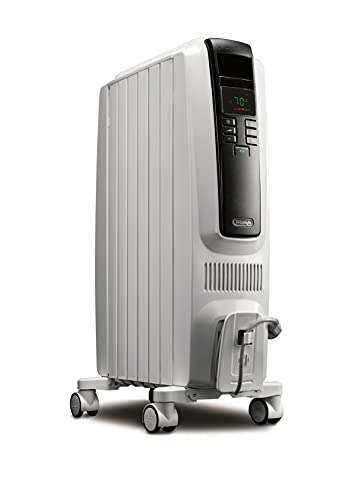
For most homes, the DREO oil-filled radiator is the best pick because it gives you 1500W heat, three output levels, and an ECO mode in a quiet package that suits bedrooms and living rooms. If you want steady supplemental heat without fan noise, that’s the one to start with.
Oil heaters are a good fit when you want room-by-room heat and you don’t want to hear the heater arguing with itself all night. They’re slow, quiet, and usually sensible for bedrooms, offices, and smaller living spaces.
Get the size wrong and you’ll pay for it twice: once on the electric bill, then again when the room still feels chilly. Pick the wrong type and you can also pick the wrong safety risk, which is a poor trade in February.
Top Oil Heaters for Home Use
#1Best Overall
DREO Oil-Filled Radiator
Best for Bedrooms and living rooms needing quiet, adjustable supplemental heat
Product 1 is the easiest starting point for most homes because it combines 1500W heating with 600W and 900W settings, plus ECO mode for steadier temperature control. The remote, touchscreen, 24-hour timer, tilt protection, triple overheat protection, and ETL listing suit bedrooms, offices, and living rooms.
Heat output 600W/900W/1500WControls Large LED display, touchscreen, remote control, ECO modeSafety Triple overheat protection, tilt protection, ETL listedTimer 24-hour timerPortability Large wheels and handles
Why it made the cut
600W, 900W, and 1500W output modes
ECO mode with precise temperature sensor
Remote, touchscreen, child lock, and 24-hour timer
Tilt protection and triple overheat protection
Good to know
The controls and features may be more than you need for a simple room heater
Skip it if Skip product 1 if you want a basic thermostat knob instead of digital controls and ECO settings.
Best for Rooms where digital controls, ECO Plus, and a timer matter
Product 5 suits you if precise electronic control is more useful than a simple dial. Its digital control panel, LED display, 24-hour timer, and ECO Plus feature regulate power flow and temperature, while the no-fan design provides gentle heat without stirring dust, pollen, or dander.
Heat output 1500WControls Digital control panel, LED display, 24-hour timerEnergy feature ECO PlusHeating design 75% more radiant surface area than RadiaSPortability Integrated handle
Why it made the cut
Digital control panel with LED display
24-hour timer and ECO Plus feature
No fan to stir dust, pollen, and dander
Integrated handle for relocation
Good to know
The product data doesn’t give a specific room-size rating
Skip it if Skip product 5 if you need a stated square-foot coverage figure to match the heater to a room.
Best for Quiet bedrooms, studies, and offices up to 161 sq. ft.
Product 3 offers two heat settings, 600W and 1500W, with a thermostat knob and fan-free design. Its steady, quiet warmth suits bedrooms, home offices, or living rooms where silent operation is preferred.
Heat output 600W/1500WRoom coverage Room coverage not specified by manufacturerControls Thermostat knobSafety Overheat protection and tip-over shutoffPortability 4 reinforced omni-directional casters and front carry handle
Why it made the cut
Two heat settings for adjustable warmth.
600W and 1500W heating modes.
Thermostat knob and automatic power adjustment
Tip-over shutoff and overheat protection
Good to know
The controls are less feature-rich than a model with a remote or digital display
Skip it if Skip product 3 if you specifically want a remote control, digital display, or timer.
Best for Bedrooms, offices, and living rooms up to 144 sq. ft.
Product 4 features two power levels, 600W and 1500W, with seven oil-filled fins for lasting heat. It includes tip-over and overheat protection, making it a safe option for indoor use without fan noise.
Heat output 600W/1500WRoom coverage Room coverage not specified by manufacturerControls 3 heat settingsSafety Tip-over protection, overheat protection, ETL certifiedDesign 7 oil-filled steel fins
Why it made the cut
Adjustable heating with two power levels.
600W and 1500W settings.
Seven oil-filled fins provide lingering heat
ETL-certified safety with tip-over and overheat protection
Good to know
No thermostat, timer, or remote control is listed in the product data
Skip it if Skip product 4 if you want a thermostat, ECO mode, or digital controls.
Best for Quiet rooms from 10 to 15 m2 needing basic adjustable heat
Product 2 is a straightforward choice for a bedroom, nursery, home office, or library where fan noise would be annoying. Three output modes cover milder and colder days, and the four casters, carry handle, tip-over switch, and overheat protection keep the design practical.
For most rooms, the DREO oil-filled radiator is the best pick here: it delivers up to 1,500 W, has three heat levels and ECO mode, and runs without fan noise. It’s an electric supplemental heater, not one of the gas heaters for homes that can heat a larger area or connect to a gas supply.
Start by matching the heater to the job. An oil-filled radiator warms one occupied room; a gas furnace serves the home through ductwork, while a gas wall heater is a fixed room heater. Those products aren’t interchangeable, and a gas model’s venting, fuel type and installation requirements matter as much as its BTU rating.
What to compare
What it tells you
What to check
Heat output
A plug-in oil radiator tops out at 1,500 W on a standard 120 V outlet.
DREO offers three output levels; lower settings can suit milder conditions.
Temperature control
A thermostat cycles the element to maintain a set temperature; ECO mode can limit unnecessary full-power operation.
DREO includes ECO mode. De’Longhi’s listed model name identifies digital controls.
Room coverage
A coverage claim depends on insulation, ceiling height and outdoor temperature, so figures from different brands may not compare directly.
Treat stated square-foot ranges as estimates, not guarantees.
Fuel and venting
Oil-filled radiators use electricity. Gas heaters may use natural gas or propane and may be vented or vent-free.
Confirm the model matches your fuel supply and local rules; indoor fuel-burning heaters need the ventilation specified by the manufacturer and a working CO alarm.
Safety and placement
Shutoffs help address tipping and overheating; clearance keeps nearby materials away from hot surfaces.
Check the manual for tip-over and overheat protection, a UL, ETL or CSA listing, and required clearance.
Portability
Casters and a carry handle make it easier to move one heater between rooms.
Compare the listed dimensions and included wheels or handles.
Compare heaters by heating job and installation, not by headline output alone.
Myth
Oil-filled radiators keep heating for free after they switch off.
Fact
The oil and metal fins store heat and release it after the element cycles off, which smooths the room’s temperature. The heater still uses electricity to warm that oil; lower energy use depends on its wattage and how long it runs.
Choose Controls You’ll Actually Use
Digital controls make a set temperature easier to select; a dial is simpler but less precise. For a quiet bedroom or living room, the DREO’s fanless design and ECO mode are the clearest fit in this lineup.
Don’t Substitute an Oil Radiator for Gas Heat
An electric oil-filled radiator won’t run on natural gas or propane, and it won’t replace a gas furnace’s whole-home heating. If you’re comparing gas heaters, check the fuel connection, venting method and whether the model is listed for indoor use before choosing.
Choose an oil heater for one room, not the whole house: a 1,500W model is a sensible supplemental-heat size for many average bedrooms, offices and living areas, while drafts, ceiling height and insulation can move you up or down a notch.
Worked Example
Say your bedroom is 12 by 12 feet. That is 144 square feet, which is right in the range a 1,500W oil heater can handle as supplemental heat. If the room has leaky windows and an uninsulated exterior wall, use the thermostat and ECO mode to maintain the room instead of assuming a larger-looking radiator will fix the heat loss.
Room12 × 12 ft
Floor area144 sq ft
Starting point1,500W oil heater
1,500W and 12.5A
Typical plug-in heater load
At 120V, a 1,500W heater draws about 12.5 amps, so it uses most of a standard 15A circuit by itself.
For an older bedroom or den, a thermostat matters more than a bigger sticker on the box because it cycles the element as the room reaches its set temperature. ECO mode can also keep the heater from running at full output when the room needs less heat.
Give The Circuit Room
Plug the heater straight into a wall outlet, never an extension cord or power strip. Don’t run other heavy loads on that circuit, and don’t expect one portable unit to heat a drafty house; that is a heat-loss problem, not a missing dial setting.
The most efficient home heating method is usually a properly sized heat pump, while the most cost efficient home heating depends on local electricity and fuel rates, insulation and the equipment already installed. An oil heater converts electricity to room heat efficiently at the point of use, but that doesn’t make it the cheapest way to heat every home. If oil heat is too expensive for your home, use the radiator for one occupied room and address drafts or compare whole-home equipment before buying a larger portable heater.
What It Costs To Run
For one room, the cheapest way to heat your home is usually to heat only the room you’re using; the most cost-effective home heating depends on your electricity rate, insulation and how many hours you run the heater. An oil-filled radiator is often cheaper to buy than a major heating-system upgrade, but oil heat is too expensive for my home if you expect one portable unit to heat the whole house.
Oil-filled heaters don’t burn oil or any other fuel, so the cost question is really electric use multiplied by runtime. The formula is watts divided by 1,000, times hours, times your price per kilowatt-hour. A 1,500W heater running for 8 hours uses 1.5 × 8, or 12 kWh; multiply that by your electric rate to get the daily cost.
Heater
Watts
Per hour
Per day (8 h)
Per month (30 days)
1,500 W oil-filled heater
1,500 W
26¢
$2.04
$61.20
Calculated at 17¢ per kWh. Assumes 8 hours each day, 30 days, and an electricity rate of $0.17 per kWh. The thermostat may cycle the heater off, so this is a full-power estimate rather than a promise of actual use.
Lower settings cut the arithmetic directly. At 600W, the heater uses 0.6 kWh per hour; at 900W, it uses 0.9 kWh per hour. Those settings cost less when the room needs a small bump of heat, although a cold, drafty room may keep the heater running longer to reach its target.
The useful comparison
The cheapest most efficient home heating choice is the system that delivers enough heat to the space you occupy without running unnecessary rooms. Use an oil-filled radiator for supplemental room heat, not as a bargain replacement for whole-house heating.
Safety And Certification To Check
The safest electric space heater for home use is a listed oil-filled model with tip-over and overheat protection, plugged directly into a wall outlet with at least 3 feet of clearance. Skip extension cords and power strips; a 1,500W heater can draw about 12.5 amps from a standard 120V outlet.
Look for a UL, ETL or CSA listing on the heater or its packaging, along with both safety shutoffs. ETL is the listing label that appears in the product data for the oil heaters covered here. A thermostat controls room temperature, but it doesn’t replace the tip-over switch or overheat protection.
Don’t leave it unattended
Don’t leave a portable heater running while you sleep or leave the house unless the manufacturer explicitly says that model is designed for those conditions. Keep curtains, bedding, furniture and clothing at least 3 feet away, and never cover the heater or its controls.
The radiator still gets hot
Oil-filled heaters are gentler than fan heaters because they radiate steady warmth without blowing air, but the metal surface still gets hot. Keep children, pets and fabrics away from the top, sides and grille area.
A gas heater changes the safety conversation entirely: carbon monoxide becomes the main risk. Indoor-rated gas equipment needs the venting or ventilation required by its manual, a working carbon monoxide alarm and compliance with local code; outdoor patio, construction and torpedo heaters don’t belong inside a home.
Before the first run
Wall outlet used directly, with no extension cord or power strip
At least 3 feet between the heater and combustible items
UL, ETL or CSA listing visible
Tip-over and overheat protection listed
Working smoke and carbon monoxide alarms nearby
What To Buy Next
For gas heaters for homes, choose a gas furnace for whole-house heating and a room heater for one cold room; the DREO oil-filled radiator in this guide is electric, not gas. If you need supplemental heat without fan noise, compare its controls and room fit with the other oil-filled options in our guide to the best oil filled radiator heaters.
1
Decide whether you need a room heater or a furnace
A wall heater or portable space heater warms a specific area; a gas furnace distributes heat through the home’s ductwork. Don’t treat a room heater’s coverage claim as a substitute for a furnace-sized system.
2
Match the fuel and venting to your home
Check whether the model uses natural gas, propane, or both, and confirm that fuel matches your home’s supply. A direct-vent heater sends exhaust through a wall vent; a vent-free model has different installation and local-code limits. Check the manual and local code before choosing either.
3
Compare output and coverage carefully
Use the listed BTU output and coverage as a starting point, not a guarantee: insulation, ceiling height, drafts, and an open floor plan change how much heat a space needs. For example, the listed Comfort Glow DVN08 is an 8,000-BTU direct-vent natural-gas heater rated for up to 250 square feet, while the ProCom MN100TBA-B is a 10,000-BTU vent-free natural-gas blue-flame model rated for up to 500 square feet. Those coverage figures come from different products and aren’t a controlled, apples-to-apples test.
4
Check installation and outage needs
Confirm the required wall opening or vent kit, mounting method, gas connection, and clearances in the manufacturer’s instructions. Some heaters operate without electricity, but don’t assume every model will run in an outage; verify the exact model’s power requirements and safety instructions.
Choose by heating job
Quiet supplemental heat for one room: the DREO oil-filled radiator is electric and runs without fan noise; it isn’t a gas heater.
Natural-gas heat for a smaller room: the Comfort Glow DVN08 is listed as an 8,000-BTU direct-vent wall heater with an included vent kit and coverage up to 250 square feet.
Natural-gas heat without electricity: the ProCom MN100TBA-B is listed as a 10,000-BTU vent-free blue-flame heater with thermostat control, an oxygen depletion sensor, and coverage up to 500 square feet.
Whole-house heating: compare a gas furnace by its system capacity and AFUE, not by a room heater’s square-foot claim.
Vent-Free Is Not Vented
A vent-free or ventless gas heater does not send combustion exhaust outdoors through a flue. Check local code before buying; vent-free gas heaters are banned or restricted in some states and cities. Use only indoor-rated models as directed, keep a working carbon monoxide alarm, and follow the manufacturer’s ventilation requirements.
More Questions, Answered
How many square feet will a 1,500W oil heater warm?
A 1,500W oil heater will usually warm about 150 square feet in an average, reasonably insulated room. Drafts, high ceilings, poor insulation and open doorways reduce that coverage, so treat the number as a room-sizing guide rather than a guarantee for the whole home.
Can I use an oil heater with an extension cord?
No. Plug the heater directly into a wall outlet because a 1,500W unit draws about 12.5 amps, which can overheat an extension cord or power strip. Keep the plug, outlet and cord free of rugs, furniture and other heat sources.
Are oil-filled heaters cheaper to run than fan heaters?
A fan heater and an oil-filled heater cost the same to run at the same wattage and electricity rate. An oil-filled model may cycle less often or keep giving off heat after its element shuts off, while a fan heater heats the room faster; the thermostat and insulation usually matter more than the heater type.
Which oil heater is best for a bedroom?
The DREO oil-filled radiator is the strongest bedroom pick here because its quiet operation, three output levels and ECO mode make overnight temperature control easier. Use the manufacturer’s sleep guidance, keep at least 3 feet of clearance, and don’t leave any heater running unattended unless the model is specifically designed for that use.
What safety certifications should I look for on a portable heater?
Look for a recognized UL, ETL or CSA listing on the heater or its label, along with tip-over and overheat protection. A certification mark supports the electrical safety evaluation, but you still need a direct wall connection, clear space around the heater and a working plug and cord.