Reliable Best Space Heater with Auto Shut Off Review
Joye
Updated October 5, 2026 15 min read
At a glance
The best space heater with auto shut off for most readers is Product 2 because it combines a 1,500 W PTC heater, a precise thermostat, and tilt-detection tip-over protection. One 1,500 W heater draws about 12.5 amps, so it belongs on a normal 15 A wall circuit, not a power strip.
Key takeaways
Pick a 1,500 W heater only if the room, outlet, and breaker can handle about 12.5 amps on a 15 A circuit.
Choose tip-over protection and overheat shutoff first; oscillation, remote controls, and timers are useful after that.
A thermostat that can hold a set temperature is better than one that simply cycles on high.
Quiet models help in bedrooms, but fanless or low-noise designs usually trade some throw for less sound.
Fuel-burning heaters are a different category; indoors, carbon monoxide protection and the manual matter more than the badge on the box.
Auto shut off matters because a heater should stop when the room is warm enough, tips over, or gets too hot. That keeps the heater from cooking the same corner all night like a stubborn toaster.
The other number that matters is 3 feet. Keep that much clear space around any plug-in space heater, and plug it straight into a wall outlet. The extension cord aisle can sit this one out.
Auto Shut-Off Heater Comparison
Model
Best for
Heat output
Auto shut off
Controls
Best for
Price
DREO 1500W PTC Heater
Best Overall
1,500 W Hyperamics PTC
Tilt-detection sensor and overheat protection
41–95°F thermostat in 1°F increments; remote; Power heat, ECO and Fan Only
Bedrooms, offices and small rooms needing precise control
Best for Bedrooms, offices and small rooms needing precise temperature control
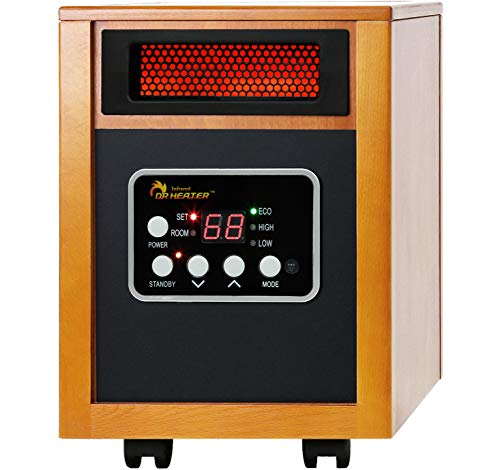
Product 2 is the strongest all-around choice because its 1,500 W Hyperamics PTC system heats quickly while the enhanced NTC chipset lets you set 41–95°F in 1°F increments. Its tilt-detection sensor improves tip-over protection, and the 34 dB brushless motor suits bedrooms and work areas where fan noise gets old quickly.
Heat system 1,500 W Hyperamics PTCThermostat range 41–95°F in 1°F incrementsNoise level 34 dBSafety Tilt-detection sensor and overheat protectionModes Power heat, ECO and Fan Only
Why it made the cut
1,500 W PTC heat with heat funnel design
Thermostat adjusts from 41–95°F in 1°F increments
Tilt-detection sensor, overheat protection and V0 flame-retardant materials
34 dB operation with remote control
Good to know
The product data does not state an ETL, UL or CSA listing
The product data does not state a coverage area
Skip it if Skip it if you specifically want a fanless heater or a stated large-room coverage rating.
Best for Bedrooms and offices where quiet, whole-room convection matters
Product 4 uses mica heating elements and fanless convection, so there is no fan noise while it runs. The 750 W and 1,500 W settings, 50–95°F thermostat, 12-hour timer and tip-over and overheat auto power-off cover the controls many bedroom users actually need.
Heat settings 750 W or 1,500 WThermostat range 50–95°FTimer 12 hoursSafety Tip-over auto and overheat protection with auto power-offDesign Fanless convection with handle and wheels
Why it made the cut
Fanless operation with 750 W and 1,500 W settings
50–95°F intelligent thermostat range
12-hour timer and screen-off setting
Tip-over and overheat auto power-off plus child lock
Good to know
The product data does not state a decibel rating
The handle should not be touched while the heater is heating
Skip it if Skip it if you want fast fan-forced heat or a compact heater without wheels and a tall panel design.
Best for Small bedrooms and offices needing oscillating heat and simple remote control
Product 1 combines PTC ceramic heating with 70° automatic oscillation, spreading warmth across more of a small room instead of aiming at one chair. The remote adjusts temperature, fan speed, heating modes and timer settings, while overheat protection and tip-over shut-off handle the basic safety jobs.
Heating technology PTC ceramicOscillation 70° automatic oscillationControls Remote control for temperature, fan speed, modes and timerSafety Overheat protection and tip-over shut-offCertification ETL-certified
Why it made the cut
PTC ceramic heat-up in seconds
70° automatic oscillation
Remote adjusts temperature, fan speed, modes and timer
ETL-certified with overheat and tip-over protection
Good to know
The product data does not state the wattage
The remote requires 2 AAA batteries
Skip it if Skip it if you want a stated 1,500 W output or thermostat adjustments in 1°F increments.
Best for Large rooms where infrared and PTC heat, wheels and a long timer help
Product 3 pairs an infrared quartz tube with PTC heating and is rated around 5,200 BTU, making it the room-heating specialist in this group. Caster wheels, a 50–85°F electronic thermostat, a 12-hour automatic shut-off timer and a 39 dB blower give it useful reach and control for larger spaces.
Power 1,500 WHeating system Infrared quartz tube and PTCHeat rating Around 5,200 BTUThermostat range 50–85°FAutomatic shut-off 12-hour timer
Why it made the cut
Dual infrared quartz and PTC heating systems
Rated around 5,200 BTU
12-hour automatic shut-off timer
Caster wheels, electronic thermostat and 39 dB blower
Good to know
It weighs 19 lb
The thermostat range ends at 85°F
The product data does not state a certification
Skip it if Skip it if you want the quietest option or a thermostat that reaches 95°F.
Best for Utility spaces needing two durable metal heaters with basic controls
Product 5 gives you two metal milkhouse heaters, each with 1,500 W high heat, 1,300 W low heat and a natural wind mode. The rotary thermostat is straightforward, and tip-over auto shut-off, overheat protection and a 3-prong plug cover the safety features stated in the product data.
Package 2 metal space heatersHeat settings 1,500 W high and 1,300 W lowCoverage claim Up to 200 sq. ft.Plug 3-prong plugSafety Tip-over auto shut-off and overheat protection
Why it made the cut
Two metal heaters in the package
1,500 W high and 1,300 W low settings
Adjustable rotary thermostat and natural wind mode
Tip-over auto shut-off and overheat protection
Good to know
The product data does not state an automatic timer
The product data does not state a certification
The product data does not state a noise rating
Skip it if Skip it if you need a timer-based shut-off or precise digital thermostat control.
The DREO Space Heater is the best overall choice for most rooms because its 1,500 W PTC heater, precise thermostat, and tilt-detection protection cover the jobs people usually mean by auto shut off. A space heater automatically shuts off only when its specific safety control or timer is triggered.
12.5 A
What a 1,500 W heater draws at 120 V
The calculation is 1,500 W ÷ 120 V = 12.5 A. That leaves little spare capacity on a standard 15 A circuit, especially if other appliances share the breaker.
Auto shut off is a label for several different controls, and they don’t all protect against the same problem. Tip-over shutoff cuts power when the heater falls; the switch that provides it is usually called a tip-over switch or tilt switch. Overheat protection reacts to excessive internal temperature, a timer shuts the heater down after a set period, and thermostat cycling turns the heating element off after the room reaches your setting.
The DREO wins for most readers because it combines the two safety controls you should care about first—tilt detection and overheat protection—with thermostat control, instead of treating a timer as the whole safety plan. A timer is useful if you’ll actually set it; it won’t detect a blocked air intake or a heater knocked onto its side.
Use the wall outlet
Plug a portable electric heater straight into a wall outlet. Skip extension cords and power strips: the heater’s sustained load can overheat a cord, plug, or strip before the circuit breaker notices a problem. Keep the heater on a solid, level surface with the clearance required by its manual.
For a broader comparison of models built around this feature, see auto shut-off space heaters. The useful question is what shuts off, and under what condition—not whether the package simply prints the phrase.
Which Specs Separate The Good Ones
A good heater matches its thermostat, safety pair, sound level, and heat pattern to the room; wattage alone won’t tell you whether it belongs beside your bed or under your desk. That is the difference between a reliable and efficient portable heater reviewed on paper and a heater that merely gets hot.
Spec
What to look for
Best fit
Thermostat
Adjustable temperature with fine control, not only low/high heat
Bedrooms, nurseries, and rooms where steady comfort matters
Safety controls
A tip-over switch plus overheat protection
Every portable heater, especially around pets or foot traffic
Noise
A quiet fan, or fanless operation if the design allows it
Bedrooms, offices, and calls where fan noise becomes irritating
Oscillation
A switchable sweep that spreads heat across the room
Open seating areas; fixed output suits a small desk zone
Timer and remote
A timer length and remote you’ll genuinely use
Hard-to-reach heaters or routines that need scheduled shutoff
Check the manual and product specifications for each control; the words auto shut off don’t identify the control by themselves.
For an office
Office space heaters with auto shut-off should have tip-over and overheat protection first. Choose a quiet fan and fixed direction for one desk, or oscillation when several people need warmth; a remote is optional unless the heater sits out of reach.
Good match
The thermostat can hold a room near a chosen temperature
Both tilt protection and overheat protection are listed
The sound and heat direction suit where you’ll sit
Choose something else if
A fan can be distracting during sleep or calls
Oscillation may waste heat in a small personal area
A timer or remote adds little if you won’t use it
If thermostat control is your deciding feature, compare space heaters with thermostat auto shut-off before choosing a model. Control is useful only when the heater can sit where its sensor reads the room rather than beside a cold doorway or heat source.
How Much Heater You Need And What It Costs
A space heater’s running cost depends on its wattage, hours, and electric rate: a 1,500 W space heater costs about 26 cents per hour at 17 cents per kWh. To estimate how much a space heater costs to run, divide watts by 1,000, multiply by hours, then multiply by your price per kWh.
Use about 10 watts per square foot as a rough starting point for electric heat, so a 1,500 W heater may cover roughly 150 square feet under ordinary conditions. Insulation, drafts, windows, and ceiling height can change that answer; a chilly, open room can outgrow the arithmetic in a hurry.
Worked Example
Say you run a 1,500 W heater for 8 hours and pay 17 cents per kWh. The calculation is 1.5 kW × 8 hours × $0.17 = $2.04 for that day. A 1,000 W heater under the same conditions costs 1.0 × 8 × $0.17 = $1.36 per day.
Runtime8 hours
Electric rate$0.17 per kWh
1,500 W result$2.04 per day
1,000 W result$1.36 per day
Heater
Watts
Per hour
Per day (8 h)
Per month (30 days)
1,500 W space heater
1,500 W
26¢
$2.04
$61.20
1,000 W space heater
1,000 W
17¢
$1.36
$40.80
Calculated at 17¢ per kWh. This assumes 8 hours of operation per day, 30 days, and an electric rate of 17 cents per kWh.
26¢
1500 watt space heater cost per hour
At 17 cents per kWh, 1.5 kW × $0.17 is $0.255, which rounds to about 26 cents per hour when the heater is drawing its full rated power.
Lower wattage makes sense for a small room, a desk, or a long daily runtime, but a 1,000 W heater may run continuously and still fall behind in a drafty space. A 1,500 W heater uses more electricity while heating, yet reaching the set temperature sooner can give the thermostat more chances to cycle off.
Safety And Certification That Matter Indoors
Electric space heaters do not produce carbon monoxide because they burn no fuel; propane, kerosene, diesel, and natural-gas heaters can, so indoor space heater safety starts with choosing the right kind of appliance. For an electric model, look for a UL, ETL, or CSA listing, and keep at least 3 feet between the heater and bedding, curtains, furniture, or other combustibles.
Indoor-rated fuel-burning heaters need the ventilation specified by the manual and a working carbon monoxide alarm. An outdoor, patio, torpedo, or construction heater doesn’t become safe indoors because a door is cracked; diesel heaters must exhaust outside the cabin, and kerosene heaters use only 1-K kerosene, never gasoline.
Myth
A heater with an auto-shutoff label is safe to run anywhere.
Fact
Auto shutoff can respond to a tip-over, overheating, or a timer, but it doesn’t make an outdoor heater suitable for a room or replace clearance, ventilation, or a CO alarm. The listing and the installation instructions still decide where the heater belongs.
Plug It In Correctly
Plug an electric heater directly into a wall outlet, never an extension cord or power strip. A 1,500 W heater draws about 12.5 amps on a 120 V circuit, leaving little spare capacity on a typical 15 A circuit; stop if the plug, receptacle, or cord becomes hot, scorched, loose, or damaged.
Sleeping With A Heater
Don’t sleep with a heater running unless the manufacturer explicitly designed that model for unattended or overnight use. A tip-over switch and overheat protection reduce specific risks, but neither removes the need for clearance or a sound outlet.
Fuel-burning heaters require proper ventilation and a working carbon monoxide alarm to be safe indoors. Electric heaters, meanwhile, need a safety certification and at least 3 feet of clearance around them to prevent fire hazards.
Before You Buy Or Call A Technician
A best space heater with auto shut off review should leave you with five checks, not just a favorite model: outlet, circuit, room size, shutoff type, and safety listing. Run the space heater auto shut off checklist below before you place an order; the right heater is the one your room and wiring can support.
Before You Buy
Confirm the heater plugs directly into a wall outlet. A 1,500 W model draws about 12.5 amps, so check that the circuit isn’t already carrying another heavy appliance.
Match the heater’s stated room coverage to the space you need to heat. A larger room may need a different heat pattern or another approved heating plan, not a heater crammed beside the furniture.
Read the manual for the exact shutoff controls: tip-over detection, overheat protection, thermostat cycling, timer, or more than one. An automatic timer doesn’t replace tip-over protection.
Look for a UL, ETL, or CSA listing on the heater or packaging. Treat vague claims such as “tested for safety” as a reason to keep comparing.
For propane, kerosene, diesel, or natural-gas heaters, confirm the model is indoor-rated, read the required ventilation instructions, and check local code before using it indoors.
Skip installation or stop using the heater if the cord is damaged, the plug gets hot, the breaker trips, or the heater smells electrical. A licensed electrician or technician should find the fault.
Product 2, the DREO Space Heater, fits this checklist well for a typical plug-in purchase because its 1,500 W output, thermostat, and tilt-detection protection are clear buying points. Still, confirm the current manual and listing before installation; product pages change, and the coldest night is a poor time to discover a missing feature.
In short
Buy only after the heater’s outlet, coverage, shutoff functions, and listing check out. Fuel-burning models need the manual and local code checked before they come indoors.
Frequently Asked Questions
Does a space heater automatically shut off when it reaches the set temperature?
Usually, yes: the thermostat stops the heating element when the room reaches your setting, then turns it back on as the temperature drops. The fan may continue briefly to cool the unit, so a running sound doesn’t always mean it’s still heating. A thermostat cycle is different from the timer or overheat shutoff.
What is it called when a space heater shuts off if it falls over?
That feature is called a tip-over switch, tilt sensor, or tip-over protection. It cuts power when the heater moves past its safe operating angle, and many models require you to set the heater upright before they will run again. Keep the heater on a level, hard surface so the sensor isn’t doing all the safety work.
Can space heaters give off carbon monoxide?
Electric space heaters don’t produce carbon monoxide because they have no flame or fuel exhaust. Combustion heaters that burn propane, kerosene, diesel, or natural gas can produce it, so an indoor-rated model, the ventilation required by its manual, and a working CO alarm are essential. Never use an outdoor, patio, torpedo, or construction heater inside.
Is it safe to leave a space heater on overnight?
The safest choice is to turn it off before sleeping unless the manufacturer specifically says the model is designed for unattended or overnight use. Tip-over and overheat protection reduce specific risks, but they don’t make blocked airflow, damaged cords, or nearby bedding safe. Keep three feet of clearance and plug the heater directly into the wall.
What size space heater do I need for a bedroom?
Start with the manufacturer’s room-size guidance, then account for insulation, ceiling height, drafts, and how cold the room gets. A typical plug-in heater tops out at 1,500 W, which draws about 12.5 amps at 120 volts; adding another heater to the same circuit can trip the breaker or overload the wiring. A smaller setting may hold temperature once the room is warm.
Do I need a UL, ETL, or CSA listed heater?
Choose a heater carrying a UL, ETL, or CSA safety listing from a recognized testing organization. Check the mark on the heater or its permanent label, not only a marketplace description, and make sure the cord, plug, controls, and housing show no damage. The listing doesn’t replace three feet of clearance or direct wall-outlet use.
Keep reading
cozy and safeCompare another buying guide focused on automatic shutoff and everyday room heating.
I am a mechanical engineer and love doing research on different home and outdoor heating options. When I am not working, I love spending time with my family and friends. I also enjoy blogging about my findings and helping others to find the best heating options for their needs.