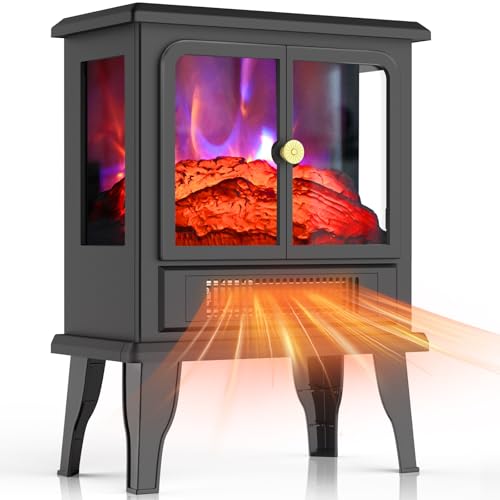
The best mini fireplace space heater for most readers is Product 5 because it pairs 1500W heat, a 750W low setting, a thermostat and tip-over shutoff in a compact stove style that fits bedrooms and offices without much fuss.
The essentials
Pick 1500W if you want the strongest heat a standard plug-in heater can give.
Choose a model with a thermostat if you want the heater to cycle instead of blasting nonstop.
Use flame-only mode if you want the look without added heat.
Keep 3 feet of clearance and plug the heater directly into a wall outlet.
For bedrooms, prioritize tip-over shutoff, overheat protection and a quiet fan.
Mini fireplace space heaters are for people who want a little visual warmth and actual heat in the same footprint. The useful ones use 1500W or less, plug straight into a wall outlet, and have tip-over and overheat protection.
If you only need to take the edge off a small room, a fireplace-style unit can make sense. If you need to warm a big open space, skip the mantel charm and buy output first.
Best Mini Fireplace Space Heaters
#1Best overall
Riseon Mini Electric Fireplace
Best for Bedrooms, offices and small living spaces needing flexible heat
Product 5 combines a 1500W high setting, 750W low setting and thermostat in a portable fireplace-style heater. Its tip-over switch and overheat protection suit everyday indoor use, while the flame can run without heat.
Heat settings 750W and 1500WHeating type PTC ceramicSafety Tip-over switch and overheat protectionControl ThermostatFlame mode Flame without heat
Why it made the cut
1500W and 750W heat settings
Thermostat cycles heat at the preset temperature
Tip-over switch and overheat protection
Good to know
No stated noise rating
The product data doesn’t specify a coverage area
Skip it if Skip it if you need a stated room-size rating or a documented noise level.
Best for Offices and bedrooms up to 200 sq. ft. where remote control matters
Product 1 adds a remote, thermostat and four operating modes to a 1500W ceramic heater. Its stated 35dB operation, 24-hour timer and child lock make it a practical choice for workspaces and bedrooms.
Power 1500WCoverage Up to 200 sq. ft.Noise 35dBTimer 24 hoursModes Low, High, Eco and Fan
Why it made the cut
35dB stated operating noise
Remote, thermostat and 24-hour timer
45° tip-over shutoff and ETL certification
Good to know
Its design is a portable ceramic heater rather than a fireplace stove
The ECO mode’s claimed savings depend on how you run it
Skip it if Skip it if the fireplace look is the main reason you’re shopping.
Best for Sleep and work areas that need a quiet stove design with 750W low heat
Product 3 offers a stove shape, independent flame and heat controls, and two heat levels including 750W for maintaining warmth. Operation below 40dB, a cool-touch housing and automatic shutoff fit rooms where quiet matters.
Heat settings 1500W high and 750W lowNoise Below 40dBControls Independent flame and heat switchesSafety Overheat protection and automatic shutoffSetup Attach four legs with included screws and screwdriver
Why it made the cut
1500W high and 750W low settings
Independent flame and heat switches
Below 40dB operation with cool-touch housing
Good to know
The legs require assembly
The product data doesn’t state a thermostat or coverage area
Skip it if Skip it if automatic temperature cycling is more useful to you than separate flame controls.
Best for Rooms where fireplace ambience matters as much as supplemental heat
Product 2 separates the flame effect from the heater, so you can use its decorative fire without producing heat. It offers 500W and 1500W settings, four flame colors, four wood-log colors and five flame-speed levels in a steel stove body.
Best for Small spots where 650W or 1000W heat is enough
Product 4 offers two heat levels, 650W and 1000W, plus a thermostat to keep your room comfortably warm. Its removable handle, tip-over safety switch, and realistic 3D flame effect make it easy to move and enjoy on a table or the floor.
Heat settings 650W and 1000WHeating type PTC ceramicSafety Tip-over protection and flame-retardant materialsControls Built-in thermostatFlame effect 3D flame and burning charcoal embers
Why it made the cut
650W and 1000W heat levels
Thermostat for steadier temperature
Removable handle and tip-over protection
Good to know
Its highest stated setting is 1000W
The manual warns about a stuck switch and directs you to contact customer service
Skip it if Skip it if you need 1500W for faster heating in a colder room.
Fireplace space heaters are electric resistance heaters in decorative cabinets, so their useful heat comes from the wattage—not the logs, flame animation or faux-wood trim. For fireplace space heaters electric Walmart searches, compare the electrical output and safety listing first; the same rule applies to a Walmart space heater fireplace electric wood heater listing.
Spec
What it does
What to look for
1,500 W
Full heat output; the practical ceiling for a standard plug-in model
Useful when the room needs the most heat the circuit can provide
750 or 1,000 W
Gentler heat with lower electrical demand
Better for a small room, mild weather or maintaining warmth
Thermostat
Cycles heat to hold a selected temperature
More useful than a decorative flame for comfort
Timer or remote
Controls when and how the heater runs
Convenient, but neither adds heating power
Flame-only mode
Runs the visual effect without heat
Useful when you want the fireplace look in milder weather
Controls change convenience or operating mode; wattage determines heat output.
A 1,500 W setting is the ceiling for ordinary plug-in fireplace-style heaters because a standard 120 V, 15 A circuit already carries about 12.5 A at that load. A 750 W or 1,000 W setting gives a smaller room gentler heat and lets the thermostat cycle instead of running full blast every minute.
In short
Choose wattage for heat, then choose the thermostat, timer, remote and flame-only mode for comfort. Flame effects add atmosphere but don’t increase the heater’s heat output.
Myth
A brighter or more realistic flame means a warmer heater.
Fact
The flame is an independent visual effect on these electric models. A heater set to 750 W produces less heat than the same unit set to 1,500 W, regardless of how bright the display looks.
Look for an ETL listing plus tip-over and overheat protection before judging the cabinet. ETL indicates the product was evaluated to applicable safety requirements; the tip-over switch can shut the heater down if it falls, while overheat protection interrupts operation if internal temperatures rise too far.
A useful buying shortcut
If the listing spends more space describing faux logs than thermostat behavior, wattage settings and safety features, keep comparing. Fireplace-style space heaters are easiest to sort when you treat the cabinet as decoration and the heater controls as the working parts.
From HeaterGuides · our own guidePage 6: heat only the rooms you use. Page 10 covers space-heater safety.Winter Heating Bill CutterSee what every heater in your home really costs, heat the rooms you use, and cut the waste in 30 days.Cost-per-hour tables for every heaterThermostat schedule and draft-proofing planRunning-cost and bill calculator (Excel)$14.99$9.99Get it for $9.99See what's inside and watch the 2-minute video →14-page printable PDF + Excel calculator · instant download · 30-day refund
Which Mini Fireplace Heater Fits Your Room
Fireplace style space heaters fit different rooms best according to their controls, noise rating and heat settings, not simply the size of the decorative cabinet. Product 5 is the straightforward match for most small rooms because it offers 750 W and 1,500 W settings, a thermostat and a tip-over switch.
Good for
Product 5 for a small bedroom, office or sitting area that needs adjustable heat
Product 3 for a quieter bedroom or office, with a listed sound level below 40 dB
Product 2 for a decorative stove appearance with 500 W and 1,500 W settings
Product 1 for remote control, a 24-hour timer and Eco mode
Not for
Product 5 isn’t the only sensible choice if quiet operation is your first concern
Product 3 is the better fit for a bedroom or office where fan noise can become irritating because its listed sound level is below 40 dB and its flame and heat controls work independently. Product 2 suits a reader who cares most about a stove-like decorative look and wants clear 500 W and 1,500 W choices.
Product 1 makes sense for a desk or chair across the room from the heater: its remote, 24-hour timer and Eco mode reduce trips to the controls. Those features manage operation; they don’t make its heating element stronger.
Match the heater to the room
Small room needing flexible output: Product 5
Bedroom or office where listed quietness matters: Product 3
Decorative stove look with two heat settings: Product 2
Remote, timer and Eco-mode convenience: Product 1
Larger nook or colder room: check the sizing and power section before choosing a compact model
Fireplace style space heaters are usually 1,500-watt electric heaters, which produces about 5,100 BTU per hour and is the practical output limit for a 120-volt plug-in unit. That makes them a sensible match for a small bedroom, office or den, while an open-plan room usually needs a larger heater or more than one heating zone.
1,500 W ≈ 5,100 BTU/hr
The plug-in ceiling
At 120 volts, a 1,500-watt heater draws about 12.5 amps. That leaves little spare capacity on a standard 15-amp circuit, so avoid running another high-wattage appliance on the same circuit.
Worked example
Say a 1,500-watt fireplace heater runs for 8 hours each day. Convert watts to kilowatts, then multiply by hours and your electricity rate: 1,500 ÷ 1,000 × 8 × $0.17. The cost block uses that same example across a 30-day month.
Heater1,500 W
Run time8 hours per day
Electricity rate$0.17 per kWh
Billing period30 days
Heater
Watts
Per hour
Per day (8 h)
Per month (30 days)
1,500 W fireplace space heater
1,500 W
26¢
$2.04
$61.20
Calculated at 17¢ per kWh. This assumes the heater draws its full rated power for all 8 hours each day at $0.17 per kWh.
A thermostat usually lowers the average cost because the heater cycles off after the room reaches its set temperature. During those off periods, the flame display may continue while the heating element rests, depending on the controls. Drafty rooms, open doors and poor insulation make the heating cycles longer.
Room situation
What 1,500 W can reasonably do
Small bedroom, office or den
Provide practical spot or room heating when the door stays closed
Large bedroom or chilly nook
Help, but expect longer run times in a drafty or poorly insulated space
Open-plan living area
Usually needs a larger heater or separate heating zones
Room shape, insulation and drafts matter as much as floor area.
Product 5’s 750-watt low setting can reduce output when full heat isn’t needed, but the thermostat still decides how often the element runs. A lower setting warms more slowly; it doesn’t make the heater more efficient per watt.
Safety Rules For Fireplace-Style Space Heaters
Fireplace style space heaters are indoor electric heaters, so plug one directly into an accessible wall outlet—not an extension cord, power strip or covered outlet. Keep the outlet visible and unobstructed so you can notice heat, discoloration or a loose connection.
Give It Three Feet
Keep at least 3 feet of clearance around the heater, especially from bedding, curtains, clothing, paper and furniture. Don’t cover the cabinet or place anything on top of it, even when the flame effect is the only feature running.
Don’t sleep with a heater running or leave the house while it’s on unless the manufacturer’s manual specifically allows that use. A thermostat, tip-over switch and overheat cutoff reduce risk; they don’t turn an unattended heater into a harmless appliance.
Your Basic Buying Filter
Look for a UL, ETL or CSA listing, plus both overheat protection and tip-over protection. The listing shows that the appliance was evaluated to a recognized electrical safety standard; the two cutoffs address overheating and an accidental knock-over.
Before You Turn It On
Plug it straight into a wall outlet with no extension cord or power strip.
Clear a 3-foot area around the cabinet.
Move bedding, curtains, clothing and paper away from the heater.
Check that the plug and outlet are clean, firm and not damaged.
Confirm the tip-over and overheat features are listed in the product instructions.
A hot-plastic smell, scorching, buzzing or a plug that feels warm means you should switch the heater off and unplug it. The heater may be overloaded, failing internally or connected to a loose receptacle; don’t keep resetting it and hoping the smell goes away.
Stop Using A Damaged Outlet
If the wall outlet is warm, loose, discolored or smells burned, leave the heater unplugged and have the receptacle checked by a qualified electrician. A 1,500-watt load draws about 12.5 amps, enough to expose a weak connection quickly.
The Quiet Details That Matter At Night
Fireplace style space heaters are easier to live with at night when the listing gives you a noise rating, a timer, remote control and separate flame and heat settings. Those details affect sleep and work more than another decorative log detail.
A heater rated below 40 dB is a good bedroom target because its fan noise should be less intrusive than louder models. Listings don’t always provide a dB figure, so treat a missing noise rating as an unknown rather than assuming the heater is quiet.
A timer can shut the heater down after you fall asleep or at the end of a workday, but it isn’t a substitute for normal shutoff habits. Turn the heater off when you leave the room or house unless the manufacturer specifically allows unattended operation.
Check The Controls
Look for independent flame and heat controls. Flame-only mode lets you keep the fireplace look without adding heat, which is useful on a cool evening or when the room has already reached its set temperature.
A remote control earns its keep when the heater sits across the room or low near the floor. Product 2, the R.W.FLAME Electric Fireplace Heater 17″ with Remote Control…, suits that setup; you can change settings without reaching behind furniture or bending down.
In short
For a bedroom, favor a published noise rating below 40 dB, a timer and separate flame controls. Pick a remote if the heater will sit across the room or near the floor.
Good For
Quiet operation matters more than extra flame effects at bedtime
A timer handles a planned shutdown during sleep or work
Flame-only mode adds appearance without more heat
Check First
A missing dB rating makes noise harder to predict
A timer can encourage careless unattended use
Remote controls add convenience only if the receiver has a clear path
More Questions, Answered
What is a mini fireplace space heater?
A mini fireplace space heater is a compact electric resistance heater in a decorative fireplace-style cabinet. The heating element supplies the warmth; the flame effect is separate and uses little or no heat-producing power.
Are fireplace-style space heaters good for bedrooms?
They can suit a bedroom if the model is rated for indoor use, fits with 3 feet of clearance, and has tip-over and overheat protection. Don’t run one while sleeping unless the manufacturer specifically says the model is designed for that use.
How many watts should a small fireplace heater have?
A 1,500-watt model gives the most heat available from a typical 120-volt outlet, while a 750-watt setting reduces output and power use. Choose the lower setting when it maintains your room temperature; a bigger cabinet won’t make a 1,500-watt heater produce more heat.
Can you run a mini fireplace space heater all night?
Only do so if the manufacturer explicitly allows unattended or overnight operation. A thermostat and timer help control runtime, but they don’t replace a tip-over switch, overheat protection, proper clearance and a direct wall connection.
Do electric fireplace heaters use a lot of electricity?
Their cost depends on wattage and runtime: a 1,500-watt heater running for 8 hours uses 12 kWh. At 17 cents per kWh, that works out to about $2.04, while a 750-watt setting would use half as much during the same period.
Is flame-only mode safe on an electric fireplace heater?
Flame-only mode is generally the lower-power setting because the heating element is off, but the unit still needs its normal clearance and direct wall outlet. Keep the cabinet and outlet uncovered, and don’t treat the flame animation as proof that the heater is safe to leave unattended.
What safety certifications should I look for on a small electric fireplace heater?
Look for a UL, ETL or CSA listing mark on the heater or its labeling, along with tip-over and overheat protection. A certification mark supports electrical safety testing, but it doesn’t make extension cords, power strips or blocked clearances acceptable.
Before you go · a welcome giftGet the Winter Heating Bill Cutter for $4.99See what every heater in your home really costs, heat the rooms you use, and cut the waste in 30 days. Normally $14.99; your welcome price saves $10.00. We'll email your link right now.or buy it now for $9.99 without the gift →One email with your link now. We never share your address.




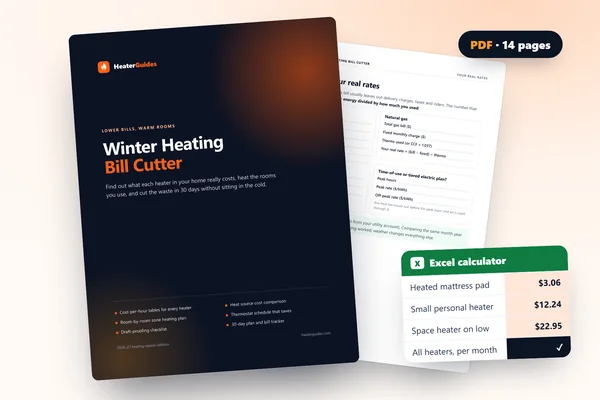 Winter Heating Bill CutterSee what every heater in your home really costs, heat the rooms you use, and cut the waste in 30 days.Cost-per-hour tables for every heaterThermostat schedule and draft-proofing planRunning-cost and bill calculator (Excel)