Top Picks for the Coziest Space Heater in 200 sq ft Rooms
Joye
Updated October 5, 2026 15 min read
At a glance
For most people searching for the best space heater for a 200 sq ft room, the DREO 1500W electric heater is the pick: it has 34 dB operation, 70° oscillation, ECO mode and ETL-listed safety features, so you get strong heat without a racket.
What to remember
For most 200 sq ft rooms, a 1,500 W heater is the safe starting point if you need primary heat.
If the room is well insulated and you want lower wattage, a 600 W wall panel can work, but it heats more gently.
Quiet bedrooms favor models with low dB ratings, oscillation, and a thermostat that holds temperature instead of blasting on and off.
Wall-mount heaters save floor space, but you need a suitable outlet, solid mounting, and a place that stays clear.
Any plug-in electric heater should go straight into a wall outlet, with 3 feet of clearance around it.
Pick the wrong heater and you’ll spend twice: once on the unit, then again on power that doesn’t buy you comfort. A 200 sq ft room is small enough that the wrong output feels either chilly or wasteful.
The trick is matching the heater to the room, then choosing the features that matter in real life: quiet operation for bedrooms, wall mounting for tight spaces, and controls you’ll actually use on a cold morning.
Best for Bedrooms and offices where quiet, even heat matters
The 34 dB operating noise is the standout here, while 70° oscillation spreads heat across more of a 200 sq ft room. ECO mode can switch between 1000W and 1500W as the thermostat maintains your setting, and ETL-certified protections cover tip-over, overheating and unattended operation. Pick it when comfort and low noise matter more than wall mounting.
Heat output 1000W or 1500WNoise level 34 dBOscillation 70°Safety ETL-certified; tip-over and overheat protectionTimer 12-hour timer; 24-hour automatic power off
Why it made the cut
34 dB operation
70° oscillation for wider coverage
ECO mode uses 1000W or 1500W
ETL-certified safety features
Good to know
Uses 1500W on high
Portable floor design takes up space
Skip it if Skip it if you specifically want a wall-mounted heater that leaves the floor clear.
Best for Medium rooms where you want oscillation and remote control
The 1500W ceramic element and wide oscillation help distribute heat beyond the space directly in front of the tower. A remote controls heat settings, oscillation and the 7-hour timer, while the cool-touch housing and overheat protection suit homes with kids or pets. Choose this one if you want a familiar tower shape that you can move between rooms.
Best for Large-room comfort with a low-noise blower and remote
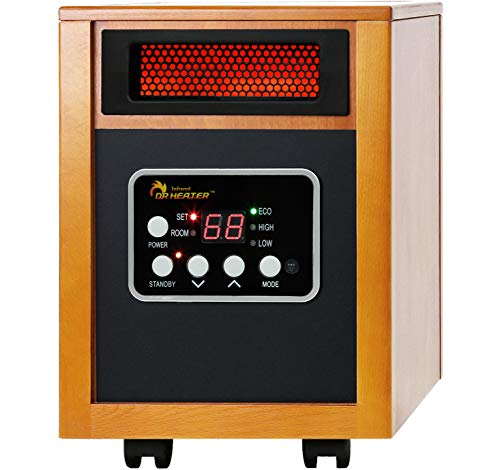
The DR-968 combines an infrared quartz tube with a PTC system and offers high and low heat settings for large-room use. Its 39 dB blower, 50 to 85 degree electronic thermostat and 12-hour automatic shut-off give you useful control from across the room. The caster wheels help when one heater serves more than one space.
Heat output 1500W; around 5200 BTUHeating system Infrared quartz tube plus PTCNoise level 39 dBThermostat 50 to 85 degreesPower draw 12.5 amps
Why it made the cut
Dual infrared quartz and PTC heating systems
39 dB noise level
50 to 85 degree thermostat range
Caster wheels and remote control
Good to know
Weighs 19 lb
Uses 12.5 amps
Its large-room design may be more heater than a well-insulated 200 sq ft room needs
Skip it if Skip it if you want the quietest listed model or a compact tower heater.
Best for Small rooms where floor space and remote control matter
This 1500W wall heater is designed for well-insulated spaces up to 200 sq ft, so it matches the room size directly. WiFi, remote and touch controls let you preheat or adjust the room without walking over to the unit, while ECO mode and the built-in thermostat help maintain a set temperature. Choose it when a wall-mounted installation is worth the drilling.
Heat output 1500W; 5200 BTUControls WiFi, remote and touch controlsInstallation Wall mountSafety ETL-listed; tip-over and overheat protectionRoom size Up to 200 sq ft in well-insulated spaces
Why it made the cut
Wall-mounted design saves floor space
WiFi, remote and touch controls
ECO mode and built-in thermostat
ETL-listed tip-over and overheat protection
Good to know
Requires wall installation
The stated room-size fit assumes a well-insulated space
Skip it if Skip it if you want a heater you can carry from room to room without installation.
Best for A well-insulated 200 sq ft room needing steady convection heat
The 600W convection panel is sized specifically for a 200 sq ft room and includes a thermostat for maintaining the set temperature. Its flat wall-mounted design keeps the floor open, and the stated 0.6 KW/HR consumption is lower than the conventional space-heater figure in the product data. Pick it when steady, modest heat matters more than fast warm-up.
For the best space heater for a 200 sq ft room, start with a 1,500 W plug-in model; that is the standard practical ceiling for a 120 V outlet and the right starting point for most rooms this size. The same answer covers how many watts do I need for a 200 sq ft room and what size space heater for 200 sq ft: choose 1,500 W for faster warm-up, or 600 W when the room holds heat well and you only need a gentle boost.
1,500 W
Standard plug-in ceiling
At 120 V, a 1,500 W heater draws about 12.5 A, so plug it directly into a suitable wall outlet rather than an extension cord or power strip.
A 600 W panel can suit a well-insulated bedroom, office or other room that already has dependable primary heat. It uses less power at any moment, but it will warm the air more slowly and may struggle against cold windows, drafts or a high ceiling. A 1,500 W heater gives you more recovery speed; it doesn’t make a poorly sealed room stop losing heat.
Check Before Choosing Wattage
Insulation: newer, tight rooms can often use lower output; leaky rooms need more recovery power.
Ceiling height: a tall room contains more air than its floor area suggests.
Drafts: check doors, windows and exterior walls where cold air enters.
Job: choose 1,500 W for primary room heating, or consider 600 W for occasional comfort heat.
Worked Example
Say a small bedroom is 200 sq ft, has a normal ceiling, closed windows and working central heat. A 600 W panel may be adequate for a slow, steady temperature lift. Put that same panel in a drafty 200 sq ft room with a tall ceiling and an open door, and expect a slow warm-up; a 1,500 W heater is the more sensible starting point.
Well-insulated bedroom600 W may fit
Drafty room1,500 W starting point
If you want to check the sizing logic against more room examples, space heaters for 200 sq ft rooms covers output and room conditions without turning the decision into a hunt for one magic number.
In short
Choose 1,500 W when the heater must bring a cold 200 sq ft room up to temperature. Choose 600 W when insulation and existing heat do most of the work.
Compare the Features That Change Comfort
For a quiet space heater for bedroom use, the thermostat matters more than a bigger wattage number because it cycles heat to hold a set temperature instead of blasting continuously. A 1,500 W heater can warm faster, but the thermostat decides how steadily and quietly it runs after the room reaches temperature.
The DREO is the Best overall choice here when 34 dB operation, ECO mode and 70° oscillation matter; 34 dB is quieter than the 39 dB model. The EconoHome Wall Mount Space Heater Panel is the Quietest fit when getting the heater off the floor matters more than portable airflow, while the Dr Infrared Heater DR-968 is the Best for large rooms among these picks. Treat those labels as room-use decisions, not a wattage contest.
Feature
What to look for
Pick that fits
Noise
Lower dB is better for a bedroom; 34 dB is quieter than 39 dB.
DREO for the quieter listed operation
Air movement
Oscillation spreads heat; 70° covers more of the room than a fixed outlet.
DREO with 70° oscillation
Mounting
Wall mounting saves floor space but removes easy portability.
EconoHome panel
Remote control
Useful when the heater sits across the room or beside a bed.
Lasko 23″ Ceramic Tower
Smart control
Wi-Fi control helps adjust a heater without walking over to it.
GiveBest Smart Wall Heater
Timer
Compare the listed timer length with your sleep or schedule; a timer and Wi-Fi solve different jobs.
Verify the model listing before buying
Use the feature that solves your room’s nuisance; the longest feature list isn’t automatically the most comfortable.
Myth
More watts equals better heat.
Fact
More watts mainly means more maximum heat and faster recovery. A thermostat, airflow pattern and noise level determine whether that heat feels steady and tolerable once the room is warm.
For the best smart space heater, choose the GiveBest Smart Wall Heater if remote app control is the reason you want smart equipment; otherwise, a physical thermostat and remote may be simpler. The Lasko is the Best budget direction when remote control matters without needing wall mounting or Wi-Fi, and a wall-mounted model is the better answer for a 200 sq ft room where floor space is scarce.
Quiet And Safe
The best electric room heaters are safe and quiet only when you still follow the label: use a wall outlet, keep 3 feet of clearance, and look for tip-over and overheat protection plus a UL, ETL or CSA listing. Fan noise is separate from heating power, so listen for the dB figure rather than guessing from wattage.
Check Running Cost Before You Buy
A 1,500 W space heater running cost depends on hours and your electric rate: a 1,500 W heater uses 1.5 kWh per hour, while a 600 watt heater uses 0.6 kWh. Use watts ÷ 1,000 × hours × days × price per kWh to estimate the bill.
Using a sample electricity rate of 17 cents per kWh, the comparison below assumes both heaters run for 8 hours a day over 30 days. That answers how much a space heater costs to run without hiding the assumptions: the 1,500 W unit consumes 360 kWh in that period, and the 600 W panel consumes 144 kWh.
Heater
Watts
Per hour
Per day (8 h)
Per month (30 days)
1,500 W space heater
1,500 W
26¢
$2.04
$61.20
600 W panel heater
600 W
10¢
82¢
$24.48
Calculated at 17¢ per kWh. Assumes 8 hours per day, 30 days, and an electricity rate of $0.17 per kWh.
A 600 watt heater cost per month is lower because it draws 60% less power while running, though it also produces less heat. A thermostat can reduce actual use for either model by switching the heating element off after the room reaches its set temperature.
Read ECO Mode Correctly
ECO mode saves money only when the thermostat lets the heater cycle down instead of running flat out. If the room loses heat quickly and the element stays on, the ECO label won’t change the basic watt-hour math.
In short
Use the formula rather than the wattage alone: 1,500 W costs 2.5 times as much to run as 600 W for the same number of hours. A smaller panel can cost less, but it may take longer to bring a cold 200 sq ft room up to temperature.
Place It Safely and Check the Label
Space heater safety starts with the outlet and clearance: plug a portable electric heater directly into a wall outlet, keep at least 3 feet around it, and never use an extension cord or power strip.
3 ft
Minimum clearance to keep around the heater
Give the heater open space from curtains, bedding, furniture, clothing and other materials that can heat up or block airflow.
When comparing an ETL listed space heater, also look for tip-over protection and overheat protection, plus a UL, ETL or CSA listing on the product or packaging. Those marks indicate the heater was evaluated by a recognized testing organization; they don’t make careless placement safe.
Wall-mount models need proper mounting exactly as the instructions specify, with a location that stays clear of curtains, bedding and furniture. The EconoHome Wall Mount Space Heater Panel and GiveBest Smart Wall Heater need more planning than a portable tower because the mounting spot becomes part of the installation.
Before You Plug It In
Use a full wall outlet with no extension cord, power strip or shared adapter.
Keep at least 3 feet of open space around the heater and leave its air intake and outlet unobstructed.
Confirm tip-over and overheat protection, then check for a UL, ETL or CSA listing.
For a wall-mount model, use the specified mounting method and verify that the spot stays clear year-round.
Keep a working smoke alarm and carbon monoxide alarm in the home, even though an electric heater does not burn fuel.
Don’t Run It Unattended
Don’t sleep with a portable heater running or leave one operating when you leave the house unless the manufacturer specifically says the model is designed for that use. Stop using it if the plug, outlet or cord becomes hot, discolored or damaged.
What Most Buyers Miss Before Hitting Buy
For a budget-minded 200 sq ft room, start with a basic 1,500 W portable heater such as the Lasko 23″ Ceramic Tower Space Heater with Remote Control; the quietest bedroom pick usually favors low fan noise, steady thermostat control and oscillation over raw blast. Choose a wall heater when floor space is the problem, and choose a portable unit when you want to move heat from room to room.
Wall-Mounted Heater
Keeps the floor clear in a small room
Stays in its assigned room and can suit a fixed setup
Portable Heater
You lose flexibility if the cold spot moves
Installation and wall placement deserve more planning
Skip the 600 W EconoHome Wall Mount Space Heater Panel if the room is drafty, poorly insulated or you expect fast warm-up; that output can make sense as gentle supplemental heat, but it has less heating headroom than a 1,500 W unit. Skip the GiveBest Smart Wall Heater if you want to carry the heater between rooms, dislike app-based controls or need a simple plug-in setup.
For sleeping, the DREO Space Heaters for Indoor Use with Thermostat is the stronger fit among these picks: its 34 dB operation, 70° oscillation and ECO mode support quieter, steadier heat instead of constant full-power airflow. A thermostat that cycles the heating element also avoids turning the bedroom into a sauna with a fan.
1
Measure the room
Confirm the space is about 200 sq ft, and note drafts, high ceilings and exterior walls that may increase the heating demand.
2
Choose the use case
Pick wall-mounted for permanent, floor-saving heat; pick portable for room-to-room use; pick the quieter DREO-style feature set for sleeping.
3
Check outlet and clearance
Confirm a direct wall outlet is available, keep at least 3 feet around the heater and verify the label shows tip-over and overheat protection plus a UL, ETL or CSA listing.
4
Buy the matching pick
Choose the heater whose mounting, controls and output fit those checks instead of buying the most feature-packed model.
Before You Place the Order
Room measured near 200 sq ft
Wall-mounted or portable use decided
Direct wall outlet confirmed
3 feet of clearance available
Safety listing and cutoff features checked
Questions People Ask
What size space heater do I need for a 200 sq ft room?
A 1,500 W electric space heater is the usual starting point for a 200 sq ft room. Drafts, poor insulation and high ceilings can make that output feel inadequate, while a well-insulated room may cycle off sooner. A thermostat helps either way by reducing heat once the room reaches its set temperature.
Is a 1,500 watt heater too much for 200 square feet?
No, 1,500 W is a normal size for a 200 sq ft room when the heater is plugged directly into a suitable wall outlet. At 120 V, it draws about 12.5 A, so avoid sharing the outlet or circuit with another high-wattage appliance. The heater should cycle off rather than run constantly once the room is warm.
What is the quietest space heater for a bedroom?
The DREO 1500W electric heater is the quiet-bedroom pick here, with a stated 34 dB operating level and ECO mode. Fan speed, oscillation and the room’s background noise still affect what you’ll hear, so use the lower setting at night if the model allows it.
Are wall-mounted space heaters better than portable heaters?
Wall-mounted heaters save floor space and are harder to knock over, which can help in a crowded bedroom or office. Portable heaters are easier to move between rooms and usually simpler to replace, but they need the same clearance and direct wall-outlet safety rules. Choose wall-mounted only if permanent placement matters more than flexibility.
How much does a 1,500 watt space heater cost to run for a month?
At 8 hours a day and $0.17 per kWh, a 1,500 W heater costs about $61.20 for 30 days: 1.5 kW × 8 hours × 30 × $0.17. Your bill changes with the thermostat cycle, daily runtime and local electric rate, so a heater that runs half the time would use roughly half as much electricity.
I am a mechanical engineer and love doing research on different home and outdoor heating options. When I am not working, I love spending time with my family and friends. I also enjoy blogging about my findings and helping others to find the best heating options for their needs.