The best 120V garage heater for most readers is a 1,500W fan-forced ceramic portable heater with thermostat, timer, tip-over shutoff, and ETL or UL listing. A 120V outlet limits you to about 1,500W, which is enough for a small garage or a one-car bay, not a drafty two-car cave.
The essentials
A 120V garage heater tops out around 1,500 watts on a standard outlet.
Pick fan-forced heat for faster warmup and infrared if you want direct, quiet heat.
Look for tip-over shutoff, overheat protection, and an ETL, UL, or CSA listing.
Plug your heater directly into a dedicated wall outlet. Avoid using extension cords or power strips, as they can overheat and create fire hazards.
If the garage is big or leaky, size the heater for a work zone, not the whole building.
A 120V garage heater works by turning household electricity into heat, then moving that heat with a fan or letting an infrared element warm people and surfaces directly. That makes wattage, airflow, and safety features matter more than brand fluff.
If your garage is larger than about 160 to 200 square feet, or badly insulated, a 120V unit can still help at the bench or in a corner, but it won’t replace a bigger hardwired heater.
Best 120V Garage Heaters for Winter Work
#1Best Garage Pick
NewAir Portable Garage Heater
Best for Garage benches and small work areas up to 160 sq ft
The 1,500-watt fan-forced ceramic element provides immediate warmth, and the tilting head lets you aim it at a bench or work area. Its handle and lightweight frame make it practical to move around a garage; dual heat settings and adjustable temperature control help you fine-tune the output.
Power 1,500 wattsCoverage Up to 160 square feetHeating element Fan-forced ceramicSafety Cool-touch exterior, automatic shut-off, ETL-certifiedMounting Portable
Why it made the cut
Tilting head directs heat where you need it
Cool-touch exterior and automatic shut-off
ETL-certified protection
Good to know
Listed for spaces up to 160 square feet
No timer or thermostat precision is specified
Skip it if Skip it if you need to heat a large, drafty garage rather than a smaller work area.
Best for Small garages up to 200 sq ft where low noise matters
For a small garage where a loud fan would get in the way, this heater is specified at 35 dB and has a thermostat, timer, and Eco mode. Its handle makes it easy to move between a garage and another room, and the tip-over shutoff and overheat protection are useful safeguards.
Power 1,500 wattsCoverage Up to 200 square feetNoise 35 dBControls Thermostat, remote, touch controls, 24-hour timerSafety Overheat protection, 45-degree tip-over shutoff, ETL-certifi
Why it made the cut
35 dB noise level and 24-hour timer
Thermostat and Eco mode
45-degree tip-over shutoff, overheat protection, and ETL certification
Good to know
Designed as a small-space heater rather than a rugged shop heater
Coverage is listed for up to 200 square feet
Skip it if Skip it if you want a heater with a metal housing built for a demanding workshop.
Best for Garage spots where mounted radiant heat suits the layout
Its infrared element offers three power settings, and the included bracket supports wall or ceiling mounting to keep the heater off the floor. The IP55 approval covers indoor and outdoor use, but there’s no thermostat, so you’ll need to adjust the settings yourself.
Power 900W, 1200W, 1500WVoltage 120V, 60HzApproval IP55Mounting Wall or ceilingControls Remote control
Why it made the cut
Three settings: 900, 1,200, and 1,500 watts
Wall- and ceiling-mounting bracket included
Remote control
Good to know
No thermostat
Mounting position limits how easily you can redirect heat
Skip it if Skip it if you want portable heat with a thermostat that adjusts to a set temperature.
This wall-mounted infrared heater keeps floor space clear and has a digital thermostat, touch screen, and remote. Wi-Fi control lets you adjust the temperature from your phone. The listed voltage is 110 volts, and the product data doesn’t specify heat output or room coverage.
Voltage 110 VoltsMounting Wall mountedControls Wi-Fi, digital thermostat, touch screen, remoteSafety Tip-over safety shut offIncluded feet Not included
Why it made the cut
Wall-mounted design saves floor space
Wi-Fi, digital thermostat, touch screen, and remote
Grill and heater stay cool to the touch
Good to know
Heat output and room coverage are not specified
Feet are not included
Skip it if Skip it if you need a portable heater or want a confirmed wattage and coverage figure before choosing.
Best for Finished spaces where flame effects matter as much as heat
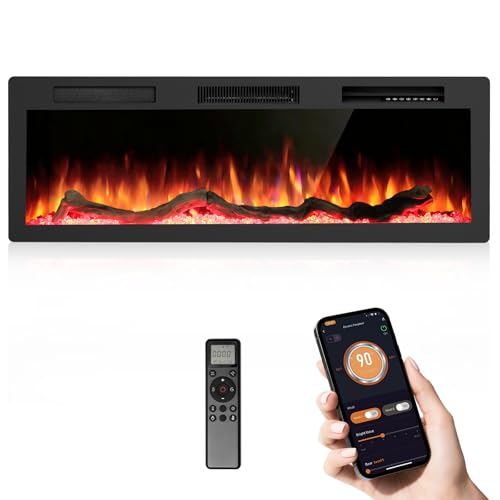
This recessed or wall-mounted fireplace offers 750-watt and 1,500-watt heating modes, with supplemental heating listed for up to 400 square feet. It suits a finished garage or adjoining living space where flame effects and multiple controls are part of the appeal; it’s a less direct fit for a workbench-focused heater.
Power 750W or 1500WCoverage Up to 400 square feetTemperature range 59-95 ℉Dimensions 50″L x 17.32″H x 5.71″WMounting Recessed or wall mounted
Why it made the cut
Two heating modes: 750W and 1,500W
Recessed or wall-mounted installation
Remote, touch controls, smartphone, and Alexa
Good to know
Designed as an indoor fireplace rather than a portable garage heater
Requires a suitable wall opening or mounting location
Skip it if Skip it if you want a portable heater you can move from bench to bay.
Garage Heaters Electric 120 Volt: What Actually Matters
For garage heaters electric 120 volt, the useful target is usually 1,500 watts with a thermostat and dependable shutoffs—not a heater that merely sounds powerful on the box. The best electric 120V garage heater and the best 120V heater for garage use depend on heat delivery, noise, and how you can mount or place it. For most small garages and one-car bays, that also makes a 1,500W unit the practical ceiling on a standard 120V circuit: 1,500 watts ÷ 120 volts is about 12.5 amps.
Myth
A 120V heater is automatically a weak heater meant only for a tiny room.
Fact
A 120V heater can deliver the full output a standard circuit can usually support. The limit is electrical capacity, not a special garage-heater penalty; a drafty or oversized garage simply loses heat faster than that output can replace it.
Fan-forced heaters warm the air by pushing it across an electric heating element, so they raise the room temperature relatively quickly and spread heat around the bay. Infrared heaters warm people, tools, and nearby surfaces more directly, which can feel better at a workbench even when the whole garage air remains cool. Neither type creates extra heat from the same 1,500 watts.
Spec
What to look for
Why it matters
Wattage
1,500W high setting
Uses the available 120V output without chasing an imaginary higher number.
Thermostat
Adjustable temperature control
Cycles the heater instead of running full blast continuously.
Safety shutoffs
Tip-over and overheat protection
Stops operation when the heater falls or gets too hot.
Noise
Fan sound listed or described clearly
Matters when you’re working, listening to music, or taking a call.
Mounting style
Portable, wall-mounted, or recessed
Determines where heat lands and how much floor space you lose.
Use the same five checks on every product card before choosing.
Compare the Five Picks
R.W.FLAME Small Space Heaters for Indoor Use: confirm the thermostat, wattage, and floor placement fit your bay.
R.W.FLAME Smart Electric Fireplace 50 Inch,Recessed & Wall…: check the required mounting method and whether its heat reaches your work area.
NewAir NGH160GA00: verify its maximum wattage, thermostat control, noise level, and mounting instructions.
DR. INFRARED HEATER Portable Infrared Indoor and Outdoor Sp…: decide if direct warmth at one work spot suits you better than warmed air.
Heat Storm HS-1500-PHX-WIFI Infrared Heater: check the mounting position and controls before treating it as a whole-garage heater.
In short
The best space heater for garage use is the one that uses the full 1,500W safely, controls temperature, and puts heat where you work. Choose fan-forced for quicker air warming; choose infrared for direct warmth at a bench or vehicle.
Measure Your Garage Before You Pick a Heater
For garage heaters electric 120 volt, the useful question is how much space you need to warm: a 1,500W heater can take the chill off a small, enclosed garage or a work area, but it may struggle to raise the temperature throughout a large, drafty garage. Space heaters work in two main ways: fan-forced models warm and circulate air, while infrared models warm people and nearby objects directly.
Electric heaters for garages are easiest to size by starting with the area you’ll actually occupy. A one-car bay is a more realistic 120V target than a two-car garage; for bench work, aim the heat at the work zone instead of trying to warm every cubic foot. There isn’t a dependable square-foot number that applies to every garage, because insulation, ceiling height, open doors and drafts all change how much heat stays in the room.
A 1,500W Heater In A One-Car Bay
Say your one-car bay measures 12 by 20 feet, or 240 square feet. A 1,500W heater can add useful heat in an enclosed, reasonably insulated space, but it won’t behave like a whole-garage furnace—especially with a tall ceiling or cold air leaking under the door. For a bench job, heating the area around you is the more realistic expectation.
Floor area12 × 20 ft = 240 sq ft
Heater1,500 W
Practical targetThe occupied area, not necessarily the w
Measure Before You Choose
Measure the garage’s length and width; multiply them for floor area.
Check ceiling height and note whether the space is insulated.
Look for drafts, gaps and doors that will be opened while the heater runs.
Decide whether you need the whole garage warmed or only a bench or hobby area.
If the garage is large or leaky, set expectations accordingly or consider a properly installed higher-capacity heating system.
Why The Same Heater Feels Different
Fan-forced heat spreads through moving air, so it can warm a small enclosed space more evenly but may take time to reach you. Infrared heat can feel useful sooner when it’s aimed at a person or work surface, but it doesn’t make cold air across the entire garage disappear.
Compare Heat, Noise, And Mounting Style
For 120v garage heater reviews, compare how you’ll use the heat before choosing a style: the best electric 120v garage heater for bench work may be a portable unit you can aim nearby, while a fixed hobby corner may suit a wall-mounted heater. The best 120v heater for garage use depends on whether you want warm air, direct radiant heat or a unit that stays out of the way.
Style or pick
Where it fits
Trade-off to check
Portable fan-forced heater, such as the NewAir NGH160GA00
A bench or work area where you can place the heater nearby
Moving air can be audible during long work sessions; check the product’s noise details.
Portable infrared heater, such as the DR. INFRARED HEATER Portable Infrared Indoor and Outdoor…
Direct heat for a person or nearby work area
The product name identifies it as portable infrared; confirm its placement and indoor-use instructions.
Wall-mounted infrared heater, such as the Heat Storm HS-1500-PHX-WIFI Infrared Heater
A fixed hobby corner where floor space matters
Fixed placement gives you less flexibility to aim heat at changing work areas.
Wall-mounted or recessed electric fireplace, such as the R.W.FLAME Smart Electric Fireplace 50 Inch, Recessed & Wall…
A set location where fireplace-style appearance is part of the choice
It’s a larger, fixed-style option rather than a portable bench heater.
Product names identify the styles shown; check each listing and manual for noise, mounting, heater controls and installation requirements.
Portable ceramic heaters suit a work area you use at different spots; infrared models suit direct warmth where you’re standing or sitting. For a parked car, don’t aim a heater at the vehicle or leave one running unattended. A wall-mounted unit can keep the floor clear in a hobby corner, but installation and clearances must follow its manual.
Choose Portable
Move the heat closer to a bench or changing work area.
Avoid committing to one permanent heating location.
Choose Fixed-Mount
Fan noise may matter if you work beside it for hours.
It occupies floor or bench space.
Noise is worth checking before you buy if the heater will run beside you for hours. Fan-forced units move air and can be audible; the product information provided here doesn’t establish noise levels for the named models, so don’t assume a portable infrared heater is silent. Compare the manufacturer’s noise details, if listed, and choose a fixed location that keeps the heater clear of your work and stored items.
Check Safety And Outlet Limits Before You Buy
For 120v garage heater reviews, treat safe wiring and shutoffs as buying requirements, not bonus features. Electric heaters for garages plug directly into a wall outlet; a 1,500W model draws about 12.5 amps at 120V, leaving little room on a standard 15-amp circuit for other heavy loads.
Keep The Connection Simple
Never run a plug-in heater through an extension cord or power strip. Use a sound wall outlet, and stop if the plug or outlet becomes hot, smells burnt, or shows discoloration. Don’t run the heater on a circuit that trips; have an electrician check the circuit rather than bypassing the breaker.
Check Before You Buy
Tip-over shutoff and overheat protection
A UL, ETL, or CSA listing mark
At least 3 feet of clearance around the heater, including from boxes, paper, fuel, and other combustibles
A plan to switch it off before you sleep or leave the house, unless the manufacturer explicitly says the model is designed for unattended operation
Wall-mounted heaters need secure mounting to the framing or other support specified by the manufacturer; don’t trust drywall anchors unless the instructions call for them. Garage dust can collect around an intake or heating element, while stored solvents add flammable vapors to the same space. Follow the manual’s cleaning instructions and keep chemicals away from the heater.
Check The Circuit First
If a freezer, compressor, or other high-draw tool shares the outlet circuit, don’t assume the heater can run alongside it. Check the breaker and the heater manual, and ask an electrician if you’re unsure.
Know What You’ll Spend To Run It
The best 120v heater for garage use costs less to run when you heat the work area for a few hours instead of trying to warm every cubic foot. In 120v garage heater reviews, compare wattage and how you’ll use the thermostat—not just the heat setting.
Calculate full-power use as watts ÷ 1,000 × hours × your electricity rate per kWh. For a 1,500W heater at an assumed $0.17 per kWh, the arithmetic is 1.5 × hours × $0.17: use 4 hours for a nightly estimate, then multiply that result by 30 for a 30-night month; use 8 hours to compare a longer shift. The cost block shows both schedules.
Heater
Watts
Per hour
Per day (4 h)
Per month (30 days)
1,500W garage heater
1,500 W
26¢
$1.02
$30.60
Calculated at 17¢ per kWh. Full-power estimate at an assumed electricity rate of $0.17 per kWh; the 8-hour nightly comparison is twice the usage.
That estimate assumes the element runs continuously. A thermostat cycles the heater off after the space warms, so actual use depends on its duty cycle, outdoor temperature, drafts, and how well the garage holds heat. A leaky garage may keep the element running most of the time.
In short
Aim heat at your bench or work zone when that is all you need; heating less space usually uses less electricity. If you plan to heat the whole garage, expect costs to rise with run time and heat loss.
What To Do Next For Your Garage
For garage heaters electric 120 volt, the best 120V heater for garage use depends on where the heat needs to go: choose a 1,500W portable unit for a small enclosed space, or aim heat at your workbench if the whole garage leaks warmth.
1
Measure the garage
Note the floor area, insulation and drafts. A small, insulated garage is the strongest fit for a 120V heater; a leaky garage may only get a useful warm spot near the heater.
2
Choose the heating style
Pick a fan-forced ceramic heater for general spot heat, or an infrared model for direct warmth at a workbench. Don’t expect either to overcome major air leaks.
3
Check the outlet and circuit
Confirm the outlet is in good condition and the circuit can handle the heater’s load. A 1,500W heater draws about 12.5A at 120V; don’t share its circuit with other heavy loads.
4
Verify safety, then buy
Look for a UL, ETL or CSA listing, tip-over shutoff and overheat protection. Plug the heater directly into a wall outlet, keep 3 feet of clearance, and follow the manual.
If you need steady heat throughout a large or drafty garage, stop asking a 120V unit to do a bigger job. Compare your electrical options for a properly installed hardwired heater, and have an electrician check the circuit and installation.
Next move
Small and insulated: use a 120V heater for the space. Leaky: seal drafts or heat only the work area. Workbench-only: aim the heat where you stand. Need more output: consider a hardwired heater.
More Questions, Answered
What size garage can a 120V heater warm?
A 120V heater is best suited to a small, enclosed garage or a defined work area; insulation, air leaks, ceiling height, and outdoor temperature all affect the result. A typical 1,500W unit is unlikely to keep a drafty two-car garage comfortably warm in cold weather.
How do space heaters for garages work?
Fan-forced models pass air over an electric heating element, then circulate the warmed air around the space. Infrared models heat people and nearby surfaces directly, so you can feel warmth sooner without bringing the whole garage up to temperature.
Is a 1,500W heater enough for a one-car garage?
It can take the chill off a small, insulated one-car garage, especially if you aim the heat at your work area and close the garage door. Poor insulation or frequent door openings can overwhelm that output, so expect spot warmth rather than even heat throughout.
Can I use an extension cord with a garage heater?
No. Plug an electric heater directly into a wall outlet; an extension cord or power strip can overheat under the sustained load. If the outlet or circuit can’t support the heater, have an electrician check it rather than improvising.
Are infrared garage heaters better than fan-forced heaters?
Infrared suits a workbench or other spot where you want direct warmth without waiting for the air to heat. Fan-forced heat spreads through a small enclosed space more evenly, but it can stir dust and may be noisier.
What safety features should a 120V garage heater have?
Look for tip-over shutoff, overheat protection, and a UL, ETL, or CSA listing. Keep the heater at least 3 feet from combustibles, place it on a stable surface, and don’t leave it running unattended or while you sleep unless the manufacturer says the model is designed for that use.
When should I skip a 120V heater and buy a hardwired model instead?
Choose a properly sized hardwired heater when a 1,500W plug-in unit can’t meet the garage’s heating needs or you want a permanent installation. Hardwired models may require a dedicated circuit and professional installation; have an electrician confirm the wiring and available capacity.