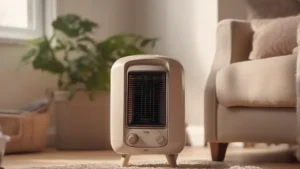
For most readers, the best portable ceramic space heater is a 1,500 W model with a thermostat, tip-over shutoff, and overheat protection because it gives quick spot heat without guesswork. If you want one for a bedroom, office, or basement corner, start with the DREO-style pick for quiet control and the Amazon Basics-style pick for simple value.
What to remember
Pick a 1,500 W ceramic heater for quick spot heating in a bedroom, office, or small living area.
Choose a model with thermostat control if you want it to cycle instead of running flat out.
Keep it on a wall outlet only, with 3 feet of clearance and no extension cord.
Skip bathroom use unless the manual explicitly allows it.
For a larger room, compare the stated coverage, not just the wattage.
A half-true belief hangs around these heaters: ceramic models heat fast, and that part is true. The missing half is coverage; a portable heater makes one occupied zone comfortable, not an entire drafty house.
That is why the right choice comes down to room size, noise, controls, and safety listing first, then extras like remote control or oscillation if they actually help the way you use the room.
Best Portable Ceramic Space Heaters
#1Quiet Room Pick
DREO Ceramic Space Heater
Best for Bedrooms and offices where quiet, adjustable heat matters
The 34 dB operation and thermostat with 1°F increments suit rooms where fan noise or temperature swings get distracting. It also has a remote, a 12-hour timer, and tip-over and overheat protection.
Power 1500WNoise 34 dBThermostat range 41–95°FTimer 12 hoursModes 5
Why it made the cut
34 dB operation
Thermostat adjusts from 41–95°F in 1°F increments
Remote and 12-hour timer
Good to know
The product data does not specify a room-size coverage figure.
Skip it if Skip it if you want a simple heater with fewer controls and modes.
Best for Small home or office spaces where straightforward controls are enough
Three settings cover high heat, lower 900W heat, and fan-only operation, while the compact 3 lb body is easy to move between rooms. Tip-over and overheat protection are built in; its non-oscillating design keeps the setup simple.
High setting 1500WLow setting 900WWeight 3 lbsNoise 43 dBSize 7.5 × 6.3 × 9.5 in
Why it made the cut
High, low, and fan-only settings
Tip-over and overheat protection
Compact, 3 lb design
Good to know
Non-oscillating
Not for bathrooms, laundry rooms, or other high-moisture areas.
Skip it if Skip it if you need oscillation or want to heat a humid room.
Best for Bedrooms and offices where a timer, remote, and child lock are useful
At 35 dB, this heater is a quiet option for a bedroom or desk area, and its thermostat, remote, and 24-hour timer make adjustments easier from across the room. The product data lists overheat protection, tip-over shutoff, ETL certification, and a child lock.
Power 1500WListed coverage Up to 200 sq. ft.Noise 35 dBTimer 24 hoursSafety features Tip-over shutoff, overheat protection, child lock
Why it made the cut
35 dB operation and 24-hour timer
Remote and thermostat
ETL-certified, with tip-over and overheat protection
Good to know
Its child lock and extra controls may be more than you need for basic spot heat.
The product data does not specify a low-wattage heat setting.
Skip it if Skip it if you want a basic heater with fewer controls.
Best for Small rooms where you want high, low, and fan-only settings
Choose between 1500W and 750W heat, or switch to cool-air fan mode when you don’t need heat. Its thermostat cycles the heater to maintain your setting, and the carry handle makes it easier to move for spot heating.
High setting 1500WLow setting 750WModes Heat and cool-air fanCord Six feetSafety Overheat and tip-over shutoff
Why it made the cut
1500W and 750W heat settings plus fan mode
Thermostat control
Carry handle and tip-over shutoff
Good to know
The product data does not give a noise level or timer duration.
Listed room coverage is not clearly specified.
Skip it if Skip it if you need a documented noise level or a timer.
Best for Small home or office spaces where you prefer a silver finish
Its three settings provide 1500W heat, 900W heat, or fan-only operation, with tip-over and overheat protection. The 3 lb, non-oscillating design suits someone who wants a compact heater with basic controls and prefers silver.
High setting 1500WLow setting 900WWeight 3 lbsNoise 43 dBSize 7.5 × 6.3 × 9.5 in
Why it made the cut
High, low, and fan-only settings
Tip-over and overheat protection
Compact, 3 lb design
Good to know
Non-oscillating
Not for bathrooms, laundry rooms, or other high-moisture areas.
Skip it if Skip it if you need oscillation or want to heat a humid room.
For most bedrooms, offices, and small living spaces, the DREO Space Heater is the first ceramic heater to consider because its quiet control suits close-range heating without making the room feel like a workshop. A ceramic heater uses an electric heating element and fan to warm nearby air quickly; an infrared heater sends more direct radiant heat toward your body and nearby objects.
In short
Choose ceramic for fast air warming, infrared for direct heat on a person or chair, and low-wattage electric heat for a small personal zone. Propane belongs outdoors unless the model is specifically indoor-rated, properly vented, or equipped with the required oxygen-depletion protection.
12.5 A
What a 1,500 W heater draws
At 120 volts, a 1,500 W heater uses about 12.5 amps, so plug it directly into a suitable wall outlet rather than an extension cord or power strip. A circuit already carrying other heavy loads may trip.
Use This Quick Decision Rule
1
Want the room air warmer quickly?
Pick a 1,500 W ceramic model with a thermostat. The fan moves warmed air around your nearby zone, making it a sensible choice for a bedroom, office, or small sitting area.
2
Want quiet, direct warmth?
Look at an infrared portable heater. Radiant heat reaches people and objects directly, so it can feel effective even when you aren’t trying to warm the whole room.
3
Want the lowest electrical draw?
Choose a low-wattage ceramic heater for a desk, chair, or other small personal zone. Expect a smaller heated area; lower wattage doesn’t create the same output as 1,500 W.
Myth
A propane heater is the better low-wattage choice for any indoor room.
Fact
Propane produces heat without drawing household electricity, but indoor use requires a model specifically rated for it, with the ventilation and oxygen-depletion protection the manual requires. Outdoor, patio, torpedo, and construction heaters stay outdoors; a carbon monoxide alarm is still necessary for approved indoor fuel-burning equipment.
Best first pick for most rooms
DREO Space Heater, Portable Electric Heaters for Indoor Use with Ther…
The DREO Space Heater fits readers who want a portable ceramic heater for a bedroom, office, or small living space and care about quiet control. Choose the Amazon Basics Ceramic Space Heater instead if simple operation matters more than extra control. For a closer feature comparison, see ceramic portable space heaters compared.
From HeaterGuides · our own guideWinter Heating Bill CutterSee what every heater in your home really costs, heat the rooms you use, and cut the waste in 30 days.Cost-per-hour tables for every heaterThermostat schedule and draft-proofing planRunning-cost and bill calculator (Excel)$14.99$9.99Get it for $9.99See what's inside and watch the 2-minute video →14-page printable PDF + Excel calculator · instant download · 30-day refund
What Actually Separates These Heaters
The useful difference between portable ceramic heaters is control, not the word “ceramic” on the box. For a dreo 1500w portable 3d automatic oscillating ceramic ptc heater review, look first at its thermostat, fan noise, oscillation, timer, and listed shutoffs; the same checklist works for a qqt portable ptc ceramic space heater for indoor use.
Spec
What to look for
Why it matters
Wattage
1,500 W high setting, plus a lower setting
High gives faster heat; low can reduce cycling and power use.
Thermostat
A real adjustable temperature control
The heater can cycle off instead of blasting heat continuously.
Timer
A clearly stated shutoff timer
Useful for a limited heating period; don’t treat it as a substitute for safe placement.
Oscillation
A switchable, quiet sweep
Spreads warmth around a room; fixed heat can be better at a desk.
Noise
A low fan setting and quiet operation
Fan noise matters more beside a bed than a flashy mode count.
Safety listing
Tip-over shutoff, overheat protection, and UL, ETL, or CSA listing
These features address common electrical and overheating hazards.
Read the manual and product label for the exact feature names; mode counts alone don’t tell you much.
A plug-in heater usually tops out at 1,500 W because a standard 120 V, 15 A household circuit supplies about 1,800 W in theory, while 1,500 W already draws 12.5 A. That leaves limited headroom for other loads on the same circuit, so don’t add a second heater to the outlet or use an extension cord or power strip.
Worked Example
A 1,500 W heater draws 1,500 ÷ 120 = 12.5 A. A 750 W low setting draws about 6.25 A. The lower setting won’t create the same burst of heat, but it can maintain a small occupied room more gently once the chill is gone.
High setting1,500 W / 12.5 A
Low example750 W / 6.25 A
CircuitStandard 15 A, 120 V household circuit
Bedroom Versus Desk
For a bedroom, prioritize a quieter fan and a thermostat that holds a steadier temperature. A simple non-oscillating heater can be the better choice under a desk or beside your chair because it sends heat where your legs are instead of sweeping the bookcase.
Before You Buy
Confirm the high and low wattage settings.
Check how the thermostat is adjusted and what temperature range the manual gives.
Confirm the timer, oscillation, tip-over shutoff, and overheat protection.
Look for a UL, ETL, or CSA listing on the product or packaging.
Plan to plug it directly into a wall outlet.
How Big A Room It Can Cover
A portable ceramic heater covers a small closed room more reliably than an open floor plan, and its practical range depends on insulation, ceiling height, drafts, and whether doors stay open. A 1,500 W heater makes the same amount of heat in every room; the room decides how quickly that heat leaks away.
For a portable ceramic space heater for an office bedroom, start with the smallest room that has a closing door and use the heater as spot heat. A 100 sq. ft. office with a normal ceiling and modest drafts is a much easier job than a 200 sq. ft. room with exterior walls, high ceilings, or a door left open to a hallway.
Worked Example
Say the same 1,500 W heater runs in two rooms. In a 100 sq. ft. office, the heater has less air and fewer surfaces to warm, so the thermostat may cycle off after the initial warm-up. In a 200 sq. ft. room, it may still provide useful local warmth, but the far side can remain cool when drafts or an open doorway carry heat away.
Smaller room100 sq. ft. office
Larger room200 sq. ft. room
Available output1,500 W maximum
Coverage Has Limits
Don’t use a portable heater as the replacement for central heat in an open-plan space. Warmth disappears into connected rooms, and placing a heater near a doorway won’t turn the whole floor into one evenly heated room.
For the best portable space heaters for large rooms, treat the advertised coverage area as a starting point rather than a promise. A borderline or poorly insulated room is the case for the DREO Space Heater, Portable Electric Heaters for Indoor Use: its 1,500 W output and automatic oscillation can spread heat more broadly than a fixed desk heater, though it still can’t overcome an open doorway and steady drafts.
For a borderline room
DREO Space Heater, Portable Electric Heaters for Indoor Use with Ther…
Choose this DREO model when you need wider circulation in a larger or draftier room; choose a fixed, simpler heater when the target is one chair or one desk.
Portable ceramic space heaters are cheap to run for short spot-heating sessions, but eight hours every night can make the meter notice. The formula is watts ÷ 1,000 × hours × rate, so a 1,500 W heater running for 2 hours uses 3 kWh; at 17 cents per kWh, that’s about 51 cents.
For a recommended low wattage portable ceramic or propane space heater, 900 W is a sensible lower electric setting when the model offers it. A 900 W ceramic heater uses 40% less electricity than 1,500 W at the same runtime; an indoor-rated propane heater follows different fuel and ventilation rules, so don’t treat it as a plug-in substitute.
Heater
Watts
Per hour
Per day (8 h)
Per month (30 days)
1,500 W on high
1,500 W
26¢
$2.04
$61.20
900 W on low
900 W
15¢
$1.22
$36.72
Calculated at 17¢ per kWh. Assumes 8 hours daily, 30 days, and electricity at $0.17 per kWh. Actual thermostat cycling can reduce the running time.
High power for a short period costs much less than heating a whole house, especially when you’re warming one desk or a closed bedroom. Long runtimes add up fast, though: the cost block shows the price of leaving the heater available for a full eight-hour night.
Use the thermostat
A thermostat saves money by cycling the heating element off after the room reaches its set temperature, then turning it back on as needed. Holding full power all evening wastes electricity once the room is already warm; a direct, stable setting beats chasing the cold with the dial.
Safety And Placement Rules
A portable ceramic space heater for an office or bedroom must plug directly into a wall outlet, sit at least 3 feet from combustibles, and stay clear of curtains, bedding, paper, furniture, and clothing. Never use an extension cord or power strip.
Check Before Buying
Tip-over shutoff
Overheat protection
UL, ETL, or CSA listing
A cord and plug that reach the wall outlet without an extension cord
A ceramic or infrared portable heater can both warm a small area, and at the same wattage their electricity use is essentially the same. Ceramic models usually push heat around the room with a fan; infrared models warm people and nearby surfaces more directly, so placement matters more than the label.
Keep the safety margin
Don’t run the heater in a humid room unless the manual specifically allows it. Don’t sleep with it running or leave it unattended unless the manufacturer says that model is designed for those conditions.
Helpful controls
A direct-readout thermostat, child lock, and timer reduce guesswork and help prevent unwanted operation. None replaces the wall outlet, 3-foot clearance, tip-over protection, or overheat protection.
What To Buy First
If you searched “amazon.com: space heater, aubkn small portable electric heaters for indoor use with thermostat and remote,12h timer, 5 mode, 1500w ptc ceramic fast safety heat,” the AUBKN listing is the control-focused option to compare: its stated features include a remote, 12-hour timer, and five modes. Choose in this order so extra controls don’t distract from whether the heater fits your room.
1
Match the room
Measure the space and compare it with each heater’s stated coverage. Choose a larger-room model only if the room actually needs the added coverage; a bigger claim won’t fix open doorways or heavy drafts.
2
Consider noise
For a bedroom, pick the quietest model. The DREO is the quiet-control pick among the models covered here; check the listing for the exact noise and operating details.
3
Choose the thermostat
For basic office heat, the Amazon Basics Ceramic Space Heater is the straightforward value choice. If you want remote operation and a timer, compare the AUBKN listing’s controls and thermostat settings before buying.
4
Check the safety listing
Confirm the exact model is UL, ETL, or CSA listed and has tip-over shutoff and overheat protection. Plug it directly into a wall outlet, with at least 3 feet of clearance.
Before You Order
Measure the room and note open doorways.
Check the outlet location; plan for a direct wall connection, not an extension cord or power strip.
Compare each model’s stated coverage with your measured space.
Questions People Ask
How many watts should a portable ceramic space heater have for a bedroom?
A 1,500 W model is the usual choice for a bedroom because it provides the maximum heat available from a standard 120 V household outlet. For a small, well-insulated room, a lower setting can maintain warmth while drawing less power.
Is ceramic heat better than infrared for a portable heater?
Ceramic heaters warm air with a fan, so they suit heating a small room; infrared heaters warm people and objects more directly, which can work better for brief, close-range use. Neither type makes more heat per watt than the other electric resistance heaters.
Can you run a portable ceramic space heater on an extension cord?
No. Plug the heater directly into a wall outlet; a 1,500 W model draws about 12.5 A at 120 V, which can overheat an extension cord or power strip.
How much does a 1,500 W ceramic heater cost to run for 8 hours?
At 17 cents per kWh, eight hours costs about $2.04: 1.5 kW × 8 hours × $0.17. Your actual bill depends on your electricity rate and whether the thermostat cycles the heater off.
Is it safe to use a portable ceramic space heater in a bathroom?
Avoid using an ordinary portable ceramic heater in a bathroom, where splashes and damp surfaces raise shock risk. Use only a heater specifically rated by its manufacturer for bathroom use, follow its placement instructions, and keep it well away from water.
Before you go · a welcome giftGet the Winter Heating Bill Cutter for $4.99See what every heater in your home really costs, heat the rooms you use, and cut the waste in 30 days. Normally $14.99; your welcome price saves $10.00. We'll email your link right now.One email with your link now. We never share your address.


 Winter Heating Bill CutterSee what every heater in your home really costs, heat the rooms you use, and cut the waste in 30 days.Cost-per-hour tables for every heaterThermostat schedule and draft-proofing planRunning-cost and bill calculator (Excel)