Yes, propane heaters can be safe indoors when the specific model is approved for indoor use and you follow its manual. For most readers, Product 1 is the practical pick for a small room: it offers 4,000 or 9,000 BTU/hr and is rated for about 225 square feet. Every fuel-burning heater also needs a working carbon monoxide alarm.
What to remember
For a small room and portable backup heat, start with Product 1.
Product 2 is rated for up to 700 square feet and needs one AAA battery for ignition.
Product 4 is outdoor use only; don’t use it in a home, tent, or vehicle.
Use a working CO alarm and follow the heater manual’s ventilation instructions.
Check local rules before installing or using a vent-free propane heater.
Say your 12-by-14-foot room is cold during a power outage and you want heat without plugging in a heater. Product 1 is rated for about 225 square feet, but its 1 lb cylinder lasts only 2.4 hours on high.
Choose by room size, fuel supply, and whether the model is explicitly approved for indoor use. Outdoor-only heaters don’t become indoor-safe because a door is open.
Best Indoor Propane Heaters by Use
#1Best for small rooms
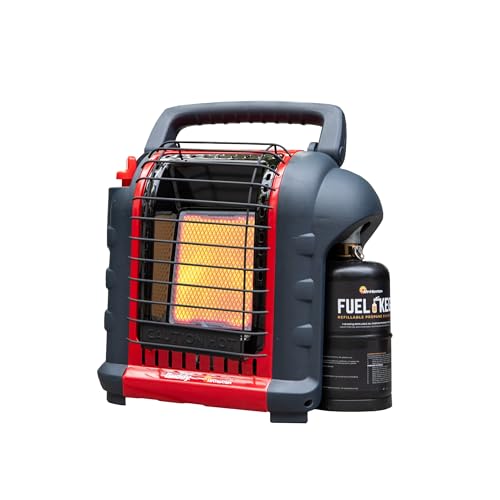
Mr. Heater Portable Buddy 9,000 BTU
Best for Small rooms up to approximately 225 square feet
Choose this for a small room when you want two heat settings and a heater approved for indoor and outdoor use. It delivers 4,000 or 9,000 BTU/hr and has an emergency low-oxygen safety system. A 1 lb propane cylinder lasts 5.4 hours on low or 2.4 hours on high.
Heat output 4,000 or 9,000 BTU/hrRated room size Approximately 225 square feetSafety feature Emergency low-oxygen safety systemRuntime on 1 lb cylinder 5.4 hours on low; 2.4 hours on high
Why it made the cut
Indoor and outdoor use approval
Two heat settings
Low-oxygen safety system
Good to know
A 1 lb cylinder lasts 2.4 hours on high
Skip it if Skip it if your room exceeds its approximately 225-square-foot rating or you need longer runtime on a small cylinder.
Best for Enclosed spaces up to approximately 450 square feet
For a larger enclosed space, this model offers three radiant-heat settings: 4,000, 9,000 and 18,000 BTU/hr. It’s designed and approved for indoor and outdoor use, with an automatic low-oxygen shut-off system. Use only authorized accessories; the product data warns that unauthorized attachments can cause serious injury.
Heat output 4,000, 9,000 or 18,000 BTU/hrRated room size Approximately 450 square feetSafety feature Automatic low-oxygen shut-off systemUse Designed and approved for indoor and outdoor use
Why it made the cut
Three heat settings
Rated for approximately 450 square feet
Automatic low-oxygen shut-off
Good to know
Runtime is not specified in the product data
Skip it if Skip it if you need a stated fuel runtime or plan to use accessories not authorized for this heater.
Best for Rooms up to 700 square feet where battery ignition is useful
This blue-flame heater is rated for up to 700 square feet and uses a battery-operated electronic ignition, so it doesn’t need electricity to start. The product data says it’s indoor safe and requires no venting or chimney. Check local code before choosing a vent-free gas heater, since rules vary by state and city.
Heat output 20,000 BTU/hrRated room size Up to 700 square feetIgnition Battery-operated electronic ignition; one AAA battery includVenting No venting or chimney required
Why it made the cut
Rated for up to 700 square feet
No electricity required for operation
Battery-operated electronic ignition
Good to know
Fuel runtime is not specified in the product data
Skip it if Skip it if vent-free heaters are restricted where you live or you want a radiant portable heater.
Best for Outdoor heating from a 20 lb propane tank
This tank-top heater mounts directly to a 20 lb tank and provides radiant heat in multiple directions. Its regulator has high, medium and low settings, and the tip-over switch shuts it off if it tips. The product data says outdoor use only, so don’t use it indoors.
Heat output 45,000, 36,000 or 30,000 BTUFuel 20 lb tankRuntime Approximately 9.5 hours on high with a 20 lb tankSafety feature Tip-over safety shut-off switch
Why it made the cut
Mounts directly to a 20 lb tank
Three regulator settings
Tip-over safety shut-off switch
Good to know
Outdoor use only
No indoor room-size rating
Skip it if Skip it for any indoor heating; this model is for outdoor use only.
Best for Indoor personal heating in spaces rated for 108–130 square feet
If you’d rather avoid burning propane indoors, this electric ceramic heater offers 950 W and 1,500 W settings, plus thermostat control. It has tip-over and overheat protection and is ETL certified. Plug it directly into a wall outlet, not an extension cord or power strip.
Heat output 950 W or 1,500 WHeating area 108–130 square feetSafety features Overheat and tip-over protectionCord 6 ft
Why it made the cut
Two heat settings and thermostat control
Tip-over and overheat protection
ETL certified
Good to know
Needs an electrical outlet
Not a propane heater
Skip it if Skip it if you need heat during a power outage or specifically want a propane model.
Propane Heaters Are Safe Indoors Only When Rated for It
Propane heaters can be safe indoors only when the specific model is designed and approved for indoor use. An outdoor, patio, torpedo, or construction heater does not belong inside. If you’re asking about the dangers of propane heaters indoors, carbon monoxide (CO) is the one to take seriously: incomplete combustion can produce this odorless gas, which you can’t reliably detect without an alarm.
For a propane heater, check the manual and product label for indoor-use approval and an oxygen depletion sensor (ODS). The ODS can shut the heater off if oxygen in the room falls, but it doesn’t detect or replace a CO alarm. Keep a working CO alarm in the home and follow the heater’s ventilation requirements; don’t assume a cracked window is enough unless the manual says so.
Confirm Before Indoor Use
The exact heater model is approved for indoor use.
The manual’s ventilation and clearance requirements can be met.
A working CO alarm is installed.
For propane models, check for an ODS and follow the manual.
Keep Outdoor Heaters Outside
Product 4, the Mr. Heater Original 540-Degree 45,000 BTU Tank Top Radiant Heater, is explicitly for outdoor use only. Don’t use it indoors. Vent-free gas heaters are also banned or restricted in some states and cities, so check local code before buying or lighting one.
Odorless
Carbon monoxide can be
A heater that seems to be burning normally can still produce CO. Don’t rely on smell or the ODS; use a working CO alarm.
Propane heaters are safe indoors only when the specific model is approved for indoor use and you follow its manual. For propane models, check for an oxygen depletion sensor, provide the ventilation the manual requires, and keep a working carbon monoxide alarm in the room. If indoor use isn’t clearly allowed on the label or in the manual, don’t use the heater inside.
Choose an Indoor Propane Heater That Fits Your Room
The best indoor propane heater depends on the room’s size and how you want heat delivered. Among these top-rated indoor propane heaters, the Mr. Heater Portable Buddy suits a smaller area; the 20,000 BTU Blue Flame covers a larger stated area; and the Big Buddy offers more output settings. The difference in blue flame or infrared indoor propane heaters is mainly what gets warmed first: room air or nearby people and surfaces.
Heater
Stated output
Rated area
Useful detail
Mr. Heater 9,000 BTU Portable Buddy Radiant Propane Heater
4,000 or 9,000 BTU/hr
About 225 sq ft
Two settings; with a 1 lb cylinder, stated run time is 5.4 hours on low or 2.4 hours on high.
Mr. Heater 20,000 BTU Vent Free Blue Flame Propane Heater
20,000 BTU/hr
Up to 700 sq ft
Battery-operated electronic ignition uses one AAA battery; no electricity required.
Mr. Heater 18,000 BTU Big Buddy Heater NF
4,000, 9,000, or 18,000 BTU/hr
About 450 sq ft
Three heat settings and an automatic low-oxygen shut-off system.
Rated areas are product claims, not a guarantee for every room.
Radiant heat travels directly to nearby people and surfaces, so it can feel useful where you’re sitting. Blue-flame heat warms room air, which then circulates. Neither style is universally more efficient; choose based on how you use the room and the model’s stated capacity.
Match the Rating to the Room
Say your room is within the Buddy’s stated 225-square-foot rating and you want direct heat nearby: Product 1 is the straightforward fit. For a room within the Blue Flame’s stated 700-square-foot rating, Product 2 offers more output, while Product 3 is rated for about 450 square feet and gives you three settings. These are starting points; room conditions can change what works.
About 225 sq ftBuddy: 4,000 or 9,000 BTU/hr
About 450 sq ftBig Buddy: up to 18,000 BTU/hr
Up to 700 sq ftBlue Flame: 20,000 BTU/hr
Product 2’s listed ignition uses one AAA battery and doesn’t require electricity; don’t assume it has a thermostat or an ODS from that fact alone. Product 3 has an automatic low-oxygen shut-off system, and its manual’s instructions on approved attachments matter: don’t add unauthorized ones. If you want to compare more indoor models, see indoor propane heater picks.
Best Indoor Propane Heater for a Power Outage
For a power outage, the Mr. Heater Portable Buddy and Big Buddy are portable radiant options listed for indoor use; the best indoor emergency propane heater depends on the room and how long you need heat. Product 2, the 20,000 BTU vent-free blue-flame model, states that it needs no electricity and uses a AAA battery for ignition.
An indoor propane heater with no electricity can be useful during an outage, but don’t assume every model works without household power. Check the manual for ignition and operating requirements. Keep the correct fuel on hand, follow the heater’s connection instructions, and have a working battery-powered or otherwise operational carbon monoxide alarm.
A 1 lb Cylinder on the Buddy
Using the stated run times, one 1 lb cylinder lasts about 2.4 hours on high or 5.6 hours on low. For four hours on high, that’s one full cylinder plus more fuel; a small cylinder won’t cover a long outage.
High settingAbout 2.4 hours per 1 lb cylinder
Low settingAbout 5.6 hours per 1 lb cylinder
Outage Readiness
Confirm the specific model’s manual permits indoor use and explains its power requirements.
Keep the correct fuel and approved connection parts available; follow the model’s instructions.
Test a battery-powered CO alarm, or confirm your existing alarm works during an outage.
Don’t Improvise
Never run a generator indoors or in an attached garage. Don’t improvise fuel connections or use accessories the heater’s instructions don’t approve; a convenient-looking adapter can create a leak or fire risk.
How to Size an Indoor Propane Heater and Estimate Fuel
The most efficient propane heater indoors is one that can meet your room’s heat needs without running harder than necessary; BTU output alone doesn’t tell you which model costs less to operate. For above 6,500 feet, the best indoor propane heater is one whose manual or manufacturer confirms it can operate there and gives any required adjustments.
Treat a stated square-foot rating as a starting point, not a promise. Insulation, ceiling height, drafts, and outdoor temperature all change how much heat a room needs.
Product information
What it tells you
Product 1: about 225 sq ft
A stated coverage guide, not a guaranteed result in every room.
Products 2 and 3
The supplied product facts here don’t provide area ratings or fuel-consumption rates.
Room conditions
Poor insulation, high ceilings, drafts, and colder weather can reduce effective coverage.
Use the heater’s own listed coverage and operating instructions when comparing models.
A Room Near the Rating
Say your room is 200 square feet. Product 1’s stated coverage of about 225 square feet puts it within the listed range, but a drafty room with a high ceiling may still feel underheated. Room size alone can’t settle the choice.
Room200 sq ft
Product 1 stated coverageAbout 225 sq ft
Estimating Fuel Cost
Calculate pounds or gallons burned per hour × hours used × local propane price per pound or gallon. You need the heater’s actual fuel consumption and your local price to get a useful estimate; the supplied facts don’t give burn rates for Products 2 and 3. Don’t assume a higher BTU rating means lower cost or better efficiency.
Product 5, the R.W.FLAME ceramic heater, offers 950 W or 1,500 W settings, but it needs household electricity. It’s an electric alternative, not outage heat.
What to Do Before You Light the Heater
Before lighting a propane heater indoors, confirm the exact model is approved for indoor use and follow its manual. Vented propane heaters send combustion exhaust outdoors; ventless or vent-free models release it into the room and may be restricted or prohibited by local code. Neither type is automatically suitable for every home.
Indoor propane heaters can provide heat during a power outage if the model operates without electricity, but check the manual: some controls or fans may need power. For an indoor direct-vent propane heater, the gas valve and vent must match the listed model’s instructions. Wall-mounted indoor propane heaters need the specified clearances and installation; gas piping and vent work belong to a qualified professional where required.
1
Choose the right model
Choose a model approved for indoor use and sized for the room. Outdoor-only patio, construction, and forced-air heaters don’t belong inside; follow the indoor model’s ventilation instructions and use a working CO alarm.
2
Check permission and instructions
Confirm local rules, especially for vent-free heaters, and read the manual for required ventilation, clearances, fuel type, and operation.
3
Install or place it as directed
Follow the model’s listed instructions. Have gas piping or vent work done by a qualified professional where required.
4
Test the CO alarm
Make sure a working carbon monoxide alarm is installed and tested according to its instructions before operating the heater.
5
Light and monitor it
Use the lighting procedure in the manual, and keep following its ventilation and operating instructions.
Stop if something seems wrong
A rotten-egg propane odor, soot, an unusual flame, or a CO alarm means shut the heater off only if you can do so safely, leave the area, and get help from outside. Don’t relight it until the cause is addressed. Headache, dizziness, nausea, or confusion can signal carbon monoxide exposure; get everyone outside and call emergency services.
If you’re still comparing indoor-rated options, best indoor propane heaters is the next step; check the model’s manual and local rules before buying or installing.
Questions People Ask
Can a standing propane heater be used indoors?
Yes, if the exact model is listed for indoor use and its manual permits the room where you plan to use it. Outdoor patio and tank-top heaters aren’t indoor heaters, even if they stand upright.
Are forced-air propane heaters safe to use indoors?
Most forced-air propane heaters are made for outdoor or construction use, so don’t run one inside a home, garage, tent, or vehicle cabin. Use one indoors only if its label and manual specifically approve indoor operation and give indoor ventilation instructions.
Can an indoor propane heater run without electricity?
Some can: models with a standing pilot or battery-powered ignition may operate without household power. Check the manual for the ignition and fan requirements; a heater that needs an electric blower won’t provide heat during an outage without power.
Are indoor propane heaters safe during a power outage?
They can be, provided the heater is approved for indoor use, the manual’s ventilation requirements are met, and a working CO alarm is nearby. Never bring an outdoor or construction heater inside as a substitute when the power fails.
What is the best indoor propane heater for use above 6,500 feet?
There isn’t a safe universal pick for that elevation: check the exact model’s manual or contact its manufacturer before use. High altitude can affect combustion, and some heaters have elevation limits or require adjustments; don’t modify the heater yourself.