For most garages where you’ll be nearby, the 9,000-BTU radiant heater is the practical pick: it’s approved for indoor and outdoor use and is rated for up to about 225 square feet. For a larger space, check the Big Buddy’s manual before indoor use; jobsite torpedo heaters are not for enclosed garages.
The essentials
Match the heater’s stated room area to the space you want warmed; an uninsulated garage may need more heat than its square footage suggests.
Use an indoor propane heater indoors only when its listing and manual allow it, with required ventilation and a working carbon monoxide alarm.
Never use an outdoor, patio, torpedo or construction heater in an enclosed garage, home, tent or vehicle cabin.
A 1-pound cylinder lasts 5.4 hours on the small Buddy’s low setting and 2.4 hours on high; plan for fuel changes.
If a heater keeps shutting off, check its manual, fuel supply and ventilation before buying parts.
Say your garage is 24 by 24 feet: that’s 576 square feet, well beyond the 225-square-foot rating of the smaller radiant pick. If you need heat only at a workbench, radiant heat can still help; heating the whole uninsulated garage is a different job.
The picks below separate indoor-rated portable heaters from high-output jobsite models. That distinction matters more than a big BTU number when you’re working around propane indoors.
Best Portable Propane Heaters for Garage Use
#1Best for most garages
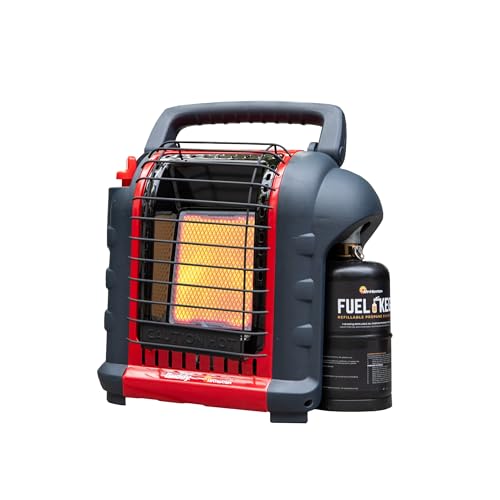
Mr. Heater 9,000 BTU Buddy Heater
Best for Nearby work in garages up to approximately 225 square feet
The 9,000-BTU radiant setting gives nearby work areas direct heat without the size of a jobsite heater. Product 1 is designed and approved for indoor and outdoor use, has an emergency low oxygen safety system, and runs on a 1 lb propane cylinder.
Heat output 4,000 or 9,000 BTU/hrRated area Approximately 225 square feetFuel runtime 5.4 hours on low; 2.4 hours on high with 1 lb propane cylindSafety feature Emergency low oxygen safety system
Why it made the cut
Indoor and outdoor use approved
4,000 or 9,000 BTU/hr settings
Runs 5.4 hours on low with a 1 lb cylinder
Good to know
Rated for approximately 225 square feet
High setting runs 2.4 hours on a 1 lb cylinder
Skip it if Skip it if your garage needs broad heat across more than approximately 225 square feet.
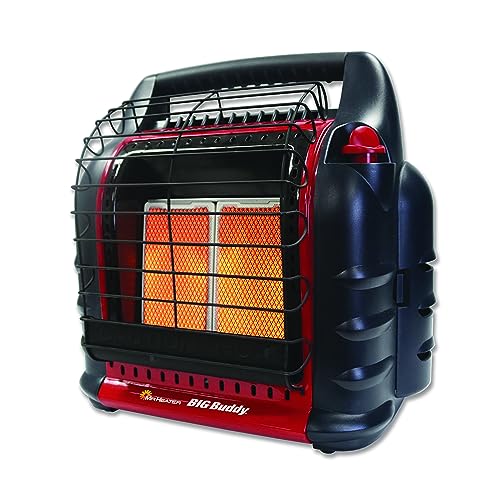
Best for Garages up to 450 square feet where the manual allows indoor use
Product 2 combines radiant heat with convection airflow, and its built-in fan helps move warmth through a larger garage. Three settings—4,000, 9,000, and 18,000 BTU—let you reduce output after the space warms; follow the manual before using it indoors.
Heat output 4,000 / 9,000 / 18,000 BTURated area Up to 450 square feetFuel runtime Up to 216 hours on two 20 lb propane tanks at low with optioHeat type Radiant and convection heat with built-in fan
Why it made the cut
Rated for up to 450 square feet
Radiant and convection heat
Runs up to 216 hours on two 20 lb propane tanks at low with optional hose
Good to know
Indoor use depends on the manual’s instructions
Optional hose is needed for two 20 lb propane tanks
Skip it if Skip it if you want a small spot heater or don’t have the ventilation and clearances required by the manual.
Best for Indoor spaces up to 130 square feet with a wall outlet nearby
Product 3 is an electric indoor heater, not a propane heater, so it avoids combustion in a small enclosed workspace. Its 950W and 1,500W settings, thermostat, tip-over protection, and overheat protection suit a small garage area with a suitable wall outlet.
Heat output 950W or 1500WRated area 108-130 square feetSafety ETL certified; overheat and tip-over protectionCord 6 ft power cord
Why it made the cut
Indoor use
Tip-over and overheat protection
Low-950W and high-1500W settings
Good to know
Not a propane heater
Rated heating area is 108-130 square feet
Requires a 120V wall outlet
Skip it if Skip it if your garage lacks a suitable wall outlet or you specifically need propane operation.
Best for Large open jobsite areas up to 2,125 square feet
Product 4 delivers adjustable 50,000-85,000 BTU forced air heat for broad, open work areas. Its fan-forced design, adjustable heat angle, electronic ignition, and 20 lb tank runtime fit construction and utility work, but a torpedo heater isn’t for an enclosed garage.
Heat output 50,000-85,000 BTURated area Up to 2,125 square feetFuel runtime 8 hours on low; 5.5 hours on high with a 20 lb propane tankPower requirement 120V outlet
Why it made the cut
50,000-85,000 BTU adjustable output
Rated for up to 2,125 square feet
Runs 8 hours on low with a 20 lb propane tank
Good to know
Not for an enclosed garage
Requires a 120V outlet and 20 lb propane tank or larger
Forced-air fan adds noise and moves combustion products
Skip it if Skip it for indoor garage use; choose an indoor-rated heater instead.
Product 5 is the largest heater here, with adjustable 75,000-125,000 BTU forced-air output for open construction and utility areas. Continuous electronic ignition and overheat and auto-cutoff protection add useful operating controls, but its torpedo design rules it out for an enclosed garage.
Heat output 75,000-125,000 BTURated area Up to 3,125 square feetFuel runtime 5.5 hours on low; 3.5 hours on high with a 20 lb propane tanPower requirement 120V outlet
Why it made the cut
75,000-125,000 BTU adjustable output
Rated for up to 3,125 square feet
Runs 5.5 hours on low with a 20 lb propane tank
Good to know
Not for an enclosed garage
Requires a 120V outlet and 20 lb propane tank or larger
High setting runs 3.5 hours on a 20 lb tank
Skip it if Skip it unless you need jobsite-scale heat in a properly open, ventilated area.
Portable Propane Heaters for Emergency Power Failure in Your Home
For portable propane heaters for emergency power failure in your home, use only a model explicitly approved for indoor use, and the listed small Buddy is the clearest fit: its product information describes it as approved for indoor and outdoor use. A residential indoor portable propane heater still needs the ventilation stated in its manual and a working carbon-monoxide alarm.
Heater
Indoor-use status
Appropriate setting
Mr. Heater 9,000 BTU Portable Buddy Radiant Propane Heater
Described as approved for indoor and outdoor use
Occupied room or garage, following the manual
Mr. Heater 18,000 BTU Big Buddy PRO Series Heater
Check the exact model manual; don’t infer approval from the name
Indoor use only if that model and local rules allow it
BILT HARD 85,000 BTU Forced Air Propane Heater
Jobsite/outdoor heater
Open, ventilated work areas only
BILT HARD 125,000 BTU Propane Torpedo Heater
Jobsite/outdoor heater
Open, ventilated work areas only
Product names and output ratings don’t replace the safety label or manual.
Carbon Monoxide Still Matters
A fuel-burning heater can produce carbon monoxide, even when the flame looks normal. Follow the manual’s ventilation requirements, keep a working CO alarm nearby, and never run a propane heater while sleeping or away from home unless the manufacturer expressly permits it. Never use either BILT HARD forced-air torpedo model in an enclosed garage or home.
The Mr. Heater 18,000 BTU Big Buddy needs a model-specific check before indoor use; its higher output and product name aren’t proof that every version is approved for a residence. Local rules can also restrict vent-free gas heaters, so check your code office or fire authority before relying on one during an outage.
If your search is for a Milwaukee portable propane heater, no Milwaukee model appears in the supplied product information. I can’t responsibly name one or compare its BTU rating, runtime or indoor approval from these cards.
Before the outage
Read the exact heater manual for indoor approval and ventilation
Install or test a working carbon-monoxide alarm
Keep the heater clear of combustibles and use the fuel container specified by the manufacturer
Compare BTU Output, Room Size and Fuel Runtime
For an Mr. Heater portable propane heater 18000 -btu portable propane heater, the key figure is BTU per hour: it describes heat output, while the area rating is only a guide. A radiant heater warms people and nearby objects directly; a forced-air heater uses a fan to move heated air, which also means it needs a 120-volt outlet for the fan and ignition.
Heater
Heat output
Stated area
Stated fuel runtime
Mr. Heater 9,000 BTU Portable Buddy Radiant Propane Heater
4,000 or 9,000 BTU/hr
Approximately 225 sq ft
5.4 hours on low or 2.4 hours on high with a 1-pound cylinder
Mr. Heater 18,000 BTU Big Buddy PRO Series Heater
4,000, 9,000 or 18,000 BTU/hr
Up to 450 sq ft
216 hours on low with two 20-pound tanks and an optional hose
BILT HARD 85,000 BTU Forced Air Propane Heater
50,000–85,000 BTU/hr
Not supplied
Requires a 120-volt outlet
BILT HARD 125,000 BTU Propane Torpedo Heater
75,000–125,000 BTU/hr
Not supplied
Requires a 120-volt outlet
Runtime changes with the setting; the Big Buddy figure is not a high-setting runtime.
2.4 hours
Product 1 on high with a 1-pound cylinder
Its stated low-setting runtime is 5.4 hours. A higher flame uses the cylinder faster.
The portable tabletop propane heater question needs a careful answer: product 1 is the smallest listed indoor-approved pick here, but the supplied data gives no dimensions and doesn’t call it tabletop. That makes it a cautious comparison answer, not proof that it’s the smallest portable propane heater overall.
A portable radiant propane heater commonly has a burner that heats a radiant surface, but the exact material varies by model. The supplied specifications don’t identify a particular heating-element material, so claims about ceramic, metal or another construction would be guesswork.
Worked Example
Say your garage is 24 × 24 feet, or 576 square feet. Product 1’s approximately 225-square-foot rating doesn’t cover that stated area, and product 2’s up-to-450-square-foot rating still falls short on paper. Cold walls, air leaks and open doors can reduce comfort further, so treat both figures as guidance rather than a promise of even heat. For a separate comparison of higher-output garage options, see 50,000 BTU garage heaters.
Garage24 × 24 ft
Area576 sq ft
Product 1 ratingApproximately 225 sq ft
Product 2 ratingUp to 450 sq ft
Product 4 and product 5 are a different class from the radiant Buddy heaters: their fans spread much more air, but the outlet requirement and jobsite use rules come with them. A rated BTU number can’t promise even comfort throughout a cold, leaky garage.
Choose an Indoor-Rated Heater for Your Garage
For a residential indoor portable propane heater, choose the Mr. Heater 9,000 BTU Portable Buddy only within its indoor approval, manual directions and required ventilation. Its low-oxygen safety system can shut the heater down when oxygen falls, but it isn’t a carbon monoxide detector and doesn’t replace a working CO alarm.
Before You Light It
Confirm the exact heater is approved for indoor use.
Follow the manual’s ventilation and cylinder-connection directions.
Keep a working carbon monoxide alarm in the garage and nearby occupied space.
Keep the heater, cylinder and connections in the arrangement specified by the manual.
Check local code before using any vent-free gas heater; some areas restrict or prohibit them.
Keep Jobsite Heaters Outside
The BILT HARD 85,000 BTU Forced Air Propane Heater and BILT HARD 125,000 BTU Propane Torpedo Heater are torpedo-style forced-air jobsite heaters. Don’t use either inside an enclosed garage, home, tent or vehicle cabin, even with the garage door cracked. Their exhaust and combustion air requirements aren’t changed by opening a small gap.
Heater
Occupied-garage decision
Mr. Heater 9,000 BTU Portable Buddy
Use indoors only as its approval and manual allow; keep ventilation and CO protection in place.
Mr. Heater 18,000 BTU Big Buddy PRO Series
The supplied information here doesn’t establish indoor approval. Verify the exact model, ventilation directions and local code first.
BILT HARD forced-air and torpedo models
Outdoor or jobsite use only; don’t use in an enclosed garage.
A product’s BTU rating doesn’t establish indoor approval.
Oxygen depletion and carbon monoxide are separate hazards: one concerns the air’s oxygen level, while the other comes from incomplete combustion and can accumulate without an obvious smell. Keep the garage ventilated as directed, and stop using the heater if the alarm sounds, anyone feels ill, or the unit behaves abnormally.
Estimate Garage Heat and Propane Use Before You Buy
A portable propane heater’s service life has no fixed figure here; use depends on storage, maintenance, operating hours and whether its safety parts and fuel connections remain sound. Size the heater for the area you intend to heat, then adjust your judgment for ceiling height, drafts, insulation and whether you need spot heat or whole-room heat.
Worked Example
Say your garage is 24 × 24 feet: 24 × 24 = 576 square feet. The Mr. Heater 9,000 BTU Portable Buddy is rated for approximately 225 square feet, so it isn’t a whole-garage match. The Mr. Heater 18,000 BTU Big Buddy PRO Series is rated for 450 square feet, still below 576 square feet, and its indoor approval must be verified for the exact model before use.
Garage24 × 24 ft
Area576 sq ft
Product 1 ratingApproximately 225 sq ft
Product 2 rating450 sq ft
Need
What to check
Spot heat
Your work area, drafts and clearance matter more than heating every corner.
Whole-room heat
Compare the full floor area with the stated coverage, then account for insulation and ceiling height.
Leaky or uninsulated garage
Expect more heat loss; a coverage label isn’t a promise of room temperature.
Rated coverage helps compare heaters; it isn’t a guaranteed heating result.
Propane cost can’t be calculated honestly from these product details because no gallons-per-hour burn rate is supplied. For example, at an assumed $3 per gallon, the arithmetic would be gallons burned × $3; the missing burn rate is why a dollar total would be invented. Follow the manual for operation, storage and maintenance, and retire any heater with damaged safety components, fuel connections or other unsafe parts.
Troubleshoot Shutoffs Before Replacing the Heater
If your portable propane heater keeps switching off by itself, turn it off and follow the exact model manual before buying parts or trying to relight it. Check that the cylinder still has fuel, the connection is correct, and the required ventilation is present.
For a Mr. Heater 3,800 BTU Little Buddy Portable Radiant Propane Heater not igniting, first confirm the exact model and manual. A 3,800-BTU Little Buddy isn’t one of the five products listed here, so don’t borrow lighting steps or cylinder advice from a different heater.
1
Shut It Down
Turn the control off and let the heater cool. Don’t keep clicking the igniter while you smell gas, see a damaged hose or regulator, or spot damage around the cylinder connection.
2
Check The Basics
Confirm the cylinder contains propane, the valve and connector match the manual, and the cylinder is positioned as specified. Follow the manual’s lighting sequence exactly; ignition parts aren’t a good place for guesswork.
3
Check Air And Safety Sensors
Restore the ventilation required by the manual and keep a working carbon monoxide alarm nearby. A low-oxygen safety system can shut the heater down when oxygen is insufficient. Never bypass, wedge open or disable that device.
Leave If You Feel Sick
Headache, dizziness, nausea or unusual sleepiness can signal carbon monoxide exposure. Move outside to fresh air immediately and contact emergency services; don’t stay inside to troubleshoot the heater.
Do This Before Buying
Measure the area.
Select an indoor-approved model if the garage will be occupied.
Verify the manual and local rules.
Arrange a working CO alarm and the required ventilation.
Buy the right propane fuel and only approved accessories.
More Questions, Answered
What should I do if a portable propane heater keeps switching off by itself?
Turn it off, let it cool, and follow the model manual before trying to relight it. Check that the heater is upright, the cylinder has fuel, and the air inlet and burner area are clear; never bypass a tip-over, oxygen-depletion, or overheat safety switch. If you smell gas or a CO alarm sounds, leave the garage and call for help from outside.
Why won’t my Mr. Heater 3,800-BTU Little Buddy ignite?
Start with the basics: confirm the cylinder contains propane, the valve is open as the manual directs, and the heater is standing upright. Follow the lighting sequence exactly, and stop if you smell gas; don’t force the igniter or take apart the gas control. A failed igniter, blocked burner, or safety sensor needs model-specific service.
What is the heating element in a portable propane heater made of?
Many radiant propane heaters use a ceramic plaque that glows and sends heat toward nearby people and objects. Catalytic models use a catalyst instead of a glowing burner surface, so check the manual for the exact design. Keep either type clear of combustibles and never touch the hot face.
How long do portable propane heaters last?
Portable propane heaters have no dependable expiration date because storage, corrosion, operating hours, and maintenance change their service life. Replace the heater or have it serviced if the hose, fittings, burner, regulator, or safety shutoffs show damage or behave inconsistently. A yearly inspection before heating season is a sensible minimum.
Can I use a portable propane heater during a home power failure?
Yes, but only if the model is explicitly approved for indoor use and you follow its ventilation requirements. Keep a working carbon monoxide alarm nearby, maintain the listed clearance, and never use an outdoor, patio, torpedo, or construction heater inside the home. Shut it down before sleeping or leaving the house unless the manufacturer specifically allows that use.