The best garage propane heater for most readers is a ceiling-mounted 50,000 BTU unit heater, because it covers a typical two- to three-car garage without jumping straight to oversized heat. If your space is larger or poorly insulated, step up to 80,000 BTU or 125,000 BTU; the real decision is size, venting and ceiling height.
Key takeaways
Measure the garage first, then pick BTU; don’t start with the biggest heater on the page.
Choose an indoor-rated, vented propane unit for a garage; never use an outdoor patio heater inside.
Check ceiling height and required clearance before you buy, or the heater may not fit.
A 20 lb propane tank holds about 430,000 BTU on paper, so higher output means faster tank drain.
If you want thermostat control and cleaner installation, ceiling-mounted unit heaters beat portable tanks for most garages.
A common belief is that propane heaters are for big, drafty spaces only. The half that’s true is the BTU part: garage heating usually does need more output than a bedroom heater, but only if the heater is indoor-rated and installed with the venting the manual calls for.
For garages, the wrong unit is usually the one with the wrong clearance, not the wrong fuel. A 50,000 BTU ceiling unit fits many standard garages; a 10-foot ceiling with 8 feet of clearance under the heater is a useful dividing line before you buy.
Best Garage Propane Heaters for Winter
#1Best Overall
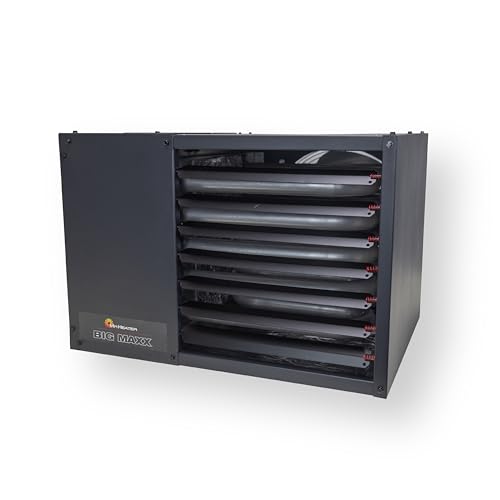
Mr. Heater 50,000 BTU Unit Heater
Best for Three-car garages up to 1,667 square feet
Product 2 is the sensible starting point for most garages because its 50,000 BTU output is rated for up to 1,667 square feet. The ceiling-mounted design keeps floor space open, while thermostat compatibility lets you control the heat without standing under the unit. Its high-temperature safety shut-off and gas safety shut-off flame sensor add useful protection.
Heat output 50,000 BTUCoverage Up to 1,667 square feetMounting Ceiling-mountedCeiling height 10-foot minimumThermostat Standard 24-volt or Wi-Fi enabled thermostats
Why it made the cut
Heats up to 1,667 square feet
Works with 24-volt or Wi-Fi enabled thermostats
Ceiling-mounted design saves floor space
Good to know
Requires a 10-foot minimum ceiling
Needs 8 feet of clearance from the heater base to the floor
Skip it if Skip it if your garage is larger than its 1,667-square-foot coverage or lacks the required ceiling height.
Best for Garages and workshops up to 2,667 square feet
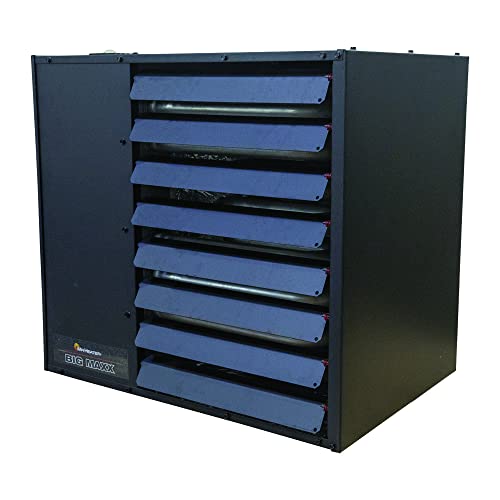
Product 3 steps up to 80,000 BTU for a larger or harder-to-heat workspace, with coverage rated up to 2,667 square feet. It keeps the same ceiling-mounted format and thermostat compatibility as the smaller unit. High-temperature and flame-sensor shut-offs cover two important fault conditions.
Heat output 80,000 BTUCoverage Up to 2,667 square feetMounting Ceiling-mountedCeiling height 10-foot minimumThermostat Standard 24-volt or Wi-Fi enabled thermostats
Why it made the cut
Heats up to 2,667 square feet
Compatible with 24-volt and Wi-Fi enabled thermostats
Ceiling-mounted design leaves the floor clear
Good to know
Requires a 10-foot minimum ceiling
Needs 8 feet of clearance from the heater base to the floor
Skip it if Skip it if your space is close to 1,000 square feet, where this output may be more heater than you need.
Best for Workshops and garages up to 1,000 square feet
Product 4 fits a smaller workspace with an 80,000 BTU rating and coverage listed up to 1,000 square feet. Its included angle brackets simplify ceiling mounting, while the spark ignition and self-diagnostic control module make the ignition system easier to monitor. The 4-inch flue and 1/2-inch gas connection are useful installation details to hand to your installer.
Heat output 80,000 BTU/HrCoverage Up to 1,000 square feetFlue size 4 inchesGas connection 1/2 inchMounting hardware Two angle brackets included
Why it made the cut
Includes two angle brackets
Has spark ignition and self-diagnostic controls
Lists a 4-inch flue size
Good to know
The listed coverage is only up to 1,000 square feet
The data does not list thermostat compatibility
Skip it if Skip it if you need coverage beyond 1,000 square feet or want a heater with stated thermostat compatibility.
Best for Large garages and work areas up to 4,167 square feet
Product 5 is the high-output choice for a large garage, with 125,000 BTU rated to heat up to 4,167 square feet. Its space-saving ceiling mount avoids taking up valuable work area, and the flexible fuel design supports propane or natural gas. Thermostat compatibility makes the output easier to manage than a simple on-or-off setup.
Heat output 125,000 BTUCoverage Up to 4,167 square feetMounting Ceiling-mountedFuel options Propane or natural gasThermostat Standard 24-volt or Wi-Fi enabled thermostats
Why it made the cut
Heats areas up to 4,167 square feet
Supports propane or natural gas
Compatible with 24-volt or Wi-Fi enabled thermostats
Good to know
May be oversized for a typical garage
Propane conversion is optional for listed 200,000-400,000 BTU models and requires a conversion kit
Skip it if Skip it if your garage is within the coverage of a 50,000 or 80,000 BTU heater.
Best for Small spaces up to 200 square feet with an outlet nearby
Product 1 is an electric ceramic heater, so it isn’t a propane garage heater, but it can suit a small space where portable heat matters more than whole-garage coverage. Its thermostat, remote, 24-hour timer and four operating modes make it convenient for brief work sessions. The 45-degree tip-over shutoff, overheat protection and ETL certification are useful safety features.
Heat output 1,500 WCoverage Up to 200 square feetNoise level 35 dBTimer 24 hoursCertification ETL-certified
Why it made the cut
Portable with a handle
Covers up to 200 square feet
Has thermostat, remote and 24-hour timer
Includes tip-over and overheat protection
Good to know
Electric rather than propane
Covers only up to 200 square feet
Uses a 1,500 W output instead of a BTU-rated garage heater
Skip it if Skip it if you need to heat a full garage, lack a nearby wall outlet, or specifically need propane operation.
Propane Heaters for Garages: Which One Fits Your Space
For most propane heaters for garages, the 50,000 BTU ceiling-mounted unit heater is the sensible starting point; larger, draftier or poorly insulated spaces may need 80,000 or 125,000 BTU. That makes the Mr. Heater 50,000 BTU Forced-Air Unit Heater the best garage heater propane buyers should compare first, while the 80,000 BTU and 125,000 BTU models suit tougher heat loads.
Heater size
Good starting fit
What changes the choice
50,000 BTU
Many single- and two-car garages
Moderate insulation, average ceiling height and limited air leakage
80,000 BTU
Larger garages or leaky buildings
Cold winters, tall ceilings, open doors and weak insulation
125,000 BTU
Large or very difficult-to-heat garages
Use only after checking the building’s heat loss and the heater’s installation requirements
BTU is a starting band, not a substitute for checking insulation, ceiling height and winter temperature.
For a 900 sq ft off-grid garage, the best type of propane heater for an offgrid garage is usually an indoor-rated vented propane unit heater in the 50,000 to 80,000 BTU class, sized to the building rather than the floor area alone. Propane supplies the heat instead of electric resistance heat, although a blower or ignition system may still need electricity. A vented setup also sends combustion gases outdoors.
Myth
Fuel-burning propane heaters require proper ventilation and a working carbon monoxide alarm to be safe indoors; do not rely on cracking the garage door open alone.
Fact
Indoor-rated vented units can be installed indoors when the manual, venting and local code allow it; outdoor-only patio, torpedo and construction heaters cannot. Keep a working carbon monoxide alarm in the garage area and follow the required clearances and ventilation instructions.
Good fit
A 50,000 BTU unit covers many ordinary one- and two-car garages.
The 80,000 BTU Mr. Heater models give more capacity for larger or draftier spaces.
A ceiling-mounted unit keeps floor space open for vehicles and tools.
Skip it if
Oversizing can cause short cycling and uneven comfort.
Installation may require gas, venting and electrical work.
A propane unit isn’t a simple plug-in choice for a garage with no approved fuel supply.
The top rated propane garage heaters still need the right installation, so don’t choose by BTU label alone. If you want a portable option rather than a fixed ceiling unit, compare portable propane heaters for garage use—but keep the same indoor-rating, carbon-monoxide and clearance rules in view.
How Much Heat You Need for a 30 by 40 Garage
For a 30 by 40 garage, start with a 50,000 BTU propane garage heater if the building is reasonably insulated and has an ordinary ceiling; move toward 80,000 BTU when the garage is drafty, tall or exposed to severe winter cold. The 1,200-square-foot floor area narrows the choice, but insulation and air leakage decide where you land.
Worked example
Say your 30 by 40 garage has an 8-foot ceiling, insulated walls and a garage door that opens several times a day. A 50,000 BTU ceiling-mounted unit is the sensible starting point. If the same building has an uninsulated ceiling and visible drafts around the door, 80,000 BTU is the more practical starting band; a 125,000 BTU heater deserves a heat-loss calculation rather than a guess.
Length × width30 × 40 ft
Floor area1,200 sq ft
8-foot air volume9,600 cubic ft
12-foot air volume14,400 cubic ft
Garage condition
Starting point
Why
30 × 40 ft, insulated, 8–10 ft ceiling
50,000 BTU
Enough output for a typical enclosed garage without starting oversized
30 × 40 ft, leaky or poorly insulated
80,000 BTU
More heat is lost through the shell and incoming air
30 × 40 ft, tall ceiling or severe winter exposure
80,000 BTU or a heat-loss calculation
The extra air volume and heat loss can outgrow a basic estimate
25 × 15 ft, insulated
30,000–50,000 BTU
Smaller floor area usually needs less output
25 × 15 ft, unheated Canadian prairie garage
50,000 BTU range, after checking heat loss
Wind, air leaks and very low outdoor temperatures can overwhelm a small heater
Use these as sizing starting points, not as a substitute for the heater listing, clearances or local code.
Ceiling height changes the job more than the floor-area number suggests: a 12-foot garage holds 50% more air than an otherwise identical 8-foot garage. Seal the garage-door perimeter, wall penetrations and ceiling before buying the next size up; a tighter 50,000 BTU system can outperform an oversized heater feeding heat into the driveway.
Don’t size by square feet alone
A 125,000 BTU unit may list a large coverage area, but that claim doesn’t replace a heat-loss check for your building. Oversizing can cause short cycling and uneven heat, while an undersized heater may run continuously and still leave the work area cold.
How Long a 20 Lb Tank Lasts
A full 20 lb propane tank holds about 430,000 BTU, so a 50,000 BTU garage heater runs for roughly 8.6 hours at full fire; cycling on and off can stretch that across much of a workday or longer.
430,000 BTU
Approximate fuel in a full 20 lb tank
Propane contains about 91,500 BTU per gallon, and a 20 lb tank holds roughly 4.7 gallons: 91,500 × 4.7 = 430,050 BTU.
Heater input
Full-fire runtime
30,000 BTU/hr
About 14.3 hours
50,000 BTU/hr
About 8.6 hours
60,000 BTU/hr
About 7.2 hours
80,000 BTU/hr
About 5.4 hours
125,000 BTU/hr
About 3.4 hours
Runtime equals about 430,000 BTU divided by the heater’s hourly input. These are full-fire estimates, not guaranteed run times.
A thermostat reduces fuel use by reducing burner time, not by making each flame-hour cheaper. For example, if a 50,000 BTU heater fires for 15 minutes in each hour, its burner averages about 12,500 BTU per hour, so the tank could last roughly four times the full-fire estimate before startup cycles and heat loss are counted.
For a 30,000 BTU tank-top heater, no electrical outlet is needed, but the listed type is intended for well-ventilated or outdoor use. Don’t use a portable or construction-style heater in a garage unless its manual specifically rates it for indoor use and gives the required ventilation and safety controls; a propane connection alone doesn’t make a heater safe indoors.
To estimate your refill cost, divide what you pay for a full refill by the tank’s usable runtime. If your 50,000 BTU heater runs 8.6 full-fire hours, divide the refill charge by 8.6 to find the full-fire hourly cost; cycling makes actual fuel use lower.
Check the heater’s input rating
The BTU number used for runtime is the heater’s fuel input per hour. A larger 125,000 BTU heater can warm a big, leaky garage faster, but it consumes the same 20 lb tank in about 3.4 full-fire hours.
In short
Plan on about 8.6 full-fire hours from a 50,000 BTU heater and 5.4 hours from an 80,000 BTU heater on one 20 lb tank. A properly sized heater that cycles will use less propane per clock hour.
Indoor Safety, Venting and Code Checks
Indoor-only models include safety features like oxygen depletion sensors; outdoor or construction heaters lack these and should never run inside garages without proper ventilation and a working carbon monoxide alarm.
A vented garage unit heater sends combustion products through a flue to the outside, while a ventless model releases combustion products into the room. Ventless propane heaters are restricted or banned in some states and cities, so check local code before buying one.
Carbon Monoxide Risk
Never run an outdoor heater in a garage, basement, tent or vehicle cabin. Incomplete combustion can produce carbon monoxide, and fuel burning also consumes oxygen; symptoms can become dangerous before you realize the heater is the problem.
Every indoor fuel-burning installation needs a working carbon monoxide alarm and the ventilation specified by the manual. An oxygen-depletion sensor is required on indoor vent-free propane models, but it doesn’t replace ventilation, a CO alarm or code approval.
Before You Light It
Confirm the label and manual allow indoor use.
Check local rules for vented and ventless propane heaters.
Install the flue, clearances and ventilation exactly as specified.
Test a working carbon monoxide alarm near the garage access to the home.
Keep outdoor, patio and construction heaters outside.
A Common Mix-Up
Indoor-rated doesn’t mean safe in any room or position. A garage heater may still need a specified ceiling clearance, permanent venting, combustion air or electrical connection, and the manual controls those details.
What the Specs Mean Before You Buy
A propane garage heater should be compared by its installation specs first and its BTU number second. Output tells you how much heat the burner can provide; the ceiling height, clearance, flue, gas connection and thermostat determine whether that heater can actually fit and work safely in your garage.
Spec
What to check
Why it matters
BTU output
50,000, 80,000 or 125,000 BTU
Higher output suits larger or leakier spaces, but an oversized unit can cycle more often.
Heated square footage
The manufacturer’s stated range
Treat it as a starting estimate; insulation, drafts and ceiling height change the result.
Ceiling height and clearance
At least a 10-foot ceiling and 8 feet of clearance below the heater where required
A low garage may rule out a ceiling-mounted unit before BTU enters the discussion.
Flue size
The listed flue diameter and venting arrangement
The flue must match the heater and installation instructions; don’t improvise reducers or elbows.
Gas connection
The required propane line, regulator and connection size
A heater is only as useful as the gas supply feeding it. Have gas work checked by a qualified professional.
Thermostat compatibility
Built-in control, 24-volt compatibility or Wi-Fi thermostat support
Remote control helps when the garage doubles as a workshop and storage room.
Match every installation spec to the garage, not just the heat output.
Measure Before You Buy
Garage length, width and ceiling height
Clearance below the proposed heater location
Distance to walls, storage and other combustible materials
Available flue route and the required flue size
Propane line location and connection requirements
Whether you want a standard 24-volt or Wi-Fi thermostat
The heater’s listed heated-square-foot range
A useful deal-breaker
If your garage can’t provide the required 10-foot minimum ceiling or 8 feet of clearance under the heater, skip that ceiling-mounted model and check its manual and local code before considering another installation. The ceiling is less forgiving than the shopping cart.
Which Pick to Choose for Your Garage
For the best garage heaters propane shoppers are comparing, the 50,000 BTU unit heater is the best overall choice for a typical garage that needs dependable heat and thermostat control. The top rated propane garage heaters in this group separate themselves by fit: bigger output helps a large, leaky space, while smart controls matter when you don’t want to walk across the garage to adjust temperature.
Best Overall: Mr. Heater 50,000 BTU Forc
Suitable starting point for a typical garage
Provides thermostat control without jumping to the largest output
Skip it if
Needs the ceiling height, clearance and venting its installation requires
Best for Large Rooms: Mr. Heater 80,000
More output for a larger or leakier garage
Ceiling-mounted design keeps floor space open
Skip it if
Can be more heater than a small, reasonably insulated garage needs
Best Smart Controls: Mr. Heater 125,000
Works with standard 24-volt or Wi-Fi thermostats
Useful when the garage is part workshop, part storage and temperature control needs to happen remotely
Skip it if
125,000 BTU is a substantial output for many residential garages
Requires careful sizing and installation planning
Best Budget: Mr. Heater Propane Unit Hea
Simpler propane unit-heater setup
Includes angle brackets and fewer extras
Skip it if
Fewer control features than the smart-thermostat pick
Its 80,000 BTU output may be excessive for a compact garage
Fast pick
Choose the 50,000 BTU model for a typical garage, the 80,000 BTU options for a bigger or draftier one, and the 125,000 BTU model only when its output and thermostat features fit the building. The R.W.FLAME Small Space Heaters for Indoor Use is electric, so it isn’t a substitute when you’re specifically choosing a propane unit heater.
Frequently Asked Questions
Can propane heaters be used indoors in a garage?
Yes, but only a propane heater listed for indoor use belongs in a garage. Follow its ventilation and clearance instructions, install a working carbon monoxide alarm, and check local code before connecting fuel or venting.
What size propane heater do I need for a 30 by 40 garage?
A 30 by 40 garage usually starts with 50,000 to 80,000 BTU, depending on insulation, ceiling height, air leakage and your winter temperatures. A poorly insulated space or one with a tall ceiling may need the larger size, but sizing by floor area alone can overshoot the load.
How long will a 20 lb propane tank last on a garage heater?
At full input, a 20 lb tank holds about 430,000 BTU, so a 50,000 BTU heater would run for roughly 8.6 hours. An 80,000 BTU heater would use the same tank in about 5.4 hours; cycling on a thermostat can extend real-world time.
Do I need a vented or ventless propane heater for a garage?
A vented heater sends combustion gases outdoors and is usually the safer choice for regular garage heating. Ventless models add combustion moisture and carbon monoxide to the room, may be restricted by local code, and still require the listed ventilation and safety controls.
What ceiling height do propane garage unit heaters need?
The heater’s installation manual sets the minimum mounting height, overhead clearance and distance from combustibles. Measure from the floor to the ceiling and around doors, lights and stored materials before buying; a BTU rating cannot tell you whether a unit fits safely.
Can I use an outdoor propane heater inside my garage during a power outage?
No. Patio, outdoor and construction heaters aren’t approved for a garage, even with the door open, because their exhaust and combustion controls are designed for outdoor air. Use only an indoor-rated heater installed as directed, and never trade carbon-monoxide safety for backup heat.