For most inground pool owners with a natural gas line, the Hayward H-Series W3H250FDN is the strongest starting pick: it delivers 250,000 BTU and has a cupro-nickel heat exchanger and self-diagnostic controls. Choose a heat pump instead if lower electrical operating costs matter more than rapid heating and your climate gives it enough warm air to work with.
What to remember
Pick the Hayward W3H250FDN as a starting point if you have natural gas and want a 250,000 BTU heater.
Choose a heat pump for steady heating in a climate where outdoor air stays warm enough for the unit to extract heat.
Don’t size a heater from pool surface area alone; confirm pool volume, climate, desired temperature and heater capacity.
Get a licensed pool-heater professional to check gas, electrical, venting and plumbing requirements before installation.
Use a pool cover when the pool is idle; reducing heat loss can matter more than adding heater capacity.
A higher BTU rating can heat pool water faster, but it doesn’t tell you what the heater will cost to run or whether it fits your pool. Fuel availability, pool volume, local weather and how often you swim all change the right choice.
A gas heater is often treated as the obvious choice for an inground pool. That is only half true: it can heat quickly, but a heat pump may cost less to operate when you maintain a steady temperature in a mild climate.
Top Picks for Inground Pools
#1Best Gas Pick
Hayward Natural Gas Pool Heater, 250,000 BTU
Best for Inground pools with a natural gas connection
For a gas-connected pool, this model pairs 250,000 BTU of heat output with a cupro-nickel heat exchanger designed to help resist corrosion from unbalanced water chemistry. Its digital LED display and self-diagnostic controls make temperature and performance checks straightforward.
Heat output 250,000 BTUFuel Natural gasHeat exchanger Cupro-nickelPool-fit information Pools and spas up to 750 sq ft
Why it made the cut
Cupro-nickel heat exchanger
Self-diagnostic controls and digital LED display
Flexible gas and electric connections on the right or left
Good to know
Requires a natural gas connection
Confirm the listed pool-fit information and installation requirements before buying
Skip it if Choose a heat pump instead if lower electrical operating costs matter more than rapid heating and your climate provides enough warm air.
Best for Natural-gas pool owners who want electronic ignition
The intermittent spark ignition pilot lights only when the heater calls for heat, so the pilot isn’t kept on between heating cycles. Its small footprint may suit a tighter equipment area, and the listed material doesn’t retain residual heat after shutoff.
Heat output 206,000 BTUFuel Natural gasModel P-R206A-EN-CIgnition Digital electronic ignition
Why it made the cut
Intermittent spark ignition pilot safety controls
Small footprint
Doesn’t retain residual heat after shutoff
Good to know
Natural gas only
Pool size coverage isn’t specified in the provided product information
Skip it if Skip it if you need a documented pool-size range before choosing a heater.
Best for Owners seeking app control and heating or cooling modes
This heat pump offers app control, heating and cooling modes, and an auto-defrost system. The manufacturer lists a 15.8 COP and a 53 dB operating noise level; check the required 220 V power and pool sizing with the manufacturer before ordering.
Heat output 75,000 BTUPower 220 VHeating range 47–104°FCooling range 47–83°FListed pool dimensions 18′ × 39′ × 48″
Why it made the cut
Heating and cooling modes
App and control-panel operation
Automatic defrost
Good to know
Requires 220 V power
Pool-fit information is given as dimensions rather than a gallons capacity
Skip it if Skip it if you need a gas heater or a clearly stated pool capacity in gallons.
Best for Pools up to 12,000 gallons that need heating or cooling
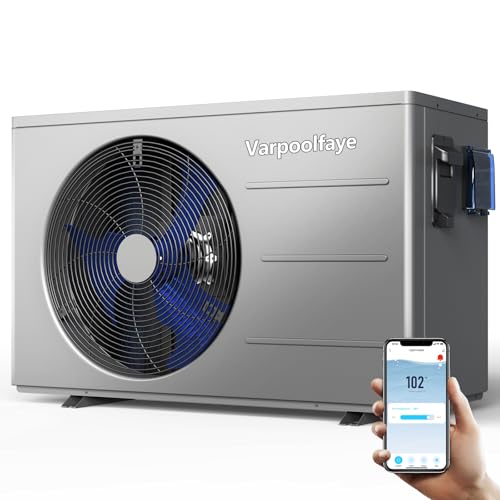
For a pool within its stated 12,000-gallon limit, this model combines a titanium heat exchanger with heating and cooling modes. WiFi app control lets you adjust the temperature and schedule, while the listed connectors are 1.5 inches.
Heat output 40,000 BTUPower 220 VPool capacity Up to 12,000 gallonsCOP 6.2Heat exchanger Titanium
Why it made the cut
Titanium heat exchanger for freshwater or saltwater pools
Heating and cooling modes
WiFi app control
Good to know
Requires 220 V power
Maximum stated pool capacity is 12,000 gallons
Skip it if Choose another model if your pool exceeds 12,000 gallons or you need a natural-gas heater.
Best for Pools up to 10,000 gallons with compatible 110 V power
This heat pump is listed for pools up to 10,000 gallons and uses a titanium heat exchanger. It offers app and touch-panel controls, plus heating and cooling; confirm its fit for your particular inground pool before purchasing because the product information also describes it as an above-ground pool heater.
Heat output 35,000 BTUPower 110 VPool capacity Up to 10,000 gallonsHeat exchanger TitaniumNoise level Below 50 dB
Why it made the cut
Titanium heat exchanger
App and touch-panel controls
Heating and cooling modes
Good to know
Listed for pools up to 10,000 gallons
Product information emphasizes above-ground pools, so inground suitability needs confirmation
Skip it if Skip it if you need a heater with clearly stated inground-pool sizing or higher heat output.
For the best pool heaters for inground pools, choose gas if you want quick heat for occasional swims and have the correct gas supply; choose a heat pump if you’ll maintain a set temperature and your climate provides suitable outdoor air. Gas burns fuel to heat pool water, while a heat pump uses electricity to move heat from outdoor air into the water.
Among pool heaters for inground pools, the Hayward H-Series W3H250FDN is the first natural-gas option to consider: it lists 250,000 BTU, a cupro-nickel heat exchanger and self-diagnostic LED controls. The Raypak 206,000 BTU natural-gas model is another option; its intermittent spark ignition calls the pilot only when heat is needed.
Heater
Listed specifications
A fit when
Hayward H-Series W3H250FDN
Natural gas; 250,000 BTU; cupro-nickel heat exchanger; self-diagnostic LED controls
You want a natural-gas option with a pilot called only when heat is needed.
AQUASTRONG heat pump
75,000 BTU; Wi-Fi control; stated 53 dB
You want a heat-pump option and your outdoor conditions suit heat-pump operation.
Varpoolfaye heat pump
40,000 BTU; 220 V; Wi-Fi; listed for up to 12,000 gallons
Your pool volume fits the maker’s guidance and the required voltage is available.
WARMBLU H10
110 V; listed for above-ground pools up to 10,000 gallons
Not a recommended inground pick without manufacturer confirmation for the exact model.
Specifications are from the supplied product information; listed claims are not guarantees of results in every pool.
Myth
A heat pump is simply a slower gas heater.
Fact
They work differently: a heat pump draws heat from outdoor air and needs electricity, so available heat can fall when the air is colder. Manufacturer savings or coefficient-of-performance claims are claims, not a promise for your climate or pool.
Match a heater to its documented specifications and your pool, then confirm the exact model, fuel, voltage, capacity and local installer requirements before buying. The supplied specifications identify the WARMBLU H10 as an above-ground heater, so ask the manufacturer to confirm that the exact model is approved for inground use before considering it.
Size the Heater to Your Pool and Climate
To size a pool heater for an inground pool, start with the pool’s actual volume and the conditions in which you’ll use it; a BTU rating or advertised pool size alone can’t determine the right heater. If you’re asking, “What size pool heater do I need?” the answer also depends on starting water temperature, your target temperature, desired heat-up time, local weather, wind exposure and whether you use a cover.
Find the pool volume in your pool records or ask your pool professional to confirm it. Don’t estimate a heater size from a listing alone: the Hayward’s stated coverage of up to 750 square feet isn’t a sizing calculation for your particular pool, and Varpoolfaye’s claim of up to 12,000 gallons should be checked against both your pool volume and the maker’s sizing guidance.
Listed size isn’t a guarantee
AQUASTRONG describes a pool measuring 18 by 39 feet by 48 inches. That listing doesn’t guarantee capacity for every climate or target water temperature. Ask the manufacturer or installer to confirm the fit for your conditions.
Myth
A higher BTU rating guarantees faster heating or a lower bill.
Fact
Greater BTU output generally means more heating capacity, but it doesn’t promise a particular heat-up time or lower operating cost. Heat pumps can deliver less heat when outdoor air is colder.
Gather these details before asking for a size
Confirmed pool volume from your records or pool professional
Starting water temperature and desired target temperature
Typical outdoor temperatures during the months you’ll swim
Whether the pool is exposed to wind and whether you use a cover
How quickly you want the water to reach your target
Write those details down, then ask an installer to confirm the heater capacity for your pool; don’t rely on an advertised pool size as a guarantee.
Compare Running Costs Before You Buy
A pool heat pump usually costs less to run than a gas heater when the weather is warm enough for efficient heat-pump operation, but your local rates, run time and heat loss decide the bill. To estimate how much it costs to run an inground pool heater, use the heater’s actual energy input and your utility rate; there’s no reliable dollar figure without both.
For electric equipment, find input watts on the nameplate or in the manual, then calculate: watts ÷ 1,000 × operating hours × electricity price per kWh. For gas, use the heater’s fuel-consumption figure from its manual and your local gas price. Don’t turn BTU output into a cost estimate without verified fuel input and efficiency figures.
Gather These Numbers
Electric heater input watts, or gas heater fuel consumption from the manual
Your electricity price per kWh, or local gas price in the units used by the manual
Typical operating hours and schedule
Your target pool temperature and local weather conditions
Any installer estimate based on your pool and climate
Compare your own utility rates and normal schedule, then ask an installer to estimate operating costs using your pool size, climate and target temperature. Actual use also changes with heater efficiency and how much heat the pool loses.
Myth
A high advertised COP or percentage saving tells you what your bill will be.
Fact
It doesn’t. The result depends on the test conditions and assumptions behind that figure, which aren’t supplied here. Compare those conditions before treating an advertised saving as a forecast.
Check electrical requirements before ordering: the Varpoolfaye listing specifies 220 V, as does the AQUASTRONG listing. A qualified electrician should confirm that your home has a suitable circuit; voltage alone doesn’t establish circuit capacity.
Check Installation, Pool Chemistry and Safety
Pool heater installation requirements include model-specific gas connections, combustion venting, clearances, electrical connections and pool plumbing, all installed to the exact manual and local code. Use qualified professionals for gas and electrical work; pool heater safety and maintenance also depend on following the manufacturer’s instructions.
If you’re buying a natural-gas model, have an installer confirm your available gas supply and connection requirements before you order. The Hayward listing describes a built-in 3/4-inch gas connection and flexible connection orientation, but that doesn’t establish that your supply or installation is compatible.
For a heat pump, confirm voltage, circuit capacity, water connections, airflow clearance, drainage and the manufacturer’s installation conditions before ordering. Don’t assume the unit will fit or work properly just because the voltage matches.
Confirm Before Startup
Installer has checked the site, utility supply and local code
Gas and electrical work will be handled by qualified professionals
Water connections, required clearances and drainage match the manual
You know the manual’s inspection, cleaning, winterization and service schedule
Pool water chemistry will be maintained within the heater manual’s limits
Hayward describes the H-Series cupro-nickel heat exchanger as offering protection against corrosion from unbalanced water chemistry. That protection doesn’t replace routine water testing and chemistry maintenance; unbalanced water can still damage pool equipment.
Stop and Call a Technician
Have a qualified technician investigate ignition problems, gas odors, unusual combustion or repeated error codes. Follow the heater manual for inspection, cleaning and winterization; don’t bypass controls or keep restarting a unit that shows a fault.
Keep More Heat in the Pool Between Swims
To keep an inground pool warm, cover it between swims: water loses heat from its surface, and wind and evaporation speed that loss. A pool heater losing heat may be working normally against cold, exposed water; leaving the pool uncovered in unfavorable weather can make heating expensive, and a larger heater isn’t automatically the fix.
Before assuming the heater has failed, compare the pool’s temperature trend with outdoor conditions and note when you used a cover. Heat pumps also need the open airflow and clearances specified in the manual; don’t box in the unit or block its intake or discharge.
Before Buying or Calling for Service
Use a pool cover between swims and track whether the temperature holds better.
Check heat-pump clearances against the manual; keep intake and discharge airflow clear.
Confirm the utility supply, pool volume and heater settings with the installer.
Call a pool technician if the unit repeatedly shuts down, shows persistent diagnostic codes, smells of gas, or won’t heat despite correct settings and adequate water flow.
Questions People Ask
Which pool heater is best for an inground pool?
For many owners with a compatible natural-gas supply, the Hayward H-Series W3H250FDN is a strong starting pick, with 250,000 BTU output, a cupro-nickel heat exchanger and self-diagnostic controls. The right choice still depends on pool size, local fuel and electricity rates, and how quickly you want the water warmed.
Are pool heat pumps worth it for inground pools?
A heat pump can be a good fit if you swim regularly and can let the water warm gradually in mild weather. Compare its installed cost and your electricity rate with a gas heater’s fuel use; a pool cover can also help limit the heat either system has to replace.
Can a pool heat pump work in cold weather?
Yes, within the operating range set by its manufacturer, but heating output and efficiency generally fall as outdoor air gets colder. Check the model’s minimum operating temperature and expected output at your typical swimming-season temperatures before buying.
How many BTUs does an inground pool heater need?
There isn’t one BTU rating that fits every inground pool: water volume, starting temperature, desired temperature, wind and how quickly you want to heat all matter. Use the heater manufacturer’s sizing guidance with your pool’s actual volume and local conditions rather than choosing from a claimed maximum pool size alone.
Can I install a natural-gas pool heater myself?
Don’t take on the gas connection or combustion venting unless local rules and your qualifications allow it; in many places, a licensed professional should handle that work. Incorrect gas sizing, venting or clearances can create fire and carbon-monoxide hazards, and the heater’s manual and local code govern installation.
Does a pool cover reduce heating costs?
Yes. A cover slows heat loss from the water surface, especially evaporation, so the heater has less work to do between swims. Use a cover made for pools and follow its instructions; remove it before swimming.
How often should an inground pool heater be serviced?
Follow the maintenance schedule in the heater’s manual, and have a qualified technician inspect it at the interval the manufacturer specifies. Arrange service sooner if you notice repeated shutdowns, unusual noises, soot, a gas smell or water leaking around the unit.