Skip to content
HeaterGuides
Electric

Best On Demand Electric Water Heater for Instant Hot Water

On this page 8 sections
  1. Electric Water Heater Comparison
  2. The Best Electric Heaters for On-Demand Hot Water
  3. Tankless Electric Hot Water: Wattage Use Per Hour
  4. Match the Heater to the Fixtures You Use
  5. Check the Panel Before You Buy
  6. Compare Electric and Gas for Your Home
  7. Keep Installation and Water Quality Safe
  8. More Questions, Answered
Straight answer
For whole-home hot water, the Rheem RTEX-24 is the strongest pick here: it’s a real 24 kW electric tankless unit rated for up to 5.9 GPM. It needs a 240 V supply, three 40 A double-pole breakers and a recommended 200 A service panel, so confirm your electrical capacity before you buy.
The essentials
Choose the Rheem RTEX-24 for whole-home use only if your electrical service can support its specified wiring.
A 3,000 W, 110 V mini heater is a low-flow point-of-use option, not a whole-house replacement.
The CAMPLUX stores 4 gallons, so it is a small tank heater rather than a tankless model.
A tankless heater’s energy use per hour depends on its operating wattage and how long it runs.
Have a licensed electrician check the panel and wiring before installing a whole-home electric tankless unit.

Electric Water Heater Comparison

RankModelBest forPowerVoltageFlow or capacityPrice
1Multiple fixtures and homes with the required electrical service24 kW240 VUp to 5.9 GPMCheck price
2
CAMPLUX 4-Gallon Electric HeaterEasy Point-of-Use Pick
A sink or small fixture that needs stored hot water nearby1.44 kW110V/120V4 gallonsCheck price
3One kitchen or bathroom sink with a short hot-water run3,000 W110 V0.3–0.5 GPMCheck price
4
xwdzswgs 3,000W Vertical HeaterVertical-Install Option
A compact under-sink installation where vertical mounting works3,000 W110 V0.3–0.5 GPMCheck price
5A small sink installation that needs a compact 110V heater3,000 W110 V0.3–0.5 GPMCheck price

The most common mistake is treating a small 110 V under-sink heater as a whole-house shower unit. At 3,000 W, these models are for low-flow point-of-use jobs; buying one for several fixtures can leave you with a very expensive trickle.

The picks below separate whole-home heating from sink-side hot water. That distinction matters more than the word “instant” on the box.

The Best Electric Heaters for On-Demand Hot Water
#1Whole-home pick
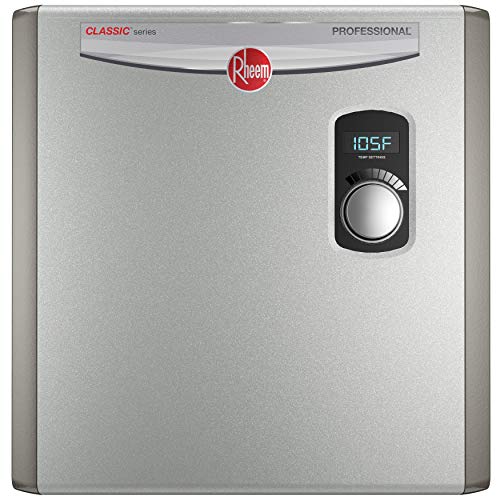
Rheem RTEX-24 24kW Tankless

Rheem RTEX-24 24kW Tankless

Best for Multiple fixtures and homes with the required electrical service
The Rheem RTEX-24 is the only full-size whole-home option here, with 24 kW of heating power and up to 5.9 GPM for multiple fixtures. Its 80°F–140°F digital control adjusts in 1-degree increments, but the three 40-amp double-pole breakers and recommended 200-amp service panel make electrical planning mandatory.
Power 24 kWVoltage 240 VFlow Up to 5.9 GPMTemperature range 80°F–140°FElectrical requirement Three 40-amp double-pole breakers
Why it made the cut
Up to 5.9 GPM
1-degree temperature adjustment
Designed for multiple fixtures
Good to know
Requires three 40-amp double-pole breakers
Needs a recommended minimum 200-amp service panel
Skip it if Skip it if you only need hot water at one sink or your electrical service cannot support the installation.
#2Easy Point-of-Use Pick
CAMPLUX 4-Gallon Electric Heater

CAMPLUX 4-Gallon Electric Heater

Best for A sink or small fixture that needs stored hot water nearby
The CAMPLUX uses a 4-gallon glass-lined tank, so it keeps a small reserve ready instead of heating a whole home’s supply. Its 1.44 kW, 110V/120V setup uses a 43.3-inch cord, and three temperature settings run from 68°F to 140°F.
Power 1.44 kWVoltage 110V/120VCapacity 4 gallonsTemperature range 68°F–140°FConnections 1/2-inch NPT
Why it made the cut
4-gallon capacity
Cord plugs into a 110V/120V supply
Freezing mode helps protect the tank
Good to know
Limited 4-gallon capacity
Not a whole-home tankless heater
Skip it if Skip it if several fixtures need hot water at the same time.
#3Fast Sink Heating
xwdzswgs 3,000W Under-Sink Heater

xwdzswgs 3,000W Under-Sink Heater

Best for One kitchen or bathroom sink with a short hot-water run
This compact 3,000W unit is sized for point-of-use heating under a kitchen or bathroom sink. The digital display, 1/2-inch NPT connections and listed protection against leakage, dry burning and overheating make it a practical small-fixture choice.
Power 3,000 WVoltage 110 VFlow 0.3–0.5 GPMTemperature performance 82°F rise at 0.3 GPM; 131°F rise at 0.5 GPMConnection 1/2-inch NPT
Why it made the cut
Heats water in 3–5 seconds
Compact wall-mounted design
IPX4 and dry-burning protection
Good to know
Flow is limited to 0.3–0.5 GPM
Only uses a 110V supply
Skip it if Skip it if you need hot water at multiple fixtures or a stronger shower flow.
#4Vertical-Install Option
xwdzswgs 3,000W Vertical Heater

xwdzswgs 3,000W Vertical Heater

Best for A compact under-sink installation where vertical mounting works
The stainless steel and ABS housing keeps this 3,000W heater compact for a kitchen, bathroom, RV or camping setup. Its LED display and leakage, dry-boil and overheat protection cover the basics, but the unit must be installed vertically.
Power 3,000 WVoltage 110 VFlow 0.3–0.5 GPMTemperature performance 82°F rise at 0.3 GPM; 131°F rise at 0.5 GPMConnection 1/2-inch NPT
Why it made the cut
Compact wall-mounted design
Heats at 0.3–0.5 GPM
Includes leakage and dry-boil protection
Good to know
Vertical installation only
Limited to 110V power
Skip it if Skip it if your available mounting space requires horizontal installation.
#5ETL-Listed Mini
xwdzswgs 3,000W ETL Heater

xwdzswgs 3,000W ETL Heater

Best for A small sink installation that needs a compact 110V heater
This mini heater provides 3,000W of point-of-use heating with an LED display and a wall-mounted design. Its ETL listing, IPX4 protection and automatic shutoff for overheating or inactivity suit a single sink, while the 0.3–0.5 GPM flow keeps its role firmly local.
Power 3,000 WVoltage 110 VFlow 0.3–0.5 GPMTemperature performance 82°F rise at 0.3 GPM; 131°F rise at 0.5 GPMConnection 1/2-inch NPT
Why it made the cut
ETL listed
Automatic overheat and inactivity shutoff
Compact wall-mounted design
Good to know
Limited to 0.3–0.5 GPM
Vertical installation only
Skip it if Skip it if you want whole-home hot water or need more than one fixture supplied at once.

Tankless Electric Hot Water: Wattage Use Per Hour

tankless electric hot water on demand wattage use per hour: Tankless Electric Hot Water: Wattage Use Per Hour

A 24 kW electric tankless water heater uses 24 kWh if it runs at full output for one hour; actual on-demand electric water heater energy use depends on water flow, incoming temperature, and how long your taps run. That’s the direct answer to tankless electric hot water on demand wattage use per hour and power consumption electric tankless water heater. Electric tankless heaters warm water as it passes through heating elements, rather than keeping a tank hot between uses.

A unit’s rated kilowatts describe its maximum heating power, not its constant draw. Some systems reduce power as demand drops or water needs less heating; this is a general operating concept, not a feature you should assume unless the product specifications say so. A 110 V mini model draws far less power, but heats far less water. The listed 3,000 W models aren’t whole-home equivalents.

Full-Output Cost Example
At an assumed electricity rate of 17 cents per kWh, a 24 kW unit running at full output for 10 minutes uses 24 kW × ⅙ hour = 4 kWh, costing about 68 cents. One hour at full output uses 24 kWh and costs $4.08. Those are full-output examples, not a prediction for intermittent household use; a shorter shower or lower flow means less runtime and energy.
Full output for 10 minutes4 kWh
Assumed rate$0.17/kWh
Cost for 10 minutes24 kWh for one hour at full output

To estimate your own use, multiply the unit’s power in kilowatts by the hours it actually heats water, then multiply by your electricity rate. For example, 3,000 W is 3 kW; at full output for 10 minutes, that’s 3 × ⅙ = 0.5 kWh. How do residential electric tankless water heaters keep hot water on demand? Sensors and controls activate the elements when water flows, so the heater warms it on the way through; how an electric on-demand tankless water heater works doesn’t mean hot water is unlimited or instantaneous at a distant tap.
From HeaterGuides · our own guidePages 9 to 13 are the fault flowcharts: no hot water, noises, smells and leaks, in order.Water Heater Owner's Toolkit: the printable guide and its Excel calculatorWater Heater Owner's ToolkitFix the common faults yourself, keep it running for years, and know when a repair is money wasted.No-hot-water flowcharts, gas and electricFlush, anode, relief valve and descaling stepsRepair-or-replace calculator (Excel)$14.99 $9.99Get it for $9.99See what's inside and watch the 2-minute video →18-page printable PDF + Excel calculator · instant download · 30-day refund

Match the Heater to the Fixtures You Use

Choose a whole-home unit for multiple fixtures only if it can handle your cold-season temperature rise and simultaneous flow; for one sink, a point-of-use heater or small storage tank may fit better. If you’re deciding on an on-demand hot water heater electric or water based for shower use, size for the shower’s flow and incoming-water temperature, not the word “instant.”

TypeBest fitCapacity check
Whole-home tanklessSeveral fixtures or a full homeFlow depends on incoming temperature and required temperature rise; Rheem’s up-to-5.9 GPM isn’t guaranteed at every winter inlet temperature.
Point-of-use mini heaterOne nearby sink or a limited loadListed mini-heater claims of 0.3–0.5 GPM and temperature rise are point-of-use guidance, not proof of shower capacity.
Small storage tankA sink with a wait for hot waterThe CAMPLUX holds 4 gallons; it can reduce sink wait, but its stored supply is finite and needs time to recover.
Match the listed capacity to the fixture’s actual flow and the coldest incoming water you expect.

A tankless electric shower head is a separate point-of-use product category, not a substitute for a whole-home heater. Check its listed flow, electrical requirements, and local code; don’t assume it can supply another fixture. For a single sink, compare purpose-built under-sink water heaters with inline options before choosing.

Myth
“Instant” means unlimited hot water at any flow.
Fact
A tankless heater warms water as it passes, but its output is limited by heating power and the temperature rise required. More simultaneous flow or colder inlet water can leave less capacity per fixture.

Can an on-demand electric heater be used with an existing electric water heater? Sometimes, if each appliance is installed for its intended load and the water connections follow its instructions; don’t assume they can share a circuit or be connected in series. Two units can serve separate loads only after checking the panel capacity and both manufacturers’ instructions. Have a plumber assess the water layout and an electrician assess electrical capacity. For filtration, follow the heater’s stated water-quality and maintenance instructions; product details must specify any required filter type.

Check the Panel Before You Buy

An on-demand electric water heater may need far more electrical capacity than a normal appliance, so check the panel before comparing features. The Rheem RTEX-24 draws 100 amps at full 24,000-watt output because 24,000 W ÷ 240 V = 100 A, yet its installation instructions specify a particular three-circuit arrangement.

Heater or requirementWhat to check
Rheem RTEX-24240 V single phase; three 40 A double-pole breakers; three sets of #8 AWG copper conductors with ground; recommended minimum 200 A service panel
3,000 W, 110 V heaterAbout 27 A at rated output; confirm the exact wiring instructions because this isn’t a standard plug-in appliance
Existing home serviceAvailable amperage, panel space, voltage, wire routing and local code
The manufacturer’s wiring arrangement takes priority over a simple amp calculation.
Don’t Make This a DIY Wiring Job
Installing a whole-home electric tankless heater yourself generally isn’t a safe DIY project. A licensed electrician should assess the service, breakers and conductors, while a licensed plumber should handle the water connections as local rules require; 240 V and a leak make poor teachers.

The wiring for an on-demand electric hot water heater must match the exact model, including breaker size, conductor size, grounding and disconnect requirements. A 110 V, 3,000 W unit pulls about 27 A at full output, so have an electrician assess the circuit instead of treating it like a device for a regular receptacle.

1
Read the nameplate
Confirm voltage, wattage, phase and the manufacturer’s breaker and conductor requirements.
2
Inspect the service
Have an electrician check the main service rating, open panel spaces, existing loads and the path for new conductors.
3
Check the plumbing location
Have a plumber verify pipe size, shutoff access, connections and room for the heater.
4
Confirm the permit path
Ask the electrician and plumber which permits, inspections and local code requirements apply before buying.

An older mobile home may be changed from an electric tank to an on-demand system, but the answer depends on service capacity, available space, plumbing and local code. Get an electrician and plumber to assess it first. An existing gas fireplace also proves very little: gas-pipe capacity, venting and permits still need professional review.

Compare Electric and Gas for Your Home

On-demand hot water can use electricity or natural gas; UV is not a water-heating fuel. Electric tankless heaters avoid combustion and fuel-gas venting, while gas models need suitable gas capacity and approved venting.

Myth
A gas fireplace means the home can add a gas tankless water heater.
Fact
A fireplace doesn’t establish that the gas piping can supply another appliance or that suitable venting exists. A professional must review gas capacity, venting and permits.
OptionMain advantageMain limitation
Electric tanklessHeats during use without combustion or a fuel-gas ventCan require substantial electrical service, such as the RTEX-24’s recommended 200 A panel
Gas tanklessCan suit homes with adequate gas supply and compliant ventingNeeds gas piping, combustion air and venting reviewed professionally
Traditional tankStores a limited reserve and may fit more easily into existing electrical serviceKeeps stored water hot and can run out during extended use
The better choice depends on the service already available and the hot-water demand.

Compared with a traditional tank, an on-demand heater warms water during use instead of maintaining a stored reserve. Choose electric tankless when avoiding combustion matters and the electrical service can support the load; choose gas tankless when the home already has adequate gas capacity and compliant venting. A home with an electric tank can switch to gas only after those conditions are confirmed.

If gas fits your home, compare on demand gas water heaters tankless by gas input, flow rate, venting and installation requirements rather than by the word instant alone.

Keep Installation and Water Quality Safe

For best filtration with an on-demand electric water heater, follow the unit manual’s instructions for sediment and scale control; there’s no universal filter that suits every model. To install a tankless electric water heater safely, verify the exact model’s certification and manual, then use licensed tradespeople where required and follow local rules.

Don’t assume one model’s listing or safety features apply to the others. The CAMPLUX Hot Water Heater 4 Gallon product data identifies it as UL listed; the other listings don’t provide consistent certification information to confirm the same for every pick. Protective features don’t replace correct grounding, breaker sizing, sound plumbing connections or required inspections.


1
Check the exact model
Confirm its recognized certification and read its installation manual. Don’t rely on a product title or marketing claim as proof that a different model is certified.
2
Use the right tradesperson
Have a licensed plumber handle water connections where required. A licensed electrician should handle 240 V work; local requirements vary.
3
Follow installation limits
Some 110 V mini models specify vertical-only installation. Follow that instruction, and don’t assume a compact unit is suitable for an RV or bathroom based only on marketing copy.
4
Plan water-quality maintenance
Hard water and sediment can affect maintenance needs. Follow the manual for flushing or scale control rather than buying an unverified universal filter.
Don’t assume it plugs in
A 110 V label doesn’t establish that a unit is plug-in, certified for your intended location or suitable for your plumbing. Confirm the exact model’s electrical requirements, installation position and permitted use before connecting it.

More Questions, Answered

How many amps does an electric tankless water heater need?
The draw depends on the unit’s kilowatt rating and supply voltage: a 24 kW heater on 240 V draws about 100 amps total at full output. The Rheem RTEX-24 splits that load across three 40 A double-pole breakers, so check the manufacturer’s wiring diagram and your service capacity rather than relying on one breaker rating.
Can you install an electric tankless water heater yourself?
A homeowner can sometimes handle the plumbing, but the high-amperage wiring and breaker work should be done by a licensed electrician where required by local code. The electrician can verify panel capacity, wire sizing, grounding and permit requirements before the unit is connected.
Can an electric tankless heater work with an existing electric water heater?
Yes, in some systems it can be installed in series with a storage tank, but the plumbing arrangement and controls must match both manufacturers’ instructions. A tankless unit may also serve a distant fixture while the tank supplies the rest of the home; have a plumber check the layout to avoid unwanted temperature swings or excessive heating.
Can an older mobile home be converted from a tank to an electric tankless water heater?
Possibly, but the existing electrical service is often the deciding constraint: a large whole-home unit may require a panel upgrade and substantial wiring changes. Check the home’s service rating, available panel space, local mobile-home requirements and the heater’s installation instructions before choosing a model; a smaller point-of-use unit may be more practical.

Joye Editor

HeaterGuides covers home heating, water heating and HVAC: how the equipment works, what it costs to run, and how to use it safely.

More in Electric