Best Under-Sink Water Heaters for Instant Hot Water
On this page 7 sections
- Under-Sink Heater Specs Compared
- Ranked Under-Sink Water Heater Picks
- How to Choose an Instant Hot Water Heater Under the Sink
- Size the Heater for the Faucet and the Wait
- Check the Outlet, Circuit and Plumbing Before Installation
- Keep the T&P Valve and Water-Heater Insulation Intact
- Questions People Ask
Under-Sink Heater Specs Compared
| Rank | Model | Best for | Capacity or power | Electrical supply | Mounting | Price |
|---|---|---|---|---|---|---|
| 1 | Bosch Tronic 3000 T 2.5-GallonBest Overall | Most sinks where you want hot water close to the faucet | 2.5 gallons | 120 volts; 12 amps | Shelf, wall or floor | Check price |
| 2 | ThermoMate 2.5-Gallon Mini TankBest Temperature Range | A single sink that needs a plug-in mini-tank with an adjustable thermostat | 2.5 gallons | 110V 120V plugin | Shelf, wall or floor | Check price |
| 3 | xwdzswgs 3000W Tankless HeaterBest Stated Flow Data | A buyer considering tankless who can verify the circuit and flow needs | 3,000 W | 110V | — | Check price |
| 4 | xwdzswgs 3000W Tankless HeaterBest Compact Tankless | A buyer prioritizing a wall-mounted tankless unit and checking its electrical fit first | 3,000 W | 110 volts | Wall-mounted | Check price |
| 5 | R.W.FLAME 1500W Ceramic Space HeaterNot a Water Heater | Room heating only; it does not heat sink water | 1,500 W | — | — | Check price |
A small heater under the sink can end the wait caused by a long pipe run, but “instant” describes where the hot water is stored or made—not a promise of unlimited flow.

One common belief is only half true: tankless heaters don’t store water, but that doesn’t automatically make them the better fit. At a sink, a mini-tank’s ready supply can be more useful than a high-wattage unit with strict wiring needs.
Ranked Under-Sink Water Heater Picks
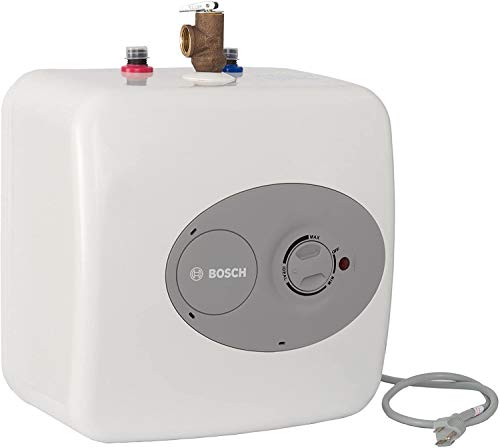
Bosch Tronic 3000 T 2.5-Gallon

ThermoMate 2.5-Gallon Mini Tank

xwdzswgs 3000W Tankless Heater

xwdzswgs 3000W Tankless Heater

R.W.FLAME 1500W Ceramic Space Heater
How to Choose an Instant Hot Water Heater Under the Sink
Choose an instant hot water heater under sink by matching its heating method, electrical supply and listed use to the faucet. A mini-tank stores a small reserve near the sink; a tankless unit heats water as it flows. An under sink water heater or under the sink water heater can be either type, so check the model rather than the label.
| Check | Mini-tank | Tankless |
|---|---|---|
| Hot water | Draws from a finite stored reserve | Heats water while it flows |
| Electrical supply | Verify voltage and wattage on the model | Verify voltage and wattage; demand depends on flow and temperature rise |
| Fit and mounting | Check dimensions, connections and mounting instructions | Check dimensions, mounting instructions and required connections |
| Controls | Check thermostat and temperature range | Check temperature controls and stated temperature-rise figures |
For the listed BOSCH Tronic 3000 T 2.5-gallon model, the product information says 120 volts and service for up to two sinks. The ThermoMate listing describes single-point or in-line use. You can connect a point-of-use heater to a hot-water line only if that model’s instructions allow it; don’t assume every under-sink unit supports that setup.
Terms such as IPX4, compact wall mounted design, smart self-diagnostic and digital display touchscreen are useful only when they appear in the specific model’s documentation. “Under sink heater Shanghai” identifies neither a rating nor a safe installation: check the model listing, instructions, voltage and local code. Keep the mini-tank-versus-tankless comparison, but replace claims about durability or easy installation with verifiable specs; remove invented testing and unlisted products. For more choices, see small electric water heaters for under your kitchen sink.
 Water Heater Owner's ToolkitFix the common faults yourself, keep it running for years, and know when a repair is money wasted.No-hot-water flowcharts, gas and electricFlush, anode, relief valve and descaling stepsRepair-or-replace calculator (Excel)
Size the Heater for the Faucet and the Wait
Instant hot water systems work by reducing the distance hot water must travel or by heating it near the faucet. A point-of-use heater can shorten the wait from a long pipe run; a whole-house tankless heater doesn’t make hot water arrive instantly at every distant faucet.
| System | What it does | Limit to keep in mind |
|---|---|---|
| Mini-tank | Stores hot water near the faucet | A 2.5-gallon tank has a finite reserve, not enough to promise a shower supply |
| Point-of-use tankless | Heats water at the faucet as it flows | Flow and the model’s stated temperature rise determine performance |
| Recirculation | Moves hot water through existing pipes | Needs a compatible system; it moves water rather than adding a local heater |
Tankless water heaters provide instant hot only after water reaches the heater, and the faucet still needs time for the heated water to travel through its branch pipe. For tankless models, greater flow leaves less time to heat each gallon. Use the product’s stated temperature-rise figures at the intended flow; don’t assume a particular faucet temperature from the voltage or product title alone.
A 2.5-gallon mini-tank provides a limited draw, not an unlimited shower. To get instant hot water in a shower, use a correctly sized whole-house heater or another system designed for that demand. Tankless water heaters provide instant hot at the heater, but not necessarily at a remote shower; a recirculating system for tankless water heaters must be compatible with the heater and its instructions. For more on point-of-use tankless options, see point-of-use tankless water heaters.
Check the Outlet, Circuit and Plumbing Before Installation
Before under sink water heater installation, check the unit’s nameplate and manual against your outlet, circuit and plumbing; installing an instant hot water heater safely depends on that match. The BOSCH Tronic 3000 T listing specifies 120 volts and 12 amps. By comparison, a 3,000-watt, 110-volt listing implies about 27 amps (3,000 ÷ 110), so don’t assume a standard receptacle or existing branch circuit can carry it.
Installing an instant electric water heater means following the exact manual for voltage, circuit, wire, mounting orientation, water connections and required protection. Have a licensed electrician handle new or altered circuit work. There’s no universal breaker size for an instant hot water shower: use the unit’s nameplate and installation manual, and have an electrician size the circuit.
For installation, shut off the water, confirm the mounting surface and clearances, then follow the manufacturer’s plumbing diagram. Fill a tank completely before energizing it; powering an empty tank can damage its heating element. These are pre-installation checks, not a complete DIY procedure.
Can you DIY on-demand water heaters? Some owners can handle work their local code permits, but electrical and plumbing rules vary. Installing 240-volt instant hot water, gas connections, venting or a T&P discharge line generally calls for a licensed trade in most places. If an instant hot water tap causes a short circuit or trips its breaker, stop using it and have the wiring and appliance checked; don’t keep resetting the breaker.
Keep the T&P Valve and Water-Heater Insulation Intact
A mini-tank’s temperature-and-pressure (T&P) valve must stay installed, and its discharge line must never be capped or plugged. Follow the heater’s instructions and local code; water-heater plumbing work, including changes to that line, often requires a licensed plumber.
Tankless heating elements can lose heat-transfer efficiency as scale builds up. To descale an instant hot water heater, use only the procedure and products specified by its manufacturer; don’t guess at chemicals or flushing steps. An electrical charging device isn’t a proven substitute for a water softener unless there’s evidence it treats the hardness in your water.
A condensing heater is a whole-house gas-heater design, not a meaningful upgrade category for the 120-volt under-sink mini-tanks here. If you’re choosing among these point-of-use models, compare tank storage and electrical requirements instead.
A mini-tank uses electricity to keep stored water hot; a tankless model uses electricity while water flows, so neither has a universal running-cost advantage. For example, at an assumed 17 cents per kWh, a 1,500-watt heater running for one hour costs 1.5 × $0.17, or about 26 cents; actual use depends on the unit and how much hot water you draw.