Best Oil Filled Radiator Heater Made in USA: 12.5 A Draw
On this page 9 sections
- Oil Filled Radiator Heater Comparison
- Best Oil Filled Radiator Heaters For 2026
- Are Any Of These Actually Made In The USA
- Which Pick Fits Your Room And Routine
- How Much Electricity These Heaters Use
- What To Check Before You Buy
- Safety, Air Quality, And Maintenance
- What Competitors Leave Out
- Frequently Asked Questions
Say your bedroom is 12 by 14 feet and you want steady heat for eight hours after work. A 1,500 W oil-filled radiator uses 12 kWh in that stretch, so at 17 cents per kWh you’re around $2.04 for the night before thermostat cycling.
That is the right way to shop these heaters: first check whether the model is actually built for your room and your outlet, then check the controls, safety cutoffs, and whether the brand can back up its country-of-origin claim.
Oil Filled Radiator Heater Comparison
| Model | Best for | Heat output | Safety | Controls | Room fit | Price |
|---|---|---|---|---|---|---|
| De’Longhi Dragon Digital Oil Filled Radiator | Best Overall | 1500W | Overheat, tip-over | Digital panel, 24-hour timer | Full room | Why it is here |
| PELONIS Champagne Oil Filled Radiator Heater | Most Features | 1500W | Overheat, tip-over | Remote, 10-hour timer | Large rooms | Why it is here |
| DREO Radiator Heater with Eco Mode | Smart Energy | 1500W | Triple overheat, tilt switch | Touchscreen, 24-hour timer | Large rooms | Why it is here |
| De’Longhi EW7707CM Oil Filled Radiator Heater | Energy Efficient | 1500W | Overheat, tip-over | Manual dials | Bedroom, office | Why it is here |
| Amazon Basics Portable Oil Radiator Heater | Budget Pick | 1500W | Overheat, tip-over | Manual switch | Up to 144 sq ft | Why it is here |
Best Oil Filled Radiator Heaters For 2026
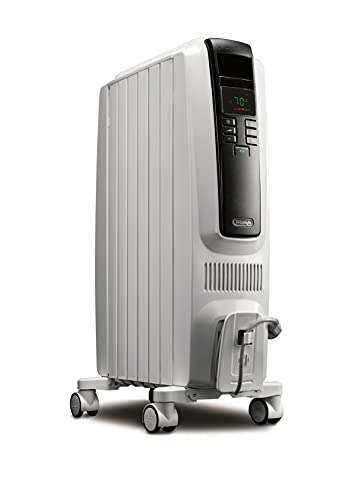
De’Longhi Dragon Digital Oil Filled Radiator

PELONIS Champagne Oil Filled Radiator Heater

DREO Radiator Heater with Eco Mode
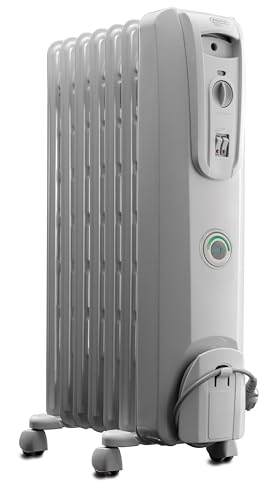
De’Longhi EW7707CM Oil Filled Radiator Heater

Amazon Basics Portable Oil Radiator Heater
Are Any Of These Actually Made In The USA

None of the oil filled radiator heaters covered here are clearly verified as made in the USA. Brands like De’Longhi and Pelonis often highlight design or company headquarters in other countries, but that doesn’t mean the heaters themselves were manufactured in the United States.
Many listings say a heater is “designed in the USA” or “distributed by a US company.” Those phrases refer to where the product is developed or marketed, not where it’s built. Actual manufacturing often happens overseas, commonly in Italy or China.
To verify where a heater is made, check the metal nameplate on the unit, the packaging carton, or the user manual—those must list the country of origin. You can also ask the seller directly in writing for confirmation. If none of these sources say “Made in USA,” assume it was made elsewhere.
If you want a reliable heater but can’t confirm US manufacture, focus instead on verified safety features like tip-over and overheat protection, the size of the room it can heat, and control options such as programmable timers or ECO modes. These specs matter more for performance and safety than country of origin.
Oil filled radiators are generally good heaters for quiet, steady warmth. They use sealed diathermic oil to retain heat and circulate it through metal fins, operating silently and efficiently. They heat slower than fan heaters but keep rooms warm longer after shutting off.
For example, the De’Longhi Dragon Digital TRD40615E is designed in Italy and has features like a 24-hour timer and ECO mode, but the country of manufacture isn’t clearly stated in public specs or seller listings. Pelonis models similarly do not claim US manufacture outright.
If you’re searching for a heater made in the USA, you’ll need to examine each product’s labeling carefully or contact the manufacturer. Currently, no popular oil filled radiator heater model widely available in the US market clearly states full US manufacture.
Buying an oil filled radiator heater is practical when you prioritize safety, energy efficiency, and control features. Until a model clearly confirms US manufacture, focus on these functional details to get the best heater for your needs.
If you want to see ratings and features that matter, check our detailed comparisons of the best oil filled radiator heaters, including the De’Longhi and Pelonis models, which balance safety, energy use, and quiet operation well despite unclear origin claims.
To choose the best heater for your room and daily routine, see our next section, which ranks models by size, controls, and noise level to help you find the right fit without guessing on country of manufacture.
 Winter Heating Bill CutterSee what every heater in your home really costs, heat the rooms you use, and cut the waste in 30 days.Cost-per-hour tables for every heaterThermostat schedule and draft-proofing planRunning-cost and bill calculator (Excel)
Which Pick Fits Your Room And Routine
Oil filled radiator heaters are prized for steady, quiet heat and energy efficiency, thanks to sealed diathermic oil circulating inside metal fins. They heat slower than fan heaters but keep warmth longer and typically include adjustable thermostats for consistent comfort. Most models have safety features like tip-over switches and thermal cut-off, making them a safe, fan-free choice for bedrooms and offices.
Choosing the right oil filled radiator depends on your room size, noise tolerance, and control preferences. The De’Longhi Dragon Digital TRD40615E leads overall with its 24-hour timer, ECO Plus mode, and larger radiant surface area, making it versatile for many rooms and routines. It has a digital LED control panel that simplifies setting and monitoring heat levels but is heavier than simpler models.
For large rooms, the PELONIS model stands out with 1,500 watts of power and 108 thermal vents that spread heat efficiently across a wider area. It offers three heat modes and an ECO setting to save energy. Its heavier weight and slower warm-up time are trade-offs for its strong output and heat diffusion.
If silence is critical, the De’Longhi EW7707CM or the Amazon Basics Portable Oil Radiator Heater both operate without fans, producing no distracting noise. The De’Longhi EW7707CM weighs about 23 pounds and suits medium to large rooms quietly, while Amazon Basics keeps things simple and quiet at a lower cost, though it warms up more slowly and offers fewer controls.
Budget-conscious buyers get good value with the Amazon Basics model. It delivers three heat settings, essential safety features like ETL certification and tip-over protection, and straightforward operation. Its simplicity means fewer adjustable options and a slower heat-up compared to pricier models.
Smart controls matter if you want remote operation, child lock, or detailed heat schedules. The DREO Radiator Heater includes an LED display, touchscreen, remote control, mute and screen-off modes, plus a 24-hour timer and eco control. This advanced interface adds convenience but comes with a higher price and a heavier unit.
| Model | Best For | Key Features | Main Drawback |
|---|---|---|---|
| De’Longhi Dragon Digital TRD40615E | Best overall | 24-hour timer, ECO Plus mode, digital LED control, wide radiant surface | Heavier and pricier |
| PELONIS Oil Filled Radiator Heater | Large rooms | 1,500 W, 108 thermal vents, 3 heat modes, ECO mode | Slow warm-up, heavy |
| De’Longhi EW7707CM | Quietest | Fan-free, suitable for medium-large rooms, quiet operation | Heavier, fewer controls |
| Amazon Basics Portable Oil Radiator Heater | Best budget | 3 heat settings, ETL certified, tip-over protection, quiet | Slower heat-up, less precise control |
| DREO Radiator Heater | Smart controls | LED display, touchscreen, remote, child lock, timer, eco mode | More expensive, heavier |
How Much Electricity These Heaters Use
Oil filled radiator heaters are almost 100% efficient at turning electricity into heat at the outlet, just like any resistance heater. They don’t create magical savings but convert every watt of electrical energy into warmth for your room.
A typical oil filled radiator heater runs at 1,500 watts. That means it draws 1.5 kilowatt-hours (kWh) of electricity for every hour the heating element is on. If you run the heater continuously for 8 hours, it consumes 12 kWh (1.5 kW × 8 h). At an average electricity cost of 17 cents per kWh, this adds up to about $2.04 per night.
Running the heater every day for 30 days at full power would total roughly 360 kWh and $61.20 on your electric bill. Real use usually costs less because the thermostat cycles the heater off when the room reaches the set temperature, so it doesn’t run at full power all the time.
Oil filled radiators heat slower than fan heaters but continue releasing stored heat from their oil after the power cuts off. This reduces temperature swings, keeping the room warmer longer and often requiring less cycling on and off. Fan heaters blow hot air quickly but cool immediately when switched off.
Although fan heaters might warm a room faster, oil filled radiators use their heat retention to maintain comfort with fewer power cycles. That can translate to smoother, more consistent warmth and potentially less electricity over a full heating session.
| Heater | Watts | Per hour | Per day (8 h) | Per month (30 days) |
|---|---|---|---|---|
| 1,500 W oil filled radiator heater | 1,500 W | 26¢ | $2.04 | $61.20 |
| Heated blanket | 100 W | 1.7¢ | 14¢ | $4.08 |
Because all electric resistance heaters are close to 100% efficient at producing heat, “efficiency” in this context means how steadily and comfortably the heater maintains warmth, not that it uses less electricity to produce the same heat. The sealed diathermic oil stores heat and radiates it evenly, which smooths out the room temperature.
Choosing between a fan heater and an oil filled radiator comes down to your preference for quick blasts of heat versus steady warmth that lingers after the heater cycles off. The oil filled radiator’s slower heat-up and cool-down cycle is economical in practice, even if the wattage ratings are similar.
If you want to explore models with programmable timers or ECO modes to reduce running costs further, the De’Longhi Dragon Digital TRD40615E offers these features to help control electricity use precisely.
For a deeper dive on selecting heaters that balance power consumption and comfort, consider looking at our guide to cozy comfort and energy use.
What To Check Before You Buy
Oil filled radiator heaters stand out for steady, quiet warmth, but not all models fit every need. Before buying, look for three heat settings—typically 600 W, 900 W, and 1,500 W—so you can adjust the output precisely to your room’s size and avoid wasting energy.
A built-in thermostat is essential. It lets the heater cycle on and off to maintain a steady temperature, saving electricity. If you want more convenience, programmable timers or ECO modes help by letting you schedule heating or optimize power use without constant manual adjustments.
Portability matters if you plan to move the heater between rooms. Choose one with casters and a sturdy handle. These heaters are heavy because of the oil inside, and dragging them damages the case and floor. Casters prevent that and make moving simpler and safer.
Don’t rely solely on radiant surface area, thermal vent count, or fin number as a shortcut to deciding if a heater will warm your space adequately. These specs hint at how well heat spreads but don’t replace matching wattage and settings to room size. A 1,500 W heater suits about 150 square feet—bigger rooms need more power or multiple units.
Controls split into simple dials or digital panels. Dials are reliable for straightforward use and fewer failures. Digital controls give repeatable precision and features like timers and ECO modes. Pick digital if you want exact settings and programming; stick with dials if simplicity and durability top your list.
An oil filled radiator heater with thermostat combines energy efficiency with comfort. The thermostat cycles the heater’s element off once the room hits the set temperature, then back on when it cools, keeping the room steady without running constantly. That’s why oil filled radiators often use less power than basic electric heaters with no thermostat.
Comparing oil filled radiator heaters to ceramic heaters, the former retains heat longer after switching off because the oil inside the fins stays warm and radiates heat gradually. Ceramic heaters cool down quickly once off and rely more on fan circulation, which some find noisier.
Safety, Air Quality, And Maintenance
Oil filled radiator heaters are a safe choice for bedrooms since they don’t have fans that stir up dust, pollen, or pet dander like fan heaters do. That steady, fan-free heat helps maintain better indoor air quality, especially for allergy sufferers.
Safety starts with the basics: always plug the heater directly into a wall outlet—never use an extension cord or power strip. Keep at least 3 feet of clearance around the heater to avoid accidental fires, and pick a model with tip-over protection and overheat protection. These features cut power automatically if the heater tips or gets too hot.
If your oil filled radiator heater stops heating and won’t restart, the most likely cause is a safety feature tripped to prevent damage or fire. The thermal cutoff switch may have opened due to overheating, the thermostat might have turned off heating after reaching the set temperature, or an internal safety switch could have activated. After letting it cool down, check if the reset button (if any) can be pressed or if the heater powers back on.
Common oil filled radiator problems usually involve tripped safety switches, damaged cords, or dust buildup blocking air flow. Dust on thermal vents and metal fins reduces heat dissipation, making the heater work harder and risk overheating.
What Competitors Leave Out
Oil filled radiator heaters excel at steady, silent heat that lasts, making them better suited for maintaining room temperature than for quickly warming a cold garage or workshop. Their sealed diathermic oil circulates slowly through metal fins, delivering warmth more deliberately than fan heaters. They’re often compared to storage heaters but differ in using oil instead of ceramic bricks to retain heat.
Warranty and customer support can be as important as a model’s wattage or features. A heater that arrives fine but lacks parts availability or responsive service becomes a headache when the cold really sets in. Look for clear warranty terms, accessible parts channels, and a straightforward return window before buying. These practical checks often matter more than vague manufacturer promises about durability.
Labeling on the carton is the only trustworthy claim about where a heater is made. Many searches for “made in the USA” end up tangled in brand origin confusion. Popular models from Pelonis or De’Longhi, for example, are generally made overseas despite being sold by American or European companies. Only the packaging or explicit manufacturer confirmation counts here.
Before first use, inspect your new heater carefully. Check the metal fins for dents or damage, roll or lock the wheels if it has them, examine the power cord for kinks or cuts, test the controls and thermostat, and confirm the safety shutoff functions by unplugging it during operation. These steps ensure your heater works safely and as intended right out of the box.
Contact points for oil filled radiator heaters often lead to Japan or Belgium, where many components or designs originate. This global supply chain is typical, so expect parts or manuals from outside the U.S. It’s another reason to verify warranty and support options carefully, especially if you want service without a long wait.