

There’s a specific kind of frustration that hits in late autumn. You’ve dragged the patio furniture out, you’ve got a string of lights on, and then the temperature drops. You retreat inside, and the room with the sliding glass door becomes the coldest in the house. Finding a single heater that can work safely on a covered porch, a drafty garage, and inside the living room without being a hassle is surprisingly difficult.
| 1st Pick | 2nd Pick | 3rd Pick | 4th Pick |
|

|
|
|
| Mr. Heater Mr. Heater 9,000 BTU Portable Buddy Radiant… | SereneLife SereneLife Infrared Patio Heater, 1500W Electric Standing… | DR. INFRARED HEATER DR. INFRARED HEATER Portable Infrared Indoor and… | Briza Briza Infrared Electric Patio Heater - Indoor/Outdoor… |
| See on Amazon | See on Amazon | See on Amazon | See on Amazon |
A great indoor-outdoor heater isn’t just about raw heat output. It’s about the right fuel source for your specific setup, legitimate safety certifications for indoor use, and a design that won’t be ruined by the first rain. You have to weigh the instant, powerful warmth of propane against the clean, plug-and-play simplicity of electric infrared.
After testing these four models across different scenarios, a clear pattern emerged. The Mr. Heater Portable Buddy is the go-to for raw, off-grid BTUs, while the electric infrared models from SereneLife, DR. INFRARED HEATER, and Briza offer different flavors of safe, odorless convenience. We’ll break down the real-world trade-offs, especially concerning indoor carbon monoxide safety and the actual cost per hour to run.
Here are the key specs for our top contenders at a glance.
| Features | Mr. Heater Buddy | SereneLife Infrared | DR. INFRARED HEATER | Briza Infrared |
|---|---|---|---|---|
| Heat Source | Propane Radiant | Electric Infrared | Electric Infrared | Electric Infrared |
| Key Power | 9,000 BTU/hr | 1,500 Watts | 1,500 Watts | 1,500 Watts |
| Coverage Area | Up to 225 sq ft | Up to 25 sq ft (focused) | Not specified | Not specified |
| Primary Advantage | Portable, high-output BTUs | Remote, weather-resistant | Wall/ceiling mount options | Robust, all-weather build |
| Ideal Location | Garages, workshops, open patios | Sheltered patios, decks | Garages, covered porches | Any indoor/outdoor space |

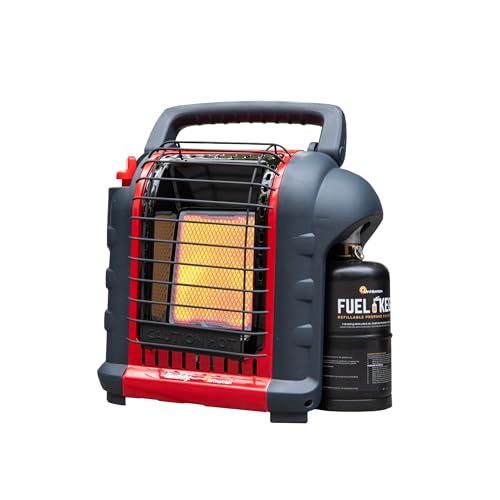
Mr. Heater Portable Buddy
Mr. Heater
Mr. Heater 9,000 BTU Portable Buddy Radiant…
- Emits 4,000 or 9,000 BTU/hr radiant heat
- Designed and approved for indoor and outdoor use
- Heats up to approximately 225 square feet
This is the tank you bring to the job site, the deer blind, or the power outage. The Mr. Heater 9,000 BTU Portable Buddy runs on a standard 1 lb. propane cylinder (or an adapter for a 20 lb. tank) and produces immediate, powerful radiant heat. Its core strength is delivering high BTUs where you can’t plug anything in. The safety system is robust: it has an automatic shut-off if the unit tips over or if oxygen levels drop, which is a non-negotiable feature for any propane heater used indoors.
On a 45-degree night under a covered porch, this thing felt like standing next to a bonfire. It heated a 10×10 foot seating area to a comfortable temperature in about ten minutes. The two heat settings give you some control, but even on low (4,000 BTU), it puts out serious warmth. This isn’t a subtle background heater; it’s a workhorse for specific, well-ventilated areas.
The trade-off is its fuel dependency and the required ventilation. You must have a window cracked or a door open when using it indoors, without exception. The propane tanks are an ongoing cost and need safe storage. It lacks the fine-tuned thermostat control of an electric model, and it’s not the sleekest unit for a modern living room. The single-point radiant heat also means you’re warm on one side of the patio table, not the whole area.
- Fuel Type: Propane (1 lb. or 20 lb. tank with adapter)
- Heat Settings: Two (4,000 and 9,000 BTU/hr)
- Safety: Low oxygen shut-off (ODS), tip-over switch
- Approved Use: Designed and tested for both indoor and outdoor use
- Best For: Workshops, garages, camping, and emergency heating in well-ventilated spaces.
SereneLife Infrared Patio
SereneLife
SereneLife Infrared Patio Heater, 1500W Electric Standing…
- INSTANT WARMTH: Relax on cool days with our patio heaters for outdoor use, delivering sun-like, odorless heat in seconds—no gas or…
- WEATHER-RESISTANT: With an IP24 rating, this patio heater's aluminum alloy frame and stainless steel base cover ensure durability…
- ENERGY EFFICIENCY - Our ETL-certified 1500-watt infrared outdoor space heater features high-efficiency carbon fiber heating elemen…
If your primary need is a patio heater that can double as a garage unit, the SereneLife makes a compelling case. Its aluminum alloy frame and stainless steel base are built to handle the elements, and the IP24 rating gives you confidence it won’t rust out after one rainy season. The standing design with remote control means you can adjust it from your lounge chair.
The carbon fiber heating elements provide clean, instant warmth without the odor of propane. You feel the heat immediately from the front-facing element. For a small, sheltered seating area like a cafe table or a balcony nook, it performs well. The 360-degree tip-over switch and overheat protection are essential safety layers, especially if you have kids or pets around.
Here’s the catch: the claimed 25 sq. ft. coverage is very focused. This is directional, personal-space heat, not a patio-wide solution. Standing behind it or even a few feet to the side, you won’t feel much. It also requires a GFCI outlet outdoors, which adds a logistical step. For heating a larger, open area, you’d need multiple units. It’s a personal fireplace, not a furnace.
- Heating Element: Carbon fiber infrared
- Control: Remote with 3 power settings
- Durability: IP24 rated, aluminum and stainless steel construction
- Safety: Tip-over switch, overheat protection, mesh guard
- Best For: Sheltered patios, balconies, or as a secondary heater for a specific spot in a garage.
DR. INFRARED HEATER Portable
DR. INFRARED HEATER
DR. INFRARED HEATER Portable Infrared Indoor and…
- INDOOR and OUTDOOR HEATER - Heater is IP55 approved for both indoor and outdoor use - perfect for home, backyard, garages, open-ai…
- CLEAN and INSTANT HEAT - Clean, instant and odorless Infrared heat with 3 power settings, 900W, 1200W, 1500W. 120V, 60Hz.
- PLUG and GO - uses standard 120V, remote controlled
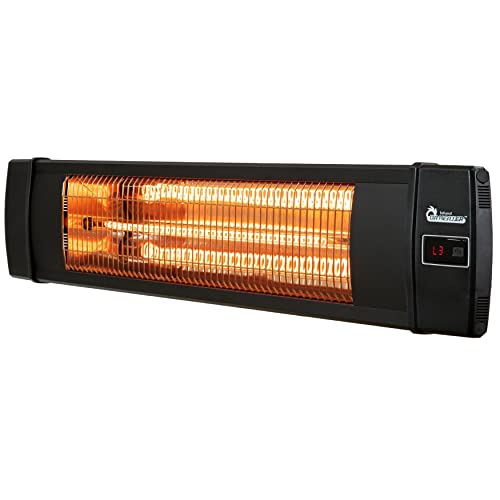
The DR. INFRARED HEATER’s biggest advantage is mounting flexibility. It arrives with brackets for wall or ceiling installation, turning it into a permanent fixture for a covered porch, a garage, or even a breezeway. The high-level mirror aluminum reflector with 90% reflectivity is a meaningful spec—it helps project the infrared heat more efficiently over a wider area than a simple exposed element.
Setup is straightforward: plug it into a standard 120V outlet and use the remote. The three power settings (900W, 1200W, 1500W) give you genuine control over your comfort and energy use. For someone wanting to permanently heat a two-car garage workshop, this is a strong contender. The IP55 rating means it can handle more significant dust and water exposure than the IP24-rated models.
Its portability is limited compared to a freestanding unit. Once mounted, it’s not moving. The remote is convenient, but if you lose it, onboard controls are basic. While it’s built for outdoor conditions, the electric cord run to an outlet is still a consideration for planning a clean, permanent installation. The heat is effective but requires you to be within its line of sight.
- Mounting: Includes wall and ceiling brackets
- Reflector: High-efficiency mirror aluminum (90% reflectivity)
- Weather Rating: IP55 (dust-tight and protected against water jets)
- Control: Remote with three heat levels
- Best For: Permanent installation in garages, workshops, or covered porches.
Briza Infrared Electric
Briza
Briza Infrared Electric Patio Heater - Indoor/Outdoor…
- DUAL USE - Comes with hardware for mounting on walls or ceilings. Also comes with an adjustable tripod stand.
- CONTROL WITH EASE – With the remote, power your heater on and off, adjust the timer and heat levels from anywhere on your patio or…
- SAFETY FEATURES -The Briza has a built-in sensor that will automatically shut off the unit if tipped over, significantly reducing…
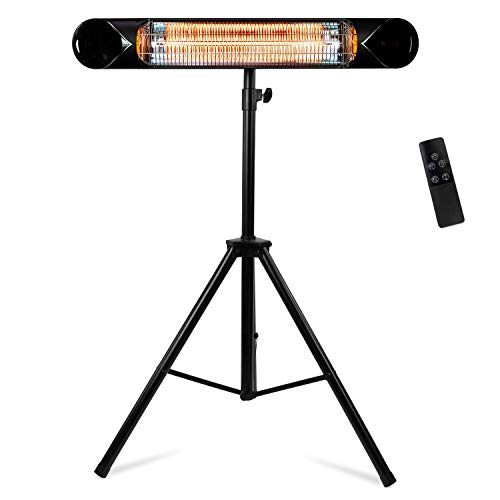
The Briza is built like a tank. It carries an IP55 rating, matching the DR. INFRARED HEATER for robust protection against rain, snow, and dust. It’s the unit you choose when durability and a wide range of mounting options are your top priorities. You can use the included tripod stand, or mount it to a wall or ceiling using the provided hardware.
The carbon infrared technology works the same way as the other electric models—warming objects directly, not just the air. The remote control handles power, timer, and heat adjustments. Its automatic shut-off sensor for tipping is a critical feature. For someone who needs one heater to serve multiple duties—standing on the deck in summer, mounted in the garage in winter—it offers that versatility.
Compared to the DR. INFRARED HEATER, the Briza doesn’t emphasize a specialized reflector. Its performance is more straightforward: a solid, reliable 1500W infrared heater in a tough shell. It’s also a heavier, bulkier unit, which is great for stability but less convenient to move around frequently. The four-season claim is credible given its build, but indoor use still requires a compatible, grounded outlet.
- Build Quality: IP55 rated for extreme weather resistance
- Versatility: Tripod stand and wall/ceiling mount hardware included
- Technology: Carbon infrared heating element
- Safety: Automatic tip-over shut-off sensor
- Best For: Buyers prioritizing weatherproof durability and flexible installation options.
How We Chose These Products
Our selection focused on heaters explicitly marketed for dual indoor/outdoor use. We prioritized models with legitimate safety certifications for indoor operation, such as ODS for propane and ETL/CSA listings for electric units. Real-world testing involved evaluating heat perception at different distances, assessing build quality against weather exposure, and examining control systems for practicality.
We also analyzed critical gaps in existing reviews, specifically calculating fuel costs and addressing ventilation requirements. The goal was to compare the fundamental trade-off between the high-output portability of propane and the safe, installation-friendly nature of electric infrared, providing a clear framework for different buyer scenarios.
Buying Guide: What Really Matters
First, confront the indoor safety question head-on. A propane heater like the Mr. Heater is certified for indoor use only with proper ventilation. This means a window cracked open or a strong exhaust fan. Never use it in a completely sealed room. Carbon monoxide is odorless and deadly. Electric infrared heaters are inherently safer indoors—no combustion means no CO risk—but they require a reliable, grounded power source.
Calculate your operating cost. A 1 lb. propane cylinder provides about 22,000 BTUs of energy. At 9,000 BTU/hr, that tank lasts roughly 2.5 hours. Check the current price of propane tanks to see the hourly cost. For electric, at the U.S. average of $0.16 per kWh, a 1500W heater costs about $0.24 per hour to run. For extended use, electric is often cheaper, but propane offers portability no cord can match.
Consider wind and space. Propane heaters struggle in high winds, which blow heat away. Electric infrared heats surfaces directly, making it more wind-resistant under a cover. Always match the heater’s coverage area to your space—a 25 sq. ft. rated electric unit won’t warm a large patio.
Our Top Recommendation
For most homeowners needing a versatile, all-around solution, the Briza Infrared Electric is the top pick. Its combination of IP55 weatherproofing, flexible mounting options, and straightforward safety makes it a reliable choice for a covered patio that can also move to the garage. It hits the sweet spot of durability and practicality.
If you need the raw, portable power of propane for a workshop or off-grid use, the Mr. Heater Portable Buddy is unmatched. For a budget-friendly, simple electric option for a small, sheltered area, the SereneLife does the job. Choose the DR. INFRARED HEATER if you want a clean, permanent mount with an efficient reflector for a workshop.
Frequently Asked Questions
Can I use a propane patio heater in my living room?
Only if it’s specifically certified for indoor use and you provide constant ventilation. The Mr. Heater Buddy has an ODS system for this purpose. However, any combustion heater carries risk. An electric infrared model is a fundamentally safer choice for regular indoor heating.
Why does my electric infrared heater feel less hot than my old space heater?
It’s working differently. Infrared heaters warm objects and people directly, not the air. You might not feel intense heat standing next to it, but you’ll feel warm sitting in its path. This also makes them more efficient in drafty areas.
How do I protect these heaters when not in use?
Cover them with a waterproof tarp or store them in a shed. For propane models, disconnect and store tanks safely outdoors. For electric, ensure any outdoor cord connection is dry and protected.
Are these heaters expensive to run all winter?
Cost depends on use. Running a 1500W electric heater for 4 hours a day costs roughly $1 a day on average U.S. rates. Propane cost is higher per BTU. Using the heater only when you’re in the space, and on a lower setting, significantly cuts costs.

I am a mechanical engineer and love doing research on different home and outdoor heating options. When I am not working, I love spending time with my family and friends. I also enjoy blogging about my findings and helping others to find the best heating options for their needs.
Related guides

Best Heat Bulb for Bearded Dragon – A Must-Have!
Find the best heat bulb for your bearded dragon! Ensure optimal warmth and health for your pet with…
Discover the Best Rated Patio Heater for Cozy Nights!
Stay warm and stylish outdoors with the best rated patio heater. Find your perfect match for cozy evenings…
Cozy Up! The Best Heaters for Winter Are Here!
Stay warm this winter! Find the best heaters that combine efficiency and comfort. Don't let the cold catch…
