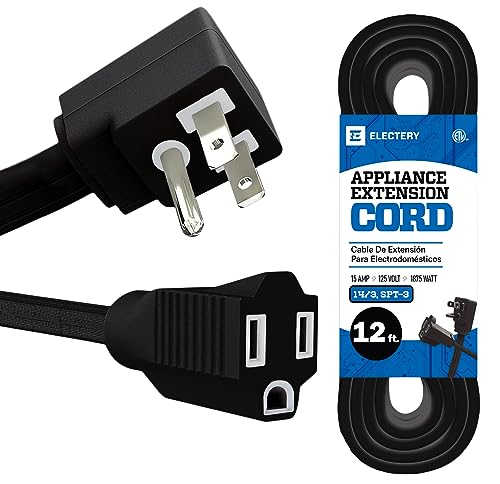
The best heavy-duty extension cord for a space heater is a 14 AWG, 15A, ETL-listed appliance cord that’s just long enough to reach the outlet; for most readers, the 6 ft model is the safest default, and the 12 ft model fits rooms where the outlet sits farther away.
Say your bedroom heater draws 1,500 W, the outlet is behind a dresser, and you need just enough reach to keep the cord flat along the baseboard. A 6 ft or 12 ft 14-gauge appliance cord can do that; a light-duty cord cannot without getting warm for the wrong reason.
A space heater already pulls about 12.5 A at 120 V, so cord size matters more than brand gloss. The cord should be short, grounded, listed for indoor use, and never routed under rugs or through a doorway that pinches it.
Best Heavy-Duty Extension Cords for Space Heaters
#1Shortest Cord Option
ELECTERY 6 Ft Appliance Extension Cord
Best for Other indoor appliances that need a short reach—not a space heater
Its 14 AWG copper wire, 15A rating and ETL listing make it the stronger match for the article’s short-cord comparison. The flat plug can fit behind furniture, but don’t use this cord to power a space heater; plug the heater straight into the wall.
Best for Other indoor appliances where a 6 ft cord won’t reach—not a space heater
The 12 ft length reaches farther than the 6 ft option, with the same 14 AWG wire, 15A rating and ETL listing. That extra reach is handy for suitable appliances, but it doesn’t make this cord appropriate for a space heater.
Best for Small spaces near a wall outlet, where you can plug the heater in directly
This heater is rated at 1500W and has ETL certification, plus overheat and tip-over shutoff features. Its thermostat and remote help with everyday adjustments, but the safety features don’t make an extension cord safe to use.
Power 1500WCoverage Up to 200 sq.ftTimer 24H timerSafety ETL-certified
Why it made the cut
1500W power
ETL certified
Overheat and tip-over shutoff
Good to know
Must be plugged directly into a wall outlet
Skip it if Skip it if you can’t place it within reach of a wall outlet without an extension cord.
Best for A room near a wall outlet where you want oscillation and remote control
Its 1500W ceramic heating, 70° oscillation and remote suit a room where you want to adjust heat without moving the heater. The heater is ETL-certified, but it still needs a direct wall connection—not either appliance cord in this guide.
Power 1500WOscillation 70°Timer 12H timerSafety ETL-certified
Why it made the cut
1500W ceramic heating
70° oscillation
ETL-certified safety
Good to know
Must be plugged directly into a wall outlet
Skip it if Skip it if the only way to reach an outlet is with an extension cord.
Best for A larger room with a wall outlet close enough for its included cord
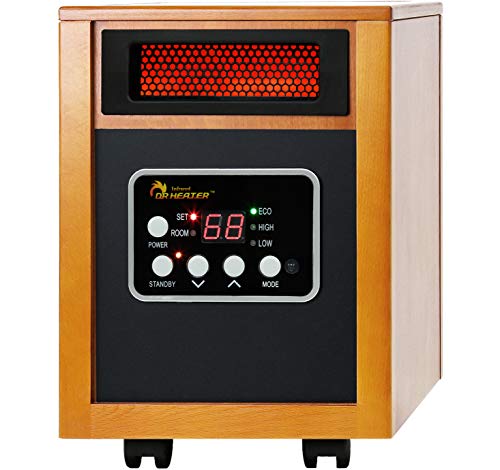
The DR-968 has a 6 ft power cord, 1500W output and tip-over and overheat protection. Its included cord is part of the heater; don’t add an extension cord to make the reach longer.
For a typical 1,500 W, 120 V space heater, use a grounded 14 AWG or heavier appliance cord rated 15 A, 125 V and 1,875 W. Choose the shortest cord that reaches the outlet without crossing a walkway.
The right extension cord for a space heater is a short, grounded, indoor-rated appliance cord—not a thin household cord or a power strip. A 14 AWG cord is the minimum practical size for a 1,500 W heater; a lower AWG number, such as 12 AWG, means thicker wire and is also suitable.
Wire size matters because a space heater is a continuous load. Thin wire can warm up, lose voltage along its length and make the plug or wall receptacle work harder. A cord’s large printed amp rating doesn’t excuse damage, loose connections or a cord left tightly coiled.
Worked example
A 1,500 W heater on a 120 V circuit draws about 12.5 A: 1,500 ÷ 120 = 12.5. That leaves little room for a light-duty cord, which is why a 15 A, 125 V, 1,875 W appliance cord in 14 AWG is the sensible floor.
Heater1,500 W
Circuit voltage120 V
Calculated currentAbout 12.5 A
Cord target14 AWG or heavier; 15 A / 125 V / 1,875
Specs Worth Checking
Spec
What to look for
Wire size
14 AWG minimum; 12 AWG is heavier
Electrical rating
15 A, 125 V and 1,875 W or higher
Plug
Grounded 3-prong plug and matching receptacle
Listing
ETL or UL listing on the cord
Shape
Flat plug when furniture sits close to the wall
Location
Indoor use only; use the cord as the label and manual allow
Match the cord to the heater and keep the route short and open.
About a 100 ft cord
A heavy-duty 100 ft cord and a 3,600 W generator don’t make a 1,500 W heater’s setup sensible. Length still adds voltage drop and floor clutter, so 100 ft is far too long for a tidy, safe room setup unless the manufacturer specifically permits it and the cord’s rating suits the load. A closer outlet or a heater with a longer factory cord is the better fix.
If you’re checking space heater extension cord safety before buying, these same labels answer what kind of extension cord you need for a space heater: grounded, indoor-rated, 14 AWG or heavier, and rated for at least the heater’s load. The space heater extension cord safety guide covers the plug, outlet and placement checks that come before running the heater.
From HeaterGuides · our own guidePage 6: heat only the rooms you use. Page 10 covers space-heater safety.Winter Heating Bill CutterSee what every heater in your home really costs, heat the rooms you use, and cut the waste in 30 days.Cost-per-hour tables for every heaterThermostat schedule and draft-proofing planRunning-cost and bill calculator (Excel)$14.99$9.99Get it for $9.99See what's inside and watch the 2-minute video →14-page printable PDF + Excel calculator · instant download · 30-day refund
6 Ft Or 12 Ft: Which Length Fits Your Room
Choose the 6 ft cord when the outlet is close to the heater, and choose the 12 ft cord when the room needs a little more reach; the shortest cord that reaches safely is the better choice. Both lengths suit the same basic target: a grounded, 14 AWG or heavier appliance cord rated for a 120 V heater.
Cord length
Best fit
What to watch
6 ft
Outlet behind or beside nearby furniture
Don’t stretch it tight or route it across a walkway
12 ft
Outlet farther around the room or beyond a bed
Keep the extra length loose, visible and out of traffic
The ELECTERY 6 ft and ELECTERY 12 ft cords cover the two practical room layouts here.
Measure the route
Measure from the outlet to the heater along the safe path—not in a straight line through the room. A cord that reaches only by crossing a doorway or walkway is too short, even if the tape measure says otherwise.
Worked room example
Say a 12 by 14 ft bedroom has the outlet 5 ft from the planned heater position along the wall. The ELECTERY 6 ft cord gives a little routing slack without leaving much loose cord. Move the heater to the opposite side of the bed and the safe wall route may need 9 or 10 ft, making the ELECTERY 12 ft cord the practical fit.
Room12 × 14 ft bedroom
Near outlet routeAbout 5 ft
Near-outlet choice6 ft
Far-side routeAbout 9–10 ft
For the common search about what size extension cord for a 120 electric heater, length and wire size answer different problems: 14 AWG handles the load, while 6 or 12 ft handles the room. Both flat plugs help when the heater sits near a wall or baseboard, but neither length should be tucked under a rug or pinched by furniture.
Space Heater Extension Cord Safety Rules
Space heater extension cord safety starts with plugging the heater straight into a wall outlet whenever possible. If an extension cord is unavoidable, use a grounded, indoor-rated, heavy-duty appliance cord with the correct amperage and wire gauge, and unwind it completely before use. A small heater can still draw 1,500 watts, so “small” doesn’t mean low load.
A space heater can be used with an extension cord only when the heater’s manual allows it. Never substitute a power strip, thin household cord, damaged plug, or cord with a loose connection. Keep the cord out from under rugs, behind doors, and away from places where the heater’s fan can pull, pinch, or drag it. The 6 ft ELECTERY cord suits a nearby outlet; the 12 ft version is for extra reach, not extra slack.
Industrial-looking isn’t enough
An industrial extension cord isn’t automatically suitable for an electric heater. Check its amperage, wire gauge, grounding, indoor rating, and listing against the heater’s load. If one of those details is missing, leave it on the store shelf.
A warm plug or cord is a stop sign, not a normal operating temperature. Turn the heater off and unplug it, then check for a loose plug, damaged receptacle, undersized cord, or a poor connection; resistance at a connection point turns electricity into heat. Discoloration, melting, a burnt smell, or repeated warmth means don’t reuse that setup until the fault is fixed.
Clearance and unattended use
Keep at least 3 feet of open space around the heater, including bedding, curtains, furniture, and clothing. Don’t sleep with it running or leave it operating while you’re away unless the manufacturer specifically says that model is designed for those conditions.
In short
Heaters and extension cords can work together only in the narrow case allowed by the heater manual and matched with a proper grounded appliance cord. The safest space heaters plugged in with an extension cord are still on a fully uncoiled, undamaged cord with nothing covering or tugging on it.
Load, Breakers, And Running Cost
For a 120 V electric heater, size the cord from the heater’s wattage: 1,500 W ÷ 120 V = 12.5 A. That makes a 15 A cord the minimum match, while a 15 A household circuit can be right on the edge if lights, a refrigerator, or another appliance shares it.
12.5 A
Current drawn by a 1,500 W heater
That is why the cord and the circuit both need room for the load; a heavier-looking cord won’t give a 15 A breaker extra capacity.
If the heater and another load share the circuit, the breaker may trip even when the extension cord is fine. Move the other load to a different circuit only if you can identify that circuit safely; an extension cord cannot repair an overloaded or weak circuit. The cord also doesn’t change the electricity bill.
Heater
Watts
Per hour
Per day (8 h)
Per month (30 days)
1,500 W space heater
1,500 W
26¢
$2.04
$61.20
Calculated at 17¢ per kWh. Assumes 8 hours per day for 30 days at $0.17 per kWh; the cord changes placement options, not the heater’s energy use.
A 100 ft cord is the wrong answer for a room heater in most homes because the extra length adds resistance and can increase voltage drop and heating at connections. A 3,600 W gas generator’s rating doesn’t make that run automatically safe: the heater still draws its own 1,500 W, the cord must be rated for that load, and the generator must operate outdoors with its exhaust kept away from the building.
Check before plugging in
Read the heater label, confirm the cord’s amp rating and gauge, then identify what else is on the breaker. If the breaker trips, stop resetting it until the total load and wiring have been checked.
What To Buy For Your Setup
For the best extension cord for a space heater—or the “best heavy duty extension cord for space heater” or even “extension cord for space hearter” query—the practical pick is the 6 ft ELECTERY cord if the outlet is close and the heater stays put. Choose the 12 ft ELECTERY cord when the outlet is farther away and the extra reach keeps the cord out of a walkway. For “what kind of extension cord do i need for a space heater,” look for 14 AWG, 15 A and ETL or UL listing.
The 6 ft cord is the best overall pick; the 12 ft cord is the better choice for a larger room or awkward outlet placement. If your heater’s own cord already reaches the outlet without stretching, buy no extension cord. Adding length you don’t need creates another connection and more cord to route safely.
1
Measure the route
Measure from the outlet to the heater’s planned position, following the route the cord can take without crossing a walkway.
2
Check the heater
Read its label or manual for wattage. A common 1,500 W heater draws 12.5 A at 120 V, so don’t assume a light-duty cord will do.
3
Confirm the cord rating
Check the cord itself for 14 AWG, 15 A and an ETL or UL listing. Match the cord’s length to the measured route.
4
Choose the shortest fit
Pick the 6 ft cord if it reaches without tension; use the 12 ft model only when the shorter one won’t. Plug the cord directly into a wall receptacle, not a power strip.
More Questions, Answered
Can an extension cord be used with a space heater?
Only if the heater’s manual permits it; many manufacturers say to plug the heater directly into a wall outlet. If the manual allows a cord, use a short, grounded, indoor-rated cord with a 15A rating, and stop using it if the plug or cord gets hot, damaged, or smells scorched.
What gauge extension cord is safe for a 1,500 W space heater?
A 14 AWG cord rated for 15A is the practical minimum for a 1,500 W heater, provided the heater’s manual allows extension cords. The heater draws about 12.5A at 120V, so don’t share the circuit with other high-wattage appliances.
Why does a 14 gauge extension cord get warm with a heater on the other end?
Some warmth can come from current flowing through the cord, but a cord that feels hot is a warning sign. Unplug it and check for a loose connection, damaged insulation, a coiled cord, or a cord that’s too long; don’t keep using it to see if the heat goes away.
What type of extension cord should you use for a room heater?
If the heater’s manual allows one, choose a short, grounded, indoor-rated appliance cord with 14 AWG conductors and a 15A rating. Keep it fully uncoiled and away from rugs, and plug the heater directly into a wall outlet whenever possible.
Before you go · a welcome giftGet the Winter Heating Bill Cutter for $4.99See what every heater in your home really costs, heat the rooms you use, and cut the waste in 30 days. Normally $14.99; your welcome price saves $10.00. We'll email your link right now.or buy it now for $9.99 without the gift →One email with your link now. We never share your address.




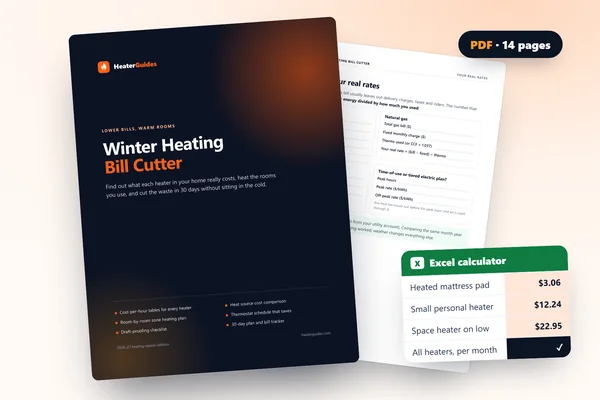 Winter Heating Bill CutterSee what every heater in your home really costs, heat the rooms you use, and cut the waste in 30 days.Cost-per-hour tables for every heaterThermostat schedule and draft-proofing planRunning-cost and bill calculator (Excel)