For most small rooms, choose the DREO 1,500W ceramic heater: it has a precise thermostat, tip-over and overheat protection, and quiet 34 dB operation. Its 41–95°F setting range suits bedrooms and offices, while the remote and timer help with everyday control. For a simpler, lower-cost option, consider the BLACK+DECKER personal heater.
Key takeaways
Choose a 1,500W model for a small room that needs supplemental heat; use 750W when that is enough to maintain comfort.
The DREO offers the quietest stated operation here at 34 dB and thermostat settings from 41–95°F.
A 1,500W heater running for eight hours uses 12 kWh; multiply that by your electricity rate to estimate the cost.
Plug an electric heater directly into a wall outlet, keep 3 feet of clearance, and check for tip-over and overheat protection.
For a bathroom, buy only a heater specifically rated for that location and follow its installation instructions.
Say your office is 10 by 12 feet, or 120 square feet, and the central heat leaves your desk cold. A portable 1,500W heater can warm that occupied room, but it draws close to the limit of a standard household outlet circuit.
The picks below favor useful controls and stated safety features over vague promises about energy savings. None makes electric resistance heat cheaper per watt; using less power or heating fewer hours is what lowers the bill.
Best Small Room Heaters for 2026
#1Best Overall
DREO Portable Ceramic Heater
Best for Bedrooms and offices where quiet, precise control matters
DREO combines 1,500W PTC heat with a thermostat adjustable from 41–95°F in 1°F increments. Its 34 dB operation, remote, 12-hour timer and tilt-detection protection suit a bedroom or office where a heater shouldn’t become the main event.
Why it made the cut
34 dB quiet operation
41–95°F thermostat range
Remote and 12-hour timer
Tilt-detection and overheat protection
Good to know
Fan-only mode still moves air
A 1,500W setting draws substantial power
Skip it if Skip it if you want only basic manual controls and no remote or timer.
Best for Desk-side warmth in a small office or personal workspace
The BLACK+DECKER keeps operation straightforward with manual controls, 750W and 1,500W heat settings, fan-only mode and an adjustable thermostat. Its 2.8-pound carry weight and automatic tip-over and overheat shutoff make it a sensible personal heater for moving between rooms.
Why it made the cut
Simple manual controls
750W, 1,500W and fan-only settings
2.8-pound portable design
Tip-over and overheat shutoff
Good to know
No timer or remote is listed
Designed for personal rather than whole-room warmth
Skip it if Skip it if you need a timer, remote control or a thermostat with a stated temperature range.
Best for Small rooms that need winter heat and summer air circulation
GiveBest offers 1,500W and 750W heat plus a cool-air fan, so the unit has a job after winter ends. Automatic thermostat control cycles the heater to maintain the preset temperature, while the carry handle, tip-over protection and overheat shutoff cover the basics.
Why it made the cut
Two heat settings plus cool-air fan
Automatic thermostat control
Tip-over and overheat protection
Six-foot lead cord
Good to know
No timer or remote is listed
The cord has a 2-prong connection
Skip it if Skip it if quiet nighttime use or timed shutoff is your priority.
Best for Bedrooms, offices and small spaces needing remote control
R.W.FLAME adds a 24-hour timer, remote control, ECO mode and a thermostat with stated ±1°F precision to a 1,500W ceramic heater. The 35 dB noise level, child lock, 45° tip-over shutoff and ETL certification make it a feature-rich choice for households with children or pets.
Why it made the cut
24-hour timer and remote
35 dB operation
±1°F thermostat precision
Child lock and 45° tip-over shutoff
Good to know
The stated coverage is up to 200 square feet
ECO mode’s energy claim is manufacturer-stated
Skip it if Skip it if you want the quieter 34 dB operation or a thermostat range stated in exact temperatures.
Best for Small apartments that also want a wall-mounted fireplace look
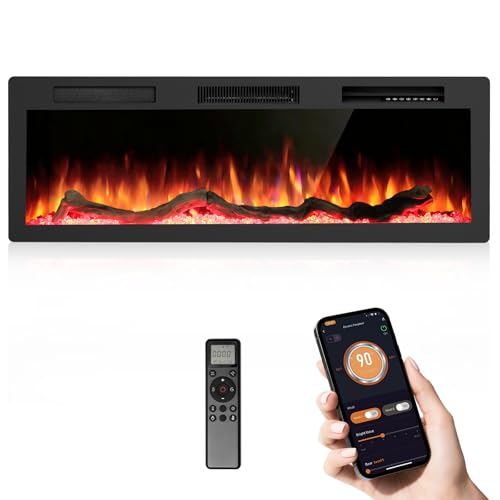
This unit adds supplemental heat to a room while serving as a recessed or wall-mounted fireplace. It offers 750W and 1,500W modes, a 59–95°F temperature range, remote control, timer, smartphone control and Alexa support, but its 50-inch format needs far more wall space than a portable heater.
Why it made the cut
750W and 1,500W heat modes
59–95°F temperature range
Wall-mounted or recessed installation
Remote, smartphone and Alexa control
Good to know
50-inch-wide installation
Requires mounting or recessed installation
Its stated coverage is supplemental and up to 400 square feet
Skip it if Skip it if you need a portable heater that can move from room to room.
For a small room heater, a ceramic space heater is the straightforward portable choice for quick supplemental heat; an oil-filled radiator warms more gradually and keeps releasing heat after its element cycles off. If you want a heater for a small apartment room, start with the room’s insulation, your noise tolerance and how often you’ll move the unit.
A 1,500 W plug-in heater is the common maximum, drawing about 12.5 A on a 120 V circuit. Lower settings matter because a 750 W or 1,000 W setting can maintain comfort with less heat output, while a thermostat can cycle the element off instead of running continuously.
12.5 A
What a 1,500 W heater draws
That leaves little spare capacity on a standard 15 A circuit, so plug the heater directly into a wall outlet rather than an extension cord or power strip.
Heater type
What it feels like
Best fit
Ceramic fan heater
Warm air arrives quickly and circulates around the room.
Fast supplemental heat and easy portability.
Oil-filled radiator
Heat builds more slowly, then lingers after the element cycles off.
A bedroom or office where quiet, steady warmth matters.
Infrared heater
Radiant heat warms people and objects in its path more directly than room air.
A seated spot where line-of-sight warmth is useful.
Panel heaters are electric convection heaters; their slim shape can help with placement, but they still need the clearance in their manual.
Compare Before You Buy
Thermostat control and selectable heat settings
Tip-over and overheat protection
UL, ETL or CSA listing
Timer or remote if you want less hands-on control
Manual placement rules, including at least 3 feet of clearance for a plug-in heater
The DREO is the best overall pick here for its 41–95°F setting range, 34 dB operation and 12-hour timer. R.W.FLAME’s small-space heater is the better fit when you want the listing’s claimed coverage of up to 200 square feet; treat that figure as a claim, not a guarantee for every drafty room. GiveBest may suit shoppers prioritizing quiet operation, but its product data gives no exact noise figure. BLACK+DECKER is the simpler choice. For more ceramic options, see ceramic heaters perfect for small enclosed spaces.
Myth
An ECO mode or ceramic element makes resistance heat inherently more efficient at the same wattage.
Fact
A 1,500 W electric heater uses the same maximum electrical power regardless of the element material or marketing mode. A thermostat can reduce run time by cycling the heater off, which can reduce consumption.
Placement Matters
Keep the heater on a stable, level surface with its air intake and outlet clear. Follow the manual’s placement rules and keep the required clearance from bedding, curtains, furniture and clothing.
How Much Heat Does a Small Room Need?
The best way to heat a small room is to match heater output to the room’s heat loss, not to square footage alone. Insulation, ceiling height, drafts, outdoor temperature and your home’s existing heat can change the result substantially.
A 1,500 W heater is a useful selection point for many small rooms because it is the common plug-in maximum, but it isn’t a promise that every model will heat a stated area. A product claim of 200 or 400 square feet won’t account for an uninsulated wall, a high ceiling or a door opening to a cold hallway.
Worked Example
Say your room is 10 × 12 feet, or 120 square feet, and a 1,500 W heater runs for eight hours. The arithmetic is 1.5 kW × 8 hours = 12 kWh. At an assumed electricity rate of $0.17 per kWh, the cost block shows the corresponding daily and 30-day estimate; replace that rate with the one on your utility bill.
Room10 × 12 ft (120 sq ft)
Heater1,500 W
Use8 hours per day
Energy12 kWh per day
Heater
Watts
Per hour
Per day (8 h)
Per month (30 days)
1,500 W space heater
1,500 W
26¢
$2.04
$61.20
Calculated at 17¢ per kWh. Assumes 8 hours daily, 30 days and $0.17 per kWh. Substitute your utility rate; a thermostat may cycle the heater off.
Using a space heater in the occupied room may let you lower the central thermostat, but the cheapest way to heat a small room depends on your furnace fuel, home insulation, thermostat setting and how many rooms need heat. A small heater in every room can cost more than lowering heat in unused rooms, so compare actual run time and energy rates instead of assuming either setup wins.
A Practical Rule
Use the heater’s lower setting or thermostat once the room is comfortable, close drafts where you can, and judge performance during the coldest part of the day. Comfort is the test; a square-foot claim is only a starting point.
The safest small room space heater is a listed electric model with tip-over and overheat protection, used on a clear floor and plugged straight into a wall outlet. For a bathroom, choose a heater specifically listed for bathroom use; a standard portable room heater doesn’t become bathroom-safe because it’s small.
Small bathroom wall heaters can work when the model is approved for that location and installed as its instructions require. For new construction, choose a fixed wall heater rated for bathroom use and have any required wiring done by a licensed electrician under local electrical code. If you’re comparing small bathroom heaters at Walmart, check the model’s bathroom-use rating rather than relying on the product category or retailer listing.
12.5 A
Current drawn by a 1,500 W heater at 120 V
That leaves little spare capacity on a standard 15 A circuit. Avoid running other high-draw appliances on the same circuit; if the breaker trips, don’t keep resetting it.
Before You Switch It On
Plug the heater directly into a wall outlet, never an extension cord or power strip.
Keep at least 3 feet of clearance and never cover the heater.
Look for tip-over and overheat protection, plus a UL, ETL or CSA listing. The R.W.FLAME Small Space Heater listing states ETL certification; don’t assume the other models have a certification unless their product data says so.
Keep the heater away from water and high-traffic paths.
Don’t leave it running while you sleep or leave home unless the manufacturer says that specific model is designed for it.
Can You Heat a Small Room Without Electricity?
You can heat a small room without electricity only with a fuel-burning appliance specifically rated for indoor use and operated as its manual requires; candles and ordinary battery heaters aren’t safe, practical room-heating substitutes. If household power is available, use a listed electric heater instead.
Myth
Burning a candle can warm a small room without much risk.
Fact
A candle is not a room heater. An open flame adds fire risk and produces combustion gases, including carbon monoxide; don’t burn candles to heat a room.
Fuel Heaters Need CO Protection
Portable gas heaters can produce carbon monoxide. Use only a model rated for indoor use, provide the ventilation its manual requires, and keep a working CO alarm in the home. Indoor propane models need an oxygen depletion sensor. Never use a patio, construction or other outdoor heater in a room, tent or vehicle cabin.
A small gas heater for a bedroom must be expressly rated for indoor use; the fact that your home has natural-gas service doesn’t make a portable heater safe to connect. Gas connections and venting require a properly rated appliance and qualified installation. Check local code before considering a vent-free gas heater, since rules vary by state and city.
Battery-powered heaters have limited practical output and run time, so check the heater’s power draw and the battery’s usable capacity before counting on one. Solar panels won’t provide dependable heat overnight without suitable energy storage. If you mean how to heat a small room without gas or electricity, there’s no safe candle or small battery device that replaces a proper heater; use another safe heated space until power returns.
Frequently Asked Questions
Are oil-filled radiators slow to heat a small room?
Yes. An oil-filled radiator takes time to warm its oil and the room, so it’s slower than a ceramic heater for a quick temperature boost. Once warm, the radiator continues releasing heat after its thermostat cycles off.
Does an oil heater make your mouth and nose feel dry?
An oil-filled electric heater doesn’t remove moisture from the air, but warming the room can lower its relative humidity and make your nose or throat feel dry. A room humidifier can add moisture; keep it clean and follow its instructions.
Can a portable gas heater be used safely in a small bedroom?
Only if the heater is specifically rated for indoor use and its manual permits bedroom use; an outdoor or patio heater is never a substitute. Follow the required ventilation, use a working carbon monoxide alarm, and choose a propane model with an oxygen depletion sensor. Check local rules, since vent-free gas heaters are restricted in some areas.
Can solar power heat a small room overnight?
Solar panels alone won’t provide heat after dark; you’d need a battery charged during the day and an electric heater sized for the room. A 1,500 W heater running for eight hours uses 12 kWh, so check the battery’s usable capacity and inverter rating before relying on it overnight.
How can you warm a small room when the central heat is off?
Close the door, block drafts, and use a listed electric space heater plugged directly into a wall outlet if you have power. Keep three feet of clearance and don’t leave it running while you sleep or leave home unless the manufacturer says that model is designed for it. Without electricity, use only an indoor-rated fuel heater as its manual directs, with a working carbon monoxide alarm.