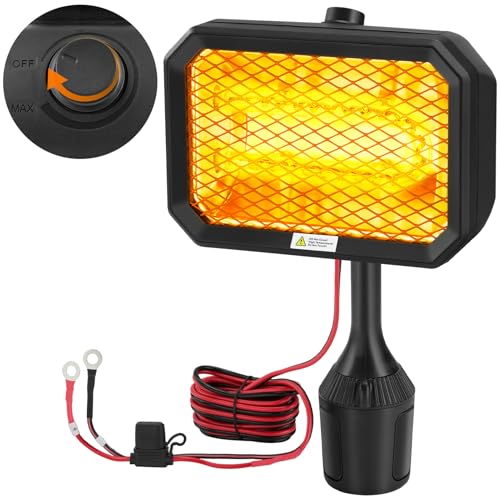
For this search, Product 1 is the best pick: its 36V electric design, stepless temperature knob, 360° adjustable head and cupholder base suit a golf cart without propane. It runs from the cart battery, so confirm your cart is 36V before buying; the other picks are indoor space heaters, not cart heaters.
What to remember
Choose Product 1 only if your golf cart supplies 36V.
A stepless temperature knob gives finer control than fixed low and high settings.
A 1,500W indoor heater belongs on a wall outlet, not a golf-cart battery.
Check the cupholder base, head direction and battery condition before a cold round.
The common mistake is buying by BTU alone and overlooking the cart’s voltage. That can leave you with an indoor heater that cannot connect to the cart, or a propane model that adds fuel handling and open-flame concerns.
The supplied data does not identify a Heater Craft G200X model, so the guide should say that plainly and avoid pretending another heater is the same product. Rank Product 1 for golf-cart use, then label Products 2 through 5 as indoor alternatives rather than suitable cart replacements.
The Best Heater Picks For Golf Carts
#1Best Overall
Kohree Golf Cart Heater 36V
Best for 36V golf carts that need adjustable heat without propane
The 36V electric design connects to the golf cart battery, while the stepless temperature knob lets you fine-tune the warmth. A 360° adjustable head directs heat toward you, and the adjustable cupholder base fits openings from 2.36 to 3.55 inches. Confirm your cart is 36V before buying.
Power 36V battery operatedCoverage Up to 120 sq. ft.Temperature control Infinite, stepless adjustmentBase fit 2.36 to 3.55 inchesCertification CE, FCC and ROHS
Why it made the cut
No propane tank or gas connection
360° adjustable heating head
Adjustable cupholder base
Up to 20 hours of runtime, depending on battery level
Good to know
For 36V electric golf carts only
Runtime varies with the cart battery level
Coverage is listed up to 120 sq. ft.
Skip it if Skip it if your cart isn’t 36V or you need a heater for a room instead.
Best for Indoor rooms where broad coverage matters more than cart fit
The 1,500W DR-968 is rated to heat spaces up to 1,000 sq. ft. Its infrared quartz and PTC heating combine radiant warmth with circulated air, while the electronic thermostat, remote and 12-hour timer add useful room control. The wood-look cabinet belongs indoors, not on a golf cart.
Power 1,500WCoverage Up to 1,000 sq. ft.Temperature control 50°F to 85°F electronic thermostatTimer 12 hoursCertification UL certified
Why it made the cut
Coverage listed up to 1,000 sq. ft.
Infrared quartz and PTC heating
50°F to 85°F thermostat
Tip-over, overheat and automatic shutoff protection
Good to know
Not designed for golf carts
A 1,500W indoor heater needs a wall outlet
Heavier furniture-style cabinet than a cart heater
Skip it if Skip it if you need a battery-powered heater that mounts in a cupholder.
Best for Indoor rooms, offices and bedrooms where low noise matters
The 1,500W PTC ceramic heater runs at a listed 34dB, and its 70° oscillation spreads warm air across a wider area. A thermostat, remote, ECO mode and 12-hour timer make it a practical room heater. The ETL-certified safety package includes tip-over and overheat protection.
Power 1,500W PTC ceramicCoverage —Temperature control Thermostat and ECO mode from 1,000W to 1,500WOscillation 70°Certification ETL-certified
Why it made the cut
34dB listed operating noise
70° oscillation
Remote, ECO mode and 12-hour timer
ETL-certified with tip-over and overheat protection
Good to know
Indoor use only
No golf cart battery connection
The data doesn’t give a square-foot coverage figure
Skip it if Skip it if you need a heater that fits a cart cupholder or runs from a 36V battery.
Best for Small indoor spaces that need portable thermostat control
This compact 1,500W ceramic heater is listed for spaces up to 200 sq. ft. Its thermostat targets the set temperature within ±1°F, while the handle, remote and four operating modes make it easy to move between rooms. The 35dB noise rating suits a desk or bedroom.
Power 1,500W ceramic PTCCoverage Up to 200 sq. ft.Temperature control Thermostat with ±1°F precisionModes Low, High, Eco and Fan ModeCertification ETL-certified
Why it made the cut
Coverage listed up to 200 sq. ft.
Thermostat precision of ±1°F
Remote and touch controls
ETL-certified with child lock and tip-over shutoff
Good to know
Indoor use only
Not powered by a golf cart battery
The listed noise level is 35dB, higher than Products 2 and 4
Skip it if Skip it if you need a cart-mounted heater or a unit rated for spaces larger than 200 sq. ft.
Best for Indoor spaces where precise thermostat settings matter
The thermostat adjusts from 41°F to 95°F in 1°F increments, giving you finer control than a basic high-low heater. DREO also includes ECO, fan-only and power-heat modes, plus a remote and 12-hour timer. Its 34dB operation keeps the fan unobtrusive in an office or bedroom.
Power 1,500W PTCCoverage —Temperature control 41°F to 95°F in 1°F incrementsNoise 34dBTimer 12 hours
Why it made the cut
41°F to 95°F thermostat range
1°F temperature increments
34dB listed operating noise
Remote, ECO mode and fan-only mode
Good to know
Indoor use only
Not a golf cart heater
The data doesn’t state a safety certification
Skip it if Skip it if you need a 36V cart heater or want a stated coverage area.
The strongest heater features for adjustable temperature are Product 1’s infinite-adjustment knob and 360° adjustable head. The knob lets you trim the heat smoothly, while the head puts warmth where wind and exposed hands need it.
Product 1’s infinite-adjustment knob is the best match for adjustable heat because it changes output smoothly instead of forcing a low-or-high choice. Wind, clothing and battery voltage can change how warm you feel during a round, so fine control is more useful than a large room-size claim. The data doesn’t establish a precise thermostat or setpoint.
Pick
Best for
Useful features
Limitation and skip-it reason
Kohree Golf Cart Heater Electric 36V
36V golf carts
Infinite-adjustment knob; 360° adjustable head; adjustable cupholder base
Requires a 36V cart. Skip it if your cart’s battery system doesn’t match.
DREO Space Heaters for Indoor Use with Thermostat, 1500W El…
Indoor rooms needing thermostat control
Thermostat; remote; timer
Designed for indoor outlet use, not cart mounting. Skip it for a golf cart.
R.W.FLAME Small Space Heaters for Indoor Use
Small indoor spaces
Indoor heating; compact format
Its data doesn’t establish cart compatibility. Skip it for battery-powered cart use.
DREO Space Heater, Portable Electric Heaters for Indoor Use…
Portable indoor heating
1,500W design; thermostat; portable format
Needs outlet use and indoor placement. Skip it for a moving cart.
Indoor-room equipment, not a 36V cart heater. Skip it unless your need is indoors.
The indoor picks have useful controls, but those controls don’t make them golf-cart heaters.
The G200X benefits come from matching control to the seat: its 360° head can aim heat toward the driver, passenger or hands, and its claimed coverage is 120 sq. ft. The adjustable cupholder base fits openings from 2.36 to 3.55 inches, giving the heater a practical mounting point instead of leaving it loose on the cart.
Control beats a big coverage number
A claimed 120 sq. ft. matters less in an open cart than directing heat at the person who needs it. Start with the lowest comfortable setting, then turn the knob up as wind strips heat away.
Golf Cart Fit Comes Before Heat Output
The G200X works as a 36V battery-operated heater with a cupholder-style adjustable base, not as a plug-in 120V space heater. Installation should be simple when the cart voltage and mounting opening match, but the battery connection still has to follow the heater and cart instructions.
Check before ordering
Confirm the golf cart uses a 36V battery system.
Measure the cupholder opening; Product 1’s stated base range is 2.36 to 3.55 inches.
Check that the battery is in usable condition and the connection point matches the heater instructions.
Make sure the 360° head has room to turn without hitting a roof support, windshield or passenger.
Keep the heater secure so it can’t become a loose object during movement.
How does the G200X heater work? Battery power runs the electric heating element, the adjustable knob changes the heat output, and the 360° head directs that heat toward a chosen seat or pair of hands. It won’t warm an open cart evenly; placement and wind decide where the warmth goes.
The indoor alternatives are poor improvisations here because their 1,500W electrical design, outlet use and indoor-room coverage claims don’t establish cart compatibility. An indoor thermostat or remote cannot solve a voltage, mounting or weather-exposure mismatch.
Match voltage first
Never connect a heater to a mismatched-voltage battery system. Confirm the cart voltage before purchase, and don’t guess at terminals or wiring; a wrong connection can damage the heater, battery system or both.
The best heater for a golf cart is Product 1, the Kohree Golf Cart Heater Electric 36V, because it uses the cart’s battery instead of propane and offers adjustable heat. Its listed runtime is up to 20 hours, but the actual time depends on battery level and how much energy the cart also needs to move.
A 36V golf cart heater gives you cleaner operation, no propane cylinder and no combustion fumes. The tradeoff is battery reserve: every minute of heat uses energy that an aging, partly charged or heavily loaded battery can’t use for driving.
Worked Example
Say a cold 18-hole round takes four hours. Treat the heater’s advertised 20 hours as an upper claim, not a guaranteed four-round schedule; the cart’s battery condition, starting charge and driving load determine what remains when you turn toward home.
Round length4 hours
Advertised runtimeUp to 20 hours
What changes the resultBattery level, age and driving load
Electric-cart running cost also needs more information than the 36V label provides. A precise estimate requires the heater’s watt draw, battery capacity, charging efficiency and your electricity rate; without those figures, claiming a dollar amount or propane savings would be guesswork.
For comparison, Products 2 through 5 are 1,500W indoor heaters. At an assumed electricity rate of 17 cents per kWh, running one for eight hours uses 1,500 ÷ 1,000 × 8 = 12 kWh; the cost block applies that rate over 30 days.
Heater
Watts
Per hour
Per day (8 h)
Per month (30 days)
Product 2, 1,500W indoor heater
1,500 W
26¢
$2.04
$61.20
Product 3, 1,500W indoor heater
1,500 W
26¢
$2.04
$61.20
Product 4, 1,500W indoor heater
1,500 W
26¢
$2.04
$61.20
Product 5, 1,500W indoor heater
1,500 W
26¢
$2.04
$61.20
Calculated at 17¢ per kWh. Assumes eight hours daily, 30 days and electricity at $0.17 per kWh.
Product 1’s stated 120-square-foot coverage is best treated as a direction, not a promise. A golf cart is open on several sides, and wind can carry away warmth long before the heater reaches that much enclosed floor area.
Certification Does Not Mean Indoor Use
The G200X can be a sensible golf-cart heater when its 36V requirement, placement and clearance are correct, but its CE, FCC and RoHS marks are not the same as a US UL, ETL or CSA listing. A certification mark describes a particular compliance claim; it doesn’t prove that a product is approved for every location.
Because Product 1 is electric, it avoids propane handling, gas leaks and combustion fumes. Keep the heater stable in the cart, use the correct voltage, and keep its hot surfaces and airflow away from combustible material.
Certification And Intended Use
An indoor heater’s safety label doesn’t turn it into a golf-cart heater. Product 2 is ETL-certified, Product 3 is ETL-certified, and Product 5 is UL-certified; Product 4’s supplied data lists safety features, but the information provided here doesn’t establish a UL, ETL or CSA certification for it.
Products 2 through 5 include stated protective features such as tip-over and overheat protection, with timers listed among the indoor-heater controls where supplied. Those features can reduce a fault’s consequences, but they don’t change the intended-use warning: an indoor space heater remains an indoor space heater.
Indoor Outlet Rules
Plug Products 2 through 5 directly into a wall outlet, never an extension cord or power strip. Keep at least 3 feet of clearance from combustibles, and don’t sleep or leave home with one running unless the manufacturer specifically says that use is allowed.
Before Using The G200X
Confirm the cart is 36V
Secure the heater so it can’t shift during movement
Keep clothing, paper and other combustibles away
Stop using it if the cord, plug or housing is damaged
Choose Your Power Path
Choose the Kohree Golf Cart Heater Electric 36V for a 36V cart; choose an indoor model for a bedroom, office or living room. That voltage-and-location check answers both questions before controls or coverage claims muddy the decision.
1
1. Identify the cart voltage
Check the cart label, charger or owner’s manual. Choose Product 1 only if the cart is 36V; a different voltage is a stop sign, not a guess-and-see project.
2
2. Measure the cupholder
Measure the cupholder opening and depth, then compare them with Product 1’s adjustable cupholder-style base. A heater that wobbles can aim heat at the wrong place and become a distraction on the course.
3
3. Pick the heating location
For cart use, choose Product 1 because its stepless adjustment, directional 360° head and battery-powered design avoid propane. For a bedroom, office or living room, skip it and compare Products 2–5 instead.
4
4. Compare the controls
Match the indoor heater to the room and the way you use it: check each model’s coverage claim, noise, timer, remote and thermostat features. Product 3 lists 200 square feet, while Product 5 lists 1,000 square feet; those are manufacturer-supplied figures, not promises for every room.
A 36V golf-cart owner should pick Product 1 when smooth heat control, directional warmth and no propane matter most. Indoor buyers should choose among the DREO Space Heaters, R.W.FLAME Small Space Heaters, the other DREO portable model and the Dr Infrared Heater DR-968 according to the controls and room-use details in their product cards—not by the biggest coverage number alone.
Before the cart moves
Charge the cart battery.
Secure the cupholder base so the heater cannot tip.
Aim the adjustable head away from seats, clothing and other fabrics.
Stop using the heater if the plug, wiring or housing becomes unusually hot.
Questions People Ask
What is the best heater for a golf cart?
The Kohree Golf Cart Heater Electric 36V is the best fit here because it runs from a 36V cart battery and has adjustable heat. Check your cart’s voltage first; a 12V or 48V cart needs a heater designed for that system.
How does a 36V golf cart heater work?
A 36V golf cart heater draws electrical power from the cart battery and converts it into heat through its heating element. Its adjustable head directs warmth toward the passenger area, while the temperature knob controls the heat output.
Is a golf cart heater easy to install?
Installation is usually straightforward only when the heater’s wiring and connector match the cart. Turn the cart off, follow the heater and cart instructions, secure the unit so it can’t shift, and have a qualified technician handle unfamiliar battery wiring.
What are the benefits of adjustable temperature control?
A stepless temperature control lets you reduce heat as the cart warms instead of switching between fixed low and high settings. That makes short rides more comfortable and can avoid using more battery power than necessary.
Can a 1,500W indoor heater be used in a golf cart?
No—an ordinary 1,500W indoor heater is a 120V plug-in appliance, while the G200X is made for a 36V cart system. A golf cart also lacks the stable wall outlet and clearance an indoor heater requires, so use a purpose-built cart heater instead.
How long can an electric golf cart heater run?
Runtime depends on the battery’s usable capacity, the heater’s power draw, the battery’s condition and the temperature setting. A simple estimate is battery watt-hours divided by heater watts, but the heater manual and cart manufacturer’s limits should decide the safe operating time.