The Heat Storm Phoenix is the best pick for most readers here because it gives you 750 or 1,500 watts, wall or floor placement, a remote, and a thermostat in one compact heater. That makes it the easiest match for a small room, office, or bedroom where you want infrared heat without giving up floor space.
Picking the wrong infrared heater usually costs you twice: once at the register and again on the bill when the room still feels cold. A 1,500 W heater is the ceiling for a normal 120 V plug-in unit, so the real question is how well the heater fits your room and how you plan to place it.
For this brand, the difference between a good buy and a clumsy one is usually mounting, wattage control, and how much of the room you expect it to cover. The Phoenix does best where you want flexible placement; the Wave is the space-saver; the Mojave suits someone who wants portability; the Tradesman is for directional heat in rougher spaces.
Best for Small rooms or offices where floor and wall placement both matter
The Phoenix gives you 750- or 1,500-watt operation, a built-in thermostat, and a remote in one compact heater. Removable feet let it sit on the floor, while mounting points let you place it on the wall when floor space is tight. Choose it for a small room or office where adjustable output matters.
Heat output 5,200 BTUWattage modes 750 W and 1,500 WPlacement Floor or wallControls Remote and built-in thermostatColor White
Why it made the cut
750- and 1,500-watt modes
Floor or wall placement
Remote and built-in thermostat
Safe-to-touch grill
Good to know
Designed for a small room or office
No tip-over shutoff listed in the product data
Skip it if Skip it if you need focused heat for a covered outdoor space or a garage work area.
Best for Small rooms or offices that suit a gray floor-or-wall heater
This gray Phoenix has the same useful setup as the white version: two wattage modes, attachable feet, wall mounting points, a remote, and a thermostat with an LED display. The 750-watt setting gives you a lower-output option when the full 1,500 watts would be more than the room needs. It fits readers who want Phoenix features with a different finish.
Heat output 5,200 BTUWattage modes 750 W and 1,500 WPlacement Floor or wallControls Remote and built-in thermostatColor Gray
Why it made the cut
750- and 1,500-watt modes
Floor or wall placement
Remote and LED thermostat display
Safe-to-touch grill
Good to know
Designed for a small room or office
Gray finish may not suit every room
Skip it if Skip it if color does not matter and you need the same features in the white version instead.
Best for Bedrooms, kitchens, or offices needing a smaller 500-1,000 W heater
The Wave runs at either 500 or 1,000 watts, making it a better choice if you don’t need the full output of larger models. It takes up less than 2 square feet on the wall, saving space. Safety features include a tip-over shutoff and a child lock. A touch-screen thermostat and remote control provide precise temperature management. When mounted over an outlet, the cord tucks neatly inside the heater.
Wattage modes 500 W and 1,000 WDimensions 13 × 4 × 17 inPlacement Floor or wallControls Touch-screen thermostat, child lock, and remoteOutlet Normal 110 V outlet
Why it made the cut
500- and 1,000-watt modes
Uses less than 2 sq. ft. of wall space
Tip-over shutoff and child lock
Floor or wall placement
Good to know
Lower maximum wattage than the 1,500-watt models
The product data does not give a BTU heat-output figure
Skip it if Skip it if you need 1,500 watts or a stated 5,200 BTU heat output.
Best for Moving supplemental heat between rooms without lifting a heavy heater
The Mojave weighs 11 lb and uses a 1,500-watt heating element, making it the portable pick when you want to carry supplemental heat from one room to another. Its Energy Efficient mode drops the wattage to 750, while the thermostat and remote handle temperature changes from across the room. The product data lists heating up to 1,000 square feet with supplemental heating, so treat that as added heat rather than a promise of whole-home heating.
Heat output 5,200 BTUWattage modes 750 W and 1,500 WWeight 11 lbControls Remote and built-in thermostatHeating claim Up to 1,000 sq. ft. with supplemental heating
Why it made the cut
11 lb portable design
750- and 1,500-watt operation
Built-in thermostat and remote
Overheat sensor
Good to know
The 1,000-square-foot figure is for supplemental heating
No floor-or-wall mounting option is listed
Skip it if Skip it if you want to mount the heater on a wall or need a stated tip-over shutoff.
Best for Patios, garages, workshops, balconies, sheds, and covered outdoor spaces
The Tradesman sends 1,500 watts of directional infrared heat toward people and objects instead of trying to warm all the surrounding air. Its motion-sensing Eco Mode can enter standby when nobody is detected and resume when motion returns. IPX4 weatherproof construction, an adjustable angle, and a remote suit covered outdoor spaces and work areas.
Heat output 1,500 W focused radiant heatWattage modes 1,500 WConstruction IPX4 weatherproofControls Remote and motion-sensing Eco ModeAdjustment Adjustable angle
Why it made the cut
Focused 1,500-watt radiant heat
Motion-sensing Eco Mode
IPX4 weatherproof construction
Adjustable angle and remote
Good to know
No lower wattage mode is listed
The product data does not list a built-in thermostat
Best suited to directional rather than room-wide heating
Skip it if Skip it for a bedroom or office where you want floor-or-wall placement and a thermostat.
The Heat Storm Phoenix is a strong fit for a small room, office, or bedroom because you can run it at 750 or 1,500 watts, place it on removable feet, or mount it to the wall. That range gives you a lower setting for maintaining comfort and a higher setting for bringing a chilly room up to temperature.
In short
For a bedroom or office, choose the Phoenix when you want one heater that can move between floor and wall placement. The Phoenix is usually the better choice than the Heat Storm Wave when its two power settings, thermostat, LED display, and remote matter more than the Wave’s floor-to-wall format.
Heat Storm lists the Phoenix at 5,200 BTU, but treat that as a product claim for supplemental heat—not a promise that it will heat an entire house or an open floor plan. Infrared warmth feels direct on nearby people and surfaces, so the room should still be reasonably enclosed; drafts can carry away heat faster than the badge number suggests.
Feature
Why it matters
750 and 1,500 W settings
Use less output in mild weather or more output when the room starts cold.
Removable feet
Set the heater on the floor when you don’t want to drill or mount it.
Wall mounting points
Keep floor space open beside a desk, bed, or chair.
Thermostat, LED display, and remote
Adjust temperature and settings without reaching behind furniture.
The Phoenix’s useful difference is flexible control and placement, not whole-house capacity.
For a bedroom, the Phoenix makes sense when you need targeted heat and can keep the door closed; a drafty room or a large open area calls for a different heating plan. The Heat Storm Phoenix review is the next useful stop if you want its controls and placement options examined separately.
Good for
Small enclosed rooms, offices, and bedrooms
Floor or wall placement
A thermostat and remote in a compact heater
Skip it if
Its 5,200-BTU claim is better read as supplemental capacity
Direct infrared warmth won’t overcome heavy drafts well
From HeaterGuides · our own guideWinter Heating Bill CutterSee what every heater in your home really costs, heat the rooms you use, and cut the waste in 30 days.Cost-per-hour tables for every heaterThermostat schedule and draft-proofing planRunning-cost and bill calculator (Excel)$14.99$9.99Get it for $9.99See what's inside and watch the 2-minute video →14-page printable PDF + Excel calculator · instant download · 30-day refund
Check Room Size Before You Buy
A 1,500-watt heater is about 5,100 BTU per hour, so the Heat Storm Phoenix is best matched to a small enclosed room or supplemental heat in a larger one—not a drafty basement or open-plan living room. There is no reliable square-foot promise here; insulation, ceiling height, windows, and air leaks decide how far that output gets.
1,500 W
About 5,100 BTU per hour
That output suits a small room or a larger room needing supplemental heat, but the room’s heat loss matters more than a printed coverage figure.
Worked example
Say your room is 12 by 14 feet. That is 168 square feet, and a 1,500-watt Phoenix is a reasonable use-case match if the room has a normal ceiling, the door can stay closed, and the insulation is fair. The same heater may struggle in that exact-size room if cold air enters around a window or the space opens into a hallway.
Room12 × 14 ft
Floor area168 sq ft
Heater setting1,500 W
Practical readingSmall enclosed room or supplemental heat
That example does not turn 168 square feet into a guaranteed coverage rating. A high ceiling gives the heater more air to warm, poor insulation lets heat escape through the walls, and drafts replace warmed air with cold air. Those conditions can matter more than the Phoenix’s 5,200-BTU product claim.
Use the lower setting carefully
The 750-watt mode can hold a comfortable temperature better in milder conditions and may cycle less aggressively, but it will heat a cold room more slowly. Start at 1,500 watts when the room needs a quick lift, then use the thermostat and lower setting when conditions allow.
For a small room, the best infrared space heater is the one whose output matches the room’s heat loss, not the one with the largest coverage claim. Pick the Phoenix for an enclosed bedroom, office, or den; look beyond it when the space is open, unusually tall, or noticeably drafty.
Compare Running Costs Before Winter Hits
A 1,500-watt infrared heater costs about $2.04 for eight hours at 17 cents per kWh, so the Heat Storm Phoenix running cost is about $61.20 per month if you use it that way for 30 days. The formula is 1.5 kW × 8 hours = 12 kWh; 12 × $0.17 = $2.04 per night.
The Phoenix’s 750-watt setting cuts that example in half: 0.75 kW × 8 hours = 6 kWh, and 6 × $0.17 = $1.02 per night. At the same eight-hours-a-day schedule, a 1,500-watt heater costs about $61.20 per month, while the 750-watt setting costs about $30.60.
Setting
Energy in 8 hours
Cost at $0.17/kWh
750 W
6 kWh
1,500 W for 8 hours is 12 kWh; at 17 cents per kWh, that runs just over one dollar to operate.
1,500 W
12 kWh
1,500 W for 16 hours is 24 kWh; at 17 cents per kWh, that’s a bit more than two dollars to run.
These are full-power examples for eight hours, not a promise that the element runs continuously.
Infrared heat can feel efficient because it warms people and nearby surfaces directly instead of waiting for every cubic foot of air to feel warm. The thermostat still draws the selected wattage whenever the heater calls for heat; the savings come when that call ends and the heater cycles off.
The Phoenix and the 1,500-watt Mojave have the same maximum electrical draw in their listed 1,500-watt versions. The Wave has a lower wattage ceiling, so it uses less electricity at full output but also supplies less heat. Room leakage and thermostat cycling matter more than the word infrared on the box: a tight bedroom may cycle off often, while a drafty room can keep any heater working nearly nonstop.
Heater
Watts
Per hour
Per day (8 h)
Per month (30 days)
Heat Storm Phoenix at 1,500 W
1,500 W
26¢
$2.04
$61.20
Heat Storm Phoenix at 750 W
750 W
13¢
$1.02
$30.60
Calculated at 17¢ per kWh. Assumes eight hours per day, 30 days, and an electricity rate of 17 cents per kWh.
The number can climb
A space heater running continuously at 1,500 W uses 1.5 kWh every hour. Check your electric rate and watch how often the thermostat cycles before treating the nightly estimate as a bill guarantee.
Match Safety And Placement To The Room
Yes, you can put the Heat Storm Phoenix on the wall, and its grill is marketed as safe to touch, but you still need three feet of clear space around the heater and must follow the manual for mounting height and location. A cooler grill reduces one contact hazard; it doesn’t make clothing, bedding, curtains, or furniture safe against the heater.
Plug the Phoenix, Wave, or Mojave straight into a wall outlet, never an extension cord or power strip. A 1,500-watt heater draws about 12.5 amps on a 120-volt circuit, which leaves little room for other heavy loads on a standard 15-amp circuit.
The Wave adds tip-over shutoff and a child lock, useful features for a floor setup or a busy room. Neither feature replaces clear floor space, a stable position, or the three-foot clearance rule; a safety switch is a backup, not a permission slip.
Confirm before buying
The wall outlet is close enough for the factory cord, with no extension cord or power strip needed.
The wall has enough open space for the mounting location and the manual’s required height.
Removable feet or the optional tripod suit the floor area if you won’t wall-mount the heater.
The remote can reach the seating or sleeping area without forcing you to place the heater near clutter.
Air can move around the heater, with at least three feet kept clear of combustibles.
Don’t leave a plug-in space heater running unattended unless the manufacturer specifically says that use is allowed. Turn it off before leaving the house, and don’t run it while you sleep unless the model’s instructions expressly permit it.
Choose the placement first
If the only usable outlet sits behind a bed, desk, or sofa, pick another location or another heating method. A heater that needs an unsafe cord path is the wrong heater for that room.
Pick The Heat Storm Model That Fits Your Use
The Heat Storm Phoenix is the best choice for most bedrooms and small rooms because its 750- and 1,500-watt settings, thermostat, remote, and wall-or-floor placement cover the common use cases without taking over the room. For a garage, choose the Heat Storm Mojave when you need a portable 1,500-watt unit for supplemental heat and the space meets the manual’s placement and electrical requirements.
Quiet operation points toward the Heat Storm Tradesman or another infrared model without a fan. Infrared heaters can be quieter than fan heaters because they warm people and surfaces with radiant heat instead of pushing air through a blower. The Tradesman Tripod Combo also makes sense when temporary placement matters more than a compact bedroom footprint.
Need
Best fit
Why
Bedroom or small room
Phoenix
750/1,500 W modes, thermostat, remote, wall or floor placement
Garage supplemental heat
Mojave
Portable 1,500 W output; use it only as supplemental heat
Quietest operation
Tradesman or fanless model
Radiant heat avoids the noise of a blower
Budget and floor space
Wave
1,000 W ceiling and floor-to-wall placement
App control
None of these
Product data doesn’t show true smart-home controls
Match the model to the job, then check the room, outlet, and placement requirements.
Good fit
The Phoenix gives you two useful wattage settings instead of one fixed output.
The Wave saves floor space when 1,000 watts is enough.
The Mojave is easier to move for supplemental heat in a larger room or garage.
Choose another model if
A 1,000-watt Wave has less maximum output than the 1,500-watt models.
A portable Mojave won’t replace a whole-house heating system.
None of the listed models is clearly built around app-based smart-home control.
For the best budget Heat Storm heater, start with the Wave if 1,000 watts can cover the job and you want floor-to-wall flexibility. Saving watts also limits heat output, so a chilly, drafty space may need the Phoenix or Mojave instead. The Phoenix HS-1500-PHX is the straightforward pick when you want the Phoenix format and its full 1,500-watt setting.
Best overall
Heat Storm Phoenix Infrared Space Heater with Attachable Feet, Remote…
Choose the Heat Storm Phoenix for a bedroom, office, or small living area where a thermostat and remote matter as much as the choice between wall and floor placement.
Pick the Phoenix for most small rooms, the Mojave for portable supplemental heat, the Tradesman for quiet operation, and the Wave when 1,000 watts and saved floor space matter more than maximum output.
More Questions, Answered
Is the Heat Storm Phoenix infrared space heater good for a bedroom?
Yes, the Heat Storm Phoenix suits a bedroom when you need supplemental heat and have a clear wall or floor location. Its thermostat and remote can help maintain a set temperature, but don’t run it while sleeping or leave it unattended unless the manufacturer specifically says your model is designed for that use. Keep the heater three feet from bedding, curtains, furniture, and other combustibles.
How much electricity does a 1,500 watt Heat Storm heater use?
A 1,500-watt Heat Storm uses 1.5 kilowatt-hours for every hour it runs at full power. At 17 cents per kWh, eight hours costs 1.5 × 8 × $0.17, or about $2.04; cycling off through the thermostat can reduce actual use.
Can you mount the Heat Storm Phoenix on a wall?
Yes, the Heat Storm Phoenix can be wall-mounted, or you can attach its removable feet for floor placement. Use the supplied mounting hardware and follow the manual’s spacing instructions rather than improvising with a shelf or bracket. A wall mount saves floor space, but it still needs three feet of clearance around the heater.
What is the difference between the Phoenix and the Wave?
The Phoenix is the model covered here, with 750- and 1,500-watt settings, a thermostat, remote, and wall-or-floor placement. The Wave is a separate Heat Storm floor-to-wall model, so compare the exact listing for wattage, dimensions, controls, and included hardware before choosing. Model names alone don’t tell you which one will heat your room better.
Is the Heat Storm Mojave too big for a small room?
Not automatically, but the Mojave may be a poor match if its listed output or physical size exceeds what your room needs. Check the model’s wattage, dimensions, and minimum clearance against the room before buying; a compact 750-watt setting is easier to manage in a small bedroom than a heater that only runs at a higher output. For a small room, the Phoenix is the simpler fit when you want two heat settings.
Do Heat Storm infrared heaters need a special outlet?
No special outlet is normally needed for a 1,500-watt Heat Storm if you have a standard 120-volt wall receptacle on a suitable circuit. At full power, 1,500 watts draws about 12.5 amps, so plug it directly into the wall—not an extension cord or power strip—and avoid sharing that circuit with another high-wattage heater or appliance.
Before you go · a welcome giftGet the Winter Heating Bill Cutter for $4.99See what every heater in your home really costs, heat the rooms you use, and cut the waste in 30 days. Normally $14.99; your welcome price saves $10.00. We'll email your link right now.One email with your link now. We never share your address.


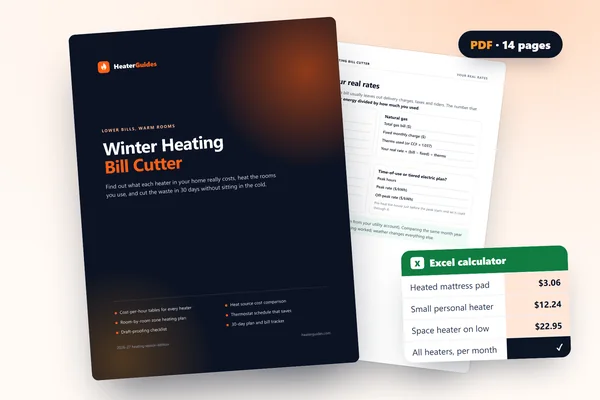 Winter Heating Bill CutterSee what every heater in your home really costs, heat the rooms you use, and cut the waste in 30 days.Cost-per-hour tables for every heaterThermostat schedule and draft-proofing planRunning-cost and bill calculator (Excel)