Transform Your Space with These Electric Fireplace Logs for Large Rooms
On this page 9 sections
- Electric Fireplace Logs for Large Rooms Compared
- The Best Electric Fireplace Logs for Large Rooms
- How to Choose an Electric Fireplace for a Large Room
- Where the Heat Actually Goes
- Sizing and Running Costs for a Large Room
- Safety and Certification for Electric Fireplaces
- Installation and Placement in a Large Room
- What to Do Next
- Questions People Ask
Electric Fireplace Logs for Large Rooms Compared
| Rank | Model | Best for | Heat output | Room size | Flame colors | Price |
|---|---|---|---|---|---|---|
| 1 | R.W.FLAME 25″ Electric Fireplace HeaterBest Overall | Heating up to 1,000 sq ft with colorful flames and quiet operation | 500W / 1500W | Up to 1,000 sq ft | 12 | Check price |
| 2 | Real Flame Malie 68″ Electric FireplacePremium Pick | A wide mantel focal point that heats up to 1,000 sq ft | 5,100 BTU | Up to 1,000 sq ft | 6 | Check price |
| 3 | A sleek built-in look without a mantel | 1500W / 750W | — | 3 | Check price | |
| 4 | R.W.FLAME 17″ Electric Fireplace HeaterBest Compact | Smaller rooms that still want cathedral style and infrared heat | 500W / 1500W | — | 4 | Check price |
| 5 | Innoflame 21″ Electric Fireplace Log SetBest Budget | Adding a realistic log set to an existing fireplace on a budget | 5,000 BTU | Up to 400 sq ft | Adjustable brightness | Check price |
A large room swallows a small electric fireplace. You get a pretty light show and a cold couch. The fix is matching the heater’s wattage and the unit’s visual scale to the room’s square footage and the wall or corner where it will sit.
Getting this wrong costs you either a second heater running all winter, or a fireplace that looks like a toy against a 16-foot wall. The five picks below cover the range: compact log sets that slip into an existing opening, wide mantel units that anchor a living room, and in-wall models that disappear into the wall.
The Best Electric Fireplace Logs for Large Rooms

R.W.FLAME 25″ Electric Fireplace Heater

Real Flame Malie 68″ Electric Fireplace
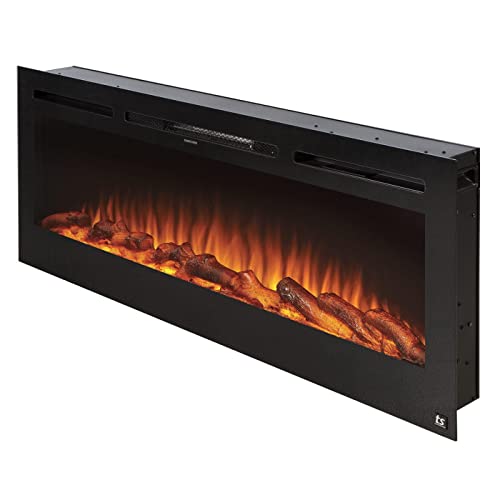
Touchstone Sideline 50″ Recessed Electric Fireplace

R.W.FLAME 17″ Electric Fireplace Heater

Innoflame 21″ Electric Fireplace Log Set
How to Choose an Electric Fireplace for a Large Room

For a large room, you need at least a 1,500-watt heater, which delivers about 5,000 BTU and can warm roughly 400 to 1,000 square feet depending on ceiling height and insulation. A unit that size plugs into a standard 120-volt outlet and won’t trip a 15-amp breaker.
The first decision is the form factor. A log set drops into an existing fireplace opening and looks like a real wood fire. A freestanding stove stands on legs and can sit against any wall. A mantel package combines the firebox with a surround and mantel, often 60 inches wide or more. An in-wall unit recesses into the wall for a flush look and needs framing work.
| Type | Large-room fit | Placement |
|---|---|---|
| Log set | Fits existing fireplace; adds heat without remodeling | Inside firebox opening |
| Freestanding stove | Portable; good for corners or open floor plans | Against a wall or corner |
| Mantel package | Large visual anchor; often 60+ inches wide | Against a wall |
| In-wall | Flush, modern look; best for new construction or remodel | Recessed in wall |
In a big room, flame realism matters more because the fireplace becomes a focal point even when the heat is off. Look for multiple flame color options, adjustable brightness, and a log bed that doesn’t look like painted plastic. The R.W.FLAME 25-inch set offers 12 flame colors and a realistic log bed; the Real Flame Malie 68-inch mantel package gives a full furniture-style presence.
Check the power cord length before you buy. Most electric fireplaces have a 6-foot cord, and the manual says to plug directly into a wall outlet, not an extension cord. Measure from where the unit will sit to the nearest outlet, and make sure the outlet is on a circuit that can handle 12.5 amps without other large loads.
For a deeper dive into specific models for large spaces, see our guide to electric fireplaces for large rooms.
Where the Heat Actually Goes
Electric fireplaces need no chimney or venting. They plug into a standard 120-volt outlet and turn electricity into heat with a resistance element, so nothing leaves the room except warmth. That makes them legal in apartments and condos where gas or wood is banned.
The heat rises. Most electric fireplaces blow warm air out the front near the floor, but within minutes it’s at the ceiling. In a room with 9-foot or higher ceilings, a ceiling fan on low, turning clockwise, pushes that warm air back down along the walls.
High ceilings and poor insulation shrink the effective area. A 1,500-watt unit rated for 1,000 square feet in an average room might only handle 500 square feet in a loft with 12-foot ceilings or a drafty addition. Treat the square-footage rating as a best-case number.
Electric fireplaces are zone heaters, not whole-house replacements. They work best when you turn down the central thermostat and heat only the room you’re in. That can cut your heating bill if the rest of the house stays cool.
Two heat delivery methods exist. Fan-forced units blow air over a heating element and warm the room quickly; you’ll hear the fan. Infrared units radiate heat that warms people and objects directly, like sunshine, and stay quieter but take longer to raise the air temperature.
If you want to compare how different types distribute heat in a large space, our electric fireplace logs for large areas guide breaks down the options.
Sizing and Running Costs for a Large Room
Large rooms need a heater that can deliver enough BTUs, but the running cost depends on the wattage you actually use. A 1,500-watt unit on high for 8 hours at 17 cents per kWh costs about $2.04 a day. That’s the number to beat when you compare settings and features.
| Heater | Watts | Per hour | Per day (8 h) | Per month (30 days) |
|---|---|---|---|---|
| 1,500 W electric fireplace (high) | 1,500 W | 26¢ | $2.04 | $61.20 |
| 500 W low setting | 500 W | 8.5¢ | 68¢ | $20.40 |
| Flame-only mode (no heat) | 50 W | 0.9¢ | 6.8¢ | $2.04 |
The formula is simple: watts ÷ 1,000 × hours × price per kWh. Run the 1,500-watt heater for 4 hours instead of 8 and the daily cost drops to about $1.02. Drop to the 500-watt low setting for all 8 hours and you pay roughly 68 cents, but the heat output falls by two-thirds.
Flame-only mode is nearly free: most units draw under 50 watts, so 8 hours of flicker without heat costs less than 7 cents. Use it for ambiance when the room is already warm.
A thermostat and timer cut wasted runtime. Set the thermostat to 68°F and the heater cycles off once the room reaches it. A timer that shuts the unit down after 4 hours stops you from paying to heat an empty room.
Safety and Certification for Electric Fireplaces
Look for a UL, ETL, or CSA mark before you buy: it means the unit passed independent safety testing. Then check for overheat protection and a tip-over switch, the two features that stop most fires before they start.
Overheat protection shuts the heater off if internal temperatures climb too high, like when a vent is blocked. A tip-over switch cuts power the moment the unit tilts past a certain angle. Both are essential in a home with kids, pets, or uneven floors.
Keep 3 feet of clearance on every side, especially in front. Curtains, furniture, and papers can ignite from radiant heat even if they never touch the unit. In a large room, that’s usually easy; just don’t tuck the fireplace behind a sofa.
Plug the fireplace directly into a wall outlet. Extension cords and power strips add resistance, which builds heat and can trip breakers or start a fire. If the cord doesn’t reach, have an electrician add an outlet where you need it.
Can you paint an electric fireplace? Yes, but only with heat-resistant paint and proper surface prep. The metal or MDF housing gets warm, and regular latex paint can peel, bubble, or release fumes. Check the manual first: some manufacturers void the warranty if you paint.
Installation and Placement in a Large Room
No chimney, no vent, no gas line. An electric fireplace just needs a standard 120-volt outlet, and you can place it almost anywhere in a large room.
Installation splits into four types, and the work involved is the main difference between them.
| Type | What it takes |
|---|---|
| Log set or freestanding stove | Plug into a wall outlet and set it where you want it. No mounting, no assembly beyond placing logs. |
| Wall-mounted | Mount a bracket to studs, hang the unit, and plug it in or hardwire it. You’ll need a level, stud finder, and drill. |
| Recessed or in-wall | Frame a rough opening, run power into the cavity, and slide the unit in. Hardwiring is common and may require an electrician. |
| Mantel package | Assemble the mantel, set it against the wall, plug in the heater insert, and level the whole thing on a flat floor. |
Placement matters for heat and safety. Keep at least 3 feet of clearance from drapes, furniture, and paper, and never block the heater outlet. If you mount one below a TV, leave at least 8 inches between the top of the fireplace and the bottom of the TV—the warm air rises and can overheat electronics.
What to Do Next
Start by measuring the room and the spot where the fireplace will go, then work through this checklist before you order.
For most large rooms, a 1,500-watt log set or freestanding unit covers 400 to 1,000 square feet. If you want a built-in look, the Touchstone 80004 Sideline fits between studs and delivers 5,000 BTU. The Real Flame Malie 68-inch mantel package gives you a full furniture piece and 1,500 watts of heat.
Once you’ve picked a model, order it and then install following the manual exactly. If you hardwire or need a new outlet, call a licensed electrician. Then sit back and enjoy the flames—no wood, no ash, no chimney sweeping.