Skip to content
HeaterGuides
Electric Heaters

De’Longhi 1500W Oil Heater Review: Best for Bedrooms?

On this page 9 sections
  1. At a Glance
  2. Top De’Longhi 1500W Oil Heater Picks
  3. Is A De’Longhi 1500W Oil Heater More Efficient Than A Baseboard Heater
  4. Choose The Right De’Longhi Model For Your Room
  5. Measure The Room Before You Buy
  6. Check Running Cost Before You Decide
  7. Use The Safety Features The Right Way
  8. What To Do Next If You Want One Now
  9. Questions People Ask
Short answer
For most readers, the best De’Longhi 1500W oil heater is the EW7707CM because it keeps a room warm quietly, has simple controls, and uses ComfortTemp to avoid running flat out all the time. A 1,500 W oil radiator can still cost about 20.4¢ per hour at 17¢ per kWh, so choosing the right model matters.
The shortlist
1
Best for most roomsDe’Longhi EW7707CM Oil Radiator
Bedrooms and offices where you want quiet heat without fussing with settings
See current price
2
Best with a timerDe’Longhi TRD40615E Dragon Digital
Anyone who wants to schedule heat before waking up or coming home
See current price
3
Best black finishDe’Longhi TRD40615EBK Dragon Digital Black
Rooms where a black finish fits better than off-white metal
See current price

The common mistake is buying a 1,500 W oil radiator for the room size, then expecting fast heat from cold. That usually means a heater running longer than you planned, which is where the bill sneaks up.

A better buy is the model that matches how you live: simple controls for a bedroom, a timer for a schedule, or more radiant surface if you want heat to feel stronger in a bigger space.

At a Glance

ModelBest forHeat outputControlsRoom fitMobilityPrice
De’Longhi EW7707CM Oil RadiatorBest for most rooms1,500 WAnalog with ComfortTempBedrooms, officesHandle and snap wheelsWhy it is here
De’Longhi TRD40615E Dragon DigitalBest with a timer1,500 WDigital, 24-hour timer, ECO PlusBedrooms, living roomsHandle and control panelWhy it is here
De’Longhi TRD40615EBK Dragon Digital BlackBest black finish1,500 WDigital, 24-hour timer, ECO PlusBedrooms, living roomsHandle and control panelWhy it is here

Top De’Longhi 1500W Oil Heater Picks

#1Best for most rooms
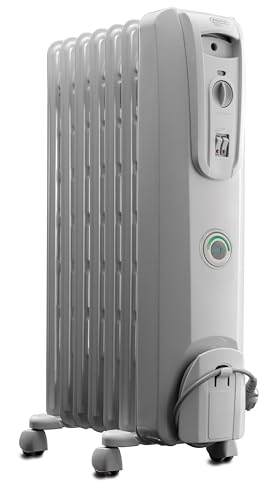
De'Longhi EW7707CM Oil Radiator

De’Longhi EW7707CM Oil Radiator

Best for Bedrooms and offices where you want quiet heat without fussing with settings
The EW7707CM keeps things simple with analog controls and ComfortTemp, which adjusts power automatically instead of holding max heat all night. The thermal slot design pushes warm air into the room while keeping the surface cooler to the touch. Snap wheels and a handle make it easy to roll between rooms.
Power 1,500 WControls Analog dial with ComfortTempMobility Snap wheels and handle
Why it made the cut
ComfortTemp saves up to 20% versus running the thermostat at max
Low surface temperature from thermal slot design
Simple dial controls, no programming needed
Good to know
No digital timer or scheduling
Analog thermostat less precise than digital models
Skip it if Skip it if you need a 24-hour timer or prefer a digital display for exact temperature readout.
See current pricePaid link · live price on Amazon
#2Best with a timer
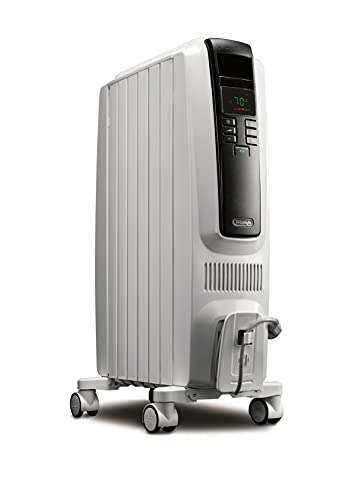
De'Longhi TRD40615E Dragon Digital

De’Longhi TRD40615E Dragon Digital

Best for Anyone who wants to schedule heat before waking up or coming home
The Dragon’s digital panel gives you a 24-hour timer and an LED display that shows exactly what the unit is doing. ECO Plus mode adjusts power flow to match the room, and the battery-style fin design claims 75% more radiant surface than older models for faster warmup. You still get the quiet, fan-free heat oil radiators are known for.
Power 1,500 WControls Digital with 24-hour timer and LED displayFeatures ECO Plus energy optimizationDesign Battery-style fins for increased radiant surface
Why it made the cut
24-hour programmable timer
ECO Plus optimizes energy use automatically
LED display shows settings at a glance
Good to know
Digital controls add complexity some users don’t need
Larger footprint than simpler models
Skip it if Skip it if you don’t need scheduling and prefer the simplicity of a dial.
See current pricePaid link · live price on Amazon
#3Best black finish
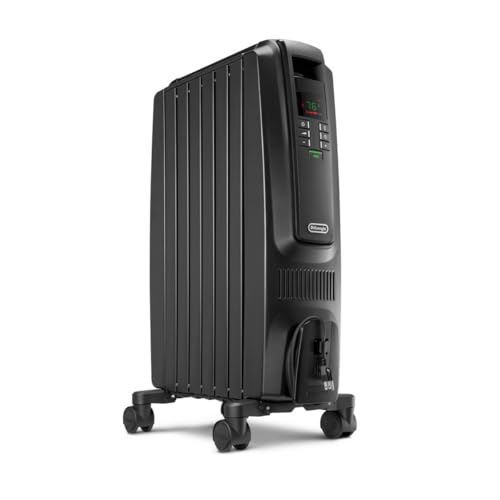
De'Longhi TRD40615EBK Dragon Digital Black

De’Longhi TRD40615EBK Dragon Digital Black

Best for Rooms where a black finish fits better than off-white metal
This is the same Dragon heater as the TRD40615E—same digital timer, same ECO Plus mode, same battery fin design—wrapped in black instead of the standard finish. You get the 24-hour scheduling and the claim of 75% more radiant surface, with a look that blends into darker furniture or modern decor.
Power 1,500 WControls Digital with 24-hour timer and LED displayDimensions 16″ × 10″ × 26″Finish Black
Why it made the cut
Black finish suits contemporary rooms
Same 24-hour timer and ECO Plus as the standard Dragon
Increased radiant surface for quicker warmup
Good to know
Costs more than the off-white version for the color alone
Still takes up the same floor space
Skip it if Skip it if color doesn’t matter and you’d rather save the difference.
See current pricePaid link · live price on Amazon

Is A De’Longhi 1500W Oil Heater More Efficient Than A Baseboard Heater

is a delongi oil radiator 1500w space heater more efficient than baseboard heater: Is A De’Longhi 1500W Oil Heater

A 1,500 W De’Longhi oil radiator and a 1,500 W electric baseboard heater pull the same wattage from the outlet when they’re running, so the electricity cost per hour is identical at full power. The difference shows up in how often each one runs and how the heat feels once the room warms up. Oil-filled radiators hold thermal mass: the oil inside stays hot after the heating element clicks off, so the unit keeps radiating warmth while drawing zero watts. A baseboard heater goes cold the moment it stops pulling power.

Nightly Cost, Same Wattage
Say you run either heater for 8 hours overnight in a bedroom. At 1,500 W, that’s 12 kWh. Multiply by your utility rate—17 cents per kWh is typical in much of the US—and you pay about $2.04 for the night, whether it’s oil or baseboard. The math is watts ÷ 1,000 × hours × rate.
Heater1,500 W
Runtime8 hours
Energy12 kWh
Rate17¢ per kWh

Where the oil radiator can save you money is in shorter duty cycles. Once the thermostat is satisfied, the oil keeps the room temperature stable longer, so the element may fire less often than a baseboard that has no thermal buffer. You won’t see half the bill, but over a month the difference can add up to a few dollars in a room you heat every evening.

Myth
Oil-filled heaters use less electricity because oil is a better conductor.
Fact
Oil is thermal mass, not a fuel. Both heater types convert every watt to heat at 100 percent efficiency; the oil just stores it and releases it slowly after the element shuts off.

The real reasons to choose one over the other come down to comfort and noise. Oil radiators run silent—no fan, no ticking from expanding metal—and the radiant warmth feels even across the room. Baseboard heaters tick and ping as the fins heat and cool, and convection can leave cold spots near the floor. If the room already has permanent baseboard heat wired to a wall thermostat, adding a portable oil radiator won’t save you anything; you’d be better off using what’s installed and setting the thermostat correctly.

Buying rule
Pick the De’Longhi oil radiator for quiet, steady heat in a bedroom or home office where you control one room at a time. Stick with baseboard if it’s already installed and serves the whole house through a central thermostat.

Choose The Right De’Longhi Model For Your Room

The three De’Longhi models at the top of this page all use the same 1,500 W heating element and radiate heat from seven to nine vertical fins, but the De’Longhi Oil filled Radiator Heater (product 1) wins for most bedrooms and home offices because it keeps controls simple, runs quietly, and uses ComfortTemp to dial back power once the target temperature is reached. The De’Longhi Dragon Digital Oil Filled Radiator Heater (product 2) adds a digital panel and a 24-hour timer, useful if you want the room warm before you wake up. Product 3 is the same digital control set wrapped in a black cabinet instead of white, so pick it only if the finish matters in your space.

FeatureProduct 1Product 2Product 3
Control typeDial knobsDigital panelDigital panel
24-hour timerNoYesYes
ComfortTempYesYes, plus ECO PlusYes, plus ECO Plus
Surface finishWhiteWhiteBlack
Best forSimple daily useScheduled heatingMatching dark decor
All three run at 1,500 W maximum and have tip-over and overheat shutoffs; the differences come down to control style and cabinet finish.

Product 1 earns the top spot because the dial thermostat and manual controls work the moment you plug it in, with no menus to navigate when you’re cold. ComfortTemp holds the room at a set point without cycling hard on and off, which saves a little energy and keeps noise low. The fins stay cooler to the touch than older oil radiators, a real advantage if kids or pets share the room. Skip it if you need a timer to warm the room before your alarm goes off.

Products 2 and 3 give you a programmable timer and ECO Plus, which adjusts heat output to match room temperature more precisely than a simple thermostat. That digital panel shows the current and target temperatures, helpful if you want to track what the heater is doing. The tradeoff is a slightly higher price and more buttons to learn. Both models use the same internal heater and the same Dragon fin design, so the black cabinet on product 3 is the only reason to choose it over product 2.

Match the model to your routine
Pick the heater that fits how you’ll actually use it, not the one with the most features. A dial thermostat and ComfortTemp handle most bedroom and office heating without fuss; a timer matters only if you want heat on a schedule.

None of these models heat a room quickly. Oil radiators take fifteen to thirty minutes to bring a cold bedroom up to temperature because the oil inside must warm first, then radiate that heat outward through the metal fins. A ceramic fan heater will blow warm air across the room in two or three minutes, so if instant heat is the priority, an oil radiator is the wrong tool. Where oil radiators win is quiet, steady warmth once they reach temperature, and they keep radiating heat for ten or fifteen minutes after the element clicks off, something a fan heater cannot do.

Oil radiator strengths
Silent operation once the thermostat settles
Radiant heat continues after the element cycles off
Low surface temperature on ComfortTemp models
Oil radiator limits
Slow to warm a cold room from a standing start
Heavy and awkward to move between floors
Takes up floor space near an outlet

Measure The Room Before You Buy

Sizing a 1,500 W oil heater starts with square footage, but the real question is whether the room holds heat or bleeds it out through windows, walls and gaps under the door. Most oil-filled radiators at this wattage work well in bedrooms and offices between 120 and 180 square feet if the insulation is decent and the ceiling is standard height. Go much larger or add poor weatherstripping, and the heater will run longer cycles without ever catching up.

Worked example
Your bedroom measures 12 feet by 14 feet, which is 168 square feet. The room has one double-hung window with storms, carpet over a subfloor, and a door that closes snugly. A 1,500 W oil radiator will bring that space from 55°F to a comfortable 68°F in about an hour, then cycle on and off to hold it. Swap in a drafty sash window and thin walls, and the same heater may take twice as long and never feel even.
Room12 × 14 ft (168 sq ft)
WindowOne double-hung with storm
Heater1,500 W oil radiator
Warm-upAbout 1 hour from 55°F to 68°F

Wattage alone won’t tell you if a heater fits. Two rooms of identical size can feel completely different: one with south-facing double-pane glass and blown-in insulation will stay warm on low, while another with old single-pane windows and an exterior wall facing north may never get there. Count the windows, check for drafts around the trim, and look at the wall construction if you know it. Those details decide whether 1,500 W is enough or just barely hanging on.

Oil radiators warm gradually
Oil-filled heaters don’t blast hot air; they warm the oil, which then radiates heat into the room over ten to twenty minutes. Start the heater before the room gets cold, especially in a bedroom or home office where you’ll be sitting still. Running it an hour before bed or before you settle in to work gives the room time to reach an even, comfortable temperature.

Ceiling height above eight feet adds volume without adding floor space, so a 150-square-foot room with a ten-foot ceiling needs more energy than the same footprint at standard height. If your room has vaulted or cathedral ceilings, expect the heater to work harder and cycle more often. A basement or slab-on-grade room will also lose heat through the floor, especially if there’s no insulation or carpet between you and the concrete.

Measure before you shop
Walk the perimeter and count the windows, exterior walls, and any gaps you can feel when you run your hand near the baseboard or door frame. A best 1500 watt space heater will do the job in a well-sealed room, but if you find more than two exterior walls or several large windows, consider adding weatherstripping or a door sweep before you expect the heater to keep up on its own.

Check Running Cost Before You Decide

Running a 1,500 W oil heater eight hours a day costs about $61 a month at 17 cents per kWh, and that number shows up on your bill whether you pick De’Longhi or any other brand. You’re paying for wattage, not the model name. Understanding that math helps you decide if an oil radiator fits your budget or if you need a smaller heater, a programmable thermostat, or shorter run times.

Here’s how the calculation works. 1,500 W is 1.5 kW, so eight hours at full power means 1.5 × 8 = 12 kWh per day. Multiply that by 17 cents and you’ll get about $2.04 per day. Over thirty days that’s $61.20, assuming the heater runs nonstop for those eight hours. ComfortTemp and ECO Plus can cut that by cycling the element on and off once the room reaches temperature, but the savings depend on room insulation, outdoor temperature and where you set the dial. Better insulation means longer off cycles and a lower bill; a drafty room or a thermostat set to 75°F keeps the element firing more often.

HeaterWattsPer hourPer day (8 h)Per month (30 days)
De’Longhi 1,500 W oil radiator1,500 W26¢$2.04$61.20
Calculated at 17¢ per kWh. Monthly cost at 17¢ per kWh before thermostat cycling savings.

If you need heat all day, look at the bill first. $61 a month adds up over a four-month heating season, and two heaters running at the same time doubles it. On the other hand, if you only need warmth for bedtime—say three hours instead of eight—the monthly cost drops to about $23, which feels a lot more manageable. Oil radiators work best when they heat one room for a few hours, not when they’re trying to replace a whole-house heating system.

Myth
Oil-filled heaters use less electricity than other space heaters.
Fact
Oil heaters don’t create heat more cheaply than ceramic, infrared or fan-forced models. All electric resistance heaters turn one watt into 3.41 BTU, so a 1,500 W oil radiator costs the same to run as a 1,500 W ceramic tower. Oil radiators just spread the warmth more gently and keep radiating after the element cycles off, which feels more comfortable but doesn’t lower the electric meter reading.
In short
Expect about $2 per day for eight hours at 17¢ per kWh, and remember that thermostats only save money when the room actually reaches the set temperature and cycles off. Shorter run times beat wishful thinking about efficiency.

Use The Safety Features The Right Way

Plug-in oil heaters belong directly in a wall outlet, not an extension cord or power strip. Drawing 12.5 amps through an underrated cord heats the wire itself, and that’s how house fires start. Keep three feet of clearance around the cabinet—no curtains, bedding or coats draped over the fins—and confirm the model carries a UL, ETL or CSA listing before you bring it home. Oil-filled radiator heaters with tip-over and overheat protection shut down automatically if they fall or the internal temperature climbs too high, but those features only work when the sensors aren’t blocked or bypassed.

De’Longhi oil radiators run cooler on the surface than a ceramic heater’s grille, but the cabinet still gets hot enough to burn skin after a few seconds of contact. That lower temperature helps around curious toddlers and pets, yet it doesn’t make the unit safe to touch for long or to leave running unattended. These are indoor electric heaters only, so no sleeping or leaving the house with one running unless the manufacturer explicitly says the model is designed for unattended operation. Most plug-in space heaters, including oil-filled models, are not.

Level placement matters
Oil heaters should sit flat and stable on their wheels or base. Placing one on thick carpet, a slanted floor or a wobbly surface can tip it over or tangle the cord underfoot. Tripping over the cord won’t just shut the heater off—it can yank the plug partway out and arc at the outlet, or pull the unit down onto someone.
Before you plug it in
Wall outlet only, never an extension cord or power strip
Three feet of clearance on all sides
Level floor so the wheels don’t roll or tip
Tip-over and overheat switches present and unblocked
UL, ETL or CSA mark visible on the label
Unattended operation
Check the manual before leaving an oil heater running overnight or while you’re away. Some models with electronic thermostats and certified tip-over protection are rated for it; most basic dial-controlled units are not.

What To Do Next If You Want One Now

Start with the room you want to heat—measure the square footage and walk the space to count windows, check door gaps, and note whether an exterior wall takes up half the perimeter. Rooms under 150 square feet with decent insulation need 1,500 W; larger or drafty rooms will ask the heater to cycle more often, which raises your bill and keeps the fan busier.

1
Pick the control style you’ll use
Bedroom and office buyers who want simple knobs and ComfortTemp should go with the De’Longhi Oil filled Radiator Heater. Schedule-driven buyers who need a timer and digital readout fit the Dragon Digital. Style-sensitive buyers get cleaner lines from the DeLonghi Dragon Digital.
2
Check the outlet and floor space
Walk to the spot where the heater will sit. Confirm the outlet is on a dedicated 15 A circuit with no other high-draw appliances sharing it, and measure 3 feet of clearance in every direction from curtains, furniture and the bed frame.
3
Read the manual before first use
Unpack the heater, verify tip-over and overheat switches work by testing them gently, and confirm the cord has no kinks. Never plug into an extension cord or power strip.
Keep it flat
Oil heaters belong on hard, level floors. Carpet can block the bottom vents and tip-over switches may not trigger reliably on soft surfaces.

Buyers still weighing brands can compare other De’Longhi space heater models or check the Dreo oil-filled 1500W heater for a different control layout. Once you’ve chosen, order, unbox, test the safety switches and set the thermostat two notches below maximum for the first night. Adjust from there.

Questions People Ask

Is a De’Longhi oil radiator good for a bedroom?
Yes, because the sealed oil reservoir radiates heat without a fan, so there’s no motor noise to wake you or keep you up. The ComfortTemp models cycle on and off automatically to hold a steady temperature, and tip-over and overheat switches shut the unit down if anything goes wrong. Never leave it running unattended unless the manufacturer states the model is designed for it, and keep three feet of clearance around the unit.
How much electricity does a 1,500 W oil heater use in a night?
Eight hours at full draw is 12 kWh, which costs about $2.04 at 17 cents per kWh. A model with a thermostat cycles off when it hits setpoint, so actual use depends on room size, insulation and the outdoor temperature. Check your utility bill for your exact rate and multiply kilowatt-hours by that number.
Is an oil-filled radiator cheaper to run than a baseboard heater?
Not if both are rated 1,500 W and plugged into the same outlet with the same electric rate. The oil radiator’s thermal mass keeps radiating a few minutes after the element clicks off, which can smooth out temperature swings, but it doesn’t lower the wattage drawn from the wall or change the cents-per-hour calculation while the element is on.
What room size is a 1,500 W De’Longhi heater good for?
A well-insulated room up to about 150 square feet, or a smaller space with exterior walls and drafty windows. Rooms with high ceilings, concrete floors or poor weatherstripping need more output than a plug-in heater can supply. Walk the perimeter and count windows and doors before you decide.
Do De’Longhi oil heaters need maintenance or refilling?
No. The oil reservoir is permanently sealed at the factory and never needs topping off or changing. Wipe dust off the fins every few weeks so it doesn’t bake onto the surface, and check the cord and plug for damage before each heating season.
Can I use a De’Longhi oil heater on an extension cord?
No. A 1,500 W heater draws 12.5 amps, which is close to the 15-amp limit of most household circuits, and an extension cord adds resistance that can overheat the wire and trip the breaker or start a fire. Plug directly into a wall outlet every time.

Joye Editor

HeaterGuides covers home heating, water heating and HVAC: how the equipment works, what it costs to run, and how to use it safely.

More in Electric Heaters