



The useful question is not whether an electric heater is “efficient” in the abstract. Every resistance heater turns almost all its electricity into heat, so the real difference is how well it controls that heat, how evenly it spreads it, and how often it can stay at a lower draw.
That is why room size, thermostat control, noise, and standby behavior matter more than a shiny badge. A heater that can hold a set point with fewer full-power bursts will usually cost less to run than one that just blasts at 1,500 W and hopes for the best.
Comparison of Energy-Efficient Electric Heaters
| Model | Best for | Heat output | Noise | Room size | Safety | Price |
|---|---|---|---|---|---|---|
| DREO 1500W Ceramic Heater with Thermostat | Best for Precision | 1500W | 34dB | Medium to large | Tip-over and overheat protection | Check today’s price |
| DREO 1500W Portable Space Heater with Thermostat | Best for Portability | 1500W | 34dB | Up to 200 sq.ft | Tilt-detection sensor, overheat protection | Check today’s price |
| DREO Large Room Space Heater with ECO Mode | Best for Large Rooms | 1500 watts | 34dB | Up to 250 sq.ft | Child lock, tip-over, overheat protection | Check today’s price |
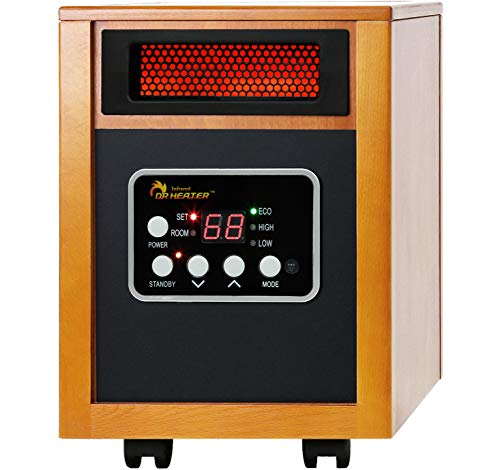
| DR. INFRARED HEATER DR-968 1500W Portable Heater | Best for Infrared Boost | 1500W (5200 BTU) | 39dB | Large rooms | Tip-over, overheat protection, auto shut-off | Check today’s price |
| PELONIS 23” Oscillating Ceramic Tower Heater | Best for Tower Design | 1500W | 50dB | 106–167 sq.ft | Tip-over and overheat protection | Check today’s price |
Best Energy-Efficient Electric Heaters
DREO 1500W Ceramic Heater with Thermostat
DREO 1500W Portable Space Heater with Thermostat
DREO Large Room Space Heater with ECO Mode
DR. INFRARED HEATER DR-968 1500W Portable Heater
PELONIS 23” Oscillating Ceramic Tower Heater
Most Energy-Efficient Electric Heaters
Electric resistance heaters are nearly 100% efficient at converting electric power into heat, so the real efficiency battle is about how quickly and precisely they deliver that heat to where you need it. The heater that runs the shortest time to reach and hold your ideal temperature uses the least electricity overall.
In practice, the most energy-efficient electric heaters rely on accurate thermostats, ECO modes that cut power intelligently, and features like oscillation to spread heat evenly. Matching the heater’s output to your room size matters just as much as the heater’s technology. A 1,500 W heater running for 8 hours uses about 12 kilowatt-hours (kWh); at 17 cents per kWh, that’s roughly $2.04 for a night’s worth of heat.
Using an electric heater in one room instead of heating the entire house with central heating often saves money. Central systems typically cost about 43% less to run for whole-home heating compared to space heaters, but if you mostly occupy one room, a targeted electric heater cuts the overall energy use. You avoid paying to warm empty rooms or hallways — a common waste in whole-house setups.
| Duration | Energy Used (kWh) | Approximate Cost at $0.17/kWh |
|---|---|---|
| 1 hour | 1.5 | The cost depends on your electricity rate; at 17 cents per kWh, running 1,500 W for 1.5 hours uses 2.25 kWh. |
| 4 hours | 6.0 | At 17 cents per kWh, a 1,500 W heater running for 6 hours uses 9 kWh of electricity. |
| 8 hours | 12.0 | Running a 1,500 W heater for 8 hours consumes 12 kWh, which you can multiply by your local rate to estimate cost. |
How To Choose By Room Size And Heat Type
The best energy-efficient electric heater depends heavily on your room size and the kind of heat you want. Large rooms usually need high-output ceramic towers with oscillation or oil-filled radiators for steady, even warmth. Small rooms do well with lower-watt models that avoid overheating and waste.
Ceramic heaters heat fast by warming air through a PTC element, making them ideal for quick bursts in living rooms or bedrooms. Oil-filled radiators take longer to warm up but hold heat silently and steadily, perfect for background heat in larger spaces or overnight use. Micathermic heaters combine radiant and convective heat, offering a middle ground that heats both objects and the air efficiently. Infrared heaters directly warm people and objects in line of sight, working well in drafty or spot-heating situations but less so for full-room warmth.
Say your room is 12 by 14 feet, which is about 168 square feet. That fits the 150 to 250 square foot heating range better than a tiny desk heater rated for under 100 square feet. For this, a 1,500-watt ceramic tower with oscillation or an oil-filled radiator rated for that size is a solid choice. A smaller 750-watt model would struggle to keep this room warm efficiently.
| Heater Type | Heat Delivery | Best Room Size | Notes |
|---|---|---|---|
| Ceramic | Fast convection heat | Small to medium (100-250 sq ft) | Quick heat, oscillation spreads warmth |
| Oil-Filled Radiator | Slow convection, retains heat | Medium to large (200-400 sq ft) | Quiet, steady, holds heat after off |
| Micathermic | Radiant + convection | Small to medium | Balanced heat, slim profile |
| Infrared | Radiant, direct heat | Small spots or drafty areas | Heats people/objects, not air |
Comparing electric radiators, oil-filled models often edge out blowers for energy efficiency in steady use. Oil-filled radiators keep radiating heat after the element turns off, using less electricity over time. Blow heaters cycle on and off more frequently, which can use more power for the same comfort level.
Electric oil heaters are energy efficient as resistance heaters go, but they can’t match heat pumps. Heat pumps move heat instead of creating it, making them more than twice as efficient for whole-home heating. However, heat pumps cost more upfront and work best when heating an entire house or a large zone. Electric radiators or ceramic heaters remain practical and energy-efficient for zoned or short-term heating, especially in homes without heat pumps.
For large rooms, a 1,500-watt ceramic tower with oscillation like the DREO Space Heater for Large Room quickly distributes heat and maintains temperature with a precise thermostat. Oil-filled radiators suit larger spaces if you prefer quiet, steady warmth that lingers after the heater cycles off. Small rooms or short-term use call for lower-watt ceramic or micathermic models, which heat fast without wasting energy.
Which electric heater is more practical and energy-efficient for higher temperature needs? Oil-filled radiators keep rooms warmer longer without constant power, making them better for sustained heat. Heat pumps remain more efficient overall but come with installation complexity and upfront cost. Electric heaters fill gaps where quick, localized heat is needed.
Running Cost And Thermostat Settings
Calculating what your electric heater costs to run comes down to a simple formula: watts ÷ 1,000 × hours × electricity rate. A 1,500 W heater running for 8 hours at 17 cents per kWh uses 12 kWh, which costs about $2.04 a night. That’s the basic math behind all electric heaters, no matter the size or style.
The most energy-efficient electric heaters for large rooms in Australia often combine a PTC ceramic element with a precise thermostat and an eco mode. These features don’t change the physics of converting electricity to heat—they convert nearly 100% of electrical energy into heat—but they reduce runtime at full power, lowering your bill by cycling the heater on and off more effectively.
Best thermostat settings to save energy start with setting the heater to a high temperature to quickly warm the room. After the room reaches comfort, lower the thermostat to the minimum temperature that keeps you comfortable. This avoids overheating and unnecessary power use. Using the timer function shuts the heater off when you don’t need it, so it isn’t idling and wasting electricity.
Oscillation spreads heat evenly, which feels better in medium and large spaces where air movement circulates warmth. But in small rooms, oscillation can create a noticeable draft and make the space feel cooler, so it’s less useful there.
| Heater Power (W) | Hours Used | Rate (per kWh) | Cost |
|---|---|---|---|
| 1,500 | 8 | Assuming electricity costs 17 cents per kWh, 1,500 watts running for one hour uses 1.5 kWh. | At 17 cents per kWh, 1,500 watts running for 8 hours uses 12 kWh of electricity. |
Safety, Certification, And Real Limits
Energy-efficient electric heaters must meet strict safety standards beyond just low power use. Look for models with tip-over shut-off and overheat protection, which cut power instantly if the heater falls or gets too hot. A sturdy power cord and plug rated for the heater’s wattage are essential to avoid electrical hazards.
A listed safety mark such as UL, ETL, or CSA shows the heater has passed independent lab tests for safe operation. Without one, you can’t be sure the heater includes these crucial protections.
Give every electric heater at least 3 feet of clearance on all sides to prevent heat buildup near combustibles. Plug-in heaters should never run on extension cords or power strips; draw directly from a wall outlet rated for 15 amps or higher. That prevents overheating of wiring and reduces fire risk.
Bathrooms and other damp areas pose special challenges. Only use heaters explicitly rated for bathroom use, and place them well away from sinks, tubs, or showers to keep water spray from reaching electrical parts. If the manual doesn’t approve bathroom use, skip it.
Energy Star certification is a U.S. EPA program started in 1992 to label appliances that meet efficiency requirements. For electric heaters, Energy Star means the unit has an efficient thermostat and power control features like eco modes or programmable timers. But the badge alone won’t guarantee the heater performs efficiently in your specific room — correct sizing and placement matter most.
Infrared heaters, ceramic heaters, and oil-filled radiators all have similar safety features when properly certified. Infrared heaters are not inherently safer than ceramic or oil-filled models; safety depends on built-in shut-offs and stable design rather than heating method.
Electric heaters shine as supplemental zone heat — small, well-insulated rooms or spots you use often. They aren’t cost-effective as a full-house heating solution. Central heating systems heat the entire home more cheaply, often 43% less expensive than electric space heaters running all day. Electric units can quickly boost comfort where you need it without heating empty rooms.
What Competitors Leave Out About Efficiency
Oscillation on an electric heater doesn’t make it more energy-efficient, but it does spread warm air more evenly across the room. If your heater swings side to side, you’ll notice fewer cold spots and better comfort without using extra power.
Keeping your heater clean is key to maintaining steady heat output. Dust buildup on the intake or grille restricts airflow and forces the heater to work harder. If your model has a filter, clean or replace it regularly. Also, check that the thermostat sensor isn’t blocked by curtains or furniture, which can cause the heater to cycle incorrectly and waste energy.
Noise levels vary widely among electric heaters, impacting where you can comfortably use them. A heater running in the low 30s decibels is quiet enough for bedrooms or study rooms. Around 50 dB, the noise is noticeable in a quiet office but not distracting for most people. Fan design influences noise as much as the decibel rating; some heaters hum or rattle more despite similar specs.
Smart thermostats and AI controls promise to cut wasted energy by adapting heat output during the day. They can be helpful if your room’s temperature needs change often, like a sunlit living room cooling at night. However, a simple, accurate thermostat often does the job for less money and with fewer technical hiccups. The smart units save energy only if you actually run your heater less or lower its power, not just because they have fancy controls.
An energy-saving intelligent thermostat on a heater typically stops power to the heating element or fan once the set temperature is reached. This prevents overheating the room and running longer than needed, but the actual savings come from how well you set the temperature and use the heater’s modes.
Using less electricity on your heater lowers emissions only if you cut runtime or heat fewer rooms. The biggest environmental gain comes from disciplined zone heating: turning down or off heaters in unused rooms. Otherwise, running a 1,500 W heater for 8 hours is still about 12 kWh, costing roughly $2.04 at 17 cents per kWh.
If you want a heater that covers your space efficiently, match size and features to your room and habits. Oscillation improves comfort but not efficiency. Keep your heater clean and sensors clear to maintain performance. Smart controls help in certain situations, but the simplest accurate thermostat often saves you money with less fuss.
More Questions, Answered
Which electric heater type is most energy efficient for large rooms?
How much can one realistically save using an energy-efficient heater?
Are infrared heaters safer than ceramic or oil-filled heaters?
Can electric heaters replace central heating entirely?

HeaterGuides covers home heating, water heating and HVAC: how the equipment works, what it costs to run, and how to use it safely.