Battery Backup That Powers 55,000 BTU Tankless Water Heaters
On this page 8 sections
- Battery Backup Tankless Water Heaters Compared
- Top Battery Backup Tankless Water Heaters Ranked
- Check Water Flow Rate and BTU Output First
- Understand Battery Ignition and Power Requirements
- Size Your Backup for Off-Grid or Emergency Use
- Confirm Safety Features and Certifications
- What Others Miss: Portability and Setup Accessories
- More Questions, Answered
When the power goes out, your tankless water heater can stop working unless it has a battery backup or a battery-operated ignition system. Choosing the right backup depends on flow rate, fuel type, safety features, and how you plan to use it—outdoors, in an RV, or at home.
This guide ranks the top battery backup tankless water heaters by real specs like BTU, gallons per minute (GPM), battery type, and safety certifications. It also explains how to size your backup, estimate running costs, and avoid common mistakes.
Battery Backup Tankless Water Heaters Compared
| Model | Best for | BTU Output | Max Flow Rate (GPM) | Battery Type | Safety Certification | Price |
|---|---|---|---|---|---|---|
| CAMPLUX Portable Tankless Water Heater 55,000 BTU | Best Overall | 55,000 BTU | 2.11 GPM | 2 D-cell batteries | CSA Certified | Why it is here |
| GASLAND Tankless Water Heater 68,000 BTU 2.64GPM | Highest Output | 68,000 BTU | 2.64 GPM | 2 D-cell batteries | CSA Certified | Why it is here |
| Camplux Pro 6L Portable Tankless Water Heater 41,000 BTU | Best Compact | 41,000 BTU | 1.58 GPM | 2 D-cell batteries | — | Why it is here |
| CAMPLUX 1.32 GPM Portable Tankless Water Heater 5L | Best Lightweight | — | 1.32 GPM | 2 D-cell batteries | CSA Certified | Why it is here |
| GASLAND Outdoor Propane Tankless Water Heater 68,000 BTU | Best Digital Display | 68,000 BTU | 2.64 GPM | 2 D-cell batteries | CSA Certified | Why it is here |
Top Battery Backup Tankless Water Heaters Ranked
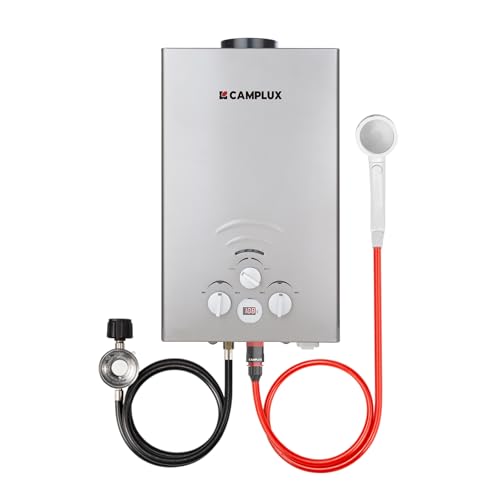
CAMPLUX Portable Tankless Water Heater 55,000 BTU

GASLAND Tankless Water Heater 68,000 BTU 2.64GPM

Camplux Pro 6L Portable Tankless Water Heater 41,000 BTU

CAMPLUX 1.32 GPM Portable Tankless Water Heater 5L

GASLAND Outdoor Propane Tankless Water Heater 68,000 BTU
Check Water Flow Rate and BTU Output First

Start by checking your tankless water heater’s water flow rate and BTU rating. These numbers tell you how much heat and power your unit needs to work properly. For example, a 55,000 BTU heater that requires a 2.5 gallons-per-minute flow rate demands a certain battery capacity and ignition power to run smoothly.
BTU output measures the heat energy the unit supplies. More BTUs mean the heater can raise water temperature faster or handle higher flow rates without losing heat. For example, a 50,000 BTU heater can heat about 1.5 to 2 GPM of incoming cold water to a comfortable 120°F. If it’s undersized, the water might be lukewarm. Oversized units waste fuel and money, cycling on and off inefficiently.
Battery-powered tankless water heaters use batteries mainly for ignition, not continuous heating power. The heater still burns propane or natural gas for heat, but the battery ignition ensures starting without a grid connection. These differ from battery water heaters, which store heated water electrically, and battery space heaters, which convert electricity directly to heat without fuel.
Match your heater’s GPM and BTU rating to your household’s peak hot water needs. A unit too small won’t meet demand; too large, and you waste fuel. This balance is the foundation before considering battery backup options.
 Water Heater Owner's ToolkitFix the common faults yourself, keep it running for years, and know when a repair is money wasted.No-hot-water flowcharts, gas and electricFlush, anode, relief valve and descaling stepsRepair-or-replace calculator (Excel)
Understand Battery Ignition and Power Requirements
Battery ignition in propane tankless water heaters typically runs on two D-cell batteries. Their job is simple but critical: they generate the spark to light the burner each time you call for hot water. This lets you run the heater off-grid or during power outages without an external electrical hookup.
Battery ignition systems need a steady power supply to light your tankless water heater’s pilot or electronic igniter. Most systems use 6-volt or 12-volt batteries. Check your heater’s manual to find the exact voltage and minimum amp-hour rating required. If your battery is too small, the heater may fail to start or shut off unexpectedly.
Expect to replace the batteries once or twice a season, depending on use. Two D cells cost a few dollars and are easy to swap out. This battery setup eliminates the need for bulky power inverters or generators just to start your water heater when the grid is down.
If you want a reliable battery-backup-for-tankless-water-heater system, focus on models designed for battery ignition and check they include or recommend the right battery type. Hot water heater battery systems that depend on external power won’t work in outages, so this onboard battery ignition is key for truly off-grid or emergency use.
Size Your Backup for Off-Grid or Emergency Use
Size your battery backup based on how long you want hot water available during a power outage or off-grid use. For instance, if your heater draws 3 amps at 12 volts and you want 8 hours of operation, that’s 24 amp-hours minimum. Add a 20% margin for safety and battery aging, so aim for about 30 amp-hours. This ensures your heater runs reliably without overtaxing the battery.
Consider a typical shower that uses 2 gallons per minute (GPM) of hot water for 10 minutes. That totals 20 gallons of hot water per use. To supply this, the heater must sustain a steady flow without running out of fuel or battery power.
Propane consumption depends on the heater’s BTU output and burn rate. For example, a 55,000 BTU heater burns about 1.5 pounds of propane per hour. A 10-minute shower uses roughly a quarter-hour of run time, so expect about 0.375 pounds of propane per shower. A 20-pound propane tank then provides around 53 showers before requiring a refill, assuming no other losses.
Battery life varies by heater model and ignition system. Most use two D-cell batteries for ignition only, drawing minimal power during operation. Still, keep spare batteries on hand, especially for emergencies. A fresh set can handle dozens of ignitions, but prolonged outages may need multiple replacements.
For off-grid setups, choose a propane tank sized for your hot water use and storage capacity. A 20-pound tank suits occasional use, while a 100-pound tank or larger fits extended off-grid needs. Store batteries in a cool, dry place and rotate them regularly to keep them fresh.
Sizing your backup means balancing hot water demand, propane supply, and battery availability. This ensures your battery-operated tankless water heater runs smoothly when you need it most.
Confirm Safety Features and Certifications
Confirm that your battery system and heater have safety features like low-voltage disconnect and proper fusing to prevent damage or fire. Look for certifications from UL or CSA, which show the equipment meets safety standards. Without these, you risk battery damage or unsafe operation during extended use.
Key safety features include a flame failure device that shuts off gas if the flame goes out, overheat protection to avoid temperature spikes, and freeze protection to prevent damage in cold conditions. These features reduce risks of fire, gas leaks and equipment failure.
Look for CSA certification on your battery heater. CSA certification means the unit meets strict safety and performance standards for both the US and Canada. Certified heaters comply with local building codes and are tested for safe operation under real-world conditions.
Avoid non-certified units indoors or in enclosed spaces. They pose carbon monoxide risks and may lack essential safety shutoffs. Using a heater without proper certification can violate local codes and endanger your home and health.
Checking for these safety features and certifications gives you peace of mind and ensures your battery water heater operates safely and effectively.
What Others Miss: Portability and Setup Accessories
Portability matters if you plan to move your heater setup or use it in remote locations. Choose batteries with handles or cases designed for transport. Also, consider accessories like quick-connect cables and battery chargers that make setup and maintenance easier in the field.
Many models come with included accessories like propane regulators, hoses, and showerheads. These simplify setup by providing everything needed to connect and operate the heater safely and quickly. Checking what comes in the box before buying can save you the hassle and expense of buying extra parts later.
For example, the CAMPLUX Portable Tankless Water Heater 55,000 BTU includes a regulator and hose designed for easy hookup to standard propane tanks. This means you won’t need to track down compatible fittings or worry about improper connections that could lead to leaks or malfunction.
Some compact models, like the Camplux Pro 6L, come with quick-release handles and tight battery compartments. These features let you swap batteries quickly without tools, making the heater easier to carry on short trips or when space is tight.
Confirming included setup accessories and portability features is especially important if you plan to rely on the heater for emergency hot water or as a battery-operated outdoor unit. Accessories ensure safe, compliant operation, and portability means you can move the heater exactly where you need it, when you need it.