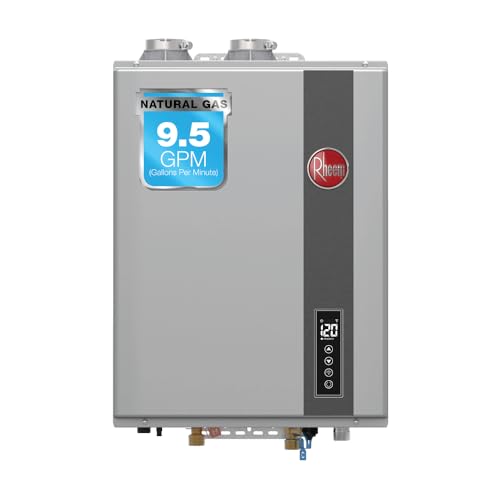
For most households with natural gas, the Rheem RTGH-95DVLN-3 is the strongest pick: it delivers 9.5 GPM at a 35°F temperature rise and has a 0.93 UEF. That flow rate is not a promise of 9.5 GPM in a cold climate; your incoming water temperature and simultaneous hot-water demand decide what the unit can actually deliver.
What to remember
Choose by required flow at your winter temperature rise, not the largest GPM printed on the box.
For natural gas, the Rheem RTGH-95DVLN-3 offers 9.5 GPM at a 35°F rise and 0.93 UEF.
The Rheem RTG outdoor model is liquid propane and needs an outdoor installation; it is not an indoor substitute.
Tankless water heater cost includes installation changes, not only the unit.
Have a qualified professional confirm gas capacity, venting, electrical needs and local code before ordering.
Getting the flow rate wrong can leave you with a costly heater that still cannot run the shower and dishwasher together. An undersized unit is a comfort problem; a poorly vented or incorrectly fueled gas unit is a safety problem.
The available product data supports four tankless picks, not five: one listed product is a portable space heater, not a water heater, so it does not belong in this ranking.
Four Tankless Picks by Household Need
#1Best for most homes
Rheem RTGH Condensing Natural Gas Tankless
Best for Natural-gas homes with several bathrooms and high hot-water demand
Its 9.5 GPM rating at a 35°F rise and 199,900 BTU/hr output suit households that may run several showers at once. The 0.93 UEF condensing design is the strongest efficiency figure among the listed tankless picks; actual flow still depends on your incoming water temperature and demand.
Fuel Natural gasFlow 9.5 GPM at 35°F riseOutput 199,900 BTU/hrUEF 0.93Installation Indoor, direct vent
Why it made the cut
9.5 GPM at a 35°F rise
0.93 UEF
Indoor direct-vent installation
Good to know
Requires natural gas and indoor direct venting
Professional installation is recommended
Skip it if Skip it if your home uses propane or you need an outdoor-mounted unit.
Best for Natural-gas homes that want a high rated flow without a condensing model
The 9.5 GPM rating at a 35°F rise and 199,900 BTU/hr output make this a high-flow option for multi-bathroom homes. Its 0.82 UEF is lower than the condensing Rheem’s, so it makes more sense when you want the non-condensing design rather than the highest listed efficiency.
Fuel Natural gasFlow 9.5 GPM at 35°F riseOutput 199,900 BTU/hrUEF 0.82Installation Indoor, direct vent
Why it made the cut
9.5 GPM at a 35°F rise
Indoor direct-vent installation
Digital temperature control with ±1°F adjustments
Good to know
0.82 UEF is lower than the listed condensing Rheem
Requires natural gas and professional installation
Skip it if Skip it if the higher listed UEF of a condensing model matters more to you.
Best for Propane homes with space for an outdoor wall-mounted unit
This model runs on liquid propane and is designed for outdoor installation, so it avoids indoor venting. Its 7.0 GPM rating at a 35°F rise and 160,000 BTU/hr output give it a lower rated flow than the natural-gas Rheems, which matters if several fixtures run together.
Best for Smaller homes using propane with modest simultaneous hot-water demand
The CX360 is an indoor propane model rated at 3.6 GPM and 82,000 BTU. Its compact listed dimensions and 3-inch OD vent connection may suit a tight installation, but confirm the venting arrangement with a qualified installer and the unit’s manual before buying.
Fuel PropaneFlow 3.6 GPMOutput 82,000 BTUInstallation IndoorVent connection 3-inch OD
Best for Supplemental room heat—not domestic hot water
This is a portable ceramic space heater, not a tankless water heater, so it cannot supply showers or sinks. Its 1,500 W rating, thermostat and tip-over shutoff may suit someone looking for supplemental room heat, but it does not belong in a tankless water-heater comparison.
Type Portable electric space heaterPower 1,500 WCoverage claim Up to 200 sq.ftTimer 24H
Why it made the cut
1,500 W power
Thermostat and 24-hour timer
ETL-certified with tip-over and overheat protection
Good to know
Does not heat water
Plug-in room heater, not a plumbing appliance
Skip it if Skip it if you need hot water for a shower, sink or household plumbing.
Best Tankless Water Heaters 2025 Need Winter Sizing
The best tankless water heater for your home is one that can meet your simultaneous hot-water demand at your winter inlet-water temperature. The best tankless water heaters 2025 searches point to the same sizing question: what is a tankless water heater, what does a tankless water heater do, and how does a tankless water heater keep up? It heats water as it flows instead of storing a tankful, so tankless hot water heaters are sized by flow and temperature rise.
9.5 GPM
Rheem RTG and RTGH rating at a 35°F rise
That rating applies at the stated temperature rise. Colder incoming water needs more heating, which reduces the flow the unit can deliver.
A 35°F rise isn’t the same as raising cold groundwater to a comfortable shower temperature. Check the manufacturer’s performance chart at your local winter inlet temperature, then have a professional calculate whether the unit covers your real demand.
1
List what runs together
Estimate the hot-water flow of the fixtures you actually use at the same time, such as a shower and kitchen tap.
2
Check winter output
Compare that combined demand with the model’s charted output at your winter inlet temperature, not just its headline GPM.
A hypothetical winter check
Say your winter inlet water is 40°F and you want 105°F water. That’s a 65°F rise—30°F more than the Rheem rating point. Its 9.5 GPM figure doesn’t tell you the output at that higher rise; use the performance chart and a sizing calculation.
Inlet water40°F
Target water105°F
Required rise65°F
A 3.6 GPM CAMPLUX may fit limited, carefully timed demand, but a listing that mentions multiple points doesn’t prove it can serve a whole home at once. For more Rheem options, see Rheem gas water heaters.
From HeaterGuides · our own guideTankless? Page 8 is the descaling routine, page 15 checks the size.Water Heater Owner's ToolkitFix the common faults yourself, keep it running for years, and know when a repair is money wasted.No-hot-water flowcharts, gas and electricFlush, anode, relief valve and descaling stepsRepair-or-replace calculator (Excel)$14.99$9.99Get it for $9.99See what's inside and watch the 2-minute video →18-page printable PDF + Excel calculator · instant download · 30-day refund
Fuel And Venting Narrow The Choices
Fuel and venting narrow these picks to the setup your home can safely support. The supplied models are Rheem and CAMPLUX; there isn’t product data here to rank or compare a Navien tankless water heater, Rinnai tankless water heater or Noritz tankless water heater by model specs.
Model
Fuel and location
Listed rating
Rheem RTG, non-condensing
Natural gas; indoor
9.5 GPM at 35°F rise; 0.82 UEF
Rheem RTGH-95DVLN-3, condensing
Natural gas; indoor
9.5 GPM at 35°F rise; 0.93 UEF
Rheem RTG, 7.0 GPM
Liquid propane; outdoor only
7.0 GPM
CAMPLUX Climatech 3
Propane; listed for indoor installation
3.6 GPM
Confirm the exact model’s installation requirements before ordering.
For a natural-gas home, the RTG is non-condensing and the RTGH is condensing. Condensing units recover more heat from exhaust, but need compatible venting and condensate handling; check the installation manual and make sure the installer quote includes both.
Indoor combustion needs careful setup
Use only a model listed for indoor installation, follow its manual’s ventilation requirements and keep a working carbon monoxide alarm in the home. Never use an outdoor-only heater indoors.
Before buying, confirm fuel type, gas-line capacity, vent route and local code. Have a qualified professional handle gas connections and venting; a wrong fuel assumption can turn a promising spec sheet into an expensive paperweight.
Tankless Water Heater Cost Goes Beyond The Unit
Tankless water heater cost includes the equipment and any site work; there’s no reliable answer to “how much is a tankless water heater” without seeing your home and the model. Get an itemized written quote, since a straightforward replacement and a job needing major changes aren’t the same project.
Quote item
What to verify
Gas line
Whether its capacity is adequate or an upgrade is needed
Venting
Materials, route and work required for the selected model
Condensate
Whether a drain is needed for a condensing model
Electrical
Connection work included in the quote
Permits and removal
Permit fees, plus removal and disposal of the old heater
Ask the installer to mark each item included, excluded or not needed.
Compare operating energy with your current heater using your actual gas or electricity rates and expected hot-water use. Estimate appliance energy cost as fuel consumed × operating hours or usage × your local fuel rate; ask the installer for a model-specific consumption estimate rather than guessing runtime. The listed 0.82 and 0.93 UEF figures are efficiency ratings, not promises of matching percentage reductions in your bill.
Get the scope in writing
Ask for labor, materials, permits and disposal to be itemized, along with any assumptions about gas-line capacity, venting and electrical work.
A Heat Pump Water Heater Is A Different Choice
A tankless water heater with heat pump isn’t among these picks: the listed tankless models are gas-fired, and none is a tankless heat-pump water heater. Typical residential heat-pump water heaters store hot water in a tank and move heat from the surrounding air into the water.
Myth
A heat-pump water heater is simply an electric version of a tankless gas unit.
Fact
They’re different equipment categories: one heats stored water using heat moved from surrounding air; the other heats water on demand with gas.
If electric operation and efficiency matter most, compare a heat-pump storage model with a tankless gas model against your available space, household demand, climate and local utility rates. A storage tank needs room; a tankless unit’s output must match the hot-water demand you’ll run at once.
Compare the whole installation
Get quotes for the equipment that fits your home, then compare installation work and local energy costs. Neither type is cheaper in every house.
Check These Details Before The Installer Leaves
For the best tankless water heaters 2026—or the best tankless water heater 2026, best tankless water heater 2025, top rated tankless water heaters, 5 best tankless water heaters or top 5 tankless water heaters—check the installation and commissioning, not just the GPM number. Ask the installer to demonstrate the unit at your fixtures and explain its limits before signing off.
1
Confirm the installation
Require the exact model’s manufacturer instructions and listing to be followed, along with local code. Have qualified professionals handle gas connections, venting and any required electrical work.
2
Test hot water at the tap
Ask how the installer will commission the unit and verify delivered temperature and flow under use. Scald risk rises above 120°F at the tap; have the temperature set to suit your household.
3
Review upkeep and cold-weather limits
Get the manufacturer’s maintenance intervals and a plain explanation of freeze protection, including what it can and cannot protect during a power outage or prolonged cold.
4
Check paperwork and local rules
Confirm warranty terms in current manufacturer documentation, not just a product listing. Check local restrictions on vent-free gas equipment before buying or installing it.
Combustion Safety
For indoor propane or natural-gas use, choose only a model rated for indoor installation, follow its ventilation requirements and keep a working carbon monoxide alarm nearby. Never bring an outdoor-only heater indoors. The CAMPLUX product data does not specify an oxygen depletion sensor, so check its manual and local rules before considering indoor installation.
Before You Sign Off
Model and installation match the manufacturer’s listing and local code
Hot-water temperature and flow were demonstrated
Maintenance schedule and freeze-protection limits were explained
Warranty terms and local restrictions were checked
Questions People Ask
What is the best tankless water heater for most homes?
For most homes with natural gas, the Rheem RTGH-95DVLN-3 is the strongest pick in this guide, with 9.5 GPM at a 35°F temperature rise and a 0.93 UEF. Check its output against your winter inlet-water temperature and the fixtures you expect to run at once before choosing it.
How much does a tankless water heater cost to install?
Installation cost depends on the heater and the work your home needs, such as changes to gas capacity, venting, electrical service or plumbing. Get an itemized quote for the specific model and ask which upgrades are included; gas connections and venting should be handled by a licensed professional.
What does a tankless water heater do?
A tankless water heater heats water as it passes through the unit instead of storing a tankful for later. That can provide a continuing supply while demand stays within the unit’s flow and heating capacity.
How does a tankless water heater work?
Opening a hot-water tap triggers the unit to sense flow and fire its burner or energize its heating elements. The water then passes through a heat exchanger, and the controls adjust heat output to meet the target temperature within the unit’s limits.
Is a Navien tankless water heater a good choice?
Navien can be a good choice if a particular model meets your winter flow demand and fits your fuel, venting and installation constraints. Compare its published flow at the temperature rise you need, not just its maximum GPM, and confirm parts and service support in your area.
What should I compare in a Rinnai or Noritz tankless water heater?
Compare the exact model’s flow at your expected winter temperature rise, fuel type, venting requirements and warranty terms. Brand names alone won’t tell you whether the unit can serve your showers and other fixtures at the same time.
Can a tankless water heater with a heat pump provide hot water on demand?
A heat-pump water heater can provide hot water from a storage tank, but it isn’t the same as a gas-fired tankless unit that heats water as it flows. Check the product’s capacity and recovery rate if you’re comparing heat-pump models for on-demand use.
Before you go · a welcome giftGet the Water Heater Owner's Toolkit for $4.99Fix the common faults yourself, keep it running for years, and know when a repair is money wasted. Normally $14.99; your welcome price saves $10.00. We'll email your link right now.or buy it now for $9.99 without the gift →One email with your link now. We never share your address.


 Water Heater Owner's ToolkitFix the common faults yourself, keep it running for years, and know when a repair is money wasted.No-hot-water flowcharts, gas and electricFlush, anode, relief valve and descaling stepsRepair-or-replace calculator (Excel)