You know that moment when you walk into a building and it feels perfect? Not too cold, not stuffy, just right. Most people never think about how that happens. But behind the walls, a complex system of sensors, controllers, and dampers is making thousands of tiny decisions every hour. That’s automated HVAC technology at work.
This article walks through the 7 powerful benefits of automated HVAC technology with real numbers, honest trade-offs, and the risks most vendor blogs skip entirely. You’ll learn what payback periods actually look like, how to retrofit an old building without ripping out the ductwork, and what happens when the network goes down. If you’re evaluating a smart thermostat for your house or a full building automation system (BAS) for a commercial property, the information here applies to both.
Amazon
Amazon Smart Thermostat, Save money and energy,…
- An Alexa thermostat - Amazon Smart Thermostat is an easy way to switch from a traditional thermostats for homes and help reduce en…
- Create comfort zones throughout your home by connecting to select Alexa devices to automatically adjust heating and cooling based…
- Save money and energy - After purchase, Amazon will send you an email with details about home thermostat rebates that may be avail…
For a quick start at home, the Amazon Smart Thermostat handles basic scheduling and presence detection without a full BAS. It’s a low-cost entry point that shows you how automated temperature control works before you commit to something bigger.

What Is Automated HVAC Technology? (Defining the Ecosystem)
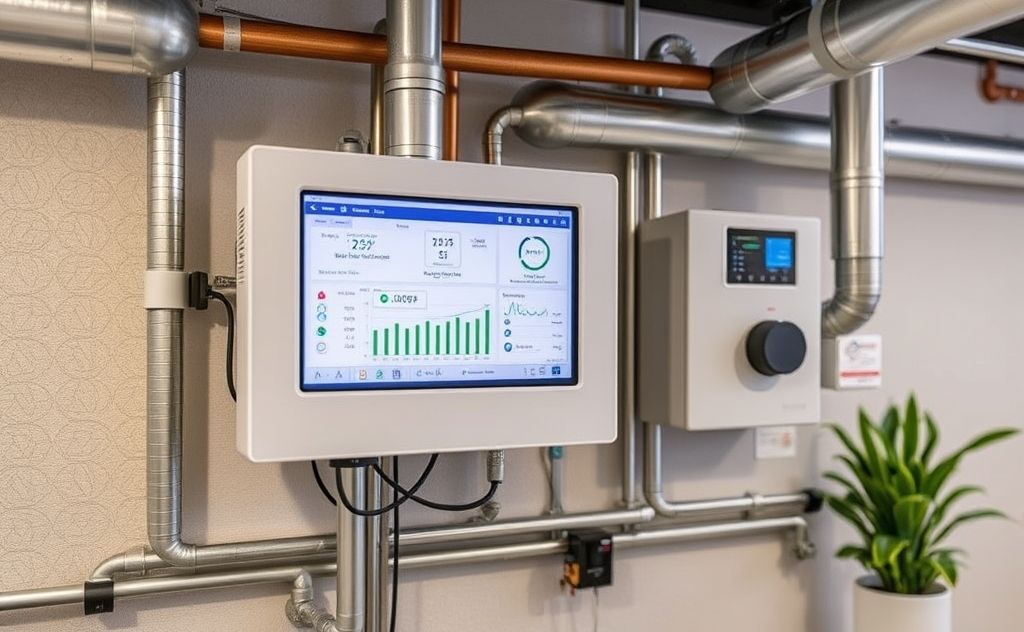
Automated HVAC is not just a programmable thermostat with Wi-Fi. It’s a layered system. At the bottom are sensors that measure temperature, humidity, CO2, and occupancy. In the middle are direct digital controls (DDC) that process that data and send commands. At the top is software that learns patterns, alerts you to problems, and optimizes schedules.
The term HVAC automation covers everything from a single smart thermostat in a condo to a full building automation system (BAS) managing a hospital campus. The scale differs, but the logic is identical: measure, decide, act, verify.
Here’s an analogy that helps. Think of a manual thermostat as a light switch. It’s either on or off, and you have to walk over to change it. Automated HVAC is a dimmer with a motion sensor and a timer. It adjusts itself based on who’s in the room, what time it is, and how much natural light is coming through the windows.
That shift from binary to continuous control is what unlocks most of the benefits below.
The 7 Powerful Benefits (The Core List)
These seven benefits are the reason building owners and homeowners make the switch. Each one has a specific mechanism behind it, not just marketing language.
1. Unprecedented Energy Optimization (Not Just Savings)
Energy savings get all the headlines, but the real story is optimization. A standard thermostat runs the system until the setpoint is reached, then stops. An automated system starts the cooling cycle earlier on a hot day, knowing the thermal mass of the building will keep rising after the sun hits the roof.
Demand-controlled ventilation is a perfect example. Instead of constantly pulling in outside air at a fixed rate, the system measures CO2 levels in each zone. When a conference room fills up, the dampers open. When it empties, they close. The EPA estimates that ENERGY STAR certified thermostats save an average of $90 per year on energy bills. That’s for a single-family home. For a commercial building, the savings scale with square footage. A 50,000-square-foot office can see annual savings between $10,000 and $40,000 depending on climate and occupancy patterns.
2. Predictive Maintenance Over Reactive Repairs
Reactive maintenance means waiting for a breakdown. That’s expensive. A compressor failure in July means an emergency service call, potential water damage, and unhappy tenants. Predictive maintenance uses data from the system to catch problems early.
Here’s how it works. The BAS tracks vibration, amperage draw, and temperature differentials on each piece of equipment. When a fan motor starts drawing 15% more current than its baseline, the system flags it. You get an alert weeks before the motor fails. That gives you time to schedule a repair during off-hours, order parts at normal prices, and avoid the emergency premium.
In practice, this extends equipment lifespan by 15-25%. A chiller that typically lasts 15 years might go 18 or 19. That’s not guesswork; it’s the logical result of catching bearing wear and refrigerant leaks early.
3. Hyper-Localized Comfort Zoning
Most buildings have hot and cold spots. The south side bakes in the afternoon while the north side stays cool. A single thermostat averages those conditions and satisfies nobody. HVAC zoning solves this by dividing the building into separate zones, each with its own damper and temperature sensor.
Variable refrigerant flow (VRF) systems take this further. They can simultaneously heat one zone and cool another by moving refrigerant instead of air. That’s a huge efficiency win in buildings with diverse uses—a server room next to a break room, for example.
Occupancy sensors play a role here too. Instead of conditioning every room to the same setpoint, the system adjusts based on presence. Empty rooms drift toward a setback temperature. Occupied rooms stay at the comfort setpoint. The result is a building that feels better and uses less energy because you’re not wasting conditioned air on empty cubicles.
4. Real-Time Data & Remote Diagnostics
Data is the hidden product of automation. Every sensor reading, every runtime hour, every temperature swing gets logged. That data is valuable for troubleshooting and for planning.
Remote monitoring means you don’t have to be on-site to see what’s happening. A facility manager can check the BAS from their phone while on vacation. If the system alerts to a high-temperature alarm in a storage room, they can adjust the setpoint remotely or dispatch a technician with a specific diagnosis.
This cuts diagnostic time dramatically. Instead of a technician spending two hours on-site figuring out what’s wrong, they arrive with a list of likely causes from the data logs. That’s a real cost saving. Service calls that used to take a full day now take two hours because the problem is already narrowed down.
5. Improved Indoor Air Quality (IAQ) Compliance
Indoor air quality (IAQ) is not just a comfort issue; it’s a health and compliance issue. Schools, hospitals, and offices face regulations on ventilation rates and CO2 levels. Automated systems handle this automatically.
Demand-controlled ventilation ties fresh air intake to actual occupancy. When a classroom fills with 30 students, CO2 rises and the system brings in more outside air. When the room empties, ventilation drops to a maintenance level. This maintains compliance without wasting energy on over-ventilating empty spaces.
The health impact is measurable. Studies show that improved ventilation reduces sick building syndrome symptoms and can cut absenteeism by 8-15%. For a company with 500 employees, that translates to thousands of dollars in recovered productivity each year. It’s not just about feeling comfortable; it’s about people showing up to work healthy.
6. Extended Equipment Lifespan
Equipment that runs smoothly lasts longer. That’s obvious, but automation makes it measurable. By avoiding short-cycling (when the system turns on and off rapidly), reducing runtime hours through smarter scheduling, and catching problems early, automated HVAC reduces wear and tear.
Consider a rooftop unit that runs 3,000 hours a year with manual control. With automated scheduling and occupancy sensing, that might drop to 2,200 hours. Fewer runtime hours means less mechanical wear, less filter loading, and lower maintenance costs. The compressor and fan motors last longer because they’re not working as hard.
The result is a longer replacement cycle. Instead of replacing a 10-ton unit every 15 years, you might get 18-20 years out of it. That deferral of capital expense is a significant financial benefit that rarely shows up in the initial ROI calculation.
7. Seamless Integration with Smart Building IoT
Modern buildings are full of connected systems: lighting, security, elevators, and fire alarms. HVAC is just one piece. The real value comes when these systems talk to each other.
IoT integration means the HVAC system knows when the security system arms at night and drops the temperature setpoint. It knows when the lighting system detects motion in a conference room and adjusts ventilation accordingly. This interoperability creates efficiencies that no single system can achieve alone.
For example, a building with demand response capability can reduce HVAC load during peak electricity pricing periods. The BAS receives a signal from the utility, pre-cools the building before the peak window, then reduces load during it. This shaves demand charges off the electric bill. Without integration, you’d need a human to manually adjust settings—and they’d probably forget.
The Hidden Costs & Cybersecurity Risks (The Missing Chapter)
Nobody likes talking about the downsides, but you need the full picture. Automated HVAC introduces two significant risks: cost and security.
Cybersecurity is the bigger concern. A BAS is a network-connected device, which means it’s a potential entry point for attackers. In 2026, a water treatment plant in Florida was hacked through a remote access tool. HVAC systems have similar vulnerabilities. If an attacker gains access to your BAS, they can shut down heating in winter, overheat a server room, or use the network as a launching pad for other attacks.
Mitigation requires a few specific steps:
- Network segmentation: Keep the BAS on its own VLAN, separated from the corporate network. If the HVAC is compromised, the attacker can’t reach file servers or email.
- Encryption: Use TLS for all communication between controllers and the central server. No plaintext passwords or unencrypted protocols.
- Regular patching: BAS controllers run embedded operating systems that need updates. Set a schedule and stick to it.
- Change default credentials: This sounds obvious, but default passwords are still a common entry point.
The cost side is simpler. Automation hardware and software have upfront costs, and commissioning (the process of tuning the system) can be expensive. A full BAS for a commercial building runs $2.50 to $7.00 per square foot depending on complexity. You’ll also need ongoing maintenance of the control system itself, which adds about 5-10% to your annual HVAC maintenance budget.
These aren’t reasons to avoid automation. They’re reasons to plan properly. Budget for cybersecurity and commissioning from the start, and the risks become manageable.
Retrofitting Legacy Systems: A Practical Guide
You don’t need to tear out your old pneumatic or analog controls to get automation benefits. Retrofitting is a valid path, and it’s often the smartest financial move.
The first step is a retro-commissioning audit. This is a systematic review of how your existing system operates compared to how it should operate. Often, you’ll find stuck dampers, misconfigured schedules, and sensors that drifted out of calibration. Fixing these issues alone can save 10-20% on energy with zero automation added.
After the audit, you have two retrofit options:
- Add-on controllers: These sit alongside your existing equipment and add digital control without replacing the core hardware. They’re ideal for older chillers, boilers, and air handlers. The controllers monitor and adjust the existing actuators and valves.
- Full DDC replacement: This replaces old pneumatic thermostats and controllers with direct digital controls (DDC). It’s more invasive but provides better accuracy and more data. This makes sense when the existing controls are failing or when you need granular data for compliance.
One common mistake is underestimating the wiring work. Older buildings often lack the low-voltage wiring needed for modern sensors. Budget for a licensed electrician to run new wires or plan for wireless sensors (which have their own battery and range limitations). Expect the retrofit to take 2-6 months for a mid-sized commercial building, not including the audit phase.
For homeowners, the retrofit is simpler. Swapping a manual thermostat for a smart one usually takes under an hour if you have a C-wire (common wire) available. The Amazon Smart Thermostat requires a C-wire for power, so check your existing setup before buying. If you don’t have one, an HVAC tech can run one or you can use an adapter kit.
Calculating Your ROI: Payback Periods and Benchmarks
Let’s get specific about money. The payback period for automated HVAC depends on three variables: current energy spend, the cost of the automation, and the efficiency gains you achieve.
Here are realistic benchmarks based on project type:
| Project Type | Typical Cost | Energy Savings | Payback Period |
|---|---|---|---|
| Smart thermostat (residential) | $100 – $250 | 8-12% of HVAC bill | 1 – 2 years |
| BAS retrofit (commercial, add-on controllers) | $1.50 – $3.50/sq ft | 15-25% | 2 – 4 years |
| Full DDC replacement (commercial) | $4.00 – $7.00/sq ft | 20-35% | 3 – 6 years |
| New construction with VRF + BAS | $12 – $18/sq ft (HVAC total) | 30-40% vs. code minimum | 4 – 7 years |
These payback periods assume utility rates stay stable. If energy prices rise, payback accelerates. The numbers also assume the system is properly commissioned. An untuned system might only deliver half the expected savings, which is why commissioning matters so much.
Don’t forget the non-energy benefits when calculating ROI. A 1% reduction in employee absenteeism from better IAQ is worth more than a 20% energy reduction in most office buildings. The productivity gains are real, but they’re harder to measure. Track sick days and comfort complaints before and after the upgrade to build a business case.
Rebates help too. Many utilities offer incentives for installing smart thermostat programs. The Amazon Smart Thermostat purchase triggers an email with details about local rebates from energy providers. Those rebates can shave 20-50% off the hardware cost, shortening the payback period further.
The Future: AI-Driven HVAC and Predictive Grids
The next wave of automation is already here. Machine learning algorithms are starting to replace rule-based schedules. Instead of a human programming setpoints, the system learns from occupancy patterns, weather forecasts, and utility pricing.
For example, an AI-driven system might learn that the east wing is rarely used on Friday afternoons and automatically adjust the zone schedule. It might pre-cool the building before a heatwave because it learned that the building’s thermal mass takes three hours to respond. These are tasks a human could do, but the AI does them continuously and without forgetting.
Predictive grid integration is the other frontier. Utilities are moving toward time-of-use pricing, where electricity costs more during peak hours. An automated system can shift HVAC load to cheaper periods—pre-cooling at 4 AM when power is cheap, then coasting through the 2 PM peak. This demand response capability is becoming standard in new BAS installations.
The trend toward future HVAC automation trends points toward fully autonomous buildings. The HVAC system will negotiate with the power grid, book maintenance appointments, and optimize for both cost and comfort without human intervention. That’s a decade away for most buildings, but the groundwork is being laid now.
Is It Time to Upgrade? A Straight Answer
Automated HVAC is not a magic bullet. It’s a tool with real costs, real risks, and real payoffs. Whether it’s worth it depends on your situation.
Here’s what I’d tell a friend asking for advice:
- Start with a smart thermostat at home. The $100-250 cost pays back in under two years, and you’ll learn the basics of scheduling and data.
- For commercial buildings, commission first. Fix the low-hanging fruit before adding automation. You’ll get 10-20% savings from tuning alone.
- Budget for cybersecurity from day one. Network segmentation and patching are non-negotiable.
- Track the data. The savings estimates are averages; your actual numbers depend on your climate, occupancy, and equipment condition.
- Look for utility rebates before you buy. They can cut the upfront cost substantially.
- Don’t automate a system that’s about to fail. Replace aging equipment first, then add controls.
- Expect a learning curve. The first month with a new BAS involves tweaking schedules and setpoints. It gets easier.
Automated HVAC rewards patience and data. The systems are smart, but they still need someone to ask the right questions. Start small, measure the results, and scale up from there.
Related guides
Top Picks for the Best Tool Belt for HVAC That Will Transform Your Workday
For HVAC professionals, the best tool belt enhances efficiency without compromising comfort. The UUP Magnetic Tool Belt stands…
How Programming Transforms HVAC Automation for Peak Efficiency
Programming is crucial in automated HVAC systems as it optimizes energy efficiency, enhances comfort, and enables remote control…
Solving HVAC Compatibility Issues in Smart Automation Systems
You just installed a brand-new smart thermostat. It pairs with your phone, the app looks great, and you…