Battery-Powered Space Heaters: Cord-Free Convenience Explained
On this page 8 sections
Battery-Powered Space Heater Comparison
| Rank | Model | Best for | Heat output | Battery type | Safety features | Price |
|---|---|---|---|---|---|---|
| 1 | FTVOGUE Cordless Heater with Built-In BatteryBuilt-in battery | Car defogging and short personal heat without buying tool batteries | 30–50°C, 50–80°C settings | Built-in 3000mAh × 2 | — | Check price |
| 2 | Yudara Cordless Heater for Milwaukee M18Milwaukee M18 | Milwaukee M18 tool owners who already have 4Ah or larger batteries on hand | 70°F in 3 sec | Milwaukee M18 18V | Flame-retardant ABS | Check price |
| 3 | wiilioe Battery Heater with Anti-TiltAnti-tilt shutoff | Car defogging and tent camping where tip-over safety matters | 10 m² coverage, 2 settings | Five-battery model (included) | Anti-tilt, overheat | Check price |
| 4 | GOWENIC Cordless Heater for Makita 18VMakita 18V | Makita tool owners who want dual USB ports for phone charging | 2 gears (low, high) | Makita BL1830/1850/1840 | Stable base | Check price |
| 5 | R.W.FLAME 1500W Ceramic Heater with RemotePlug-in, not battery | Bedrooms and offices where you have an outlet and want full power | 1,500 W | Plug-in (not battery) | Tip-over, overheat, ETL | Check price |
Say your car is parked outside at 18°F and the windshield is fogged solid. A cordless heater can help clear the glass, but a common 2Ah 18V battery usually buys you only about 30 minutes to 1 hour at high heat, so the job has to be quick.
That short runtime is the whole game here. Battery-powered heaters work best for defogging, a desk, a tent corner, or a small personal zone; they are poor substitutes for a corded room heater.
Best Battery-Powered Space Heaters

FTVOGUE Cordless Heater with Built-In Battery
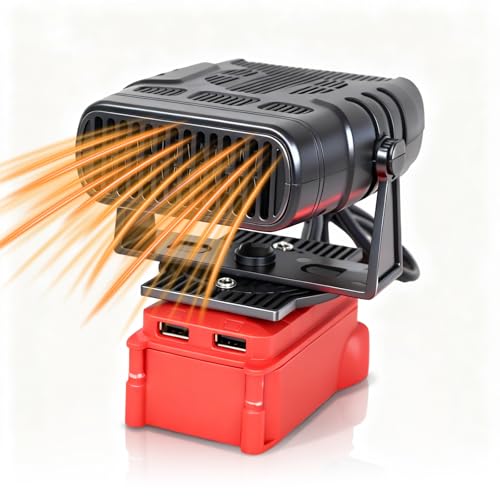
Yudara Cordless Heater for Milwaukee M18

wiilioe Battery Heater with Anti-Tilt

GOWENIC Cordless Heater for Makita 18V

R.W.FLAME 1500W Ceramic Heater with Remote
Battery-Powered Space Heaters: What Matters Most

A battery powered space heater is a personal heater, not a room heater. Most cordless models deliver 150 to 200 watts of heat—enough to warm your hands at a desk, defog a windshield or take the edge off a cold corner, but nowhere near the 1,500 watts a plug-in space heater sends into a bedroom. That distinction shapes every other choice: runtime, battery type, and where the heater actually helps.
The first decision is battery design. Built-in rechargeable models have their own lithium-ion pack, usually 6,000 to 8,000 mAh, and charge via USB-C or a wall adapter. You carry just one device and plug it in overnight for a full charge by morning. Tool battery heaters take 18V or 20V batteries from brands like Milwaukee, DeWalt, or Makita. If you already own those batteries and a charger, you can swap packs to extend runtime. If not, you’ll need to invest in batteries and a charger. Choose built-in for simplicity and lighter weight. Choose tool battery if you want longer runtime and already use compatible batteries.
Heat output and control settings separate a functional heater from a frustrating one. Look for models that list wattage—150 W, 180 W, 200 W—rather than vague claims of “instant warmth.” Dual heat settings let you stretch runtime on low or push full heat when you need it fast. An adjustable thermostat or automatic temperature control cycles the heating element on and off to hold a set warmth level and conserve the battery. Without it, the heater runs wide open until the pack dies.
Noise matters more in a battery heater than in a plug-in unit because you’re using it inches from your face in a car or at a desk. Most small cordless heaters with PTC ceramic elements and a quiet fan measure around 45 to 46 decibels—about the sound of a refrigerator hum. Anything louder becomes a distraction in close quarters. Check the spec sheet or user reports before you buy.
| Feature | Why It Matters |
|---|---|
| Built-in battery | Simpler, lighter, charges via USB; no extra batteries to buy |
| 18V tool battery | Swap batteries for longer use; works if you already own the platform |
| Dual heat settings | Low stretches runtime; high delivers faster warmth |
| Adjustable thermostat | Cycles heat on and off to save battery and hold steady warmth |
| 45–46 dB noise | Quiet enough for a car cabin or desk without distraction |
Some battery powered cordless space heaters include dual USB charging ports on the housing. That’s a convenience feature for topping off a phone or headlamp, not a heating feature. The USB ports draw from the same battery that powers the heating element, so charging your phone while running the heater on high will shorten your heat time. Useful in a pinch, but don’t mistake it for a power bank with a heater attached.
 Winter Heating Bill CutterSee what every heater in your home really costs, heat the rooms you use, and cut the waste in 30 days.Cost-per-hour tables for every heaterThermostat schedule and draft-proofing planRunning-cost and bill calculator (Excel)
How Long a Battery Charge Lasts
A battery powered space heater running on a common 2Ah 18V tool battery will give you about 30 minutes to 1 hour on high, depending on the heater’s wattage and fan speed. That’s enough time to defog a windshield or warm your hands in a cold workshop, but it won’t heat a room for an evening. The math is straightforward: a 2Ah battery at 18V holds roughly 36 watt-hours of energy. A 150 W heater draws that down in about 14 minutes of pure runtime, though real-world efficiency and the battery management system stretch it closer to half an hour.
Larger batteries extend that window. A 4Ah battery holds twice the energy of a 2Ah pack, so you can expect somewhere near an hour to two hours on high, and longer on low. A 5Ah or 6Ah battery pushes runtime further still, but the heater’s own draw and the battery’s discharge curve mean you won’t quite double the time with every doubling of capacity. Heat output stays the same; you’re just refilling the fuel tank.
Short bursts suit these heaters better than sustained warming. Five minutes to clear condensation off a car window, ten minutes to take the edge off a cold tent while you pack up camp, or fifteen minutes aimed at your feet under a desk—all realistic. Trying to heat a 150 square foot bedroom for three hours straight will drain a 5Ah battery in under an hour and leave you hunting for the charger. Space heaters with tip-over protection that plug into the wall are the better call for that job.
Built-in rechargeable batteries, like the 6500mAh pack in some car defogger models, follow the same rules. That’s roughly 24 watt-hours if it’s an 18V nominal pack, so you’re looking at 10 to 15 minutes of heating on high. These models recharge via USB-C or a 12V car adapter, which is convenient, but the small capacity means you’ll need to top them off between uses. Keep a charged spare tool battery or a power bank on hand if you’re counting on heat when you need it.
Which Battery Type Fits Your Heater
Tool-battery heaters require the exact compatible battery family listed by the maker. Milwaukee-compatible models need Milwaukee M18 batteries, DeWalt-compatible models need DeWalt 20V MAX packs, and mixing brands won’t work—the terminals, voltage curves and communication protocols differ. If you already own a drill, impact driver or other cordless tools from one of those platforms, a heater that shares the same battery system makes sense because you can swap packs between tools and avoid buying into a second ecosystem.
Built-in rechargeable heaters are simpler for casual buyers. You plug a USB or barrel-jack cable into the heater itself, wait for the charge cycle to finish, then unplug and carry it. No separate battery to track, no compatibility chart to check. Models like the Diydeg with a 6,500 mAh built-in pack are ready out of the box once charged, and you’ll never face the “wrong battery” problem at checkout.
Replacement cost is the trade-off. When a tool-battery pack wears out after several hundred charge cycles, you replace it yourself by buying a new pack and snapping it in. Built-in batteries that lose capacity often require a warranty claim or professional repair, and many small heaters aren’t designed to be opened. For frequent users running heaters daily in cold garages or vehicles, tool-battery models usually offer more affordable maintenance over time.
Most 18V tool-platform heaters suit owners already using that brand’s batteries. Picking a Milwaukee-compatible heater makes little sense if your drill is DeWalt, and starting fresh means buying a heater plus battery and charger. Rechargeable battery powered heaters with built-in packs cost less upfront and work well for occasional tasks like car defogging or spot heating without the commitment to a tool battery system.
Can a Battery Heater Defog Car Glass
Car windshield defogging is one of the best real uses for a battery powered heater. Cordless models clear condensation and light frost without idling your engine, and they work in vehicles where the defroster has failed or you’re trying to save fuel on a cold morning. Directing warm air at the glass for two to five minutes cuts through fog and thin ice well enough to drive safely.
Thick ice is a different problem. Battery heaters lack the sustained output to melt heavy frost quickly—expect slow progress and a drained battery before you’re halfway done. For large cabins like SUVs or vans, the small fan and low wattage mean you’ll warm the windshield long before the back seats feel any heat. Here’s the rule: if you need the glass clear, these fit; if you need the whole car warm, look elsewhere.
Tilt heads and 360-degree rotation make the biggest difference. Aim the heater at the base of the windshield to push warm air upward across the glass, or angle it toward your feet and face for personal comfort while the car warms up. Models like the HYUDUO 200W with full rotation let you follow the frost line without repositioning the unit. Fixed-angle heaters still work, but you’ll spend more time holding them in place or propping them against the dash.
Battery powered heaters sold as indoor personal heaters or car defoggers are designed for enclosed spaces and include the tip-over and overheat protection you need in a vehicle. Outdoor-rated construction heaters, propane torpedo heaters, and diesel cabin heaters are not the same thing. Never use an outdoor heater in a closed car unless the manual explicitly states it’s safe for vehicle cabins—carbon monoxide from fuel-burning models is invisible and deadly, and high-output electric construction heaters lack the shutoff features that prevent a tipped unit from igniting upholstery.
Stand-alone battery powered models with built-in rechargeable batteries simplify car use because you charge them at home, toss them in the trunk, and forget about swapping tool batteries in the cold. Tool-battery heaters work just as well if you already own the compatible battery family, but remembering to grab the charged battery on your way out the door is one more step. Either way, keep a USB cable in the glovebox if your heater doubles as a phone charger—dead phones and dead batteries tend to happen on the same morning.
Safety And Noise Checks Before You Buy
Look for tip-over protection and overheat shutoff as baseline safety features on any battery powered heater you’re considering. These shut the unit off when it’s knocked over or when internal temperatures climb too high, and they’re standard on most cordless models but absent on a few cheaper imports with vague specs.
Low-voltage cordless heaters still need a stable base and flame-retardant housing where the maker lists it in the spec sheet. Just because a heater runs on 18 V doesn’t mean it can’t overheat if you block the vents or set it on an uneven surface. Keep the intake and exhaust clear, and place the unit on a hard, flat surface—car floor mats and soft blankets can both obstruct airflow.
Prefer a product with a clear safety listing or compliance claim from the manufacturer, and avoid anything with vague labeling or no support documents. UL, ETL and CSA marks are rare on imported cordless heaters, but a model that names its certifications and provides a downloadable manual is a better bet than one with no contact details and stock photos only. Check the listing for a support email or a manual link before you buy.
Noise matters in a car cabin or at a desk: under about 46 dB is quiet enough for close-range use, roughly the sound of a library or a low conversation. Fan noise still matters in a small space, though, and a heater rated at 46 dB can sound louder if the fan whines or rattles. Read reviews that mention noise, and expect any model with a high-speed setting to be audible when it’s running full tilt.
USB ports are useful only if the heater can keep running while charging a phone without overloading the battery. Some dual-port models will run the heater and charge a device at the same time; others cut heating power or drain the battery faster. Check the manual or the Q&A section to confirm whether simultaneous operation is supported, and remember that charging a phone pulls another 5 to 15 W from a battery already working hard to deliver heat.
