Solar Water Heater Financing: Pick the Loan That Actually Fits
On this page 9 sections
- Why Financing a Solar Water Heater is a Smart Investment
- Top Financing Options Compared
- How the Federal Tax Credit Lowers Your Net Cost
- Eligibility and Approval Criteria
- Step-by-Step Guide to Getting Financed
- What Happens if You Move or Refinance?
- Calculating Your True Payback Period
- Frequently Asked Questions About Solar Water Heater Loans
- Take the Next Step: Compare Your Financing Options Today
You got a quote for a solar water heating system. The equipment and installation run somewhere between $5,000 and $10,000 depending on collector size, tank type, and your roof. The savings estimate looks great on paper, but you do not have that kind of cash sitting in a checking account. So you start looking at financing, and suddenly you are drowning in APRs, loan terms, and program names you have never heard of.
This guide cuts through that noise. You will learn which financing structures actually exist, how lenders evaluate you, and what the 30% federal tax credit does to your net cost. You will also see a realistic payback calculation that compares your monthly loan payment against your monthly energy savings. By the end, you will know exactly which questions to ask a lender and which loan type fits your credit profile.
If you camp, hunt, or just want a backup for power outages, a portable unit like the 4Patriots Sun Kettle solves a different problem. It boils 16.9 ounces of water in about 45 minutes using sunlight alone, with no gas or electricity. That is a useful emergency tool, but it is not a replacement for a whole-house system. For that, you need real financing.
Why Financing a Solar Water Heater is a Smart Investment

Most people think solar water heaters are a luxury item. The math says otherwise. A typical household spends $400 to $600 per year on water heating. A solar thermal system can cover 60% to 70% of that load. If your annual bill is $500, you are looking at $300 to $350 in yearly savings.
Now consider the system cost. A good quality solar water heater with installation runs about $7,000 before incentives. The federal tax credit knocks 30% off that amount, bringing your net cost to $4,900. State rebates can shave off another $500 to $1,000 depending on where you live. At $350 per year in savings, your simple payback period lands between 11 and 14 years. That is a long time, but the system itself lasts 20 to 25 years with minimal maintenance. For those considering installation, explore durable ducting options for diesel heater installs.
Financing changes the picture. You do not need to wait until you have $5,000 saved up. You can spread the cost over 10 or 15 years and start saving on your utility bill immediately. The trick is making sure your monthly loan payment is lower than your monthly energy savings. That is the only way financing makes sense.
Top Financing Options Compared
You have four main paths to finance a solar water heater. Each one has a different interest rate, approval process, and set of trade-offs. The table below summarizes them, and the sections after it go into detail.
| Loan Type | Typical APR | Term Length | Upfront Cost | Best For | Key Risk |
|---|---|---|---|---|---|
| Credit Union Loan | 5% – 9% | 5 – 15 years | $0 – $500 | Good credit (680+) | Loan is tied to you, not the house |
| Utility On-Bill Program | 0% – 4% | 5 – 10 years | $0 | Renters or low cash flow | Repayment stays with the meter, not the homeowner |
| State / Local Program | 0% – 3% | 5 – 20 years | $0 | Income-qualified households | Limited funding; long waitlists |
| Personal Loan (Bank) | 10% – 18% | 3 – 7 years | $0 | Quick approval, no liens | High APR makes payback difficult |
Credit Union Loans
Credit unions are the sweet spot for most homeowners. They offer fixed APRs between 5% and 9% on solar loans, which is far better than a big bank’s personal loan. Many credit unions also offer interest-free loans for energy improvements if you have been a member for a while. You will need a credit score above 680 and a debt-to-income ratio under 45% to get the best rate.
The downside is that these loans are unsecured. That means the lender looks at your credit history and income, not your home equity. If you default, they can garnish wages or send the debt to collections, but they cannot foreclose on your house. That makes the approval process more strict on your credit profile than a home equity loan.
Utility On-Bill Programs
On-bill repayment is the most underrated financing option. Your utility company pays for the system upfront, and you repay the cost through a line item on your monthly electricity bill. The APR is usually 0% to 4%, and there are zero closing costs. The repayment term is typically 5 to 10 years.
The catch is transferability. The repayment obligation is tied to the utility meter, not to you personally. If you sell your house, the new owner takes over the remaining payments. That can be a selling point if the system lowers their utility bill, but it can also scare off buyers who do not want the debt. Check with your utility to see if the payment transfers or if you must pay it off at closing.
State and Local Government Programs
Some states run their own solar loan programs with subsidized interest rates. California’s GoGreen Home Energy Financing, New York’s NY-Sun, and Massachusetts’ Mass Solar Loan are the most well-known. These programs offer APRs as low as 0% for income-qualified households, with terms up to 20 years.
These loans are often repaid through a property assessment, which means the debt stays with the house. That is great for transferability, but it also means you cannot sell the home without addressing the lien. Approval times can be slow. Expect 4 to 8 weeks from application to installation, and that is if the program has funding available. Many of these programs run out of money mid-year and open waitlists.
How the Federal Tax Credit Lowers Your Net Cost
The Inflation Reduction Act extended the federal solar tax credit through 2032. It covers 30% of the total system cost, including equipment, labor, permits, and even the inverter. There is no cap on the credit amount for residential systems.
Here is the part most articles get wrong: the credit is non-refundable. That means it only reduces your tax liability to zero, and you get the rest back as a refund. If you owe $2,000 in federal taxes and your credit is $2,100, you get the $2,000 wiped out plus a $100 refund. If you owe $0 in taxes, you get nothing that year, but you can carry the credit forward to future years.
Let us run the numbers on a $7,000 system. Your credit is $2,100. That reduces your net system cost to $4,900. If you finance the full $7,000, your loan payment is based on $7,000, but you can apply the $2,100 tax credit as a lump-sum payment toward the principal in the first year. That shortens your loan term and reduces total interest paid.
For a 10-year loan at 6% APR, the monthly payment on $7,000 is about $78. If you apply the $2,100 credit in month one, your new principal is $4,900, and you can recast the loan to a payment of about $54 per month. That $24 difference is meaningful over 10 years, and it brings your payment much closer to your monthly energy savings.
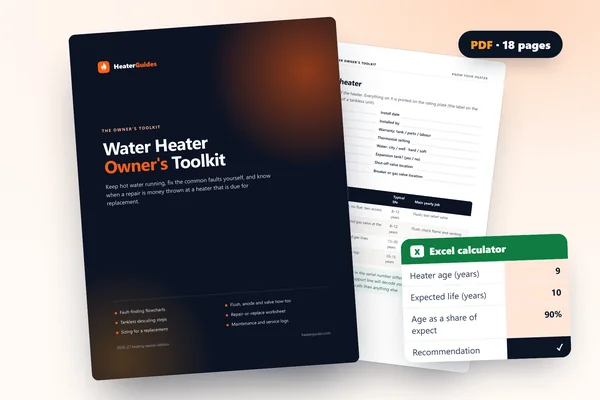 Water Heater Owner's ToolkitFix the common faults yourself, keep it running for years, and know when a repair is money wasted.No-hot-water flowcharts, gas and electricFlush, anode, relief valve and descaling stepsRepair-or-replace calculator (Excel)
Eligibility and Approval Criteria
Lenders look at three things when you apply for a solar loan: credit score, debt-to-income ratio, and home equity (for secured loans).
Credit score thresholds matter more than you think. A score above 740 gets you the best advertised APR. A score between 680 and 739 gets you a slightly higher rate, usually 1% to 2% more. Below 680, you will struggle to find a credit union loan, and you will be pushed toward personal loans with double-digit APRs. If your score is below 620, your only realistic option is a state program or an on-bill repayment plan, which often have looser credit requirements.
Debt-to-income ratio (DTI) is the second gate. Most lenders cap DTI at 45% for unsecured solar loans. That means your total monthly debt payments, including the new solar loan, cannot exceed 45% of your gross monthly income. If you earn $5,000 per month and pay $1,800 in existing debts, your DTI is 36%. Adding a $78 solar payment brings it to 37.5%, which passes. If your DTI is already 43%, that $78 payment pushes you to 44.5%, and you might get rejected.
Home equity only matters if you choose a secured loan, like a home equity line of credit (HELOC) or a Property Assessed Clean Energy (PACE) loan. These loans use your house as collateral, so they offer lower APRs. But they also put your home at risk if you default. I generally steer people away from PACE loans unless they have no other option, because the closing costs and interest rates can be opaque.
Step-by-Step Guide to Getting Financed
Getting a solar water heater loan is not like financing a car. You cannot walk into a dealership and drive out with a system. The process takes time, and the order of operations matters.
Getting Quotes from Approved Contractors
Start with the contractor, not the lender. Many state programs and utility on-bill plans require you to use an approved installer. These contractors are vetted by the program administrators, and they know the paperwork. Get at least three quotes. Ask each contractor for a system design that includes the collector area, tank size, and estimated annual energy output. Do not accept a quote that lacks these numbers.
Once you have a quote, take it to a credit union or a state program. Do not apply for multiple loans at once. Each hard credit inquiry drops your score by a few points, and multiple inquiries in a short window can trigger a red flag. Apply to one lender, get a decision, and move on if it does not work.
Pre-Qualification vs. Full Approval
Pre-qualification is a soft credit check that tells you what rate and term you might get. It does not guarantee funding. Full approval requires a hard credit check, income verification, and sometimes an appraisal of your home. Do not sign a contractor agreement until you have full approval in writing.
The timeline from application to installation is usually 3 to 6 weeks. The first week goes to credit checks and underwriting. The second week goes to the contractor scheduling a site visit. The third and fourth weeks go to permits and inspections. Installation itself takes one to two days. Your first loan payment is typically due 30 to 45 days after the loan funds, which is usually the same day the system is turned on.
What Happens if You Move or Refinance?
This is the question nobody asks until it is too late. The answer depends entirely on the loan structure.
Unsecured credit union loans and personal loans are tied to you. If you sell the house, you must pay off the remaining balance from the sale proceeds. That can eat into your equity, so factor that into your decision if you might move within 5 years.
On-bill repayment programs are tied to the meter. The new homeowner assumes the payment, and they also get the benefit of lower energy bills. Some buyers balk at this, so you may need to offer a credit at closing to sweeten the deal.
PACE loans and property-assessed loans stay with the property. The new owner takes over the assessment, and the lien remains on the title. This is the cleanest option for transferability, but it can complicate refinancing your mortgage. Lenders sometimes require the PACE loan to be subordinated, which adds paperwork and fees.
Calculating Your True Payback Period
Here is a realistic cost-benefit analysis. Assume a $7,000 system, a 30% tax credit, and a 10-year loan at 6% APR.
- Monthly loan payment (before credit): $78
- Monthly loan payment (after applying $2,100 credit): $54
- Average monthly energy savings: $29 (based on $350 per year)
- Net monthly cost: $25
Your net cost is $25 per month for the first 10 years. After the loan is paid off, your net savings is $29 per month, or $350 per year, for the remaining 10 to 15 years of the system’s life. Over a 20-year period, you pay $3,000 in net loan costs and save $5,250 in energy. That is a $2,250 positive return, not counting the value of hot water during a power outage.
If your system costs more, or your savings are lower, the math flips. A $10,000 system with $250 in annual savings will never pay back. Run these numbers before you sign anything. Ask the contractor for a written savings estimate, and do not trust verbal promises.
Frequently Asked Questions About Solar Water Heater Loans
Can I get a solar water heater loan with bad credit?
Yes, but your options are limited. Utility on-bill programs and some state programs do not check credit scores at all, or they use a softer check that ignores your score. You will pay a slightly higher APR through these programs, but you avoid the predatory rates of personal loans. If your credit score is below 600, do not apply for a credit union loan; you will waste a hard inquiry.
Does the 30% tax credit apply to the loan interest?
No. The credit applies only to the cost of the system itself, including equipment and installation. Loan interest, closing costs, and application fees are not eligible. If your lender charges an origination fee, that fee is not tax-credit eligible either.
How does on-bill repayment affect my utility bill?
You will see two line items on your bill: the solar loan repayment and the reduced energy charge. The loan payment is fixed, but the energy charge fluctuates with your usage. Some utilities cap the total bill at the pre-solar amount, so you never pay more than you did before. Check if your utility offers that protection; it is a valuable feature.
Can I finance a solar water heater with a home equity loan?
You can, but it is rarely the best choice. Home equity loans have lower APRs than unsecured loans, but they come with closing costs, appraisal fees, and the risk of foreclosure. If you have significant equity and a stable income, a HELOC might make sense for a large system. Otherwise, a credit union loan is simpler and cheaper to set up.
What happens to the loan if the system fails?
The loan is independent of the equipment. You owe the money regardless of whether the system works. That is why you should use an approved contractor and check the warranty terms. Most solar thermal systems have a 10-year warranty on the collectors and a 6-year warranty on the tank. If the system fails, you are still responsible for the loan, so do not skip the maintenance schedule.
Take the Next Step: Compare Your Financing Options Today
- Get three written quotes from approved contractors before you talk to any lender.
- Check if your utility offers an on-bill repayment program with a bill cap.
- Apply the 30% federal tax credit to the loan principal in year one, not to your monthly budget.
- Target a monthly loan payment that is within $25 of your monthly energy savings.
- Ask every lender about prepayment penalties and loan transferability before signing.
- If your credit score is below 680, skip credit unions and go straight to state programs.
- Run the payback calculation yourself, and do not trust a contractor’s verbal savings estimate.
Financing a solar water heater is not about finding the lowest APR. It is about matching the loan structure to your credit profile and your timeline in the home. A credit union loan works for most people, but on-bill programs and state incentives can be better if you qualify. Start with the quotes, then compare the financing. That order keeps you in control of the process.
For more context on how solar heating systems perform in real conditions, see this solar heater timing guide. If you are comparing tank options, this water heater brand comparison covers durability and warranty differences.