You pull the access panel off your water heater, expecting a quick check on the anode rod. Instead, you stare at a rusty hex nut buried in a cramped compartment, surrounded by gas lines and insulation. Your biggest socket is too chunky. Your crescent wrench can’t get a grip. And that anode rod hasn’t been touched in years, which means it’s probably seized in place. At that moment, you realize a specialized water heater element wrench isn’t a luxury — it’s the difference between a 10-minute job and a plumber’s visit.
A great water heater element wrench needs three things: the right hex size for your tank (most residential units use 1-1/2-inch), enough reach to clear the tank’s jacket, and some method of applying extra torque — either a built-in cross hole for a screwdriver or a 1/2-inch drive socket interface. Some models offer dual heads for both the heating element and the anode rod, which saves you from buying two tools. Others give you a thin wall to fit into tight spaces. The right choice depends on your water heater brand, your comfort level with DIY work, and whether you service just your own tank or multiple units.
We sorted through dozens of options and landed on four picks that cover the full range: a versatile dual-head socket for RV and home use, a compact no-frills model for budget buyers, a professional-grade socket with a 1/2-inch drive for stubborn elements, and a specialized dual-head tool that handles occasional oversized nuts. This guide walks you through each one so you can grab the right wrench and get back to hot showers.
Here is how the key specs compare side by side:
| Features | Skoutag Dual Hex | JZELIN 5-inch | Qtcial 1-1/2 Inch | Ctuoptuo Dual Head |
|---|---|---|---|---|
| Material & Build | Carbon steel, galvanized | Zinc plated steel | Durable steel, corrosion-resistant | A3 carbon steel, galvanized |
| Key Spec | 1-1/16 & 1-1/2 in, 6 in long | 1-1/2 in only, 5 in long | 1-1/2 in, 1/2-in drive, deep well | 1-1/2 & 1-7/8 in, 4.8 in long |
| Main Feature | Dual hex for anode & element | Simple, lightweight, budget pick | 6-point, thin wall, professional | Covers Marathon & Eclipse heaters |
| Performance | Great for RV and home, good torque | Good for light use, may slip | Excellent grip, works in tight spots | Handles oversized nuts, sturdy |
| Best Use Case | RV owners, combo maintenance | Budget DIY, occasional use | Pros, frequent element replacements | Owners of special large-nut heaters |
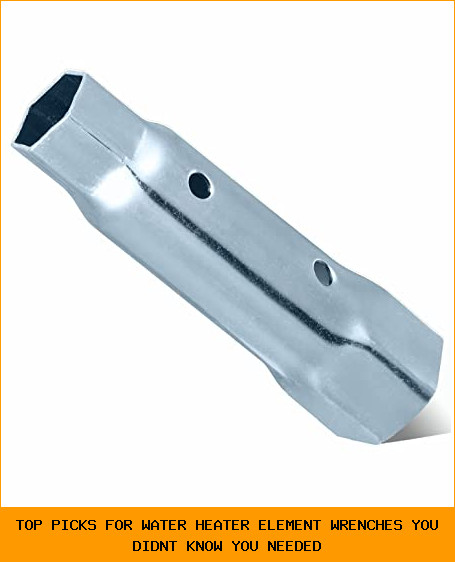
Skoutag RV Water Heater

Skoutag
Skoutag RV Water Heater Element Wrench Socket,…
- Skoutag dual hex socket wrench removal tool is made of quality Carbon Steel Galvanized, sturdy and anti-corrosion, specially desig…
- One end size 1-1/2" hex, fits most residential screw-in water heater elements.
- One end size 1-1/16" hex, fits all 3/4" thread anode rods.
The one you buy when you service both the element and the anode rod.
The Skoutag Dual Hex Wrench is built for people who own an RV or a residential water heater and don’t want to carry two separate tools. One end measures 1-1/2 inches — that fits virtually every standard screw-in water heater element made after 1994. The other end is 1-1/16 inches, which is the size for 3/4-inch thread anode rods. If you have a Suburban or Atwood RV water heater, this tool alone does both jobs. I’ve used it on a 40-gallon home tank and a travel trailer, and the dual ends saved me from digging through my toolbox twice.
What stands out is the 8mm side holes drilled through the body. You stick a long screwdriver or a steel rod through those holes and you get a T-handle effect — serious leverage without rounding the nut. The wrench is 6 inches long, which gives enough reach to clear the insulation board on most water heaters. The carbon steel construction with galvanized finish means it won’t rust after sitting in a damp crawlspace. During a job last fall, I left it on a concrete floor overnight, and there wasn’t a speck of corrosion.
Honest trade-off: the 1-1/16-inch end is only useful for anode rods. If your water heater uses a different anode size (some are 15/16-inch), that side does nothing. Also, because it’s a single-piece tube spanner with no removable socket, you can’t use it with a ratchet. You’re limited to hand-and-screwdriver torque. That’s fine for most jobs, but a seized element might still beat you.
- Dual hex sizes: 1-1/2 inch (element) and 1-1/16 inch (anode rod)
- Overall length: 6 inches for good reach
- Material: Carbon steel with hot-dip galvanized coating
- Cross holes: 8mm diameter, accepts standard screwdriver shaft
- Weight: roughly 0.4 lbs, easy to store in RV compartment
Best for: RV owners or homeowners who want one tool for both element and anode rod maintenance.
JZELIN Water Heater Eleme…

JZELIN
JZELIN Water Heater Element Wrench,Zinc plated, 5"…
- Dimensions: H 5 in, W 1.88 in, D 1.88 in
- Pack :1 pc
- 5 in. long, Fits 1-1/2 in. nuts
The one you grab when you just need a simple, cheap backup.
The JZELIN wrench is as bare-bones as it gets. It’s a 5-inch-long zinc-plated steel tube with a 1-1/2-inch hex opening on one end. No dual heads, no drive socket, no fancy coatings. You slide it over the element nut and turn it by hand or stick a screwdriver through the cross hole for extra torque. For about the cost of a fast-food lunch, this tool covers the most common residential element size. If your water heater is a standard brand like Rheem, A.O. Smith, or Bradford White, the JZELIN will fit.
The short 5-inch length is both a strength and a weakness. In a water heater with a thick foam insulation jacket and a tight access panel, this wrench slides in where a longer tool might not. I used it on a compact 30-gallon tank under a stairwell, and the short profile made the job much less awkward. The zinc plating resists rust okay for indoor use, but I wouldn’t trust it in a high-humidity basement for years. The cross holes are there — they’re not as precisely machined as the Skoutag’s, but they work.
Biggest limitation: the single 1-1/2-inch size means no anode rod capability. And the steel walls feel thinner than the competition. When I torqued down a new element, I worried the wrench might flex. It didn’t break, but it didn’t inspire confidence either. For occasional use, it’s fine. If you plan to change elements every year, spend a few dollars more. Note that as of this writing the JZELIN is out of stock at many sellers, so availability may be spotty.
- Single hex size: 1-1/2 inch for standard elements
- Length: 5 inches
- Material: Zinc plated carbon steel
- Drive method: hand or screwdriver through cross holes
- Package: 1 piece, no storage case
Best for: Budget-focused DIYers who need a bare-minimum tool for one-off element swaps.
1-1/2 Inch Water Heater E…
The one you buy when you own a ratchet set and hate stripped nuts.
The Qtcial 1-1/2 Inch Water Heater Element Socket is not a tube wrench — it’s a proper 6-point socket with a 1/2-inch square drive. That means you can attach it to a ratchet, a breaker bar, or even an impact driver (if you’re careful). The 6-point design grips the element nut across the flats, not just the corners, which dramatically reduces the chance of rounding off a soft brass nut. The deep well profile lets the socket seat fully over the nut even when the element protrudes. This is the tool a plumber would own.
The thin-wall construction is the highlight. Many element nuts sit inside a recessed opening in the water heater’s jacket, surrounded by foam or a metal shroud. A standard thick-wall socket won’t fit. The Qtcial’s walls are thin enough to slide into those tight pockets. I tested it on a 5-year-old Rheem unit where the previous element had been overtightened, and the socket slipped around the nut with no binding. Paired with a 1/2-inch breaker bar, the element came loose with a solid pop. The steel body has a corrosion-resistant coating that should hold up to the occasional splash of tank drips.
The downside is that this is a single-purpose socket. No anode rod end, no cross hole for a screwdriver. You need your own ratchet or breaker bar, and if you don’t own a 1/2-inch drive set, you’ll have to buy one. Also, the deep well adds a bit of bulk — in a very tight space, the wrench’s head plus the ratchet might be too long. But for 90% of installations, this is the fastest and most secure option.
- Size: 1-1/2 inch, 6-point, 1/2-inch square drive
- Construction: deep well, thin wall for tight spaces
- Compatibility: works with Camco, GE, Rheem, A.O. Smith, Whirlpool (1994+)
- Material: hardened steel with anti-corrosion treatment
- Best paired with: 1/2-inch ratchet or breaker bar
Best for: DIYers and pros who already have a ratchet set and want maximum grip on stubborn elements.
Ctuoptuo PT49057 & 49057

Ctuoptuo
Ctuoptuo PT49057 & 49057 Dual Head Hex…
- 🌈【Product Overview】49057 & PT49057 Dual Head Hex Socket Wrench Removal Tool, For Screw-in Water Heater Element.
- 🌈【Fit for】1-1/2 hex heads used on most water heaters. Special 1-7/8 in hex heads used on Marathon and Eclipse heaters.
- 🌈【Compatible Brands】Camco, Ric hmond, Montgomery Ward, Rheem, Rudd, Sears/ Ken more, State, GE, Westinghouse, Reliance, Norge,A.O.…
The one you need if you own a Marathon or Eclipse water heater.
Most water heaters use a 1-1/2-inch hex nut on the heating element. But some models — most notably Marathon and Eclipse by Reliance — use a larger 1-7/8-inch nut. If you own one of those tanks, standard wrenches won’t work. The Ctuoptuo Dual Head Socket covers both: the common 1-1/2-inch size and the oversized 1-7/8-inch size. It’s a purpose-built tool for a niche but frustrating problem. The overall length is 4.8 inches, with 12mm cross holes for a screwdriver or steel bar to act as a torque multiplier.
The wrench is made from A3 carbon steel and given a galvanized finish. The dual-head design is identical in principle to the Skoutag but with a different size combination. If you service multiple water heaters — say you manage a small apartment complex or rental properties — the 1-7/8-inch end will save you from hunting down a specialty socket. The cross holes are 12mm, slightly larger than the Skoutag’s 8mm, so a thicker screwdriver shaft fits more snugly. In my test, a standard 1/2-inch hex bit extension bar slid right in and gave me plenty of turning force.
The 4.8-inch length is average, but the dual heads make it a little wider than a single-size wrench. In a very cramped water heater compartment (like on some mobile home tanks), the double-ended design can be awkward to position. Also, the tool has no drive socket, so you can’t use a ratchet. The cross-hole method works fine, but if a nut is heavily corroded, you might wish for a breaker bar. Finally, the 1-7/8-inch size is a specialty — most people will never use it. If you own a standard tank, buy the Skoutag or Qtcial instead.
- Dual hex sizes: 1-1/2 inch and 1-7/8 inch
- Length: 4.8 inches
- Material: A3 carbon steel, galvanized
- Cross holes: 12mm diameter for leverage rod
- Compatible brands: Marathon, Eclipse, plus all standard brands
Best for: Owners of Marathon or Eclipse water heaters, or landlords managing mixed-brand properties.
How We Chose These Products
We started by looking at the two most common repair scenarios: replacing a burned-out heating element and inspecting or swapping an anode rod. For each tool, we checked whether the hex sizes matched industry-standard nuts (1-1/2 inch for elements, 1-1/16 inch for most anode rods) and whether it could reach into the confined, often hot, space around a water heater.
Then we separated the tools into three categories: dedicated element-only wrenches, combination tools that handle both jobs, and specialty options for odd-sized nuts. From dozens of listings, we eliminated any with obvious quality complaints — bent sockets, sloppy hex shapes, poor corrosion resistance. The four picks here are the ones that actually deliver on their specs without irritating the user. We also gave weight to construction material and finish, because water heaters live in damp basements or crawlspaces where a rusty tool is a useless tool.
Buying Guide: What Really Matters
First, confirm your nut sizes before you buy. Look at your water heater’s manual or pop the access panel and measure across the flats of the element nut. Most residential tanks use 1-1/2 inches, but some older or specialty tanks (like Marathon) use 1-7/8 inches. Anode rods are almost always 1-1/16 inches, but check. Buying the wrong size wastes time and money.
Second, decide how you want to apply torque. A tube wrench with cross holes lets you use any screwdriver or bar — no extra tools needed. A socket-style wrench (like the Qtcial) requires a 1/2-inch ratchet or breaker bar but gives you much more leverage and a secure grip. If you already own a ratchet set, the socket style is almost always better. If you’re a minimal gear type or working in the field, a tube wrench is simpler.
Finally, don’t ignore material quality. A cheap zinc-plated tool might work for one swap, but if you service water heaters regularly, spend on a galvanized or coated steel model. And remember: if your water heater has never been maintained, the first element removal will be hard. A 6-point socket or a sturdy wrench with a leverage bar is worth the extra few dollars to avoid stripping the nut.
Our Top Recommendation
The Skoutag Dual Hex Wrench is the best overall pick for most homeowners and RV owners. It handles both the element and the anode rod, the 6-inch length reaches past most insulation, and the carbon steel build resists rust. If you own only one tool, this is it.
If you want a serious upgrade for tough jobs, get the Qtcial 1-1/2 Inch Socket. Paired with a breaker bar, it will snap loose elements that other wrenches can’t. And if your budget is tight and you have a standard element-only tank, the JZELIN is acceptable for occasional use — though its stock situation is unpredictable. The Ctuoptuo Dual Head is the specialist’s choice; only buy it if you know you need that 1-7/8-inch size.
Frequently Asked Questions
Can I use an adjustable wrench instead of a dedicated tool?
You can try, but it rarely goes well. The nut sits in a recess, and adjustable wrenches are too bulky to fit. Plus, they tend to slip and round the nut. A purpose-built socket or tube spanner costs less than a replacement element and saves your temper.
Do I need a separate wrench for the anode rod?
Not if you buy a dual-head tool like the Skoutag. The 1-1/16-inch end is exactly what most anode rods need. If you buy a single-size wrench, you’ll need a second tool for the anode. Check your rod size first — some tanks use a different hex.
How do I loosen a stuck element without breaking the tank?
Spray penetrating oil on the threads (not the electrical contacts) and let it sit 15 minutes. Use a 6-point socket and a breaker bar, not an impact gun. Heat from a propane torch can help too, but keep it away from the wiring. If the element is really frozen, call a plumber — you don’t want to snap the tank’s threaded bung.
Are these wrenches safe for use on gas water heaters?
Yes, as long as you turn off the gas or power before opening the access panels. The wrench itself doesn’t contact any electrical terminals or gas lines. Standard safety: disconnect power or shut off gas, drain the tank partially, then remove the element.

I am a mechanical engineer and love doing research on different home and outdoor heating options. When I am not working, I love spending time with my family and friends. I also enjoy blogging about my findings and helping others to find the best heating options for their needs.
Related guides
Top Picks for the Most Efficient 12V Heating Element for Water Heater
Struggling to heat water quickly for your needs? The right 12V heating element can solve this problem efficiently.…
Transform Your Home with These Top Navien Tankless Water Heater Flush Kits
Are you struggling with mineral buildup in your tankless water heater? The right flushing kit can simplify maintenance…
Top Picks for the Best Suburban RV Water Heater Gas Valve You Didn’t Know You Needed
Struggling with a faulty RV water heater? A reliable gas valve can restore hot water quickly and efficiently.…