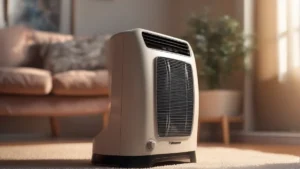
Product 1 is a sensible pick for a small room or desk, not a large open space. Its 1,500 W output, remote, timer, and tip-over shutoff fit short, attended heating runs; don’t assume the timer makes overnight use safe unless the manual allows it.
Buy it if
Buy it if you want a compact heater for a bedroom, office, or small garage bay and can plug it directly into a suitable wall outlet.
Skip it if
Skip it if you need to heat an open-plan room or expect one 1,500 W plug-in heater to warm a big house.
Quiet Room Pick
R.W.FLAME Compact Ceramic Heater
Best for Bedrooms, offices, or small garage bays needing quiet spot heat
Product 1 pairs 1,500 W ceramic heat with a thermostat and remote, so you can adjust it without getting up. Its 35 dB noise claim and 24-hour timer suit a bedroom or office where fan noise and manual shutoff are concerns. The 45° tip-over shutoff and overheat protection add useful safeguards, but they don’t replace the required three feet of clearance or a direct wall outlet. Its stated coverage is up to 200 sq ft; don’t expect it to heat a large open space on its own.
Power 1,500 WListed coverage Up to 200 sq ftNoise claim 35 dBTimer 24 hoursSafety features Overheat protection, 45° tip-over shutoff, child lockCertification ETL-certified
Why it made the cut
Remote and touch controls with Low, High, Eco, and Fan modes
24-hour timer and thermostat
45° tip-over shutoff, overheat protection, and child lock
ETL-certified
Good to know
1,500 W limits it to supplemental heat in larger rooms
Coverage claim is up to 200 sq ft; room conditions affect results
Must plug directly into a wall outlet, not an extension cord or power strip
Skip it if Choose a larger-room alternative or address insulation if you need heat across a big open space.
Say your office is 12 by 16 feet with a drafty window and you want the chill knocked down before morning. A 1,500 W ceramic heater can help there; a 400-square-foot open basement is another story, because the heat leaks out as fast as the heater makes it.
Product 1 is the kind of compact electric heater that makes sense for personal or small-room heat, not for replacing your central system. The specs point to quick warmup, a thermostat, a 24-hour timer, remote control, and basic safety shutoffs, which is the right mix for a desk, bedroom, or bathroom break from the cold.
Electric Space Heater Reviews: What Product 1 Does Well
Electric space heater reviews make Product 1 look most useful for small, occupied spaces: its 1,500 W ceramic PTC heat is aimed at rooms up to 200 sq. ft., not an entire floor. Searches for a Dreo space heater review, Decker space heater review, or Duraflame space heater reviews usually point to the same decision—how quietly and evenly a heater can warm the space in front of you. Here, the answer is a compact unit with practical controls rather than a furnace impersonator.
The thermostat lets you choose a target temperature instead of running full blast continuously. A remote keeps you from reaching across the room, the 24-hour timer can shut the heater down after you fall asleep or leave for work, and Eco mode reduces output once the room is near the set temperature. The claimed 35 dB noise level suits a bedroom or office where fan noise gets old quickly. Ceramic PTC heat also adjusts electrical resistance as the element heats, which helps control output; it doesn’t create extra heat from the same wattage.
Feature
What it means in daily use
1,500 W ceramic PTC heat
Strong plug-in output for a small room or nearby work area
Thermostat and Eco mode
Less time running at full output after the room warms
Remote and 24-hour timer
Controls from a chair and scheduled shutoff
35 dB claimed noise
A quieter fit for sleep, calls, or desk work
Tip-over protection
Shuts the heater off if it gets knocked over; keep the safety clearance anyway
The useful features are control and convenience; the wattage still sets the heat ceiling.
A bedroom, home office, basement corner, or bathroom dressing area is the sensible assignment. A low-wattage heater is better for one person at a desk when direct warmth matters more than heating all the air, while 1,500 W is the common ceiling for a plug-in heater on a standard US outlet. For broader buying context, compare it with other best rated space heaters after you measure the room.
In short
Choose Product 1 for nearby, small-space heat with quiet controls and scheduled operation. Its 200 sq. ft. claim is a useful boundary, not a promise that every drafty room of that size will feel warm.
Use the controls, not a cord workaround
Plug the heater directly into a wall outlet—never an extension cord or power strip—and leave the thermostat or timer to do the routine work. The heater can manage its cycle; the outlet still has to carry the load.
Measure The Room Before You Buy
Reviews of space heaters low wattage models favor personal warmth, while a 1,500 W heater is the better choice when you need to warm a small room’s air; a compact under desk space heater belongs beside one person’s legs, and a crawl space heater needs code-compliant installation and the right environment rather than a casual plug-in unit. The Ryog space heater search doesn’t change that sizing rule: measure first, then match the heater to the room and circuit.
Worked example
Say your bedroom is 12 by 14 feet. Multiplying the dimensions gives 168 sq. ft., which falls below Product 1’s stated 200 sq. ft. coverage claim. That leaves some room for furniture, but a draft under the door, poor insulation, or an open doorway can make the heater work harder and the room feel cooler than the area number suggests.
Room12 × 14 ft
Area168 sq. ft.
Product 1 claimUp to 200 sq. ft.
ResultWithin the stated coverage range
Space
What the heat has to do
Practical fit
Small office
Warm a seated person and a limited room volume
1,500 W suits a closed, reasonably insulated office
Bedroom
Hold a set temperature for several hours
1,500 W fits the stated range when doors and windows aren’t especially drafty
Drafty garage corner
Fight air leakage and cold surfaces
Expect slower warming; improve the draft or use another heat source rather than trusting the area alone
Room area is a starting point. Air leakage can be the deciding factor.
Lower wattage has a tradeoff
Low-wattage heaters are gentler on weak circuits and make sense for one person close by, but they move less heat into the room air. A crawl space also brings moisture, dust, clearance, and installation concerns, so use equipment approved for that location and follow local code; don’t put a portable room heater under the house and hope the crawl space becomes a bedroom.
From HeaterGuides · our own guidePage 6: heat only the rooms you use. Page 10 covers space-heater safety.Winter Heating Bill CutterSee what every heater in your home really costs, heat the rooms you use, and cut the waste in 30 days.Cost-per-hour tables for every heaterThermostat schedule and draft-proofing planRunning-cost and bill calculator (Excel)$14.99$9.99Get it for $9.99See what's inside and watch the 2-minute video →14-page printable PDF + Excel calculator · instant download · 30-day refund
Safety Features That Actually Matter
A space heater safety features review should start with the protections that interrupt a fault: an ETL listing, overheat protection, and a tip-over switch that shuts the heater off when it tilts 45°. Product 1 also has a flame-retardant case and a child lock; those are useful safeguards, not permission to ignore placement.
Safe space heaters still need a sound outlet and clear space around them. Plug the heater straight into a wall outlet—never an extension cord or power strip—and keep at least 3 feet between it and bedding, curtains, furniture, or anything else that can burn. A child lock can prevent someone from changing the controls, but it doesn’t keep small hands away from a hot grille.
Before You Switch It On
Check the ETL listing and inspect the cord and plug for damage.
Set the heater on a stable, level surface, away from foot traffic and water.
Keep the grille and air intake clear, with 3 feet of clearance around the heater.
Use a wall outlet; stop if the plug or outlet becomes hot, discolored, or smells scorched.
Follow the manual, and don’t leave the heater running unattended unless the manufacturer says that model is designed for it.
Placement Still Matters
Overheat protection and tip-over shutoff reduce risk if something goes wrong; they don’t make a heater safe under a desk piled with clothes or beside a curtain. If the heater trips repeatedly, unplug it and check for blocked airflow or a damaged outlet rather than bypassing a safeguard.
Use the Child Lock as Intended
Lock the controls after setting the temperature and timer, then place the heater where children can’t touch the grille or pull the cord.
What It Will Cost To Run
How many watts does a space heater use? Product 1 draws 1,500 W on its highest setting, or about 12.5 A on a 120 V circuit—near the practical limit of a standard 15 A outlet circuit. Avoid running another high-draw appliance on the same circuit; a breaker that trips is a warning, not a scheduling suggestion.
12.5 A
Approximate draw at 1,500 W and 120 V
That leaves little room on a 15 A circuit for other substantial loads.
To estimate electricity use, divide watts by 1,000, multiply by hours of operation, then multiply by your electricity rate per kWh. For example, 1,500 W ÷ 1,000 × 8 hours × an assumed $0.17 per kWh gives the nightly cost; the heater uses 12 kWh in those 8 hours. Your bill may differ because the heater can cycle off as the room warms.
Heater
Watts
Per hour
Per day (8 h)
Per month (30 days)
Product 1 at full power
1,500 W
26¢
$2.04
$61.20
Calculated at 17¢ per kWh. Example assumes 8 hours a day for 30 days at $0.17 per kWh; full-power use is an estimate, not a promise about your bill.
A WiFi space heater can help if you want to preheat a room or shut the heater off remotely, but smart controls don’t change its wattage. Product 1 has a remote control; don’t assume that means it connects to WiFi. Check the manual or product specifications for app control.
Eco Mode Changes the Average
Eco mode may cycle the heater instead of running flat out to hold a selected temperature. That can reduce average use when the room reaches the setpoint, but a cold, drafty room may keep the heater running near full power.
How It Compares With Larger Room Heaters
If you’re comparing space heaters at Walmart or another big retailer, judge the coverage area, thermostat range, noise, timer length, and safety shutoffs—not the word “large” on the box. A larger heater may move air farther or across a wider area, but a standard plug-in model still tops out at 1,500 W; more airflow doesn’t create more heat.
For quick warmups in a bedroom, office, or small garage bay, the R.W.FLAME Small Space Heaters for Indoor Use is the more direct fit. A larger fan heater can spread warmth across the room faster, but it may take up more floor space or make more noise. Neither choice turns one 1,500 W outlet into whole-house heating.
An oil-filled space heater for winter is often the better choice for long, steady bedroom use. It takes longer to warm up, then keeps radiating heat after its thermostat clicks off because the oil and metal casing stay warm. That can make the room’s heat feel steadier; the ceramic R.W.FLAME is better when you want warmth sooner.
Heater type
What it does well
Trade-off
R.W.FLAME ceramic
Quick warmth and compact use
Fan noise; limited to 1,500 W
Larger fan heater
Moves warm air across more of the room
May be louder or bulkier; still capped at 1,500 W
Oil-filled radiator
Steady radiant warmth after cycling off
Slower warmup and a larger footprint
Compare the way each heater delivers heat, not just its advertised room size.
Check the useful specs
Coverage claims are estimates, not a guarantee for a drafty or poorly insulated room. Compare the listed coverage area with your measured room, then check the thermostat range, timer length, operating noise, and overheat and tip-over shutoffs. If you want to compare more room-heater options, see cozy and warm room heaters.
Choose the R.W.FLAME for
Faster warmups in a small occupied space
Remote control and timer
A compact heater with tip-over protection
Look elsewhere if
A 1,500 W limit won’t supply whole-room heat for every large or drafty space
Fan airflow may be less appealing than steady radiant warmth while you sleep
What To Do Next For Your Room
For safe space heaters, start with the room and the outlet—not the product label. An oil-filled space heater for winter suits long, steady bedroom use; a compact under desk space heater suits personal warmth, while the R.W.FLAME is for quick heat in a small room.
1
Measure the room
Write down its length and width. Decide whether you need warmth at one desk, heat for a small room, or steadier output over long stretches.
2
Check the outlet
Use a wall outlet directly, never an extension cord or power strip. A 1,500 W heater draws about 12.5 A at 120 V.
3
Check placement and comfort
Keep 3 feet of clearance from combustibles, then consider whether fan noise is acceptable where you’ll sit or sleep.
4
Check controls and listing
Confirm the timer and thermostat meet your needs, and look for a UL, ETL, or CSA listing plus tip-over and overheat protection.
Choose Product 1 if you want remote-controlled, quick warmth in a small occupied room and its fan noise and 1,500 W limit suit the space. Keep looking if you need heat for a large open area or prefer the slower, steadier output of an oil-filled radiator.
Next move
Measure the room, then check the outlet and placement where the heater will sit. If the room fits a plug-in heater and you want fast warmth, compare Product 1’s controls and safety features; if you want sustained bedroom heat, compare oil-filled models instead.
Electric Space Heater Reviews: What Product 1 Does Well
More Room Coverage
DREO 30-Inch Oscillating Heater
Best for Rooms where wider heat distribution matters
Product 2 adds customizable oscillation and lists coverage up to 300 sq ft, making it a better fit when you want warmth spread across more of a room. It also offers five heat levels, ECO mode, and a remote; its listed noise level is 25 dB.
Why it made the cut
Customizable oscillation up to 120°
Five heat levels, ECO mode, and remote
Good to know
Still an electric space heater, so it may not be enough for a large open space
Skip it if Skip it if you need whole-house heat or a heater for an outdoor area.
Best for Quiet rooms where you prefer fan-free heat
Product 3 uses fan-free convection and infrared heating, with a stated noise level of 23 dB. Its two power settings, 750 W and 1,500 W, let you choose a lower or higher output, though the data doesn’t give a room-coverage figure.
Why it made the cut
Fan-free design with a 23 dB noise claim
Two power settings: 750 W and 1,500 W
Good to know
No room-coverage figure is provided
Skip it if Choose another model if you want a remote, timer, or stated coverage area.
Most plug-in electric space heaters draw up to 1,500 W on high, or about 12.5 A on a standard 120 V circuit. Lower settings use less power, but check the heater’s label for its actual wattage.
Is a compact under desk space heater safe to run at work?
It can be, if you plug it directly into a wall outlet, keep it at least 3 feet from paper, fabric, and furniture, and use a model with tip-over and overheat protection. Don’t run it under a desk where coats, cords, or your feet can block the heater or its airflow.
What makes a space heater safe to use in a bedroom?
Look for a UL, ETL, or CSA listing, tip-over shutoff, and overheat protection, then follow the manual’s clearance and operating instructions. A timer doesn’t make overnight use safe by itself; leave the heater running while you sleep only if its manufacturer says it’s designed for that use.
Should I buy an oil-filled space heater for winter instead?
Choose an oil-filled radiator if you want steady, quiet heat and don’t need warmth immediately; its oil stores heat and releases it gradually after the element cycles off. It still draws electricity while heating, so it won’t cost less to run than another electric heater delivering the same heat over the same time.
Before you go · a welcome giftGet the Winter Heating Bill Cutter for $4.99See what every heater in your home really costs, heat the rooms you use, and cut the waste in 30 days. Normally $14.99; your welcome price saves $10.00. We'll email your link right now.or buy it now for $9.99 without the gift →One email with your link now. We never share your address.


 Winter Heating Bill CutterSee what every heater in your home really costs, heat the rooms you use, and cut the waste in 30 days.Cost-per-hour tables for every heaterThermostat schedule and draft-proofing planRunning-cost and bill calculator (Excel)