The DREO Smart Wall Heater is the best pick for most readers because it gives you 1500 watts, app and voice control, and 120° oscillation for even zone heat without taking up floor space. A 1500W heater draws about 12.5 amps, so it already sits near the limit of a standard 15A household circuit.
Wall-mounted electric heaters make sense when you want the floor clear and the heat aimed at the room you actually use. They are at their best in bedrooms, offices, and finished basements where a fixed heater can do its job without getting kicked, dragged, or buried under laundry.
The catch is that wall mounting does not make a heater more efficient by itself. Efficiency comes from the heater type, the thermostat, and how well the room holds heat; the mount mainly changes placement and convenience.
Top Wall-Mounted Picks
#1Best Overall
DREO Smart Wall Heater
Best for Bedrooms and offices where app control and broad heat distribution matter
The 120° oscillation spreads warm air across more of the room than a fixed airflow pattern. App scheduling, Alexa and Google Home compatibility, and a thermostat adjustable from 41 to 95°F make it a strong fit if you want to set a heating routine without giving up remote control.
Heat output 1,500WOscillation 120°Thermostat range 41–95°FTimer 24 hours
Why it made the cut
120° oscillation
App, Alexa, and Google Home control
Thermostat adjusts in 1°F increments
Good to know
Room-size coverage isn’t specified in the product data
Uses 1,500W at full output
Skip it if Skip it if you need a published room-size rating or a hardwired heater.
Best for A well-insulated room up to 200 sq ft where WiFi control is useful
The 1,500W heater offers WiFi, remote, and touch controls, plus an ECO mode that adjusts output as the room reaches its set temperature. Its stated coverage is up to 200 square feet as a primary heat source in a well-insulated room; check that condition before relying on it for everyday heat.
Heat output 1,500WStated output 5,200 BTURoom size Up to 200 sq ft as primary heat in a well-insulated roomWiFi 2.4 GHz only
Why it made the cut
WiFi, remote, and touch controls
ECO mode adjusts heating output
ETL-listed with tip-over and overheat protection
Good to know
WiFi works with 2.4 GHz networks only
Coverage depends on good room insulation
Skip it if Skip it if your WiFi network is 5 GHz only or the room is poorly insulated.
Best for Living rooms and bedrooms up to 400 sq ft needing supplemental heat
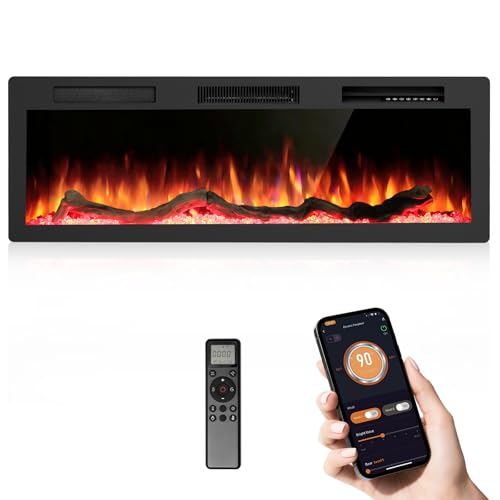
This 50-inch unit can be wall-mounted or recessed, so you can choose between a visible wall fixture and a built-in look. It offers 750W and 1,500W heating modes, Alexa and WiFi control, and adjustable flame colors and speed for a heater that also serves as a focal point.
Dimensions 50 in L × 17.32 in H × 5.71 in WHeating modes 750W and 1,500WTemperature range 59–95°FRoom size Up to 400 sq ft for supplemental zone heating
Why it made the cut
Wall-mounted or recessed installation
Two heating modes: 750W and 1,500W
Remote, touch, smartphone, and Alexa controls
Good to know
Designed for supplemental zone heating
Its 50-inch width needs more wall space than a compact heater
Skip it if Skip it if you want a simple, compact heater rather than a fireplace-style fixture.
Best for Bedrooms and offices where a standard-plug wall heater can serve up to 150 sq ft
The 1,500W PTC heater has a remote, touch screen, adjustable thermostat, and 30° manual oscillation. The product lists up to 150 square feet for use as a main heat source, making that the more useful figure to check when sizing it for a room.
Heat output 1,500WMounting Wall or desk mountedOscillation 30° manualThermostat range 41–95°FRoom size Up to 150 sq ft as a main heat source
Why it made the cut
Remote and touch-screen controls
30° manual oscillation
Thermostat range of 41–95°F
Good to know
Room coverage is limited to a stated 150 sq ft for primary heat
Oscillation is manual
Skip it if Skip it if you need broader oscillation or a room-size rating above 150 square feet for primary heat.
Best for Small rooms up to 50 sq ft with an existing 240V circuit
This 500W convector uses quiet, fan-free convection and has a built-in electronic thermostat with a backlit LCD. Its surface-mount design suits a small room where hardwired heat is wanted; it isn’t a plug-in replacement, and the product lists lower output on a 208V circuit.
Heat output 500W at 240V; about 375W at 208VRoom size Up to 50 sq ft on a 240V circuitMounting Surface mountThermostat Built-in electronic thermostat
Why it made the cut
Quiet convection with no fan noise
Built-in electronic thermostat and backlit LCD
Surface-mount installation
Good to know
Requires hardwiring to a 240V circuit
Rated for up to 50 sq ft at 240V
Skip it if Skip it if you need a plug-in heater or don’t have the appropriate circuit and qualified installation.
The best wall mounted heater for most rooms is a plug-in 1,500W model with a thermostat, timer and the right heat style for how you use the space. For safe, efficient electric space heaters, look for tip-over and overheat protection and a UL, ETL or CSA listing; efficiency means controlling temperature well, not getting more heat from the same watts.
A standard 120V outlet puts a firm ceiling on plug-in heat: 1,500W draws about 12.5A, close to the limit of a typical 15A circuit. Check what else shares that circuit before choosing a heater. A hardwired unit may use a different supply, so follow its nameplate and installation instructions rather than treating it like a plug-in model.
Match The Heat Style To The Room
PTC ceramic heaters warm quickly and often use a fan to move heat into the room; that fan can be audible. Convection heaters warm air that rises and circulates, usually with less fan noise but a slower-feeling response. Electric fireplace heaters add a flame effect for appearance, while their heating function still depends on the unit’s rated output.
Oscillation spreads warm air across a wider area, which can help if you sit in different spots. Check the thermostat’s temperature range and whether its sensor is near the heater, where it may read warmer than the far side of the room. A timer helps you schedule run time; it doesn’t make the heater use fewer watts while it’s heating.
Spec
What to check
Rated power
Up to 1,500W for a plug-in model on a standard 120V outlet
Heat delivery
PTC ceramic for quick fan-driven heat; convection for quieter, gradual warmth; fireplace style for flame appearance
Temperature control
Thermostat range and where the sensor sits
Coverage features
Oscillation, if you want heat aimed across a wider area
Installation and controls
Plug-in or hardwired; timer, noise and safety protections
Compare the details that affect daily use, not just the feature count.
Before You Choose
Confirm the unit is plug-in or hardwired, and that your outlet or wiring matches its instructions.
Check for tip-over and overheat protection and a UL, ETL or CSA listing.
Choose fan-driven or convection heat based on whether quick warmth or quieter operation matters more.
About “Energy Efficient”
For electric resistance heat, watts set the rate of electricity use while the heater runs. “Energy efficient” usually means a thermostat holds the set temperature with less overshoot and unnecessary cycling; it doesn’t turn 1,500W into a lower-watt heater.
If you’re comparing Walmart space heaters advertised as energy efficient, use the same checks: rated watts, thermostat behavior, safety listing and the installation type. A smart app or flame effect can be useful, but neither changes the heater’s electrical limit.
From HeaterGuides · our own guidePage 6: heat only the rooms you use. Page 10 covers space-heater safety.Winter Heating Bill CutterSee what every heater in your home really costs, heat the rooms you use, and cut the waste in 30 days.Cost-per-hour tables for every heaterThermostat schedule and draft-proofing planRunning-cost and bill calculator (Excel)$14.99$9.99Get it for $9.99See what's inside and watch the 2-minute video →14-page printable PDF + Excel calculator · instant download · 30-day refund
Room Size And Running Cost
A 1,500W wall heater uses 1.5 kWh per hour, so eight hours consumes 12 kWh; electric heaters energy saving comes mainly from heating only the room you use and limiting runtime. At a stated electricity rate, the arithmetic is simple.
Heater
Watts
Per hour
Per day (8 h)
Per month (30 days)
1,500 W wall heater
1,500 W
26¢
$2.04
$61.20
Calculated at 17¢ per kWh. Assumes eight hours per day, 30 days, and electricity at $0.17 per kWh.
The cheapest most efficient electric heater isn’t a special brand or a clever coating. Resistance heaters turn nearly all the electricity they consume into heat, so a lower-wattage model costs less because it delivers less heat, while a thermostat can reduce runtime after the room reaches temperature.
Worked example
Say a bedroom heater runs at its full 1,500W setting for eight hours each night. That is 12 kWh per night before the thermostat cycles it off, so the actual bill can be lower if the room holds heat and the control reduces runtime.
Power1,500 W
Runtime8 hours
Energy used12 kWh
An electric heater efficiency chart will show very little difference in heat made from each watt among resistance models. Compare thermostat behavior, fan operation, oscillation and how well the heater fits the room instead. A fan can spread heat faster, while an oil-filled radiator warms more slowly and quietly.
Oil-filled electric heaters are nearly as efficient as other resistance heaters; they aren’t more efficient just because they contain oil. The oil stores heat, so the radiator keeps releasing warmth after the element cycles off, then runs again when the thermostat calls for heat. That changes the timing, not the electricity-to-heat conversion.
A solar energy efficient space heater is usually a muddled search phrase: these wall heaters are plug-in electric appliances, not solar devices. Solar panels could supply electricity to a heater through a properly sized system, but the heater itself doesn’t create solar heat or use energy for free.
Room size still matters because drafts, insulation, ceiling height and outdoor temperature determine how long the heater must run. For a large or poorly insulated room, check the guide to the best space heater for large room before assuming another 1,500W plug-in unit will solve the problem.
Safety And Installation Rules
Safe efficient electric space heaters need a direct wall connection, clear air around the cabinet and protection against overheating; a wall mount doesn’t excuse a poor outlet or blocked airflow.
Use the wall outlet
Plug a plug-in heater directly into a wall outlet, never an extension cord or power strip. Keep at least 3 feet between the heater or electric fireplace and curtains, bedding, furniture, paper or other combustibles.
Before mounting, look for tip-over protection, overheat protection and a UL, ETL or CSA listing in the product information. Flame-retardant housing is useful where the manufacturer specifies it, but it doesn’t replace clearance or the correct electrical connection.
Plug-In Versus Hardwired
Most models in this guide are plug-in units. The Stelpro is a 240V hardwired wall heater, so installation belongs to a qualified electrician and may require a suitable circuit, box and local-code approval; it isn’t a casual DIY swap for a household plug.
Before first use
Don’t run a heater unattended or while sleeping unless the manufacturer specifically says that model is designed for those conditions. Check the cord, outlet and mounting hardware, and stop using the unit if the plug or receptacle becomes hot.
A listing badge doesn’t make a Walmart space heater energy efficient, and a wall-mounted heater isn’t automatically the best wall mounted heater for every room. Match the model’s voltage, mounting method and safety instructions to the room before you make holes in the wall.
Which Pick Fits Your Room
For most rooms, the best wall mounted heater is the DREO Smart Wall Heater; the best wall mounted electric fireplace is R.W.FLAME, and the best space heater for large room use is R.W.FLAME when you want heat plus a visible flame display.
Choose by the room’s job, not by the heater’s finish. DREO and Arecovas make more sense in bedrooms and offices, while the hardwired Stelpro is the better fit for a tiny space where quiet, steady heat matters more than app controls.
Need
Pick
Why it fits
Best overall
DREO Smart Wall Heater
1,500 watts, app and voice control, and 120° oscillation for spreading heat across a room.
Large room with atmosphere
R.W.FLAME Smart Electric Fireplace
750W or 1,500W heat, a visible flame effect, and stated coverage up to 400 sq ft.
Quiet heat for a tiny room
Stelpro Wall Heater
Hardwired operation suits a small space needing constant heat without a portable unit taking up floor area.
Bedroom or office
Arecovas Wall Heater
A straightforward wall-mounted choice for personal rooms where floor space is already spoken for.
Budget smart option
GiveBest Smart Wall Heater
A practical pick when Wi-Fi and wall mounting matter more than especially refined fan behavior.
The shortest route from room type to model.
R.W.FLAME is the large-room choice only within its stated 400-square-foot coverage and with realistic expectations: 1,500 watts is still 1,500 watts of electric heat. The flame display changes the room’s look, not the heater’s electrical output. That makes the fireplace decor-first, so it isn’t the cheapest or bare-bones most efficient electric heater if efficiency means getting the most plain heat for each dollar.
Best overall
DREO Smart Wall Heater, 1500W Space Heater for Bedroom, White, Standa…
Pick DREO for a bedroom, office, or living area where you want wall-mounted heat that can move across the room and be adjusted from an app or by voice.
DREO suits rooms where remote control and broad airflow matter.
R.W.FLAME adds a flame effect and two heat settings for a larger living space.
Stelpro avoids fan noise in a small room with hardwired, steady heat.
Know the trade-off
R.W.FLAME takes a decor-first approach and costs more to run than a heater used only for bare-bones heat if its flame features encourage longer runtime.
Stelpro needs suitable hardwired installation, so it isn’t the quick plug-in choice.
GiveBest is sensible on a budget, but its fan behavior may feel less polished.
A simple rule settles most close calls: choose DREO for controllable zone heat, R.W.FLAME for a living room where the flame effect earns its wall space, Stelpro for a small quiet room, Arecovas for a bedroom or office, and GiveBest when smart access and wall mounting outrank fan finesse.
What Most Buyers Miss
Control quality and room conditions often matter more than a higher wattage rating: a good thermostat and ECO mode can hold a steadier temperature without running the heater harder than needed. Safe efficient electric space heaters should have a recognized safety listing, tip-over and overheat protection, and the controls you’ll actually use.
Heater type
Efficiency at the heater
What changes in use
Wall-mounted electric
Nearly all electricity becomes heat at the point of use
Thermostat, airflow and placement affect comfort and runtime
Oil-filled electric radiator
Nearly all electricity becomes heat at the point of use
Slower to warm; stored heat continues after cycling off
Portable fan heater
Nearly all electricity becomes heat at the point of use
Quick heat, but the fan can be noticeable
Electric heater efficiency chart: resistance heaters turn nearly all the electricity they use into heat indoors; efficiency differences mostly show up in control and comfort.
Myth
Oil-filled electric heaters are cheaper to run because they stay warm after switching off.
Fact
They’re often quieter and their oil holds heat between thermostat cycles, which can feel gentler. But they’re not inherently cheaper to run: for the same heat delivered, electric resistance heaters use broadly similar electricity. A thermostat that avoids overheating matters more than the oil.
Wall mounting clears floor space and can help warm air circulate, but it won’t seal a drafty window or make a poorly insulated room hold heat. Fixing air leaks can improve comfort more than swapping one 1,500W heater for another.
Pay for smart controls only if you’ll use them
App or voice control is useful if you schedule preheating before you enter a room. If you’re happy to turn the heater on manually, Wi-Fi adds little besides another device asking for your network password.
Buying rule
Choose a wall unit when you want fixed placement and clear floor space; choose an oil-filled radiator for quieter, gradual heat; choose a plain portable heater when you need to move heat between rooms. Compare thermostat control and how you use the room before paying more for wattage or smart features.
Frequently Asked Questions
Are wall-mounted space heaters more efficient than portable heaters?
Not by themselves: both convert nearly all the electricity they use into heat, so equal-watt models running for equal hours cost about the same. A wall-mounted heater can use less energy if its thermostat and controls help you heat only the occupied room and avoid unnecessary runtime.
How efficient are oil-filled electric heaters compared with wall heaters?
Oil-filled electric heaters and wall heaters turn electricity into heat at roughly the same rate at the point of use. The oil stores heat and releases it after the element cycles off, but that stored heat isn’t free; choose based on placement, comfort and controls rather than expecting lower bills from the oil alone.
What size wall-mounted heater do I need for a bedroom or office?
Start with the room’s floor area, insulation, ceiling height and drafts; a common plug-in 1,500W unit may suit a modest, reasonably insulated room, but it can’t overcome substantial heat loss. For a cold or poorly insulated room, check the heater’s coverage guidance and consider a heat-loss calculation instead of assuming a higher setting will solve it.
What is the cheapest most efficient electric heater for a small room?
A basic 1,500W electric heater with a usable thermostat is often the simplest low-cost choice for a small room, though wall mounting can add installation cost. No resistance heater is meaningfully more efficient at turning electricity into heat; savings come from accurate temperature control, a closed door and shorter run time.
Can I mount a plug-in wall heater on drywall without hardwiring it?
Only if the heater is designed and listed for that mounting method and its instructions allow installation on the wall material you have. Use the specified fasteners and clearances, plug it directly into a suitable wall outlet, and don’t conceal or modify the cord; hire an electrician if the model requires hardwiring.
Before you go · a welcome giftGet the Winter Heating Bill Cutter for $4.99See what every heater in your home really costs, heat the rooms you use, and cut the waste in 30 days. Normally $14.99; your welcome price saves $10.00. We'll email your link right now.or buy it now for $9.99 without the gift →One email with your link now. We never share your address.




 Winter Heating Bill CutterSee what every heater in your home really costs, heat the rooms you use, and cut the waste in 30 days.Cost-per-hour tables for every heaterThermostat schedule and draft-proofing planRunning-cost and bill calculator (Excel)