Skip to content
HeaterGuides
Water Heater

State Water Heaters: 3 Specs That Decide the Right One

On this page 7 sections
  1. State Water Heaters
  2. Bradford White Vs State Water Heater
  3. How State Water Heater Problems Start
  4. How Long A 20 Lb Tank Lasts
  5. State Water Heater Installation Rules
  6. What To Do Next With Your State Water Heater
  7. Questions People Ask
Straight answer
State water heaters are water heaters sold under the State brand, usually as tank or tankless units for homes. An electric water heater is a water heater that uses electric heating elements to warm stored water. Pick one by fuel type, size, venting, and local code, not by the logo alone.

The most common mistake is buying by brand name first and capacity second. A 40-gallon tank that is too small will run out of hot water; one that is too large will cost more to keep hot every day.

Another easy miss is assuming every state allows the same gas setup, pan drain, or vent material. Codes vary, and a cheap shortcut can turn into a leak, a failed inspection, or a very dull afternoon with a drain pan and a shop vac.

State Water Heaters

State Water Heaters

State water heaters are a brand family, not one single design; State sells both storage-tank and tankless units using gas or electricity. For tankless vs traditional water heaters in the United States, choose stored hot water for simpler peak-demand comfort, or on-demand heating when space and standby losses matter more; the best tankless water heater brands for 2025 and 2026 depend heavily on local service.

A traditional tank keeps a reservoir hot so a shower can start immediately, while a tankless unit heats water as it flows through a heat exchanger. Tank models can run out during back-to-back showers, then recover; tankless models avoid that empty-tank pause but need enough gas supply or electrical capacity to meet the flow rate.

TypeComfortRecoveryVentingTypical use
Storage tankHot water is ready until the tank is depletedReheats after heavy useGas models need approved venting; electric models don’t use combustion ventingApartments, family homes, and cabins needing predictable service
TanklessContinuous hot water within its flow limitHeats during use; no storage tank to emptyGas models need venting; electric models need suitable electrical capacitySmall homes, cabins, and space-limited installations
GasUsually strong recovery, depending on model and fuel inputOften faster for heavy demand than a similar electric tankCombustion venting and code-compliant gas work are requiredFamily homes and high-demand households
ElectricQuiet, steady tank comfortDepends on element input and stored volumeNo combustion vent; electrical circuit and installation must suit the unitApartments, single-bath homes, and homes without gas service
Tank versus tankless describes storage; gas versus electric describes the heat source.

Running cost comes from two different patterns. A storage tank uses energy to replace heat lost while sitting hot all day, while a tankless unit uses more power or gas during a draw and little or none between draws; compare fuel price, efficiency, hot-water volume, and your daily schedule rather than the logo alone.

Myth
Tankless automatically costs less to run.
Fact
Tankless can reduce standby losses, but a high-demand household may trigger substantial gas or electrical use during long draws. A lightly used tank may have the lower bill if its size and insulation suit the household.
In short
Pick tank storage for straightforward installation and dependable peak comfort. Pick tankless when space, standby loss, or continuous hot water matters and the home’s gas supply, electrical service, venting, and local technician support can handle it.

For the mechanics behind each design, see how a water heater works; larger households comparing electric storage can also start with the best 80 gallon electric hot water heater guide.

Bradford White Vs State Water Heater

Bradford White vs State water heater is a model-by-model decision: compare the exact fuel and capacity, warranty length, recovery rate, first-hour delivery, venting needs, controls, parts access, and installer support in your area.

A familiar local technician and a supplier with the right parts can matter more than brand loyalty. The practical buying rule is simple: choose the model your plumber can service and your local supplier actually stocks parts for, especially if the heater fails during a January cold snap.

Good choice when
A local plumber knows the model
Replacement parts are available nearby
The recovery rate and first-hour delivery match your household
Look elsewhere when
A familiar logo can hide different model requirements
Warranty coverage may depend on installation and registration
Tankless units may need special venting, gas supply, or electrical capacity
Compare the equipment, not the badge
The better choice among State, Bradford White, and Rheem depends on the specific model, fuel, warranty terms, service network, and installation requirements. A State tankless water heater versus Rinnai comparison should use those same checks rather than brand reputation alone.

That rule also answers searches for the better water heater brand among State, Bradford White, or Rheem: select the unit that fits the load and has dependable local support. For a deeper model-by-model warranty comparison, see Bradford White vs State water heater.

How State Water Heater Problems Start

My State LE gas water heater is beeping usually means the control board has detected a fault, not that the heater has developed a decorative alarm. Common causes include ignition trouble, a failed sensor, overheating, scale, low water flow, or a venting problem.

Hard-water scale coats the heating surface and acts like insulation, so heat moves into the water more slowly. A tankless unit may then run longer, overheat, shut down, or short cycle—starting and stopping before it finishes a normal heating call.

For “how do I descale a State GTS-540-NIH 100 water heater,” use that model’s service instructions and an approved descaling solution; the manual’s isolation-valve procedure matters. If the unit lacks service valves, keeps faulting after a flush, or you’d need to open the combustion compartment, call a qualified technician.

Safe checks first
Read the display or blink pattern and write down the fault code before resetting it.
Confirm the gas shutoff is open and the water valves are open; don’t remove sealed gas controls.
Check that the intake and exhaust terminations are clear of leaves, snow, and nests.
Look for leaks around fittings, the relief valve, and the tank or heat exchanger.
Check that the CO alarm has power and that the heater’s breaker or service switch has not tripped.
Stop and leave
Gas odor, a CO alarm, repeated shutdowns, soot, or a leaking tank needs immediate attention. Leave for gas odor or a CO alarm, avoid switches and flames, and call the gas utility or emergency services from outside; shut water or fuel only if you can do so safely.

Five strong replacement signs are a leaking tank body, repeated fault shutdowns after proper repair, severe corrosion, rusty hot water that returns after the plumbing is checked, and water damage around the heater. A faulty sensor or valve can be repairable, so use the signs in 5 clear signs you need a new water heater now as a replacement screen, not a diagnosis.
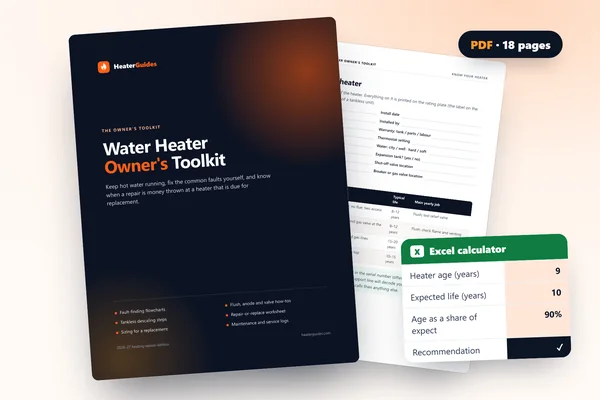
From HeaterGuides · our own guidePages 9 to 13 are the fault flowcharts: no hot water, noises, smells and leaks, in order.Water Heater Owner's Toolkit: the printable guide and its Excel calculatorWater Heater Owner's ToolkitFix the common faults yourself, keep it running for years, and know when a repair is money wasted.No-hot-water flowcharts, gas and electricFlush, anode, relief valve and descaling stepsRepair-or-replace calculator (Excel)$14.99 $9.99Get it for $9.99See what's inside and watch the 2-minute video →18-page printable PDF + Excel calculator · instant download · 30-day refund

How Long A 20 Lb Tank Lasts

state water heaters: How Long A 20 Lb Tank Lasts

A 20 lb propane tank lasts about 11 hours if a 40,000 BTU-per-hour water heater burns continuously, but a home usually gets more calendar days because the burner cycles on only while recovering hot water. Showers, incoming water temperature, and the heater’s input rate decide the real answer.

Worked example
A 20 lb cylinder holds roughly 4.7 gallons of propane. At about 91,500 BTU per gallon, that is approximately 430,000 BTU. At 40,000 BTU per hour, 430,000 ÷ 40,000 is about 10.8 hours of continuous burner time. If showers and recovery use the burner for two hours per day, that is roughly five days; actual results vary, and you shouldn’t run a cylinder completely empty.
Tank20 lb
FuelAbout 430,000 BTU
Example input40,000 BTU/h
Continuous burnAbout 10.8 hours

Heavier winter use shortens runtime because colder inlet water needs more heat. Long showers and repeated tub fills do the same, while a lower-input heater may burn longer but consume fuel more slowly. Check the rating plate for the actual input instead of estimating from the tank label.

Indoor safety
An outdoor heater or an unvented heater is not an indoor water-heating substitute. Use indoor-rated equipment with the venting and combustion air the manual requires, plus a working CO alarm; a propane cylinder also needs storage and connection practices that follow local code.

State Water Heater Installation Rules

How to install a State hot water heater depends on its fuel, venting, electrical supply, and local code; a licensed plumber or electrician should handle gas piping, venting, 240 V wiring, and the T&P discharge line in most places. An instantaneous water heater follows the same rule: confirm flow and electrical or gas requirements, mount it as the manual specifies, connect approved water and fuel lines, test for leaks, and verify venting before use.

QuestionPractical answer
Drain panOften required where a leak could damage finished space; local code and the State manual control the requirement.
Ohio, no drain availableNo drain does not automatically remove the pan requirement. Ask the local building official or plumber about an approved pan, drain route, or leak-control arrangement.
New Jersey, Schedule 40 exhaustPEX cannot replace the listed vent or exhaust material. Use only the pipe, fittings, supports, and clearances allowed by the heater manual and code; PEX is a water-line material, not a vent.
California gas heatersGas water heaters can still be sold and installed in California, but local rules, emissions limits, permits, and model standards vary by location and unit.
The manual and the authority having jurisdiction settle installation details.
Keep the vent system honest
Never improvise a vent with PEX, unlisted pipe, or a convenient adapter. A blocked or wrong-material exhaust can send combustion gases indoors. Never cap or plug the T&P valve discharge line.
1
Check the site
Confirm fuel, clearances, vent route, electrical circuit, seismic or mounting requirements where applicable, and whether a drain pan is required before ordering the replacement.
2
Use approved connections
Match every pipe and fitting to the model manual and local code. A gas connection, vent, 240 V circuit, or T&P line deserves licensed trade work in most jurisdictions.
3
Test before handoff
Check water and fuel connections for leaks, confirm the burner or elements operate, verify the vent draft or exhaust arrangement, and leave the owner the model and serial information.
Disposal
Shut off fuel or power, drain the tank safely, and disconnect it.
Follow local rules or a scrap-metal program for recycling the steel tank and other metal.
Never dump, cut into, or transport a tank that still contains pressure or water.

The EPA does not provide one nationwide curbside method for every old water heater; disposal rules are usually handled locally. Call the hauler, transfer station, or scrap program before loading the tank, since some locations require the unit to be drained and separated from other waste.

What To Do Next With Your State Water Heater

In short
A working State water heater needs its model and serial number recorded before trouble starts. A dead or leaking unit needs a basic power, fuel, ignition, and leak check, followed by repair, replacement, or a code review.
1
Working heater
Photograph the rating plate and record the model, serial number, fuel, capacity, and installation date. That information makes parts and warranty conversations far less theatrical.
2
No hot water
Check the breaker or disconnect, gas supply, pilot or electronic ignition, and obvious leak signs. Stop and call for service if you smell gas, see a serious leak, or find damaged wiring.
3
Replacing the unit
Compare fuel, capacity, recovery rate, venting, electrical demand, local code, and nearby service support before comparing brand names.
4
Before installation
If the vent, gas line, 240 V wiring, pan, or T&P discharge arrangement is changing, have the required licensed trade and local code official review it first.

Choose the path in order: record details if the heater works; check basic power, fuel, ignition, and leaks if it does not; repair a safe, serviceable fault; replace a leaking or uneconomical unit; and check code before installing anything with changed fuel, venting, or wiring.
Questions People Ask

What is the difference between State and Bradford White water heaters?
Both brands sell several tank and tankless models, so the brand name alone doesn’t determine performance. Compare the exact fuel, capacity, recovery rate, warranty terms, controls, venting, and local service support before choosing.
Why is my State gas water heater beeping?
A beeping State gas water heater usually has a diagnostic alert from its control system, such as an ignition, sensor, power, or overheating fault. Read the display or count the beep pattern, then follow the model’s service instructions; leave immediately and call for help if you smell gas or a carbon monoxide alarm sounds.
How long does a 20 lb propane tank last on a water heater?
A 20 lb propane tank holds roughly 430,000 BTU, so a 40,000 BTU-per-hour burner would run for about 11 hours continuously. Actual calendar life is longer because the burner cycles, but heavy hot-water use, cold incoming water, and a low tank can shorten it.
Do you need a drain pan under a water heater in Ohio?
Ohio requirements depend on where the heater sits and which local code provisions apply. A pan is commonly required where a leaking tank could damage floors, ceilings, or finished space, and the pan needs a properly routed drain when the code or installation instructions require one.
Can you use PEX instead of copper for a water heater vent or exhaust?
No. PEX is a water-supply pipe and cannot replace the listed vent or exhaust material. Use the vent type, diameter, fittings, and termination specified for that heater; PEX may be acceptable for water connections only when the product instructions and local code allow it.
Is California banning gas water heaters?
California does not have one blanket rule that immediately bans every gas water heater in every home. State emissions rules and local building codes can affect new construction, replacement choices, and which models may be sold or installed, so check the current requirements where you live before buying.

Joye Editor

HeaterGuides covers home heating, water heating and HVAC: how the equipment works, what it costs to run, and how to use it safely.

More in Water Heater