Space Heaters for 600 Sq Ft Rooms: About 12 Cents an Hour to Run
On this page 8 sections
- Comparison of Space Heaters for 600 Sq Ft Rooms
- Top Space Heaters for 600 Sq Ft Rooms
- Choose the Right Heater Type for 600 Sq Ft Rooms
- Calculate Running Costs and Power Needs Accurately
- Place Your Heater for Maximum Effectiveness in a 600 Sq Ft Room
- Check Safety Features Specific to Larger Room Heaters
- How Room Insulation Changes What Your Heater Can Do
- Frequently Asked Questions
Comparison of Space Heaters for 600 Sq Ft Rooms
| Rank | Model | Best for | Heat Output (BTU) | Noise Level (dB) | Safety Features | Price |
|---|---|---|---|---|---|---|
| 1 | DR. INFRARED HEATER DR-968 Portable Space HeaterBest for Large Rooms | Heating 600 sq ft rooms quietly and safely with dual heating | 5200 BTU | 39 dB | Tip-over, Overheat | See it on Amazon |
| 2 | DREO Smart Wall Heater 1500WBest for Smart Control | Rooms needing even heat distribution with app and voice control | — | — | — | See it on Amazon |
| 3 | Ballu Mica Infrared Space HeaterBest for Energy Saving | Large rooms needing quiet, efficient infrared warmth with flexible placement | — | Whisper-quiet | — | See it on Amazon |
| 4 | DREO 25 Inch Electric Space HeaterBest for Quiet Operation | Large rooms up to 270 sq ft needing quiet, safe heat | — | 25 dB | Tip-over, Overheat, Child lock | See it on Amazon |
| 5 | DREO 16 Inch Electric Heater for Large RoomBest for Portability | Rooms up to 250 sq ft needing fast, quiet heat with smart safety | — | 34 dB | Tip-over, Overheat, Auto-off | See it on Amazon |
A 600 sq ft room needs a heater that balances power, coverage, and safety without blasting noise or high running costs. A 1500-watt electric heater with good airflow and safety features generally fits the bill.
Not all heaters marketed for large rooms perform well in spaces this size. Infrared and ceramic models with thermostats and quiet fans offer the best mix of comfort and control. Below, you’ll find the best options tailored to 600 sq ft rooms, along with clear advice on sizing, running costs, and placement.
Top Space Heaters for 600 Sq Ft Rooms

DR. INFRARED HEATER DR-968 Portable Space Heater

DREO Smart Wall Heater 1500W

Ballu Mica Infrared Space Heater

DREO 25 Inch Electric Space Heater
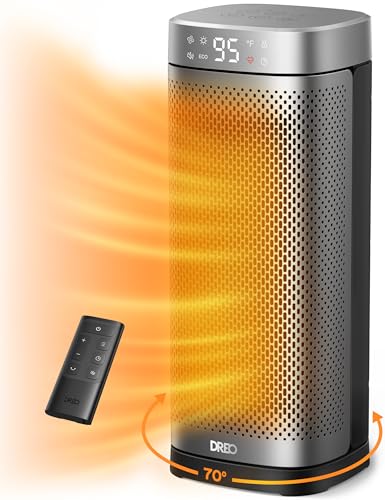
DREO 16 Inch Electric Heater for Large Room
Choose the Right Heater Type for 600 Sq Ft Rooms
For a 600 sq ft room, a ceramic heater with a fan gives you the most even warmth. It moves heated air continuously, covering the whole space without cold corners.

Ceramic heaters use a PTC ceramic element and a fan to circulate warm air. At 1,500 watts, they heat a 600 sq ft room to comfortable levels in about fifteen minutes, assuming eight-foot ceilings and typical insulation. The fan is what makes the difference: it pushes heated air into circulation rather than letting it pool near the heater.
Infrared heaters work differently. They aim warmth directly at people and objects, like sunlight through a window. That makes them excellent for spot heating a desk, a chair, or a corner of a garage, but they won’t spread heat evenly across a larger room. You’ll feel warm where the beam lands; the air six feet away stays cool.
Oil-filled radiators heat slowly and silently. Once the oil inside warms up, the unit radiates heat for a long time, even after the element clicks off. They suit bedrooms and offices where fan noise is unwelcome and you don’t need heat fast. Expect twenty to thirty minutes to feel the difference in a 600 sq ft space.
All plug-in space heaters top out at 1,500 watts on a standard 120-volt outlet, which delivers about 5,100 BTU. That’s enough for a 600 sq ft room under normal conditions. Anything drawing more power needs a dedicated circuit or a 240-volt line, which takes it out of the portable category.
If you want the room itself warmed evenly, pick a ceramic model with oscillation or a wide fan. If you want to feel warm at your desk without heating the whole garage, infrared does that job with less wasted energy. For quiet, steady background heat that won’t disturb sleep, an oil-filled radiator fits.
Specific models tested for 600 sq ft rooms appear in our guide on which electric heaters heat 600 sq ft well.
 Winter Heating Bill CutterSee what every heater in your home really costs, heat the rooms you use, and cut the waste in 30 days.Cost-per-hour tables for every heaterThermostat schedule and draft-proofing planRunning-cost and bill calculator (Excel)
Calculate Running Costs and Power Needs Accurately
A plug-in space heater maxes out at 1,500 watts on a standard 120 V outlet, delivering about 5,120 BTU. That’s enough for a well-insulated 600 sq ft room, but every model pulls the same power at high.
Running cost depends on hours and your electric rate. A 1,500 W heater for 8 hours uses 12 kWh. At 17 cents per kWh—the US average in late 2026—that’s about $2.04 a day, or roughly $61 a month if you run it every night. The math: 1,500 W ÷ 1,000 × 8 hours × $0.17.
| Heater | Watts | Per hour | Per day (8 h) | Per month (30 days) |
|---|---|---|---|---|
| 1,500 W heater (high) | 1,500 W | 26¢ | $2.04 | $61.20 |
| 750 W heater (low) | 750 W | 13¢ | $1.02 | $30.60 |
Thermostats and ECO modes cut that figure considerably. A heater set to 70°F cycles on and off to hold temperature, running closer to 4 or 5 hours out of 8. Models like the Lasko Ellipse claim up to 50 percent savings in AutoECO mode by idling the fan between heating cycles.
Low-wattage heaters—300 to 500 W personal models—cost less to run but heat only the person in front of them. They work under a desk or beside a chair, not for a whole room.
Heater type changes how heat feels, not how much electricity you pay. Ceramic heaters blow warm air fast with a fan. Infrared models warm skin and objects directly, so the room feels comfortable sooner even though the air temperature lags. Oil-filled radiators heat slowly and keep radiating after they click off, which stretches the off-cycle and can trim a few cents per day—but all three types draw the same 1,500 W when the element is on.
Check your actual electric rate on your utility bill; it ranges from under 10 cents in Louisiana to over 30 cents in Hawaii and parts of New England. Multiply the kWh figure above by your rate to see what a heater costs you.
Place Your Heater for Maximum Effectiveness in a 600 Sq Ft Room
The best placement for a space heater in a 600 sq ft room is near cold spots or entry points where drafts enter. These areas sap warmth and cause discomfort, so placing the heater there directly counters heat loss.
Avoid tucking the heater behind furniture or too close to walls. Blocking airflow reduces the heater’s ability to circulate warm air, forcing it to work harder and raising running costs. At least 3 feet of clearance from combustibles is essential to prevent fire hazards.
Using a heater with oscillation or fan mode helps spread heat evenly in the whole room instead of concentrating warmth in one spot. This is especially important for a 600 sq ft space, where a single fixed-direction heater can leave cold zones.
Choose floor placement or wall mounting depending on your heater type and room layout. Floor units work well for portable heaters that can be moved around to target different areas, while wall-mounted models free up floor space and often provide more consistent distribution.
Say your room is 20 by 30 feet. A heater placed near the main entrance or a large window will block cold air drafts and raise comfort quickly. Meanwhile, avoiding corners and ensuring the heater’s airflow isn’t obstructed makes sure the heat reaches all parts of the room efficiently.
Check Safety Features Specific to Larger Room Heaters
Essential safety features for space heaters include tip-over switches, overheat protection, and cool-touch exteriors. Each plays a key role in preventing accidents and fires, especially in larger 600 sq ft rooms where heater use is extended.
A tip-over switch cuts power instantly if the heater falls, stopping fire risks caused by contact with flammable materials. This feature is standard on quality portable heaters and critical in homes with pets or kids.
Overheat protection automatically shuts off the heater if internal temperatures rise beyond safe limits. This prevents damage to the unit and reduces fire hazards caused by components overheating during long use periods.
Cool-touch exteriors keep the heater’s surfaces safe to touch, lowering burn risks. This is especially important near traffic areas or in homes with children, where accidental contact with a hot surface is possible.
Look for UL or ETL certifications to ensure the heater has undergone rigorous safety testing. These listings verify compliance with safety standards, giving you confidence in the product’s construction and protective features.
A remote control adds safety by allowing you to adjust settings without bending near the heater, reducing the risk of burns or knocking it over. This convenience also encourages proper use and timely shutoff.
Noise level affects comfort and perceived safety. A quieter heater won’t disturb sleep or conversations, making it easier to keep the heater running safely for longer stretches without distraction or irritation.
How Room Insulation Changes What Your Heater Can Do
A 1,500-watt heater working harder in a drafty room costs you the same 1,500 watts but delivers less comfort. Poor insulation forces the heater to run longer cycles to replace heat leaking through walls, windows and gaps, which means higher bills without better warmth.
Well-insulated rooms let the thermostat cycle the heater off sooner. If your heater runs eight hours in a leaky room but only four in a sealed one, you’ve cut your cost in half—from about 12 kWh to 6 kWh per night. The heater hasn’t changed; the room has.
Infrared heaters warm objects and people directly, but cold walls and windows absorb that radiant heat before you feel it. A room with single-pane windows or uninsulated exterior walls feels harder to heat with infrared even when the heater’s output stays steady. Ceramic heaters with fans move warm air and work better in leaky spaces, but sealing drafts helps both types.
Check for drafts around windows, doors, electrical outlets and baseboards before adding a second heater. Weatherstripping and outlet gaskets cost less than running an extra 1,500 W unit and solve the problem at the source. In older homes, the attic hatch and recessed lights leak more heat than most people expect.
A built-in or separate thermostat keeps the room at your target temperature without manual adjustments. The heater cycles off when the air reaches setpoint and back on when it drops, which prevents overheating and wasted energy. In a room with uneven insulation—say, one cold exterior wall—the thermostat maintains comfort while the heater adapts to the load.