


Many believe that 1500-watt heaters are the only effective option for space heating. While 1500 watts offer maximum power, 1000-watt heaters provide efficient, targeted warmth with lower energy use and safer operation for smaller spaces.
Choosing a 1000-watt heater means balancing heating speed, room size, safety features, and operating costs. This guide focuses on the best tested models that excel in these areas, especially for households with kids or pets.
1000-Watt Space Heater Features Compared
| Model | Best for | Heat Output (Watts) | Safety Features | Room Size Coverage | Noise Level (dB) | Price |
|---|---|---|---|---|---|---|
| BZGG Portable 1000W Ceramic Space Heater | Best Overall | 1000 | Tip-over switch, overheat auto shut-off, UL-certified | Up to 200 sq ft | 40 | View on Amazon |
| Gaiatop 1000W Ceramic Space Heater with Wood Legs | Most Stylish | 1000 high, 400 low | Overheat protection, tip-over auto shut-off, flame-retardant materials | Small spaces | — | View on Amazon |
| Aiwa 1000W Ceramic Space Heater with Fan Mode | Most Versatile | 1000 | Overheat protection, tip-over auto shutoff | — | — | View on Amazon |
| COMFORT ZONE 1000W Desktop Ceramic Heater | Best for Desks | 700 and 1000 | — | — | — | View on Amazon |
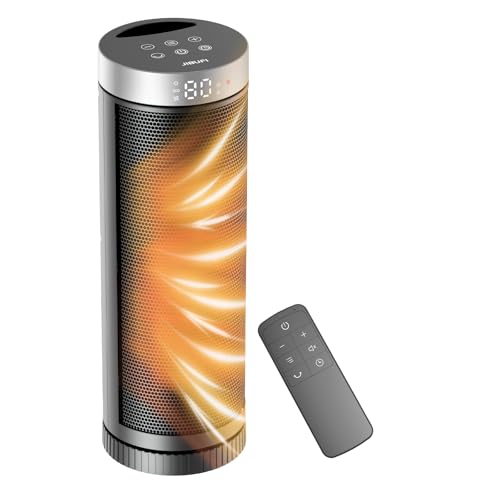
| JIBUFI 1500W Space Heater with Thermostat and Timer | Most Powerful | 700, 1000, 1500 | Tip-over shutoff, overheat protection, ETL-certified | — | — | View on Amazon |
Top 1000-Watt Space Heaters Tested and Ranked
BZGG Portable 1000W Ceramic Space Heater
Gaiatop 1000W Ceramic Space Heater with Wood Legs
Aiwa 1000W Ceramic Space Heater with Fan Mode
COMFORT ZONE 1000W Desktop Ceramic Heater
JIBUFI 1500W Space Heater with Thermostat and Timer
How To Pick a 1000-Watt Heater That Works for You
A 1000-watt space heater usually heats rooms from about 100 to 200 square feet, depending on insulation and layout. It draws roughly 8.3 amps from a standard 120 V outlet, staying well within a typical 15-amp circuit’s limit.
A 1000-watt heater supplies a moderate heat level, typically enough to warm rooms from 100 to 150 square feet, depending on insulation and outside temperature.
Safety features are non-negotiable. Look for a tip-over switch that cuts power if the heater falls, overheat protection that shuts it off if it gets too hot, and cool-touch surfaces that prevent burns on the housing or controls. These features protect children, pets, and your home from fire risk and injuries.
Noise is another key factor. Ceramic heaters with fans tend to be louder, while oil-filled radiators and infrared heaters usually run quietly or silently. If you want a heater for a bedroom or a quiet office, check user and test reports for noise levels before buying.
Heater types affect how the heat feels and spreads. Ceramic heaters warm the air quickly with a fan, good for spot heating. Oil-filled radiators heat more slowly but keep radiating warmth after turning off, ideal for steady room heating. Infrared heaters warm objects and people directly without heating all the air, which can feel more natural in small spaces.
Remote controls and digital thermostats add convenience and efficiency. A thermostat lets the heater maintain a set temperature without running constantly, saving energy and preventing overheating. Remote controls allow safe adjustment from a distance, eliminating the need to bend down or reach behind furniture.
Sizing and Running Costs of 1000-Watt Heaters
Say your room measures 12 by 14 feet, about 168 square feet. A 1000-watt heater uses 1,000 watts or 1 kilowatt continuously. Running it for 8 hours consumes 8 kilowatt-hours. At a rate of 17 cents per kWh, that costs about $1.36 per night.
Running a 1,000 W heater for 8 hours uses 8 kWh. At 17 cents per kWh, that costs about $1.36 daily. Over a 30-day month, expect roughly $40.80. These figures help you compare costs to other heating options.
Compared to a 1500-watt heater, a 1000-watt model uses one-third less electricity, which can add up over a heating season. For many small rooms, 1000 watts is enough to maintain a comfortable temperature without the extra cost or noise of a larger unit.
A digital thermostat is crucial to avoid wasting energy. Without one, the heater runs continuously, even if the room is already warm. With a thermostat, it cycles on and off to keep your set temperature, saving money and extending the heater’s lifespan.
Say you have a 150-square-foot insulated bedroom and run a 1000-watt heater for 6 hours each night. That’s 6 kWh per night or about $1.02 at 17 cents per kWh. Over a 30-day month, the cost is roughly $30. The thermostat might reduce actual run time by a third, lowering costs further.
Sizing your heater right and using its thermostat properly keeps comfort up and your electricity bills down. For larger spaces, consider multiple smaller heaters or a higher wattage model, but remember the trade-offs in cost and noise.
For more on choosing heaters that fit your space and run quietly, see efficient quiet.
Safety Features That Protect Kids, Pets, and Your Home
Tip-over switches shut off the heater if it falls, preventing fires. Overheat protection cuts power if internal parts get dangerously hot. These features are standard now and essential for homes with children or pets.
A tip-over switch is essential. If the heater tips or falls, it immediately cuts power to avoid fire risks. This feature alone prevents many injuries in busy households with kids or curious pets.
Overheat protection adds a second layer of safety. If internal components get too hot, the heater shuts off before surfaces can ignite or cause burns. This is critical because some heaters can fail hot-surface tests, meaning their exhaust or grille reaches temperatures that can burn skin on brief contact.
Look for cool-touch exteriors. Heaters designed with plastic or insulated casings keep the outside surface safe to touch, reducing burn hazards. Models that use ceramic heating elements often maintain lower housing temperatures compared to metal-bodied heaters, helping with child safety.
Certification from UL (Underwriters Laboratories) or ETL (Electrical Testing Laboratories) means the heater meets strict safety standards, including tip-over and overheat tests. Skip models without these marks, especially if you need a child-safe space heater or one safe for pets who might bump it.
Pet-friendly safety means the heater won’t get hot enough to burn paws or fur if brushed against, and its tip-over switch should react fast to any knocks. Some heaters also feature protective grilles that block small noses and tails from reaching hot parts.
Remote controls improve safety by letting you adjust heat without bending near a potentially hot unit on the floor. That keeps kids and pets away from the heater during operation.
What Quiet Operation Means and Which Models Deliver It
Quiet operation means the heater runs without distracting fan noise or mechanical sounds. Some 1000-watt models use ceramic elements with quiet fans, while others rely on convection or infrared heating with no fan at all. Models with no fan are nearly silent, making them ideal for bedrooms or offices.
Quiet operation usually means noise below 40 decibels, about the sound of a quiet library. Some 1000-watt heaters use brushless fans or convection-only designs to keep noise low, making them suitable for bedrooms or offices.
Most quiet heaters operate around 40 decibels, roughly the sound level of a quiet library or soft rainfall. This lets you use them overnight or while working without distraction.
Ceramic heaters tend to be the quietest because they rely on convection and small fans running at low speeds, or sometimes no fan at all. This near-silent operation makes them ideal for bedrooms.
Among tested models, the BZGG 1000W Portable Space Heater and the COMFORT ZONE Ceramic PTC Desktop Heater stand out for their low noise output, allowing you to focus or sleep without a constant background noise.
You can check noise levels at home by turning on the heater at its highest setting and listening from a typical sitting or sleeping distance. If the sound is louder than a conversation at normal volume, it may be too noisy for sleep.
Choosing a heater with a fan-only mode can also help. That mode circulates air without the heating element running, which is useful for mild temperatures and further reduces noise during use.
Why Some 1000-Watt Heaters Warm Better Than Others
The best heating technology for a 1000-watt heater depends on the balance between quick heat delivery and how evenly that heat spreads across your space.
Ceramic heaters with PTC (Positive Temperature Coefficient) elements heat up rapidly and draw only as much power as needed to maintain temperature. This makes them efficient and fast at warming small to mid-size rooms. Their fan-driven airflow helps distribute heat beyond the immediate area.
Some heaters warm better because of how they move air. Models with oscillation spread heat more evenly. Ceramic heaters heat up quickly, while oil-filled radiators hold warmth longer after turning off. Infrared models warm objects and people directly rather than the air.
Infrared heaters work differently by warming objects and people directly rather than heating the air. This direct radiant heat feels immediate and can be more comfortable in drafty or larger spaces, though the warmth is concentrated in the heater’s line of sight.
Oscillation is a key feature that improves heat distribution. Heaters that rotate side to side or up and down push warm air around the room instead of concentrating it in one spot. This spreads heat evenly, making a 1000-watt heater more effective at warming whole rooms rather than just spot heating.
Heat distribution varies by heater design. Direct heating models, like infrared or ceramic with fans, quickly warm people and nearby surfaces. Whole-room heating relies on convection and circulation, as with oil-filled radiators or ceramic heaters with oscillation, to raise ambient temperature consistently.
Choosing between ceramic and oil-filled heaters means weighing speed against lasting warmth. Ceramic heaters offer fast, efficient heat with airflow, while oil-filled radiators provide slower but quieter, residual warmth with no fan noise or dust circulation.
Frequently Asked Questions
Can a 1000-watt space heater warm a medium-sized room effectively?
Are 1000-watt heaters safe to use around children and pets?
How much does it cost to run a 1000-watt space heater per hour?
Is a remote control necessary for a 1000-watt space heater?

I am a mechanical engineer and love doing research on different home and outdoor heating options. When I am not working, I love spending time with my family and friends. I also enjoy blogging about my findings and helping others to find the best heating options for their needs.
Related guides

Space Heaters With Digital Thermostat: Accurate Control Explained
What makes a digital-thermostat heater truly smart? Get expert insights to choose the perfect model for your comfort…
Little Space Heaters for Offices: Compact, Quiet & Safe
Ever shivered at your desk? Find the perfect little office space heater to banish the chill and boost…
Nursery-Safe Space Heaters: Gentle Warmth With Safety Priority
What truly makes a space heater safe for your nursery? Our essential buyer's guide reveals the key features…
