For most readers searching solar powered indoor space heater, the best real-world pick is a 1,500 W plug-in ceramic heater, not a stand-alone solar unit. A 1,500 W heater draws about 12.5 A on a 120 V circuit, which is the limit that matters before the first cold snap.
Solar space heaters sound simple until you check the numbers. A heater that actually warms a room needs steady power, and most “solar” products in this niche are really for coops, pet houses, greenhouses, or solar-generator setups.
If you want heat in a bedroom, office, or basement, the useful question is how much power you have, how much area you need to warm, and whether the heater has the safety controls that let you leave it running for a short stretch without drama.
Best Solar-Powered Space Heaters By Use
#1Best for most rooms
DREO 1500W Ceramic Heater with Oscillation
Best for Bedrooms, offices and living rooms where you need even heat and quiet operation
The 70-degree oscillation and trackball system spread heat across large rooms more evenly than a fixed heater, while the 34 dB noise level keeps it quiet enough for sleep or concentration. ECO mode cuts between 1000 W and 1500 W to hold your target temperature without constant cycling, and the 12-hour timer plus 24-hour auto shutoff handle the safety even if you forget it’s running. ETL certification, tip-over and overheat protection cover the basics.
Power 1500 WNoise level 34 dBOscillation 70°Timer 12 hoursCertification ETL
Why it made the cut
70° oscillation boosts heating coverage by 20% in large rooms
34 dB operation quieter than most ceramic heaters
Smart ECO mode adjusts wattage automatically to maintain set temperature
V0 flame-retardant materials and multiple shutoff features
Good to know
Oscillation mechanism adds moving parts that can wear over time
No handle for room-to-room carrying
Skip it if Skip it if you need to carry the heater between rooms several times a day—the fixed base makes that awkward.
Best for Moving heat between bedroom, bathroom and home office throughout the day
The carry handle and compact size let you move this heater in seconds, and the 2-second ceramic PTC startup means you feel heat the moment you plug it in. A 24-hour timer and remote let you set it from across the room, and the ±1°F thermostat precision keeps the temperature steady in spaces up to 200 square feet. Child lock blocks accidental changes if you have pets or kids around.
Best for Large rooms where you want infrared and forced-air heat working together
The dual system—infrared quartz tube plus PTC—delivers about 5200 BTU, which Dr Infrared claims is 60% more heat than single-system models. Caster wheels let you roll it between rooms, and the electronic thermostat ranges from 50°F to 85°F with a 12-hour auto shutoff. The remote, tip-over and overheat protection are standard, and the lifetime filter means one less consumable to track.
Best for Chicken coops, pet houses and greenhouses where grid power isn’t available
This is a true solar heater—30 W from a solar panel with USB and DC ports—but 30 W won’t heat a bedroom or office. It’s designed for small outdoor enclosures where even a little warmth helps: dog houses, chicken coops, drying spaces. The 100 cm cable and automatic shutoff at preset temperatures mean you can mount it and leave it, and the overheating protection keeps it safe in enclosed spaces.
Power 30 WPorts USB and DCCable length 100 cmSafety Automatic shutoff at preset temp
Why it made the cut
Actually solar-powered with no grid connection needed
USB and DC ports for flexible device charging
Automatic shutoff prevents overheating in enclosed spaces
100 cm cable and simple sunlight placement
Good to know
30 W output cannot heat indoor living spaces
Performance depends entirely on sunlight availability
No spec for operating temperature range or battery backup
Skip it if Skip it for any indoor space where people spend time—30 W is one-fiftieth the output of a plug-in heater and won’t raise room temperature meaningfully.
Hubsoul 30W Solar Heater with Monocrystalline Panel
Best for Pet enclosures, cars and camping where you need a lightweight solar heat source
Another 30 W solar model, this one built with a monocrystalline panel and a portable design meant for outdoor settings like shelters, vehicles and gardens. It won’t heat a room, but it adds warmth to small pet houses, coops or a car interior on a sunny day. The lightweight and compact build makes setup easy anywhere you can position the panel in sunlight.
Power 30 WPanel type MonocrystallineApplications Pet houses, cars, camping
Why it made the cut
Monocrystalline solar panel for efficient energy capture
Lightweight and portable for camping or temporary setups
Works in multiple settings: pet houses, cars, gardens
Good to know
30 W output inadequate for indoor human comfort
No detail on cable length, ports or shutoff features
Product listing warns to consult size needs before ordering, suggesting fit issues
Skip it if Skip it unless you specifically need a solar option for a pet enclosure or vehicle—the grid-powered models heat faster and more reliably.
A solar-powered space heater for indoor use is either a standard 1,500 W plug-in heater drawing from grid power you’ve offset with rooftop panels, or a portable electric heater running from a large solar generator with enough battery capacity to sustain the draw. The 30 W solar panel heaters in most product listings aren’t room heaters. They’re low-wattage warmers for chicken coops, dog houses, parked cars and small greenhouses—places where raising the temperature 10 or 15 degrees above ambient makes a real difference.
For a bedroom, office or living room, you’ll need a heater pulling 750 to 1,500 W. That’s 6.25 to 12.5 A on a 120 V circuit, which a small rooftop panel can’t deliver in real time. A solar powered heater capable of warming a 150-square-foot bedroom requires either grid power or a battery bank holding several kilowatt-hours, recharged over days of sun. The panels that ship with portable “solar heaters” top out around 30 to 50 W—enough to trickle-charge a 12 V battery, not enough to sustain a space heater’s draw.
Myth
A solar-powered space heater can warm your bedroom from a small panel mounted on the roof or windowsill.
Fact
A 1,500 W heater draws 12.5 A continuously. Even a large 300 W rooftop panel delivers only 2.5 A in full sun, and winter sun is weaker and shorter. You need either grid power or a solar generator with a battery bank large enough to cover the heater’s draw for hours.
Decision rule: which heater suits your need
Room heater for home: 750 to 1,500 W plug-in with thermostat, tip-over and overheat shutoff, UL or ETL listing. Runs on grid power or a solar generator with 1,000+ Wh capacity.
Coop, dog house or greenhouse: 20 to 50 W panel-and-12V-heater kit. Raises temperature modestly; no thermostat needed in most designs.
Parked vehicle or tent: 12 V DC heater drawing 3 to 5 A from a portable battery, trickle-charged by a 30 to 100 W panel. Not for enclosed sleeping without ventilation.
Match the heater to the space and the power you have available.
Never use an outdoor propane heater indoors
Some readers searching for solar alternatives find unvented propane or kerosene heaters marketed as portable. Without an oxygen depletion sensor and the ventilation the manual requires, carbon monoxide builds silently. Only indoor-rated models belong inside, and you still need a working CO alarm.
From HeaterGuides · our own guidePage 6: heat only the rooms you use. Page 10 covers space-heater safety.Winter Heating Bill CutterSee what every heater in your home really costs, heat the rooms you use, and cut the waste in 30 days.Cost-per-hour tables for every heaterThermostat schedule and draft-proofing planRunning-cost and bill calculator (Excel)$14.99$9.99Get it for $9.99See what's inside and watch the 2-minute video →14-page printable PDF + Excel calculator · instant download · 30-day refund
Which Specs Separate The Good Picks
The wattage ceiling for any plug-in space heater is 1,500 W, which draws 12.5 A on a standard 120 V household circuit. Most home circuits are rated for 15 A, so a heater at full draw leaves 2.5 A of headroom—enough for a lamp or phone charger, not enough for a vacuum or hair dryer on the same circuit. Models advertising 1,800 W or 2,000 W are either measuring something other than plug draw, or they’re 240 V units that need a dedicated circuit and won’t work in a standard outlet.
What separates a safe, useful pick from marketing noise: a UL, ETL or CSA safety listing, a thermostat with a stated range in degrees (not just a dial with no numbers), tip-over and overheat shutoff, and a realistic room-size claim. The R.W.FLAME and DREO models in the product cards above have all four. The Hyuduo 30 W panel heater has none, because it’s a 12 V trickle unit for a dog house, not a room.
Features that matter for indoor heating
Thermostat range: 40°F to 95°F or similar, so you can set a target and let the heater cycle. Dial-only models with no degree marks guess.
Timer: 1 to 12 hours or 24-hour programming. Useful for bedrooms and offices where you want heat for a set window.
Oscillation: Spreads warmth across a wider area. Most ceramic tower heaters oscillate; most infrared panels don’t.
Remote control: Helpful if the heater sits across the room or you’re using it from bed.
ECO mode: Cycles between high and low or adjusts output to hold the set temperature without overshooting. Cuts runtime and cost in milder weather.
Noise level: Ceramic fan heaters run 45 to 55 dB; oil-filled radiators and infrared panels are silent but slower to warm a cold room.
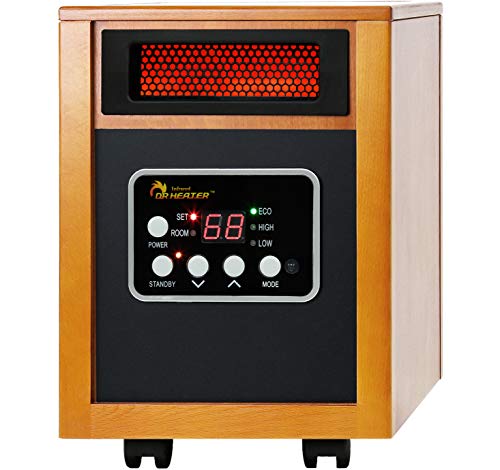
For a bedroom, look for a model under 50 dB with a thermostat and timer—something you can set to 68°F and forget. The Dr Infrared Heater DR-968 fits that case: quiet infrared heat, remote control, 12-hour timer. For a basement or garage where noise doesn’t matter, a 1,500 W ceramic tower with oscillation covers more ground faster. The DREO model has both oscillation and app control, useful if you’re preheating the space before you walk in.
If you’re running the heater from a solar generator rather than grid power, runtime depends on the battery’s watt-hour capacity. A portable battery powered heater drawing 500 W will run twice as long as one pulling 1,500 W from the same battery—something to weigh when you’re sizing the system for off-grid or backup use.
How Much Power And Money It Takes
Most plug-in space heaters pull 1,500 W, the maximum safe load for a standard 120 V household circuit. That’s 12.5 A at full tilt, which means you can’t run two heaters on the same 15 A breaker without tripping it—run one per circuit. If you’re wondering about battery-powered or solar-generator operation, the numbers get harder fast: a 1,500 W heater running for one hour consumes 1.5 kWh, so a 1 kWh portable battery will keep it going for only about 40 minutes once you account for inverter losses.
12.5 A
What a 1,500 W heater draws on 120 V
That’s close to the 15 A breaker limit, so extension cords and power strips add resistance that can overheat the connection.
Running costs depend on your electric rate and hours of use. Say you run a 1,500 W heater for 8 hours a night: 1,500 W ÷ 1,000 × 8 hours = 12 kWh per night. At 17 cents per kWh, that’s 12 × $0.17 = $2.04 each night, or about $61 a month if you run it every evening. Drop the runtime to 4 hours and the monthly bill halves to around $30.
Heater
Watts
Per hour
Per day (8 h)
Per month (30 days)
1,500 W space heater
1,500 W
26¢
$2.04
$61.20
Calculated at 17¢ per kWh. Monthly cost assumes the heater runs every night at full power; a thermostat cycling on and off cuts actual consumption by 30 to 50 percent.
Solar generators and battery banks face the same 12 kWh demand for an 8-hour night, which is far beyond what a small portable unit can store. A typical 500 Wh camping battery delivers half an hour at 1,500 W; even a large 2 kWh station gives you barely 90 minutes before it’s drained. If you’re sizing a solar-powered heating unit for off-grid use, plan on serious storage—multiple kilowatt-hours—and enough panel capacity to recharge it the next day.
Safety Rules That Actually Matter
Plug your space heater straight into a wall outlet, never into an extension cord or power strip. Extension cords and strips aren’t rated for the sustained 12.5 A draw of a 1,500 W heater, and the extra resistance heats the connection enough to melt insulation or start a fire. If the outlet feels warm after an hour of use, stop and call an electrician—it’s a sign of a loose connection or undersized wiring.
Clearance and placement
Keep 3 feet of clearance on all sides and set the heater on a flat, hard surface away from bedding, curtains, paper, and anything flammable. Never put it on a bed, couch, or carpet that can block the intake grill.
Before you buy, confirm the heater carries a UL, ETL, or CSA listing—that’s third-party proof it meets North American safety standards. Look for tip-over shutoff and overheat protection; both features cut power automatically if the unit falls or the internal temperature climbs too high. Don’t run a heater while you’re asleep or out of the house unless the manufacturer’s manual explicitly says the model is designed for unattended operation, and even then keep a working smoke alarm in the room.
Before first use
Outlet is on a dedicated 15 A circuit with no other high-draw appliances
Power cord has no frays, kinks, or damage
Heater sits on a flat surface with 3 feet of clearance in every direction
Smoke alarm in the room is working and less than 10 years old
Tip-over and overheat switches click when tested per the manual
Space heaters cause thousands of house fires every year, almost always from clearance mistakes or damaged cords. Check the cord and plug every few weeks during heavy use, and replace the heater if you see scorching, melted plastic, or a plug that doesn’t fit snugly.
What Solar Can Realistically Power
Solar-powered space heaters for indoor use hit a wall after sunset: panels make electricity only while the sun shines, so you’ll need a battery bank and inverter to run a 1,500 W heater at night. A standard plug-in heater pulls 1,500 W continuously, which means 12 kWh over an eight-hour night. To deliver that, you’d need a battery system rated for at least 1,000 Ah at 12 V—closer to 1,500 Ah if you want any reserve—plus an inverter that handles the 1,500 W load and the startup surge. Most portable solar generators top out at 500 to 1,000 Wh of storage, enough to run a 1,500 W heater for twenty minutes to an hour before the battery dies.
Running a 1,500 W heater overnight
Say you want eight hours of heat in a cabin with no grid power. Your heater draws 1,500 W, so eight hours costs 12,000 Wh, or 12 kWh. A 12 V battery bank needs 1,000 Ah of usable capacity to deliver that (accounting for the inverter’s efficiency loss). Add panels to recharge during the day—figure 1,200 W of panel capacity in good sun to replace what you used overnight and keep pace with losses.
Heater draw1,500 W
Runtime8 hours
Battery needed1,000 Ah at 12 V
Panel capacity1,200 W minimum
Small 30 W solar heaters for greenhouses, coops and pet houses work because they run only while the sun’s out, the enclosure is small, and you’re taking the chill off rather than heating to 70°F. These units draw power straight from the panel with no battery, so they stop at dusk. Indoor home heating from solar is a storage problem, not a panel problem.
Off-grid and camping
Portable solar generators work for short bursts—an hour of warmth while you cook—but won’t carry a 1,500 W heater through a cold night. Look for a lower-wattage 12 V DC heater designed for RVs, or bring a sleeping bag rated for the overnight low.
For pet houses and coops
Hyuduo 30W Solar Panel Heater Portable Solar Powered Heater with USB…
The Hyuduo 30W panel heater suits small outdoor shelters where daytime sun exposure is steady and nighttime heat isn’t required.
Most plug-in space heaters use 1,500 W on high, drawing 12.5 A from a standard 120 V circuit. Lower settings drop to 750 W or 1,000 W, cutting the draw proportionally. Smaller personal heaters may use 200 to 500 W, but they heat a much smaller area.
Can a solar generator run a space heater overnight?
A solar generator can run a 1,500 W space heater overnight only if it has enough battery capacity and inverter rating. Eight hours at 1,500 W drains 12 kWh, which requires a very large battery bank—far beyond what most portable solar generators offer. Budget units with 500 to 1,000 Wh will run out in less than an hour on high.
Are solar-powered space heaters good for indoor use?
True stand-alone solar space heaters struggle indoors because they need direct sunlight and lose all output after dark unless paired with a sizable battery. A standard plug-in heater drawing from a home solar array or grid power is far more practical. The heater itself is identical; the difference is in how you generate the electricity.
What kind of solar system can run a house space heater?
Running a 1,500 W space heater for eight hours takes 12 kWh, so you’d need at least four 400 W panels in full sun to generate that in a day, plus a battery bank and inverter if you want heat after sunset. A grid-tied system with net metering is simpler: your panels offset the heater’s draw without needing batteries.
Why are space heaters dangerous?
Space heaters cause fires when plugged into extension cords or power strips, placed too close to bedding or curtains, or left running unattended. Always plug straight into a wall outlet, keep three feet of clearance on all sides, and look for tip-over and overheat shutoffs. Never run one while asleep unless the manual explicitly says the model is designed for unattended use.
Before you go · a welcome giftGet the Winter Heating Bill Cutter for $4.99See what every heater in your home really costs, heat the rooms you use, and cut the waste in 30 days. Normally $14.99; your welcome price saves $10.00. We'll email your link right now.or buy it now for $9.99 without the gift →One email with your link now. We never share your address.




 Winter Heating Bill CutterSee what every heater in your home really costs, heat the rooms you use, and cut the waste in 30 days.Cost-per-hour tables for every heaterThermostat schedule and draft-proofing planRunning-cost and bill calculator (Excel)