Choose this heater for controllable spot heating in one occupied bedroom or office. Its thermostat, remote, timer, and fan-assisted ceramic output are useful there, but choose a different design for fixed installation, whole-home heating, or truly silent operation.
Buy it if
Buy it for one occupied room where portable, adjustable heat and remote control matter.
Skip it if
Skip it if you need whole-home heat, fixed installation, or heat without fan noise.
Best for one room
DREO Portable PTC Ceramic Heater
Best for Occupied bedrooms, offices and other single-room spaces
The compact design combines 1,500 W PTC heat with a heat funnel and fan to move warm air farther through one room. Its thermostat adjusts from 41–95°F in 1°F increments, while the remote, timer and handle make everyday use easier. Choose it for portable, fan-assisted heat; skip it if you need silent or unattended heating.
Maximum power 1,500 WNoise level 34 dBThermostat range 41–95°F in 1°F incrementsHeating modes 5 modesTimer 12 hoursSafety materials V0 flame-retardant materials
Why it made the cut
34 dB brushless DC motor and winglet fan
Thermostat adjusts in 1°F increments
Tilt detection and overheat protection
Remote, handle and 12-hour timer
Good to know
Fan-assisted heat still makes some noise
The 1,500 W maximum suits room heating, not whole-home heat
Requires careful placement and direct wall-outlet use
Skip it if Skip it if you need silent operation, whole-home heating or unattended use.
A heater’s shape can make it easier to place and control, but it can’t change the heat you get from its electrical input. For this model, the useful design details are its heat funnel, quiet brushless fan, adjustable thermostat and portable handle.
The belief that a bigger heat reach means lower energy use is only half true: airflow can spread warmth farther across a room, but it doesn’t make a 1,500 W heater use less electricity at full power.
The essentials
The DREO is a 1,500 W PTC ceramic heater with a fan, thermostat, remote and 12-hour timer.
Its thermostat range is 41–95°F in 1°F increments; the listing specifies 34 dB operation.
At 17 cents per kWh, running at 1,500 W for eight hours costs about $2.04 before any thermostat cycling.
Plug it directly into a wall outlet, keep three feet clear, and don’t leave it running unattended unless the manual permits it.
A wall heater saves floor space; an infrared-and-PTC alternative combines radiant heat with fan-circulated air.
What the Spec Sheet Says
Maximum power
1,500 W
Noise level
34 dB
Thermostat range
41–95°F in 1°F increments
Heating modes
5 modes
Timer
12 hours
Safety materials
V0 flame-retardant materials
Heater Designs That Suit One Room
Among heater designs, the DREO suits portable, fan-assisted spot heat in one occupied room; it isn’t a replacement for central heating. Its modern heater design pairs a PTC ceramic element, which heats as electricity passes through it, with a fan that moves warm air into the room. That makes it useful when you want heat directed into the space you’re using.
DREO calls the outlet a heat funnel and claims it helps the warmth reach farther. Treat that as an airflow claim, not proof of lower energy use or a guarantee about room size. The brushless DC motor and winglet fan are listed at 34 dB, but where you place the heater and how sensitive you are to fan noise still matter.
1,500 W
About 12.5 A at 120 V
A standard 15 A circuit has limited capacity left once this heater is running. Avoid sharing the circuit with other high-draw appliances.
For a room heater design, the practical extras are a carry handle, remote, five modes, a 12-hour timer and a thermostat adjustable from 41–95°F in 1°F steps. Those controls make it easier to set and adjust the heat without walking over to the unit; they don’t change the heater’s maximum electrical draw.
Myth
A heat funnel or ergonomic casing means the heater uses less electricity.
Fact
The shape can affect airflow and ease of use, but the heater still draws up to 1,500 W. Farther reach doesn’t mean lower energy use.
Where the Heat Design Has Limits
Space heater designs can change how heat reaches you, but DREO’s product data doesn’t establish a specific square-foot coverage. Insulation, ceiling height, drafts and outdoor temperature all affect whether one heater can keep a room comfortable.
A fan-assisted ceramic heater distributes heated air; an infrared heater warms people and surfaces more directly. Neither makes more heat than its electrical input supplies. The choice is about how the warmth feels and spreads, not a shortcut around the heater’s wattage.
Design
What it offers
What to keep in mind
Portable ceramic
Fan moves heated air through the room
Needs floor space and a suitable outlet
Wall-mounted
Keeps the heater off the floor
Installation and placement must follow the model instructions and local requirements
Infrared
Warms people and surfaces more directly
The warmth is more localized than circulating warm air
Different shapes change placement and heat delivery, not the amount of heat a given electrical input can produce.
A modern wall heater design is a fixed-installation choice, not a style upgrade that automatically heats better. If you’re weighing a built-in look against portable use, modern design for heaters covers the trade-off.
Myth
A modern or ergonomic heater casing guarantees energy savings.
Fact
A casing may improve controls, placement or airflow. It doesn’t guarantee lower electricity use; the heater’s draw and how long it runs determine that.
What It Costs to Run
The heater running cost at full power is about $2.04 per day for eight hours, assuming electricity costs $0.17 per kWh. A 1,500 W electric heater uses 1.5 kW: 1.5 kW × 8 hours = 12 kWh per day; 12 kWh × $0.17 = $2.04. That’s the continuous full-draw estimate, not a promise about your bill.
Heater
Watts
Per hour
Per day (8 h)
Per month (30 days)
DREO heater at 1,500 W
1,500 W
26¢
$2.04
$61.20
Calculated at 17¢ per kWh. Estimate assumes continuous full-power operation and an electricity rate of $0.17 per kWh.
The thermostat may cycle the heater off after the room reaches its setpoint, lowering electric heater energy use compared with running continuously. How much depends on heat loss, room conditions and how often the heater needs to run. ECO mode and lower heat settings can also reduce consumption if they lower average wattage or run time; they don’t make the heat free.
Check Your Rate
Use the per-kWh rate on your utility bill for a closer estimate. The thermostat’s 1°F increments are setting steps, not a guarantee that the room will hold that exact temperature; drafts and sensor location affect the reading.
Safety Depends on Placement and Use
Space heater safety starts with placement: keep this portable heater at least 3 feet from combustibles and plug it directly into a wall outlet. The DREO’s listed tilt-detection sensor, overheat protection and V-0 flame-retardant materials are safeguards, not permission to ignore clearance or supervision.
Switch It Off and Reposition It
Blocked airflow, an unstable surface, or curtains or bedding nearby are reasons to switch the heater off, let it cool, and correct its position before using it again.
Before You Switch It On
Plug directly into a wall outlet; never use an extension cord or power strip.
Leave at least 3 feet between the heater and curtains, bedding, furniture or other combustibles.
Set it on a stable, level surface with its air intake and outlet unobstructed.
Check the product label for its listing and the manual for exact operating instructions; don’t assume a certification that isn’t shown.
Don’t run it while sleeping or away from home unless the manufacturer says this model is designed for that use.
Choose the Right Heater Shape
For a heater design comparison, choose between the two DREO ceramic models by their listed controls and features; choose the Dr Infrared DR-968 if you prefer a larger cabinet and a mix of infrared quartz and PTC heat. Ceramic versus infrared describes how heat is produced and delivered, not proof that one uses less electricity at the same wattage.
Model
Listed design details
A sensible fit
DREO Space Heater, Portable Electric Heaters for Indoor Use…
1,500 W ceramic; thermostat and remote; 41–95°F setting range; listed 34 dB noise
You want a stated temperature range and noise figure.
DREO Space Heaters for Indoor Use with Thermostat, 1500W El…
1,500 W ceramic; thermostat and remote; 70° oscillation; ETL certification
You want oscillation and a listed ETL certification.
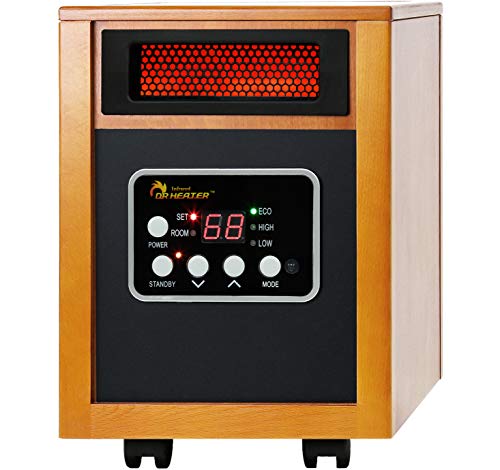
Dr Infrared Heater DR-968 Portable Space Heater
Infrared quartz and PTC heating; wood-look cabinet; listed 39 dB noise
You prefer a larger-looking cabinet and a dual heat approach.
Descriptions of coverage aren’t guaranteed room-size ratings. No listed detail here proves that one design heats more efficiently at equal wattage.
The DR-968’s infrared quartz and PTC combination gives you a different style of heat delivery, while the DREO models are ceramic fan heaters. Pick by the features and feel you want; don’t treat the DR-968’s larger appearance or dual approach as evidence of higher efficiency.
Before You Buy
Room and heat-loss expectations: account for drafts, insulation and how much of the room you need to warm.
Outlet and circuit: confirm the outlet and circuit can handle a heater drawing up to 1,500 W; plug directly into the wall.
Clearance: check the manual’s required spacing from furniture, curtains and other combustibles.
Thermostat needs: compare the temperature range and controls you’ll actually use.
Noise tolerance: consider the listed 34 dB or 39 dB figures, and remember fan noise may matter in a quiet room.
Safety details: verify the specific model’s safety listing and read its manual for placement and operating limits.
DREO Heater Picks Compared
If you need coverage
DREO Oscillating Large-Room Heater
Best for Larger rooms where wider moving airflow matters
The 70° oscillation spreads heat across more of the room, and the trackball system is designed for quiet movement over more than 750,000 cycles. Its ECO mode switches between 1,000 W and 1,500 W as it maintains the set temperature.
Why it made the cut
70° oscillation with 20% wider heating coverage
ETL-certified safety features
ECO mode uses 1,000 W or 1,500 W
Good to know
Oscillation adds moving parts and floor-space needs
Skip it if Skip it if you want the simplest fixed-direction heater.
Best for Living rooms and offices needing quieter layered heat
Quartz infrared heat warms nearby surfaces while the PTC system heats and circulates the air, giving this model a different feel from a single-PTC heater. The wood-look cabinet, 39 dB blower and 50–85°F thermostat make it a better fit for a visible living space.
Why it made the cut
Quartz infrared and PTC dual heating
UL certified with metal housing and cool-touch cabinet
Good to know
Heavier furniture-style design is less portable
Skip it if Skip it if you want the smallest, easiest-to-carry heater.
What is the difference between a standard electric convection heater and a forced-air heater?
A standard convection heater warms air that rises and circulates naturally, while a forced-air heater uses a fan to move warmed air toward you. This ceramic model is forced-air, so it distributes heat faster but produces some fan noise.
What should you look for in a modern wall heater design?
Look for a listed installation method, a built-in thermostat, overheat protection, and controls you can reach without moving furniture. Check the required voltage and clearance before buying; a wall-mounted heater may need electrical work that a portable plug-in model doesn’t.
What are the different designs of solar power heater systems?
Solar air heaters use sunlight to warm air directly, while solar electric systems use panels to power an electric heater or heat pump. Passive solar design relies on window placement, insulation, and thermal mass instead of a separate heater.
How does an infrared heater compare with a ceramic heater?
Infrared heat warms people and surfaces directly, so you feel it quickly within its line of sight. A ceramic heater warms air with a fan and spreads that warmth around the room; some models combine both methods.
What makes a room heater design suitable for a small house?
A suitable design has controllable output, a thermostat, and safety features matched to each occupied room. Portable heaters can handle spot heating, but relying on several plug-in heaters for a small house may overload circuits and won’t replace a properly sized central system.
How do heater designs affect where the warmth is felt?
Radiant heaters feel warmest where their heating element can see you, while fan heaters send warmth along the airflow path. Oscillation spreads forced air across a wider area, but furniture, open doors, and drafts still change where the heat ends up.
Can a clay pot candle heater safely heat a room?
No. A candle-and-clay-pot setup produces too little useful heat for a room and adds an open-flame, hot-surface, and combustion hazard. Keep candles away from heater experiments; they aren’t a substitute for a listed heater.