Skip to content

Expert home heating guides, reviews & repairs

Heater GuidesHeaterGuides
Daily Fluctuations

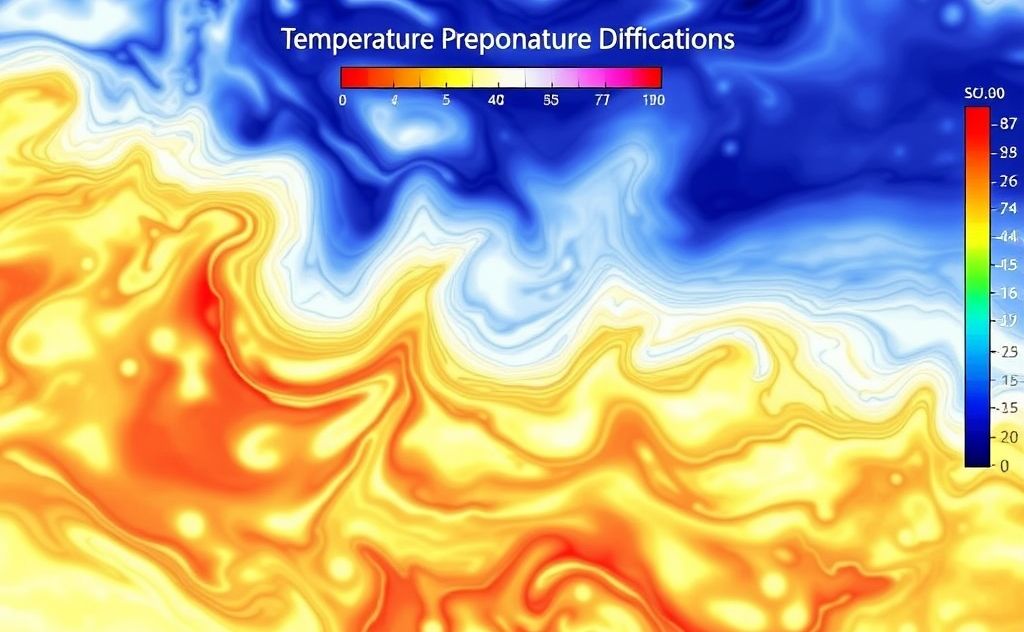
Advanced AI Models Accurately Predict Daily Temperature Changes

You planned a weekend hike based on Tuesday’s forecast, and Saturday arrived ten degrees colder and soaked. Or you scheduled an outdoor event, and the afternoon heat wave fried your guests. Most people shrug it off. But if your job, budget, or safety depends on the weather, a miss by a few degrees matters. The good news is that the technology behind these forecasts just changed fundamentally.

Traditional weather prediction relies on solving complex physics equations on supercomputers. It works, but it is slow and often struggles with local details. Now, advanced AI models are doing something different. They learn from decades of historical weather data to spot patterns humans might miss. This article explains how these models work, where they beat old methods, and where they still fail. You will walk away knowing what is real, what is hype, and how to use this shift to make better decisions.

Newentor

Newentor Weather Station Wireless Indoor Outdoor Thermometer,…

  • [Color LCD Screen Weather Station] Newentor temperature & humidity monitor with a large color LCD display shows essential home wea…
  • [Two Power Modes & Adjustable Backlight] To enjoy a 24/7 continuous always-on vibrant display, simply connect this home weather st…
  • [3-channel Home Weather Stations Wireless Indoor Outdoor] Wireless temperature forecast station supports up to 3 remote sensors to…

For home use, a personal weather station can give you a baseline of local conditions that complements any national forecast. The Newentor wireless indoor outdoor thermometer tracks temperature and humidity in multiple rooms or spots, giving you a live picture of your immediate environment while the AI models handle the big picture.

advanced ai models accurately predict daily temperature changes

Why Daily Temperature Prediction is the New Frontier for AI

Forecasting rain or storms gets the headlines. But daily temperature is the metric that actually drives energy bills, crop health, and public safety. A one-degree error might not ruin your picnic, but it can cost a utility company millions in misallocated power. For farmers, a frost prediction that is off by two degrees can kill an entire orchard.

AI models excel here because temperature is a continuous, highly correlated variable. It follows daily cycles and seasonal trends. Machine learning algorithms can ingest massive datasets of past temperatures, pressure systems, and wind patterns to learn those cycles. They do not have to guess. They have seen similar conditions before and know what usually happens next.

The shift is not just academic. The European Centre for Medium-Range Weather Forecasts (ECMWF) now runs an AI-based model that produces forecasts in under one minute. That is a fraction of the time a traditional physics-based model takes. Speed matters because it allows for more frequent updates and faster reactions to sudden changes.

How AI Models Outperform Traditional Forecasting (With Real Numbers)

The numbers are hard to ignore. Google’s GraphCast model has shown a 90% skill score in predicting weather up to ten days ahead when compared to the industry-standard high-resolution forecast (HRES) from ECMWF. For temperature specifically, the margin is smaller but still significant. Some studies show AI models reduce daily temperature error by 10-20% compared to traditional numerical weather prediction (NWP) over a 3-5 day horizon.

Let’s put that in context. A typical 5-day high-temperature forecast from a good NWP model has an average absolute error of about 2.5°C (4.5°F). An AI model trained on the same data can push that down to roughly 2.0°C (3.6°F). That might not sound like much, but for a utility company planning load, a 0.5°C difference across a city of a million people translates to megawatts of power. It is the difference between running a peaker plant or not.

Another advantage is data assimilation. Traditional models require a complex process to merge new observations into the physics equations. AI models can be retrained or fine-tuned more quickly. NOAA, for instance, deployed a new AI-driven global weather model that cuts forecast generation time from hours to minutes, allowing forecasters to update guidance more often during severe weather events like heatwaves or cold snaps.

Inside the Machine: From Raw Data to Daily Temperature Output

People treat AI forecasting like a black box. It is not magic. It is a pipeline of data and math that you can understand. Here is how it works in practice.

Data Sources and Preprocessing

The process starts with raw data. This includes surface observations from thousands of weather stations, satellite radiance measurements, radar returns, and balloon-borne radiosondes. All of this is fed into a data assimilation system that creates a consistent 3D grid of the atmosphere. Think of it as taking a blurry, incomplete picture and sharpening it using physics constraints. For daily temperature, the model needs accurate initial conditions for the lower troposphere, not just the surface.

Missing data is a constant problem. A station might go offline, or a satellite pass might be delayed. Models handle this by using statistical interpolation, filling gaps with nearby observations or historical climatology. This is where the challenges in predicting daily temperature changes start to appear. Sparse data over oceans or mountains creates more uncertainty.

The Neural Network Architecture Behind the Prediction

Most modern models use a type of architecture called a graph neural network (GNN). The atmosphere is represented as a mesh of connected nodes. Each node has properties like temperature, pressure, and humidity. The network learns how these nodes influence each other over time. It processes the input grid, runs through multiple layers of computation, and outputs a prediction grid for future times.

For temperature, the model does not just output a single number. It outputs a probability distribution. This is crucial. It tells you not just that the high will be 20°C, but that there is a 70% chance it will be between 19°C and 21°C. This uncertainty information is more valuable to a decision-maker than a single point forecast. You can plan for the range, not just the average.

The Critical Limitations of AI Weather Models (And How Experts Fix Them)

AI models are not perfect. They have a few well-documented weaknesses that you should know about before you bet your budget on them.

Black-box bias: The model learns from historical data. If the past 30 years had a particular climate pattern, the model assumes the future will look similar. During record-breaking heatwaves or unusual cold snaps, AI models can underestimate the extremes. They have never seen anything like it in their training data. Human forecasters often step in and nudge the output up or down based on their understanding of the current atmospheric dynamics.

Training data gaps: The models are only as good as the data they train on. Regions with sparse historical records, like parts of Africa or the Arctic, have higher error rates. The model has less to learn from. This is a known issue. Researchers are working on transfer learning, where a model trained on data-rich regions is adapted for data-poor ones.

Handling rare events: A sudden stratospheric warming or a volcanic eruption can throw off the model completely. These events are rare and not well represented in the training set. Mitigation involves a hybrid approach. The AI model runs first, and then a traditional physics model runs a quick check. If the two disagree significantly, forecasters manually review the situation. This is called model verification, and it is a standard step in operational forecasting.

Who Benefits Most? A Cost-Benefit Breakdown for Farmers, Cities, and Energy Grids

So who should actually pay attention to these new models? The short answer is anyone whose operations are weather-sensitive. But the cost-benefit math differs for each group.

  • Farmers: They gain from better frost warnings and growing degree-day calculations. A more accurate 7-day temperature forecast lets them time irrigation and pesticide application. The cost is low—most weather apps now use AI models behind the scenes. The benefit is directly tied to crop yield and input costs.
  • City planners and public works: They use temperature forecasts to decide when to pre-treat roads for ice or open cooling centers during heatwaves. A false alarm costs money in wasted salt and overtime. A missed event costs lives. The improved accuracy of AI models reduces both false alarms and misses, though it does not eliminate them.
  • Energy grid operators: This is where the biggest financial impact lies. A 1°C error in a daily high-temperature forecast can change regional electricity demand by 1-2%. For a large grid, that is millions of dollars in a single day. AI models’ better temperature predictions directly translate to better load forecasting and lower wholesale electricity prices.

For small businesses, the calculation is simpler. A landscaping company that can predict the next day’s high within 1°C can schedule crews more efficiently. A restaurant with a patio can decide whether to staff extra servers. The cost is essentially zero if they use a modern weather API. The benefit is fewer wasted labor hours and better customer experience.

Open-Source vs. Proprietary: Which AI Model Should You Trust?

You have two main options: open-source models you can run yourself, or proprietary models you access via an API. Each has trade-offs.

Feature Open-Source (e.g., GraphCast, Pangu-Weather) Proprietary (e.g., IBM GRAF, Tomorrow.io)
Cost Free to download; requires your own GPU hardware Subscription or per-API-call pricing
Customization Full control; you can fine-tune on local data Limited to the provider’s settings
Technical skill needed High; requires Python, ML frameworks, and data engineering Low; simple REST API calls
Data privacy Your data stays on your servers Data is sent to the vendor
Support Community forums and GitHub issues Dedicated support team and SLAs
Update frequency Depends on the community or your own effort Continuously updated by the vendor

For a local government or a small utility, running your own open-source model is rarely worth the effort. You would need a data scientist on staff and a GPU cluster. The proprietary route is usually cheaper when you factor in labor. For a research institution or a large tech company, open-source offers the flexibility to build custom climate models that integrate with your own data streams.

One word of caution: do not trust the model just because it is new. Verify its performance against your own local observations for a month. Track its errors. A model that is great for the US Midwest might be terrible for a coastal mountain valley. Local validation is the only way to know.

The Future: Hybrid Systems Where AI and Human Meteorologists Collaborate

The best forecast centers are not replacing meteorologists with AI. They are building hybrid workflows. The AI model generates the raw forecast quickly. A human meteorologist then reviews it, checks it against the latest radar and satellite imagery, and issues a final public forecast.

Why keep the human in the loop? Because AI cannot understand context. It does not know that a local festival is happening and that a 30% chance of rain is a bigger deal than usual. It cannot explain why the forecast changed. Humans add judgment, local knowledge, and communication. The AI adds speed and consistency.

This collaboration also helps with adaptation strategies. As global warming shifts baseline temperatures, historical training data becomes less representative. Human forecasters can adjust the AI’s output based on current climate trends that the model has not fully internalized. This is an active area of research, but the early results show that hybrid systems have the lowest error rates of all.

What You Can Do With This Information Today

  • Stop treating a single forecast as the truth. Look for the probability range, not just the high and low.
  • If you run a weather-sensitive business, test an AI-driven forecast API against your own site data for two weeks. Measure the error yourself.
  • For home use, pair a national AI forecast with a local sensor like the Newentor station to catch microclimate differences in your yard.
  • Do not ignore the old physics models. The best results come from comparing AI output with traditional NWP and looking for disagreements.
  • Be skeptical of any model that claims 100% accuracy on daily temperature. A 1-2°C error on day 5 is still normal, even for the best systems.
  • If you are a developer, start with an open-source model like GraphCast to learn the mechanics, then move to a managed API for production.
  • Keep an eye on NOAA and ECMWF releases. They are integrating AI into operational systems now, which means the public forecast you see in your phone app will keep getting better.
Share
Written by Joye

I am a mechanical engineer and love doing research on different home and outdoor heating options. When I am not working, I love spending time with my family and friends. I also enjoy blogging about my findings and helping others to find the best heating options for their needs.

Keep reading

Related guides

Free newsletter

Heater deals and guides, worth opening

Price drops, new guides and safety recalls. One email, only when it matters.

No spam. Unsubscribe in one click. Privacy policy.