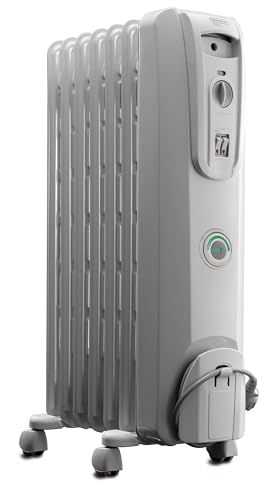
Oil-filled radiator heaters deliver steady, silent warmth by heating oil inside sealed fins, which then radiate heat evenly over time. They use electric resistance elements, so their heat output matches wattage exactly, typically between 600W and 1500W in US models.
Many believe oil-filled radiators heat faster or cheaper than other electric heaters. The truth is they provide slower but more even heat and retain warmth after power off, making them ideal for quiet, comfortable heating rather than instant blast heat.
Oil-Filled Radiator Heater Comparison
| Model | Best for | Wattage | Safety Features | Heat Settings | Portability | Price |
|---|---|---|---|---|---|---|
| Pelonis Oil Filled Radiator Heater 2025 Upgraded | Best Overall | 600/900/1500 W | Tip-over and overheat protection, ETL certified | 3 modes | Caster wheels, knob controls | Check today’s price |
| Pelonis Champagne Oil Filled Radiator Heater | Best with Remote | 600/900/1500 W | Tip-over and overheat protection | 3 modes, 5 temperature levels | Caster wheels, carrying handle | Check today’s price |
| Pelonis Oil Filled Radiator Heater 2025 Upgraded White | Best in White | 600/900/1500 W | Tip-over and overheat protection, ETL certified | 3 modes | Caster wheels, knob controls | Check today’s price |
| Pelonis Radiator Heater Dual Knobs 1500W | Best Budget Pick | 600/900/1500 W | Tip-over and overheat protection | 3 modes | Caster wheels, carrying handle | Check today’s price |
| Amazon Basics Portable Oil Radiator Heater | Best Compact | 600/1000/1500 W | Tip-over and overheat protection, ETL certified | 3 modes | Caster wheels, carrying handle | Check today’s price |
Best Oil-Filled Radiator Heaters Ranked for Quiet, Efficient Heat
Pelonis Oil Filled Radiator Heater 2025 Upgraded
Pelonis Champagne Oil Filled Radiator Heater
Pelonis Oil Filled Radiator Heater 2025 Upgraded White
Pelonis Radiator Heater Dual Knobs 1500W
Amazon Basics Portable Oil Radiator Heater
How to Use Oil Filled Radiator Heaters Safely and Efficiently
Oil-filled radiator heaters warm your space by heating oil sealed inside the fins. This oil stays hot for a while, so the heater continues radiating heat even after the power switches off.
Start by plugging your heater into a dedicated 15 amp, 120 volt circuit. Avoid extension cords; the heater draws about 12.5 amps at 1,500 watts, which risks overheating cords or tripping breakers.
Set the thermostat to maintain a comfortable, steady temperature rather than maxing it out. Running the heater constantly at full power uses more electricity without more heat once the room reaches the set temperature.
Keep at least 3 feet of clearance around the heater, especially from curtains, papers, and furniture. Never cover or block the fins that radiate heat; doing so risks overheating and fire.
Most modern oil-filled radiators include tip-over and overheat protections. They automatically shut off if tipped or if internal temperatures exceed safe limits. Confirm these features before buying or using the unit.
Never leave the heater running unattended unless the manufacturer explicitly states it is safe for that use. Even with safety features, unattended operation increases fire risk, especially in homes with children or pets.
Measure Your Room and Match Wattage for Effective Heating
An oil radiator heater works by heating oil inside sealed fins, which radiate warmth steadily. Most US models top out at about 1,500 watts, enough to heat rooms up to roughly 150 square feet if well insulated.
Match your room size to the heater wattage for effective warmth. For example, a 1,500 W oil-filled radiator can comfortably heat about 150 square feet in an average room with normal insulation.
For larger or drafty rooms, one 1,500 watt heater isn’t enough. You’ll need multiple units or a supplemental heat source. Adding heaters raises electricity use proportionally, so weigh running costs carefully.
Higher wattage oil-filled radiators above 1,500 watts are rare in the US market. Expect to find mostly 600 to 1,500 watt models. If you see claims for 2,000+ watt models, check specs carefully for real output.
Where you place the heater also matters. Position it near cold walls or windows, or centrally in the room, to spread heat evenly and avoid cold spots.
The Pelonis Oil Filled Radiator Heater (2025 Upgraded) is a top brand for portable electric oil radiators. It offers adjustable thermostat control and safety features that suit most rooms up to 150 square feet comfortably.
Measure your room first and calculate wattage need before buying. For example, a 12 by 14-foot room is 168 square feet, needing around 1,680 watts, so a single 1,500 watt unit might fall short in cold weather.
If your room is larger, poorly insulated, or drafty, consider multiple heaters or a different heating solution altogether rather than overspending on a single oversized oil radiator.
For more on picking the right heater for your space, see the buying guide on top oil-filled radiator heaters in 2026.
Compare Running Costs and Heat Output Versus Other Electric Heaters
Oil-filled radiators use electricity like any resistance heater, so their heat output per watt is about the same as other electric space heaters. They do not produce more heat per watt; their advantage lies in steady, quieter heat and heat retention after switching off.
Running costs depend entirely on wattage, hours of use, and your electricity rate, not the heating method. For example, a 1,500-watt oil-filled heater running eight hours daily at 17 cents per kilowatt-hour costs about $2.04 per night (1500 W ÷ 1000 × 8 h × $0.17). If you’re considering alternatives, check out the best propane boilers residential.
Unlike fan heaters, oil-filled radiators take longer to warm up because they heat the oil inside before radiating heat through metal fins. However, that oil retains warmth after the heater switches off, smoothing temperature swings and reducing cycling. This means less frequent on-off cycles for your thermostat.
Fan heaters deliver heat immediately by blowing warm air, but the noise and dry air they produce can be drawbacks. Their heat disappears once turned off, requiring constant operation for steady warmth.
Infrared quartz heaters work differently by warming objects and people directly rather than heating air. They provide instant, focused warmth but may leave corners or entire rooms cooler since they don’t circulate heated air effectively.
Oil-filled radiators shine as quiet, steady background heaters, ideal when you want gentle, even heat without the noise or dryness of fans, or the spotty coverage of infrared. They aren’t economical or cheap in terms of energy use compared to other electric heaters because all resistive heaters use the same power effectively, but they can feel more comfortable due to their heat retention and gentler airflow.
What Safety Features to Look For in Oil-Filled Radiator Heaters
Oil-filled radiator heaters are safe when they include essential safety features and are used as directed indoors with a working thermostat.
A tip-over switch cuts power immediately if the heater falls, preventing fire risks. This is critical because these heaters can be heavy and top-heavy on casters.
Overheat protection monitors the internal temperature and shuts the heater off if it gets too hot, guarding against electrical faults or blocked airflow.
Look for ETL or UL certification on the label. These indicate compliance with US safety standards, ensuring the heater has been tested for electrical and fire safety.
Child lock or control lock features prevent accidental changes to settings, useful in homes with children or pets who might touch the controls.
Check the cord and plug ratings. Avoid models with thin or low-quality cords that risk overheating or damage from repeated movement. The cord should be heavy enough to handle the heater’s current draw, typically around 12.5 amps for a 1,500 W heater.
Most oil-filled radiator heaters come with built-in thermostats to keep room temperature steady by cycling power on and off. This reduces energy waste and prevents overheating, making them safer and more efficient than non-thermostat models.
Sizing Oil-Filled Radiators for Large or Drafty Rooms
You need as many oil-filled radiators as the total wattage required to heat your space, but more units don’t always mean better heating or lower costs.
Each 1,500-watt oil radiator adds about 5,100 BTU per hour of heat (since 1 watt equals roughly 3.41 BTU). So, two units deliver 3,000 watts or 10,200 BTU. Heat output sums linearly by wattage, just like any electric resistance heater. Oil-filled radiators aren’t more efficient per watt than other electric heaters; their advantage lies in steady, radiant warmth.
Large or drafty rooms lose heat quickly through windows, walls, and gaps. Adding several oil heaters might fill the heat demand, but it increases electricity use proportionally. For example, running two 1,500-watt units for 8 hours at 17 cents per kWh costs about $4.08 nightly (1,500 W × 2 ÷ 1,000 × 8 × 0.17). That quickly adds up if you rely solely on multiple units.
Improving insulation or sealing drafts is a better first step. If the room is very large or poorly insulated, central heating or a dedicated furnace usually makes more sense than multiple portable oil radiators.
Freezing temperatures do not damage the sealed oil inside the heater, but store your units indoors when not in use to avoid mechanical or electrical damage. Oil-filled radiators are designed as supplemental heat sources or zone heaters, not whole-house solutions.
Using multiple units can work but be mindful of their combined power draw on your electrical circuit and the ongoing cost. Often, upgrading insulation or the main heating system yields more comfort and efficiency.
Smart Features, Portability, and Maintenance You Should Know
Many oil-filled radiator heaters come with thermostats, remote controls, programmable timers, and eco modes to help balance comfort and energy use.
A built-in thermostat lets the heater switch on and off automatically to keep your room at the set temperature, cutting waste. Remote control and scheduling let you pre-heat rooms on your own timetable, which some find worth the added complexity.
Portability depends largely on weight and design. Most models weigh around 26 pounds and have caster wheels and handles to move them safely. Heavier units aren’t convenient for frequent relocation but work well if you place them in fixed spots.
Oil-filled radiators require no oil refills; the oil is sealed for the life of the heater. That keeps maintenance straightforward: just clean the fins and exterior regularly to prevent dust buildup, which can reduce heat transfer and pose a fire hazard.
Avoid digital features that don’t match your needs. Some users prefer simple, manual controls since digital interfaces can be less reliable and harder to repair.
Use caster wheels and handles to move the heater carefully. Avoid dragging or tipping the unit, which can damage internal components or the sealed oil.
Oil-filled radiators are as efficient as any electric resistance heater, with a coefficient of performance of 1. Their steady heat output and retained warmth after shutdown make them comfortable and economical for zone heating.
For readers wanting a model with a thermostat and timer, the Pelonis Oil Filled Radiator Heater (2025 Upgraded) includes these features plus remote control and eco mode, making it a practical choice for flexible heating control.
If you want to explore these features in more detail, check out our full buying guide on the best oil filled radiator heater models.
More Questions, Answered
Are oil-filled radiators more economical to run than fan heaters?
Can oil-filled radiators heat large or drafty rooms effectively?
Do oil-filled radiator heaters require oil refilling or maintenance?
What safety certifications should I look for when buying an oil-filled radiator?
Are there oil-filled radiator heaters with smart controls or programmable thermostats?

HeaterGuides covers home heating, water heating and HVAC: how the equipment works, what it costs to run, and how to use it safely.