Midea Quartz Space Heater Review: Uses About 12 Cents Per Hour
On this page 9 sections
- What the Spec Sheet Says
- How Midea Quartz Heaters Deliver Heat
- Noise, Build Quality, and Real-World Use
- Energy Use and Running Costs for Midea Quartz Heater
- Safety Features and Maintenance You Should Know
- How Midea Quartz Heaters Compare to Other Quartz and Infrared Models
- Checklist Before Buying or Using the Midea Quartz Heater
- Heaters Like the Midea Quartz Model
- More Questions, Answered
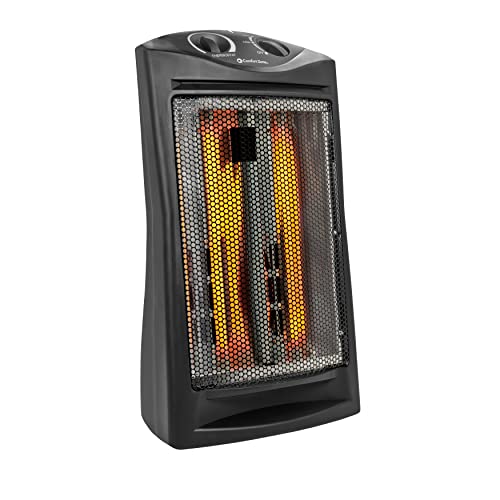
Comfort Zone Quartz Tower Heater
Quartz heaters like the Midea use electric resistance quartz tubes to produce radiant heat that warms people and objects directly rather than heating the air. This makes them feel fast and focused compared to traditional convection heaters.
The Midea Quartz Space Heater offers three power settings up to 1500 watts, an adjustable thermostat, and built-in safety features. Understanding its real-world performance, energy use, and limits helps you decide if it fits your winter heating needs.
What the Spec Sheet Says
| Heat type | Radiant with fan assistance |
|---|---|
| Heat settings | 2 (high and low) |
| Controls | Top-mounted thermostat and temperature knobs |
| Safety | Tip-over switch, stay-cool handle |
| Design | Slim tower, black finish |
How Midea Quartz Heaters Deliver Heat

The Midea Quartz Space Heater uses quartz tubes to produce radiant heat that warms objects and people directly rather than heating the air. Quartz heaters are electric resistance heaters that generate heat by passing current through quartz heating elements, which quickly glow and radiate infrared energy.
This model offers three heat settings—500 watts, 1000 watts, and a maximum of 1500 watts—controlled by an adjustable thermostat. The thermostat lets you set a target temperature, and the heater cycles power to maintain it efficiently.
Because quartz heaters radiate heat instantly, you don’t have to wait for the air to warm up as you would with convection heaters. The warmth feels immediate and focused on whatever the quartz tubes face, making it ideal for personal spaces.
The Midea Quartz is best suited for rooms up to about 150 square feet. Beyond that size, its directional radiant heat won’t distribute evenly unless you move the heater or supplement with other heat sources. Unlike fan heaters, it doesn’t blow warm air around; instead, it delivers heat in a straight line from the quartz tubes.
| Feature | Specification |
|---|---|
| Power settings | 500 W, 1000 W, 1500 W |
| Heating method | Quartz tube radiant heat |
| Thermostat | Adjustable temperature control |
| Coverage area | Up to 150 sq ft |
| Heat delivery | Instant, directional radiant heat |
Noise, Build Quality, and Real-World Use
Quartz heaters like the Midea model run nearly silent because they have no fan. You’ll hear only a faint glow from the quartz tubes, making them well suited for bedrooms, offices, and workshops where quiet is essential.
The Midea heater’s metal housing weighs about 6 pounds, making it sturdy yet portable enough to move around easily. Its solid build helps it withstand regular use with minimal wear reported over months of operation.
Because it lacks oscillation and a fan, the Midea does not circulate air or dust. This reduces noise and prevents stirring allergens, but it also means heat stays focused rather than spreading widely.
Adjusting the heat requires manual control directly on the unit; there is no remote. While some users may miss remote convenience, manual knobs are reliable and straightforward.
If you’re wondering if quartz heaters are any good, the Midea Quartz Space Heater review shows it performs well for targeted, instant warmth in small spaces. It’s less suited for heating large or poorly insulated rooms, so consider your space before deciding.
 Winter Heating Bill CutterSee what every heater in your home really costs, heat the rooms you use, and cut the waste in 30 days.Cost-per-hour tables for every heaterThermostat schedule and draft-proofing planRunning-cost and bill calculator (Excel)
Energy Use and Running Costs for Midea Quartz Heater
The Midea Quartz Space Heater uses about 1,500 watts at its highest setting, which draws approximately 12.5 amps from a standard 120 V outlet. This means it’s on the upper edge of what a typical household circuit can handle continuously.
Energy consumption varies with the heat setting you choose and how long you run the heater. Midea offers three settings: 500 W, 1,000 W, and 1,500 W. Running at full power for 8 hours uses 12 kilowatt-hours (kWh). At a typical US residential rate of 17 cents per kWh, that adds up to about $2.04 for the night.
Quartz heaters like this one are electric resistance heaters, so their efficiency is essentially the same as any other plug-in electric heater: close to 100% of electric energy converts to heat. Their advantage lies in the radiant heat delivery, which warms objects and skin directly rather than heating the air first.
Because radiant heat feels warmer at lower air temperatures, you can avoid over-heating the entire room’s air, potentially saving energy by keeping the thermostat lower. This is especially useful in small, personal spaces where focused warmth is enough.
Unlike some models, the Midea Quartz Space Heater does not have an ECO mode or oscillation feature. While this simplifies operation and reduces mechanical complexity, it also means fewer options to reduce energy use automatically or spread heat more widely.
| Heater | Watts | Per hour | Per day (8 h) | Per month (1 days) |
|---|---|---|---|---|
| Heated blanket | 100 W | 1.7¢ | 14¢ | 14¢ |
Safety Features and Maintenance You Should Know
The Midea Quartz Space Heater uses an overheat sensor and tip-over switch to cut power when temperatures rise too far or the heater falls over. Those features reduce risk; they don’t make a running heater safe to cover, crowd against furniture or leave unattended.
Quartz heating is electric resistance heating with infrared output, not microwave radiation. The quartz tubes get hot and radiate heat toward you and nearby objects, while the thermostat cycles power to hold the set temperature. Quartz heaters aren’t inherently more efficient than other electric heaters at turning electricity into heat; their practical advantage is focused warmth, so you may heat your occupied spot instead of the whole room.
The Midea has no fan or replaceable air filter, so maintenance is mostly cleaning and inspection. Unplug it, let the tubes and grille cool completely, then wipe the housing and accessible tubes with a dry cloth. Never spray cleaner into the heater or open the case.
Keep the heater indoors in a dry location, and don’t use it outdoors or in a damp garage, bathroom or other wet area. Moisture can reach electrical parts and create a shock hazard; a dry cloth is the right cleaning tool, not a wet one.
The outer housing is designed to stay cooler than the quartz tubes, but the grille and nearby surfaces can still be hot enough to burn. Keep children, pets, paper and fabric away, and don’t cover the heater while it’s operating.
The listed warranty is 1 year for defects in materials and workmanship, while misuse, heavy use and normal wear are excluded. If the cord, plug, thermostat or safety switch behaves oddly, stop using the heater rather than bypassing a safety device.
For the broader rules on clearance, smoke alarms and turning a portable heater off before bed, follow portable space heater safety guidance.
How Midea Quartz Heaters Compare to Other Quartz and Infrared Models
The Midea is a good quartz heater for focused warmth in a personal space up to 150 sq ft, but it won’t heat a large, drafty room as evenly as a fan-forced or oil-filled heater. Quartz is the heating element; infrared describes the radiant heat it sends toward nearby people and objects.
What Quartz Heating Means
A quartz heater runs electricity through heating elements inside quartz tubes, which glow hot and send infrared energy outward. That warmth reaches your chair, hands and nearby surfaces directly instead of waiting for the whole room’s air to warm. It isn’t microwave radiation, and the quartz tube doesn’t make electricity more efficient.
For a plain-language explanation of the technology, see quartz space heaters explained. The useful distinction is simple: quartz changes how heat reaches you, not how much electricity the heater needs.
Quartz Versus Ceramic And Oil-Filled Heaters
| Heater type | How it heats | Best use | Main tradeoff |
|---|---|---|---|
| Midea quartz | Radiant infrared heat from quartz tubes | One person or a small area up to 150 sq ft | Focused warmth fades quickly outside the heater’s line of sight |
| Ceramic space heater | A heating element warms air, then a fan circulates it | Warming room air more evenly | Fan noise and moving dust |
| Oil-filled radiator | An electric element heats oil, which releases heat gradually | Quiet, steady room heating | Slow to warm and less direct for a cold person |
| Other infrared heater | Radiant heat from a different electric element or emitter | Spot heating when you can sit within its beam | Coverage depends heavily on placement and emitter design |
Are Quartz Heaters More Efficient?
Quartz electric heaters are not more efficient than ceramic or oil-filled electric heaters at turning electricity into heat. A 1,500 W Midea uses 1.5 kWh in one hour at full power, just like another 1,500 W resistance heater; the thermostat may reduce total use by cycling the heater off after the area warms.
Quartz can still feel more efficient in a personal space because you can warm your body without heating every cubic foot of air. That advantage disappears in a poorly insulated room where you need broad, sustained room heat.
Checklist Before Buying or Using the Midea Quartz Heater
Midea quartz heater maintenance is simple but important: regularly inspect the power cord for damage before every use, and wipe dust from the quartz tubes when the heater is unplugged and cool. Its safety depends on following clear rules: never block the heater, keep flammable materials away, and use the built-in thermostat to prevent overheating.
Heaters Like the Midea Quartz Model

Comfort Glow Infrared Quartz Heater